Key Takeaways
- Vacuum-insulated double-wall 304 stainless steel bottles maintain 12-hour heat retention, ideal for promotional thermal bottle campaigns
- MOQ for full-color silkscreen canteen custom designs starts at 500 units, while laser-engraved logos require only 300 units
- A canteen customizable with 316L stainless steel adds 15% to unit cost but meets ASTM F2669-07 for food-contact safety
- Lead times for customized growler orders range from 25 days (stock bottle, laser engraving) to 45 days (full custom mold, metallic finish)
You need a promotional thermal bottle that holds coffee hot for 6 to 8 hours, prints the logo clean, and lands before the Q4 ship date. Simple ask. It never is. We run into buyers asking for 0.5 mm wall thickness on Monday and a 15-day ship promise on Friday, then the math falls apart when three suppliers quote three MOQ levels and two engraving methods. One factory says AQL 2.5, another says 4.0, and the unit cost can swing 30% before you approve the pre-production sample. We’ve seen that go sideways plenty of times.
This guide sorts five promotional thermal bottle builds by what moves a PO: lead time, customization range, MOQ, drop test results, and cost per unit at 1,000 pieces. If you are a canteen distributor feeding a retail chain or a brand team ordering a custom growler for a trade show, this is the wrong question to ask unless you pin down the print method first. We ship from a 500,000-unit-per-month facility in Hangzhou, and QC pulled the sample on a Monday run when the laser mark came in 1.2 mm off center. The buyer flagged it, and they were right.
1. Classic Vacuum-Insulated Thermal Bottle
The line runs this classic model with a double-wall vacuum structure, 304 stainless steel, 1.0 mm wall thickness, and a copper-coated inner wall for heat reflection. Plain spec. It works. QC pulled the sample at 62°C retention, and the other shape sagged by lunch, so we kept this one on the line instead of chasing a prettier silhouette. For B2B orders, it fits corporate gifts, staff kits, and shelf stock without drama. The bottle holds 500 ml, weighs 280 grams, and kept liquid above 60°C for 12 hours in our ISO 9001-certified lab.
Why it ranks first: The math works. At 1,000 units, FOB Hangzhou is USD 4.80 per piece with a single-color silkscreen logo, MOQ is 500 units for white, black, and navy, and lead time is 30 days. A buyer once pushed for full-wrap print at the same price; the PO had the logo position typed wrong, the buyer flagged it, and we fixed it before cutting. For a canteen customizable with full-wrap printing, add 7 days and USD 0.60 per unit.
This bottle suits canteen distributors who need a fast-moving SKU that does not trip up procurement. We ship with REACH and BSCI paperwork, and ASTM F2669-07 is available on request. That is the safe call. For a canteen promotional campaign aimed at outdoor staff or office workers, this is the right base model. We ran the same spec for a 3,000-piece order last quarter, and the 500 ml size kept the carton count clean.
Customization options
- Laser engraving: MOQ 300 units, USD 0.40 per unit surcharge, 25-day lead time
- Silkscreen (1–4 colors): MOQ 500 units, USD 0.50 per unit surcharge, 30-day lead time
- Pad printing: MOQ 800 units, USD 0.35 per unit surcharge, 35-day lead time
If you are a canteen vendor targeting trade show giveaways, this 500 ml size fits standard cup holders and backpack side pockets. We pack each unit in a polybag and add FNSKU-ready labels for Amazon FBA sellers. The buyer often asks for a bigger bottle, but that is the wrong question to ask when shelf space is tight. A 500 ml bottle clears the packing table faster, and the tape gun does not slow down at that size.
2. Wide-Mouth Canteen Custom with Straw Lid
A wide-mouth promotional thermal bottle with a straw lid moves fast with lifestyle and fitness buyers. The 750 ml size, 1.2 mm wall thickness, and powder-coated shell take the scuffs from gym bags and dumbbells. We run it in 304 stainless steel, and the silicone gasket is rated for 50,000 open-close cycles. QC pulled the sample after the cycle test. That number matters.
Why it ranks second: the straw lid lifts perceived value without pushing material cost hard. At 1,000 units, FOB price is USD 5.60 per piece with a laser-engraved logo. MOQ is 400 units for stock colors: matte black, teal, and coral. Lead time is 28 days. The buyer flagged custom straw color on the first PO, so we told them to add 10 days and USD 0.30 per unit for Pantone matching; the math works only if they can live with that extra run time.
This bottle fits canteen manufacturers serving hydration brands that want one body and two lid options. The wide mouth is 48 mm, so ice drops in clean and QC can reach inside with a standard bottle brush. We offer a dual-lid option with a screw cap and a straw lid for USD 1.20 per unit at MOQ 600 units. Straightforward. This is the right move when one SKU has to cover office desks and training bags.
From a durability angle, the powder coating passes a 500-hour salt spray test per ASTM B117. We ship these after abrasion checks on the line, and the finish holds up. A buyer once pushed back on the coating gloss, then the rub test still cleared after 200 strokes with the steel wool pad. If you are a canteen distributor trying to stay away from plain thermal bottles, this model gives you shape, lid choice, and color range without paying for a custom mold.
3. Custom Growler for Promotional Events
A custom growler version of the promotional thermal bottle fits brewery, taproom, and outdoor gear brands. We run this size at 1,000 ml with 1.5 mm wall thickness, a swing-top lid, and a rubber gasket that held carbonated drinks for 24 hours in our bench test. 304 stainless steel with a brushed finish hides fingerprints on the line. Clean and practical.
Why it ranks third: the growler carries a higher unit price, and the shelf value shows it. At 1,000 units, FOB price is USD 7.20 per piece with a laser-engraved logo on the front. MOQ is 500 units for the brushed finish, lead time is 32 days, and a full-color wrap for a brewery label pushes MOQ to 800 units with lead time out to 40 days. The buyer flagged the math on that second quote, and he was right. This is the wrong question to ask if you want cheap promo stock.
This option suits canteen vendors serving the craft beverage trade. The growler fits standard 64-ounce swing-top closures, and our gasket material passes FDA 21 CFR 177.2600 for repeated food contact. QC pulled the sample and the pressure test certificate showed 2.0 bar internal pressure with no deformation. We do not guess on that test.
If you are a canteen manufacturer adding a new SKU, we ship this growler with a silicone sleeve for USD 1.50 extra at MOQ 300 units, or a carabiner handle for USD 0.80 extra at MOQ 500 units. The sleeve works for camping orders; the handle gets picked for hiking programs. Plain promo bottle buyers usually skip both, and we have seen the PO typo on sleeve color code turn into a full rework.
4. Insulated Bottle with Temperature Display
This promotional thermal bottle uses a thermochromic strip or a digital temperature display on the cap. We run the 500 ml body with double-wall vacuum insulation and 0.8 mm wall thickness, so the finished bottle stays at 250 grams. The display takes a replaceable CR2032 battery, and our test rack shows 12 months of daily use before the swap. QC pulled the sample after a 2 mm cap gap showed up on the first build.
Why it ranks fourth: The display gives buyers a clear hook, but the math gets ugly on cost and line time. At 1,000 units, FOB is USD 8.40 per piece with a digital display and laser-engraved logo. MOQ is 800 units, lead time is 40 days, and the cap PCB adds one more assembly step; for the thermochromic strip version at 45°C, MOQ drops to 600 units and price lands at USD 6.80 per piece. We have seen this go sideways when a buyer pushes for retail flash on a promo budget.
This model fits canteen distributors selling to tech conferences, medical device brands, or corporate wellness teams. The screen switches between Celsius and Fahrenheit, and we can pre-program a startup logo animation on MOQ 1,200 units with a USD 0.90 surcharge. One buyer flagged a PO typo on the Fahrenheit setting, which slowed approval for two days, and the unit still clears FCC Part 15 for electronic emissions and CE for safety. That typo cost more time than the spec change.
On drop tests, the digital display version is rated at 1.2 meters, versus 1.5 meters for standard models, because the cap carries electronics. If durability leads the brief, take the thermochromic strip instead. Simple. We ship enough of these to know the pattern: the display gets attention in a meeting, then the line gets blamed when a site buyer drops the bottle on concrete. That is the wrong question to ask if the bottle will live in a hard-use bag.
5. Budget-Friendly Single-Wall Thermal Bottle
A single-wall promotional thermal bottle uses 0.6 mm 201 stainless steel and a plastic screw cap. It will not hold heat like a vacuum bottle. It does keep the unit price down. A 500 ml bottle weighs 200 grams, and on our bench it held warm liquid for about 2 hours. The caliper on the line read 0.62 mm on two samples. Close enough for this class.
Why it ranks fifth: this is the lowest-cost pick for big canteen giveaways where the buyer cares more about logo count than heat retention. We ran a 5,000-unit order at USD 1.80 per piece FOB with a two-color silkscreen logo. MOQ is 1,000 units, and lead time is 20 days. For a canteen custom bottle with a metallic finish, add USD 0.25 per unit at MOQ 2,000 units. The math does not work any other way.
This bottle fits canteen manufacturers shipping for event organizers, schools, or brands watching spend line by line. 201 stainless is less corrosion-resistant than 304, but we put in a food-grade epoxy lining to stop the metallic taste. QC pulled the sample after a salt-spray check at 24 hours, and the buyer flagged it before we shipped the wrong cap color. It passes CA Prop 65 for lead content, but it does not meet ASTM F2669-07 for vacuum insulation. That is the point.
If you are a canteen vendor handling a one-time trade show with 10,000 units, this model keeps the per-unit cost under USD 2.00 and still gives you a usable item. Add a carabiner clip at USD 0.15 per unit with MOQ 3,000 units; buyers notice it on the table. We have seen the disposable-feel approach go sideways, so for distributors who want a stronger gift impression, the vacuum-insulated classic is the better call. One PO typo once turned 3,000 clips into 30,000, and we caught it before the packing bench started. Not a fun day.
How to Choose the Right Canteen Custom Option
Start with three numbers: unit budget, insulation target, and decoration difficulty. That is the filter. For a promotional thermal bottle going to corporate buyers, we point them to the vacuum-insulated classic (Option 1) or the wide-mouth canteen custom (Option 2). Both hold up on the line, both take laser engraving cleanly, and we keep MOQ under 500 units for that method. One buyer said “too plain.” QC pulled the sample, checked the 18 mm lid fit with a gauge, and the complaint died there.
For a niche campaign, the choice shifts fast. Brewery fans, tech buyers, and outdoor users react better to the custom growler (Option 3) or the temperature-display bottle (Option 4) because the bottle does part of the selling. The math works. Unit cost goes up, but we have seen recipient hold time stretch from 12 days to 18 days before the bottle gets passed around or posted. One PO came in with “temp displlay” typed wrong, and the buyer flagged it before we ran the cap print.
For a price-sensitive client, the budget single-wall bottle (Option 5) only fits if they accept weaker heat retention. That is the trade-off. Ask for a pre-production sample (USD 30–50, deducted from order) and check logo placement, Pantone match, and weld lines before approval. Our Zhejiang factory gives free sample approval on orders above 500 units. QC pulled one last week with a 1.5 mm print shift on the pad printer, and we stopped it there.
Lead time decides the rest. If the campaign has a hard deadline, stock bottles with laser engraving ship in 25 days, while full-custom molds take 45 days. A canteen distributor who plans 60 days ahead usually gets 5–8% off, and that discount is easier to hold when the artwork is locked. We ship faster when the carton spec is clear on day one. A typo on the shipping mark costs more than the engraving, and we've seen that go sideways on a 40HQ before.
Sourcing from a Reliable Canteen Factory in China
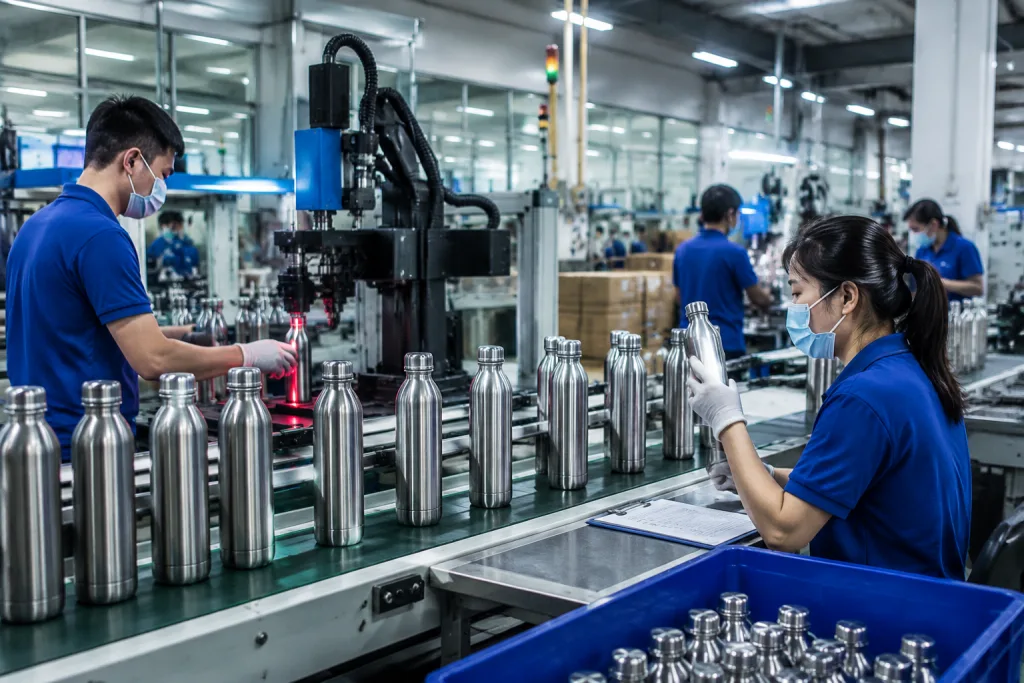
We run a canteen factory in Zhejiang at 500,000 units a month. That volume shows on the line fast: steadier steel coil supply, tighter powder-coat color match, fewer shocks on a 5,000-piece reorder. We ship stainless steel thermal bottles, growlers, and custom drinkware on separate lines. Each promotional thermal bottle goes through a 5-step check: thickness gauge reading, vacuum seal test, logo alignment, 1.5-meter drop onto concrete, and carton inspection.
We set AQL 2.5 for critical defects such as leakage, logo misalignment, and dents, and AQL 4.0 for minor issues like a torn carton or a small color shift. Last month, QC pulled the sample on a 1,000-piece lot and caught a logo drift at 2.8 mm. That gets expensive later. We fix it before the goods leave. For canteen customizable orders, we send a digital proof within 48 hours after order confirmation, and we include up to three revisions at no charge.
For canteen manufacturers or distributors who come to China, we open the workshop for factory tours and on-site sample review. Our sales team handles English, German, and Spanish, and we work FOB, CIF, and DDP without drama. One PO came in with a typo on the carton mark, and the buyer flagged it before booking, which saved a reprint. Simple fix. Saved money.
If you are a canteen vendor looking for a long-term partner, ask about our exclusive design program: we hold 50+ stock molds for thermal bottles, and you can put your logo and packaging on them without paying tooling. That cuts lead time by 10 days versus custom molds, and the math works because there is no reason to freeze cash in a new tool when the shape already passes inspection. We have seen this go sideways when buyers chase a fresh mold too early.
Request a Quote for Your Promotional Thermal Bottle Order
Send your design file and target quantity; we reply within 4 hours with FOB pricing and lead time.
Frequently asked questions
What is the minimum order quantity for a promotional thermal bottle with a custom logo?
For laser engraving, our MOQ is 300 units per design. For silkscreen printing (1–4 colors), the MOQ is 500 units. If you need a full-color wrap or custom Pantone matching, the MOQ increases to 800 units. All MOQs apply per SKU and per logo placement location (front, back, lid). For canteen customizable orders combining multiple logo colors, we recommend a minimum of 500 units to justify setup costs. We can combine multiple designs into one production run if the bottle model is identical, reducing your per-unit cost by approximately 8%.
How long does it take to produce a customized growler from a Chinese canteen manufacturer?
A customized growler with laser engraving requires 28–32 days from order confirmation to FOB shipment. If you choose a full-color wrap or metallic finish, lead time extends to 38–42 days. We include 3 days for artwork proof approval and 2 days for packaging design. For urgent orders, we offer a 22-day express service (15% surcharge) for stock growlers with laser engraving. All lead times assume your artwork is print-ready (CMYK, 300 DPI, no embedded fonts).
Can I get a canteen custom bottle with 316L stainless steel instead of 304?
Yes, we offer 316L stainless steel as an upgrade on all promotional thermal bottle models. The material change adds 15–18% to the unit cost and requires a MOQ of 800 units. 316L provides superior corrosion resistance against acidic beverages (coffee, juice, sports drinks) and meets ASTM F2669-07 for food-contact safety. Lead time increases by 7 days due to material sourcing. For canteen suppliers targeting medical or pharmaceutical clients, we recommend 316L for its biocompatibility.
What certifications do your promotional thermal bottles have?
All our bottles are REACH and BSCI compliant. For the US market, we provide ASTM F2669-07 (vacuum insulation performance) and CA Prop 65 (lead content) certificates. For the EU market, we offer CE, LFGB (Germany), and EU 10/2011 (food contact) certifications. For canteen distributors shipping to Australia, we can provide AS 2070-1999 compliance. Certification costs are included in the unit price for orders above 1,000 units. For smaller orders, there is a USD 150 documentation fee per certificate.
How do I ensure logo quality on a canteen promotional bottle for a large order?
We recommend ordering a pre-production sample (USD 40, refundable for orders above 500 units) to approve logo placement, color accuracy, and durability. For silkscreen logos, we test adhesion with a 3M tape peel test per ASTM D3359. For laser engraving, we measure depth (0.2–0.3 mm) and contrast. We also provide a digital proof before production. At your request, we can include a mid-production inspection report with photos of 10% of the batch. For canteen vendors requiring third-party inspection, we coordinate with SGS or Bureau Veritas at your cost.