Key Takeaways
- A usable RFQ for a promotional thermal bottle usa should name material, capacity, insulation time, decoration, packaging, and target MOQ in one line.
- For custom drinkware, sample approval usually needs 2 rounds and 7-14 days per round, not one quick photo review.
- A typical Chinese canteen factory MOQ for a custom thermal bottle starts around 500-1,000 units, with bulk lead time of 25-35 days after sample approval.
- Budget on FOB China terms, not just unit price; a $2.80 bottle can become $4.10 landed once print, carton, and freight are added.
Buying a promotional thermal bottle usa looks easy on the shelf. The hard part is keeping the spec, the quote, and the sample lined up. We have seen a 304 stainless bottle pass insulation tests, then blow the campaign because the lid seeped after a 2 kg drop test, the print scratched on day one, or the lead time slipped from 12 days to 18 days. That eats budget fast.
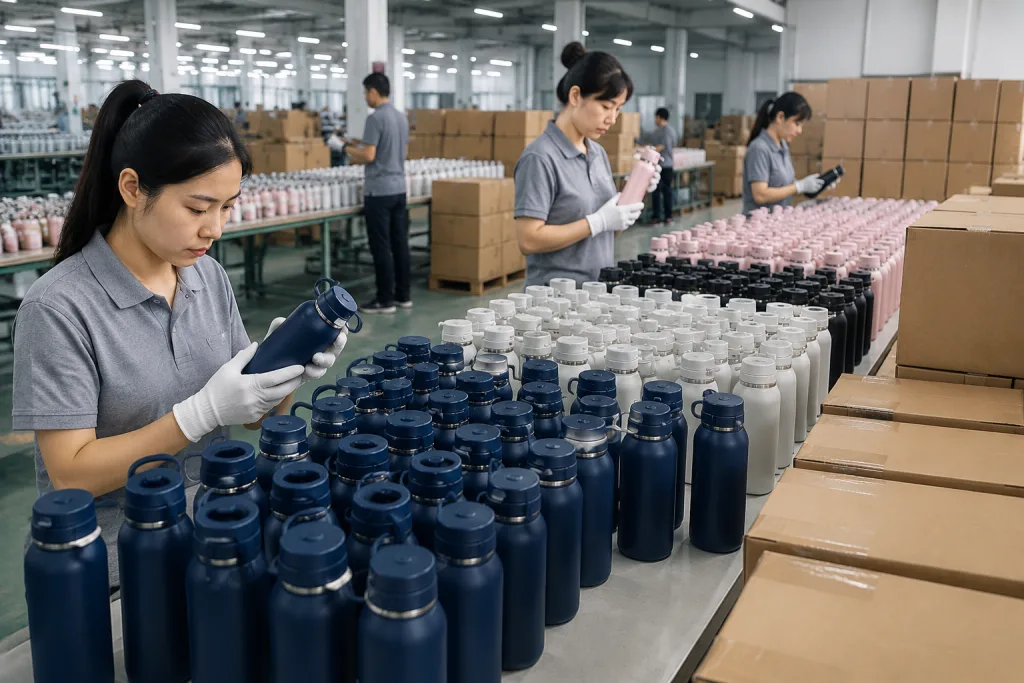
We build and ship custom drinkware from Hangzhou, Zhejiang, and the same pattern shows up in the US market every season: the buyers who get this right run the job like a line check, not a catalog order. Start with a tight RFQ, compare samples on the bench, then lock the bulk PO on measurable points. This is the wrong question to ask if you are choosing a canteen factory or canteen manufacturer in China; a 1 mm lid gap or a missing Pantone code on the PO turns into a real problem at 3,000 or 10,000 units. QC pulled the sample, and the buyer flagged it on the spot.
Start with the right RFQ
A clean RFQ saves more cash than any haggling trick. Send “need custom bottles for promo” and a canteen supplier will quote generic steel, generic lids, generic packaging. We’ve seen that go sideways on the line. You end up comparing a decent sample against a leaky pilot. For promotional thermal bottle usa sourcing, write the brief the way QC reads it, not the way a brochure sounds.
Put the basics in black and white: 500 ml, 750 ml, or 1,000 ml capacity; SS304 inner and outer wall; wall thickness if dent resistance matters; 12 hours hot / 24 hours cold; decoration method; lid style; carton spec. On one order, QC pulled the sample at 1.2 mm wall thickness because the buyer had only written “sturdy bottle” on the PO. If the bottles are for a distributor drinkware program, say whether you need retail boxes, barcodes, or Amazon FNSKU labeling. Ask for FOB Shanghai or FOB Ningbo, not just EXW. That is the right comparison.
- Capacity: 500 ml, 750 ml, or 1,000 ml
- Steel: SS304 inner, SS201 outer only if price is the only driver
- MOQ: 500, 1,000, or 3,000 units by color
- Lead time: 25-35 days after sample approval
- Compliance: REACH, LFGB, FDA, or Prop 65 as needed
If you want a cleaner first quote, send artwork in AI or PDF, list Pantone numbers, and ask for a line-by-line split: bottle body, lid, print, carton, freight. We run this every week, and the math does not work if the buyer hides the print file or leaves the lid type blank. One typo on a PO can turn “matte black” into “matt black” and stall the sample desk for a day. A useful RFQ leaves no room for that.
Read the quote line by line
A good quote is not one unit price. It shows where the money sits. For custom canteen programs, we want the blank bottle, decoration charge, packaging charge, and sample charge on separate lines. If the supplier refuses that split, you are not buying a custom drinkware program. You are buying their margin. We saw a PO last month with “logo fee” typed as “lgo fee,” and that typo hid a $180 setup charge until QC pulled the sample on the bench.
On a normal promotional thermal bottle usa order, FOB pricing can land around $2.20 to $4.80, depending on capacity, lid complexity, print count, and carton spec. A straight 1-color silkscreen on a simple 500 ml bottle may add $0.12 to $0.25 per unit. Laser engraving can add $0.25 to $0.60, and it holds up better on a premium custom canteen or customizable drinkware campaign. A double-wall bottle with a vacuum performance claim costs more because the canteen factory has to control weld quality and leak testing, not just run a logo through the line. The buyer flagged a “premium finish” upcharge once, and the math did not work. We run that check at 24 hours, before the line starts packing.
What to check in the quote
- Unit price by tier: 1,000 / 3,000 / 5,000 / 10,000 pieces
- Sample cost and whether it is refundable against bulk
- Tooling or logo setup charge, especially for embossed lids
- Carton spec: 24 pcs, 12 pcs, or individual retail box
- Testing standard: AQL 2.5 for critical defects is a normal starting point
Cheap canteen promotional pricing with no testing line is not cheap. It pushes the risk into your warehouse, and we have seen that go sideways on a 2,000-piece run with dented cartons and leaking caps. That is the wrong question to ask. Ask what is included, what is missing, and who pays when the first 48 cartons fail inspection. On the floor, a 2 mm cap gap is enough to start trouble.
Choose the build that sells
Not every bottle sells on the same basis. Match the build to the use case, or the promo looks sharp on day one and tired by month three. For a trade show handout, a basic stainless thermal bottle with a matte powder coat and one-color logo is enough. For a retail-ready or distributor line, we run a tougher finish, a better lid, and a cleaner box. QC pulled one sample with a loose collar at 18.2 mm, and the buyer flagged it fast.
If the client asks for canteen customizable options, send a spec sheet with real choices: 18/8 stainless steel, powder coating, screw lid, straw lid, or fold-down handle lid. For custom growler programs, the neck opening and lid seal matter more than decoration. A customizable growler for beer or cold brew should be leak-tested, usually 100% on a vacuum bottle line or under an agreed sampling plan. For a canteen distributor, the SKU count has to stay tight; 3 lid options and 2 sizes already stretch the line. The math does not work if they want 7 finishes and 4 caps.
One honest rule from Zhejiang factories: if the lid feels cheap, the bottle gets returned before the logo gets noticed.
That sounds blunt because it is. A good canteen manufacturer knows the body is only half the product. The lid, gasket, and thread finish decide whether the customer keeps using it. We had a PO last quarter with a typo on the cap spec, and the whole carton stack had to be rechecked by hand.
Demand samples that prove reality
Samples expose weak sourcing fast. Photos hide too much. For a promotional thermal bottle usa order, ask for one pre-production sample with the real lid, gasket, finish, and carton. If decoration matters, get a print proof on the exact base material. We saw one logo pass on a flat panel and fail on a curved bottle body. The curve changes the result. On the bench, that miss shows up in 10 minutes.
We run three sample stages. First is the plain body sample, which checks shape, welds, and polish. Second is the decorated sample, which checks logo size, alignment, and coating adhesion. Third is the functional sample, which checks leak resistance, lid torque, and insulation performance. On our line, the plain body sample usually takes 7-10 days, and revisions add another 5-7 days. A buyer once pushed for 48 hours from a canteen factory in China. The math does not work. QC pulled a shell with a 0.3 mm seam line, and that saved us from a bad sign-off.
- Leak test: inverted at room temperature for 30 minutes
- Drop test: 1 meter onto carton-cushioned concrete or agreed surface
- Thermal claim: verify against your own fill-water method
- Decoration: check rub resistance after 24 hours cure time
For customized canteen or customized drinkware programs, put sample approval into the PO. We had a PO typo once where “approved sample” became “approved style,” and the buyer flagged it only after QC pulled the sample card. Without that line, the factory can treat your notes as style comments, not binding acceptance criteria. That is the wrong question to ask. The sample is the contract. We ship only after the buyer signs off on the exact unit, carton mark, and 1 pc packing detail.
Lock the bulk PO details
Your bulk PO needs to read like a controlled buy, not a loose email thread. Put the SKU, quantity, 18/8 or 304 stainless, decoration method, packing spec, inspection standard, and delivery term on each line. If the order is 5,000 pieces, split it by color and carton count. Keep the numbers tight. We saw one PO where the buyer typed 5,000, then the carton note said 4,800; QC pulled the sample and the whole line stopped for half a day.
For promotional thermal bottle usa programs, the PO should carry product name, color code, print artwork reference, sample approval date, unit price, total amount, shipping port, target ship date, and penalty or remedy language if timing slips. For Zhejiang sourcing, confirm the payment structure too: 30% deposit and 70% before shipment is still the usual setup on a lot of orders. On a 12,000-piece run, we accepted a letter of credit only after the buyer flagged cash flow; on a 500-piece reorder, that ask would not have worked. The math does not work. A 3 mm typo on the PO can cost a day.
Useful PO line items
- SKU and capacity, such as 12oz or 750ml
- Material grade and surface finish, for example 304 stainless with matte powder coat
- Logo method: silkscreen, laser, or heat transfer
- Packaging: bulk pack or individual retail box
- Inspection: AQL 2.5 / 4.0 or agreed custom plan
- Delivery term: FOB Ningbo or FOB Shanghai
That level of detail keeps canteen vendors and canteen manufacturers on the same page. It also gives your freight forwarder and receiving team enough to work with without chasing you for basics; we ship cleaner when the PO says carton marks, net weight, and destination warehouse up front. This is the wrong question to ask if the PO is still vague.
Inspect before you pay balance
Pre-shipment inspection is not optional on a promotional order with thin margin. One bad carton can wipe out the savings from a cheaper quote. We run this on every lot under 10,000 units, and AQL 2.5 for major defects plus 4.0 for minor defects is a sane baseline. For a complex print, we tighten the call on leakage, broken lids, and off-color artwork. QC pulled a sample at the line last month and found a lid that failed after 18 kgf on the torque tester. That miss turns into a buyer complaint fast.
Ask the inspector to check carton drop condition, logo color, lid fit, and random fill testing. For customizable growler or custom growler programs, verify volume tolerance too; nobody is happy when a 64 oz bottle comes up short by 40 ml. If the shipment is going to Amazon or a retailer, confirm packaging and barcode placement before the pallet is wrapped. We saw a PO typo on the barcode suffix turn into a warehouse hold once. The buyer flagged it after the fact, and the math does not work.
If the supplier refuses inspection or pushes you to skip it, stop there. We ship from Zhejiang, and there are enough good canteen manufacturers here to avoid a blind load. A factory that will not open the cartons is telling you something. Don't pay balance first.
Plan freight and landed cost
The real price of a custom canteen is not the FOB quote. It is the landed cost after freight, duty, and any repacking you need in the US. On a recent 500-unit run, a $3.10 FOB thermal bottle landed at $4.68 because the carton held 12 pcs instead of 24, and the buyer flagged a typo on the PO before we booked space. Compare like for like. FOB to FOB. Not FOB to EXW, and not unit price against landed price.
For a 1,000-unit promotional order, air freight can work if the event date is fixed, but the math starts to break on low-margin drinkware. We run this every week from Ningbo and Shanghai. Ocean freight is the normal move for larger custom drinkware orders, with 7-10 days for inland trucking and export booking, then 20-30 days on water to the US West Coast, 32-40 days to the East Coast. If the schedule is tight, carry a 10% buffer on time and quantity. That buffer costs less than a missed show, and a late dock appointment at the warehouse will burn a week fast.
A canteen vendor who knows landed cost will ask about carton size, pallet count, and whether you want 48 pcs per master carton before the line starts. QC pulled the sample at 280 mm height and 1.1 kg gross, then we changed the inner box to fit more units per pallet. This is the wrong question to ask if you only stare at FOB. Better packing beats a prettier quote, and we have seen a 24 pcs carton save $0.22 a unit before duty even hits.
Know which supplier fits the job
Not every buyer needs the same partner. A brand owner usually wants a canteen manufacturer that can handle artwork, compliance, and repeat reorders with color drift held under 1.0 Delta E. A distributor canteen buyer may care more about stock continuity, mixed-SKU packing, and logo changes that do not slow the line. A promotional agency often wants the fastest path from RFQ to sample, even if the decoration menu is narrow.
Ask direct questions. How many units per month can you produce? What is the standard MOQ by model and color? Can you support 30,000 units monthly if the campaign grows? At BottleForge in Hangzhou, Zhejiang, we run a thermal drinkware line that can push 100,000+ units per month across multiple models, but the headline number is not the test. QC pulled the sample on a 26 mm cap thread once, and the buyer flagged it before we shipped the first carton. The real question is whether your canteen custom spec fits the tooling and the schedule.
- For campaigns: canteen promotional programs with simple print, 7-10 day sampling, and fast turnaround
- For retail: customized canteen or customized drinkware with tighter finish control and carton checks
- For channel sales: distributor drinkware with stable reorders, 12-day vs 18-day lead time, and carton discipline
The best canteen suppliers are not the loudest. They answer with numbers and keep those numbers steady across China production cycles and repeat orders. We have seen this go sideways when a PO typo changed the lid color from black to blue, so this is the wrong question to ask if you only want a quote. Ask who can ship the same spec twice.
Send your RFQ and get a real quote
If you need a promotional thermal bottle usa program from China or Zhejiang, send the specs, artwork, and target MOQ. We will quote line by line.
Frequently asked questions
What MOQ should I expect for a promotional thermal bottle usa order?
For a standard custom thermal bottle, many China factories quote 500 to 1,000 units per color as the practical starting point. If the model is already tooled, 300 units may be possible, but the unit price usually rises by 15% to 30%. For a new cap or complex finish, tooling can push MOQ higher. A clean buyer brief should ask for MOQ by size, color, and logo method, because silkscreen and laser engraving often have different thresholds.
How much does a custom drinkware bottle cost FOB China?
A simple promotional thermal bottle often lands in the $2.20 to $4.80 FOB China range depending on capacity, steel grade, lid type, and decoration. A 500 ml bottle with one-color print may sit near $2.40 to $3.10, while a more premium double-wall model with powder coating and laser logo can move above $4.00. Always ask for a cost split by body, lid, print, carton, and sample so you can compare canteen suppliers fairly.
How long does sample development usually take?
A realistic sample cycle is 7 to 10 days for the first prototype and another 5 to 7 days for revisions, especially if you need exact Pantone matching or a new lid color. For a promotional order, you may need 2 rounds before approval. If a canteen manufacturer says they can fully finalize a custom canteen in 48 hours, that usually means the sample is not being tested properly.
What compliance documents should I request?
For US and EU buyers, ask for material declarations plus relevant test reports such as FDA contact suitability, LFGB if needed, REACH for chemical limits, and Prop 65 if the product enters California retail channels. If the order is for Amazon or a retailer, ask for barcode and carton labeling support too. A responsible canteen factory should be able to provide these documents from a qualified lab, not just a PDF with a logo on it.
Can I use one factory for custom canteen and custom growler programs?
Yes, if the factory has the right tooling and testing setup. Many canteen manufacturers can handle both, but the specs are different. A custom growler usually needs a wider mouth, stronger lid seal, and stricter leak control than a basic thermal bottle. Ask for separate quotations and sample tests. If you need 3,000 units of customized growler and 5,000 units of customizable drinkware, make sure the supplier can hold both lines without pushing one order behind the other.