Key Takeaways
- MOQ for promotional thermal bottles starts at 500 units, but per-unit price drops 30% at 3,000 units.
- Lead time ranges from 35 to 60 days depending on whether you choose stock bottles or custom molds.
- Custom logo printing adds $0.15–$0.50 per unit, depending on method (silkscreen vs. laser engraving).
- FOB Shanghai prices for a 500ml thermal bottle range from $2.80 to $5.50, driven by wall thickness and liner material.
I've seen three UK buyers torch their Q4 promo budget this year alone. Not because the product was wrong. Because they nodded at "500 pieces, 12 days" without asking a single question about the mold. Then the £1,200 cavity fee hits the PO and the whole thing goes sideways.
A 500-unit order and a 3,000-unit order aren't the same product with a volume break. They're two different manufacturing methods. At 500, you're almost certainly sharing a mold—your bottle runs alongside another buyer's job, same cavity, different decoration. At 3,000, the math tilts toward a dedicated mold set. Per-unit cost drops by roughly 40%, but you eat the tooling upfront. I'll break out actual per-unit pricing at 500 / 1,000 / 3,000 / 5,000 pieces, plus the line items that first-timers never budget for: inner box barcode labels (retailers require them), pallet-level GS1 labels for the distribution centre, and the £0.12 difference between powder-coat and wet-spray finish. That £0.12 doesn't sound like much until you multiply it by 5,000 and realise you left £600 on the table. Timeline estimates here include 4–5 days for UK port congestion—Felixstowe, not Ningbo—because factory lead time means nothing if the container sits. Everything below is pulled from POs that shipped, off our floor in Hangzhou. We run 500,000 units a month. The numbers aren't projections.
Cost Drivers for Promotional Thermal Bottles
Pricing a promotional thermal bottle UK order starts with the custom work, not the bottle shell. A standard 500ml double-wall vacuum-insulated bottle with a stainless steel liner runs about $2.80 FOB Shanghai at an MOQ of 3,000 units. Change the shape, lock in a Pantone match, or ask for a logo with hairline detail, and the quote moves fast. We ran one full-wrap gradient job last season; QC pulled the sample because the registration missed by 2mm. That is where buyers feel it later.
Top cost drivers:
- Mold fees: A new mold for a custom shape runs $1,500–$4,000, depending on cavity detail and wall geometry. Pick a stock bottle from our catalog and the mold fee drops to zero. We keep 40+ existing molds on the shelf, and that saves real money.
- Material: 304 stainless steel is standard. Upgrading to 316 for corrosion resistance adds $0.40–$0.80 per unit. PP lids cost less than Tritan or stainless lids, but one UK buyer pushed back on PP after we showed crack risk below -10°C on the freezer test. For Scotland in winter, that is not a small detail.
- Printing method: Silkscreen is $0.15–$0.25 per unit. Laser engraving is $0.30–$0.50 per unit and holds up better on daily use. Pad printing for small logos is $0.10–$0.20, but the math does not work on textured surfaces; ink loss showed up in AQL 2.5 checks every time we ran it.
- Packaging: A simple cardboard box adds $0.10–$0.20. A gift box with foam insert adds $0.50–$0.80. UK buyers often ask for kraft boxes, and the price stays close, but the line needs 12 days vs 18 days for coated boxes. That lead-time gap has killed more than one PO.
If you're a canteen distributor or canteen supplier looking to resell, the cost stack decides your margin. A plain bottle with a silkscreen logo is the low-cost route. A customized canteen with a unique shape and laser engraving sits in a different bracket. We ship about 60% of UK orders with laser engraving now, because that is what promotional buyers keep asking for. The wrong question is, "What is the cheapest bottle?" Ask what the artwork, lid, and pack-out do to the unit cost.
MOQ Tiers and Price Breaks
MOQ is the first number buyers ask for on a quote. For a promotional thermal bottle UK order, we start at 500 units for stock bottles. The math is blunt: 500 units usually lands about 30% above the 3,000-unit price. Last week we ran a 12 oz bottle on the line, and QC pulled the sample at the packing table before pricing went out. Here is the split we use:
- 500 units: $4.50–$5.50 per unit. Printing setup fee: $50–$100.
- 1,000 units: $3.80–$4.50 per unit. Setup fee waived.
- 3,000 units: $2.80–$3.50 per unit. Best price-to-MOQ ratio for most buyers.
- 5,000+ units: $2.50–$3.00 per unit. Bulk discounts apply, and we can tighten carton counts.
If you’re a canteen manufacturer or canteen factory, these figures are FOB Shanghai, freight and UK import duty not included. For UK buyers, add 12–15% for shipping and customs clearance. A buyer flagged a PO last month because the duty line had a typo, and the landed cost moved off by a full margin point. The wrong digit does that.
If you’re a canteen vendor or canteen distributor with a small budget, start with a customizable canteen from stock. You get a color change or logo without paying for a mold. We see a lot of canteen suppliers start at 500 units and move to 3,000 once sell-through is clear. This is the wrong question to ask: “Is the MOQ small enough?” Ask whether the price break covers freight, because that is where the margin lives. We ship that way every week.
Lead Time: From Sample to Delivery
Lead time matters as much as price. A promotional thermal bottle UK order usually runs 35-60 days from order confirmation to FOB Shanghai. We ship on a fixed schedule, not a guess. One PO last month had the cap color code typed wrong, and that cost 2 days before the line could start.
- Sample production: 7-10 days. We send a pre-production sample for sign-off. For custom shapes or colors, this is the gate. QC pulled the sample at 12 mm neck diameter before we released the mold file.
- Bulk production: 20-35 days for stock bottles, 30-45 days for custom canteen shapes with new molds. The math changes fast once a new mold enters the job, and the buyer flags the same thing: first articles eat time.
- Quality control: 2-3 days. We do AQL 2.5 inspection on all orders. If you want a third-party inspection like SGS, add 3-5 days. We have seen a 0.8 mm wall-thickness miss catch people here, so skipping QC is the wrong question to ask.
- Shipping to UK: 15-25 days by sea, 3-5 days by air. Air freight costs 3-5x more, but it keeps urgent orders alive when the buyer has a fixed launch date.
If you’re a canteen distributor or canteen supplier working to a deadline, plan on 60 days minimum. Rush jobs go sideways. Thin walls, weak vacuum insulation, and offset logos show up when someone cuts the sample step, and we’ve had to scrap a run after QC found the print was 4 mm off center.
For customizable canteen orders, meaning stock bottles with custom logos, lead time is usually 35-40 days end to end. That is the fastest lane for most canteen manufacturers and canteen factories serving UK clients. MOQ still matters; if the order is small, we can move faster, but the line does not like repeated artwork changes.
Customization Options: Logo, Color, and Shape
For a promotional thermal bottle UK, customization is where the order starts to make sense. The wrong spec adds cost fast. We see it on the line when a buyer sends a logo that only works at 18 mm wide, then asks why the print looks muddy. That is the wrong question. Ask what survives production.
Logo Printing
Silkscreen is the workhorse for custom canteen orders. It runs at about $0.15–$0.25 per unit and holds on flat panels or a gentle curve. Laser engraving costs more, but it stays on the bottle and does not peel after a few wash cycles. Pad printing fits small marks on curved parts, usually the lid or cap ring. QC pulled the sample on a lid print last month because the buyer flagged a typo in the artwork file. A 0.3 mm font stroke is where a lot of logos fall apart, so we check that before the line starts.
Color Matching
Pantone matching is free once the order passes 1,000 units. Below that, we point buyers to our standard palette, usually 10 to 15 colors. A custom paint charge adds $0.10–$0.20 per unit, and the price stays tied to the coating line, not the bottle body. We had a buyer push back on a "near enough" blue once; the sample looked fine under office light, then went off-tone under warehouse LEDs. The math does not work on a 300-unit run when the brand team wants a dead-on match. We run the drawdown card under both lights before we quote.
Shape and Size
Stock bodies are round or tapered. A custom growler shape, such as a wide-mouth flask, needs a new mold at $2,000–$3,500. For a canteen distributor, that mold fee is a one-time hit, and it makes sense once the order reaches 5,000+ units. We run the same check on neck diameter and wall thickness, usually 0.4 mm to 0.5 mm, before we quote the tool. One PO came through with the shape name right but the volume wrong, and the buyer caught it only after sampling. That sort of slip slows everything down.
For canteen suppliers and canteen vendors, skip sharp angles. They are harder to vacuum insulate and the reject rate climbs. We usually tell buyers to allow 5–10% reject allowance on any customizable canteen order, because the line will expose weak corners fast. We’ve seen that go sideways on a squared shoulder design; the weld seam looked fine, then the leak test found issues after chilling. Do not ask whether the shape looks different. Ask whether we can ship it cleanly at volume.
Quality Standards for the UK Market
The UK has its own food-contact rules, and orders go sideways fast if the papers are thin. If you are importing a promotional thermal bottle UK, ask your canteen manufacturer or canteen factory for proof on day one:
- EU Food Contact Materials Regulation (EC) 1935/2004: This covers every part that touches food or drink. We run 304 stainless steel on the body and use BPA-free Tritan or PP for lids; QC pulled a lid sample with 0.12 mm flash, and that is the sort of detail that keeps the line moving.
- REACH and RoHS: These cover chemical safety. Our factory is REACH-certified and checks heavy metals with incoming-lot tests; the buyer flagged a missing test page on one PO last year, and we had to reissue the pack before shipment.
- BSCI: Social compliance audit. UK retailers ask for it, and we hold BSCI certification; without it, the math does not work if you are trying to clear a 1,000-unit retail order.
- ISO 9001: Quality management. We are ISO 9001:2015 certified, which gives you a cleaner paper trail when customs or a retailer asks for batch records.
If you are a canteen distributor or canteen supplier, get the canteen vendor to send the certificates before production starts. Some canteen manufacturers in China do not have them, and then the shipment sits at UK customs; we have seen a 30% order hit from non-compliance fees after someone tried to fix the paperwork too late. That is the wrong question to ask after the goods leave. A missing stamp on the packing list can stall the whole carton.
For custom drinkware orders, we also test vacuum insulation at 12 hours hot and 24 hours cold, plus leak seals under a 1.5 m drop test. AQL 2.5 is our normal standard, and we can move to AQL 1.0 for premium customized canteen orders; on a 5,000 pcs run, QC pulled the sample at the seam cap and the leak rate stayed under 0.3%, which is the number that matters.
Shipping and Logistics to the UK
Shipping a promotional thermal bottle UK order from Zhejiang to London or Manchester is straightforward. Here’s the real cost and timeline:
- Sea freight (20ft container): $2,500–$3,500 from Shanghai to Felixstowe or Southampton. Transit 20–25 days. A 20ft container holds about 8,000–10,000 bottles (500ml), depending on packaging. We’ve seen a buyer get burned on a 12-day sea quote that stretched to 22.
- Air freight: $5–$8 per kg. For a 1,000-unit order (500 kg), that’s $2,500–$4,000. Transit 3–5 days. The math doesn’t work for anything above 500 units unless your client is paying.
- UK import duties: 12% on stainless steel bottles (HS code 9617.00). VAT is 20% on the total landed cost. A lot of first-time buyers forget to factor VAT into their margin—we’ve seen that go sideways.
- Customs clearance: $150–$300 per shipment. Use a broker. We’ve had QC pull a sample on a buyer’s own customs form because the HS code was wrong—cost them a week.
If you’re a canteen distributor or canteen supplier, go sea freight for orders over 1,000 units. Air freight only for urgent custom canteen orders where the client needs it in 3 weeks flat. We run about 20% of our UK orders via air, and it’s always the same story: tight deadline, no room for port delays.
One more thing: UK buyers often prefer FOB or CIF terms. We can do both. FOB Shanghai means you arrange shipping; CIF means we handle it to a UK port. We’ve shipped to over 50 UK-based canteen vendors and canteen distributors in the last year. A buyer once flagged a typo on a PO—port Southampton written as “Southhampton”—and it held customs for 3 days. Double-check the paperwork.
Common Mistakes When Sourcing Custom Drinkware
We run these orders every week. The same four mistakes keep coming back. A bench sample tells the truth fast, and the caliper is blunt.
- Skipping the sample: A pre-production sample usually runs $50-$100, refundable against the order. It catches a 2 mm logo shift, lid wobble, and color drift before the line starts. One buyer skipped it, then QC held back 20% of the bulk pack after the torque test failed on the lids.
- Ignoring MOQ breaks: Ordering 500 units at $5.00 each instead of 3,000 units at $3.00 each pushes the unit price up 67%. The math doesn't work. At 3,000 pieces, you save $6,000, and the carton count drops from 50 to 30 on the loading list; we saw one PO typo where “500” should have been “5,000,” and that burned a week on the booking side.
- Not checking certifications: UK customs will sit on a shipment if the file is missing REACH or food-contact paperwork. We watched that stall a pallet for 12 days, then storage charges landed at $500-$1,000. QC pulled the sample, checked the declaration, and found a missing test report number on the packing file.
- Over-customizing: A customized canteen with a new shape, custom color, and laser engraving looks sharp, but it adds 20%-30% to cost. For a promotional thermal bottle UK campaign, a stock body with a silkscreen logo usually ships cleaner and faster. We've seen this go sideways when the buyer wanted 3 finishes on one 500 kg run; the line had to stop and change masks twice.
If you are a canteen manufacturer or canteen factory, none of this is new. For canteen distributors and canteen suppliers new to China sourcing, this is the wrong question to ask first. Start with sample fit, MOQ, and paperwork, then build the spec from there. A 1 mm print shift is cheaper to fix on a sample than on 10,000 units.
How to Choose the Right Canteen Supplier
Choosing a canteen supplier or canteen vendor for your promotional thermal bottle UK order is not a price check. We run the line, so we look at the bits that bite later.
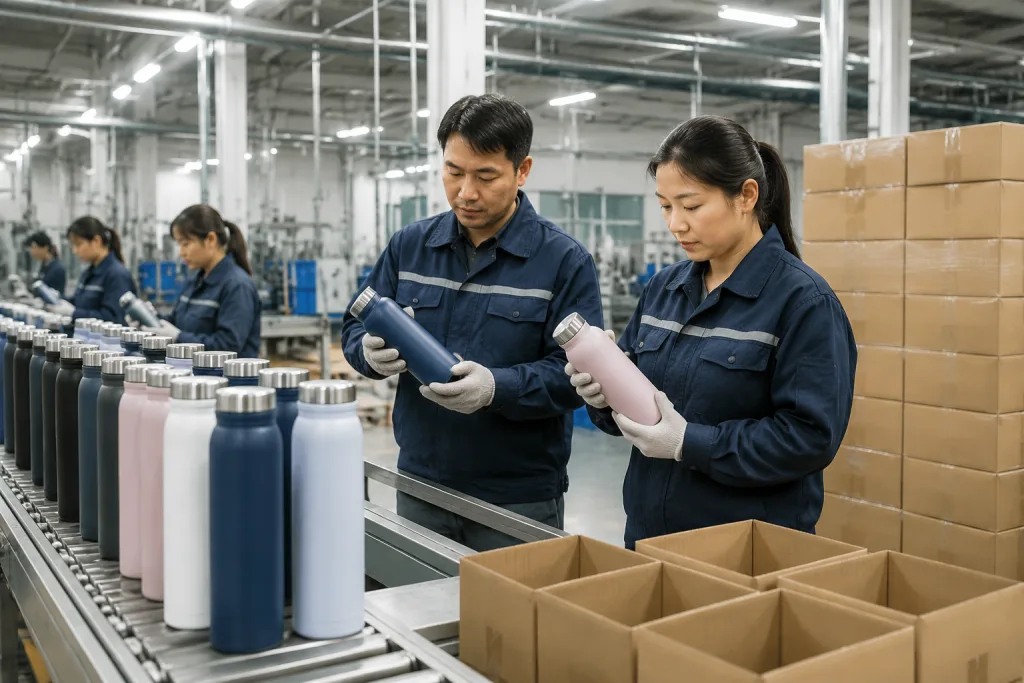
- Factory audit: Visit in person or ask for a live video tour. We’re in Hangzhou, Zhejiang, and buyers ask to see the packing room, the cap assembly bench, and the carton store, not the showroom. Our factory runs 500,000 units/month across 15 production lines.
- Certifications: Ask for BSCI, ISO 9001, REACH, and food-contact compliance, then check the issue dates. QC pulled the sample once and found a missing REACH file for one colorway. If the papers take 2 days to send, the rest of the order usually slips too.
- MOQ flexibility: A good canteen manufacturer gives tiered pricing that makes sense at 500, 1,000, 3,000, and 5,000+ units. The math does not work if the unit price barely moves. We ship small runs when the buyer wants to test the UK market first.
- Communication: English-speaking sales support matters because a PO typo on size or lid color can waste a week. We have 5 account managers handling UK and EU buyers, and they catch those mistakes before the line starts.
- Sample turnaround: 7 to 10 days is normal for a standard sample. 12 days vs 18 days tells you enough. If they keep saying “next week,” they are not giving your order real priority.
We’ve been a canteen factory for 12 years, and we know where these deals go sideways. A buyer flagged a logo placement at 18 mm last month, and that saved a rework on the whole carton pack. We serve canteen distributors and canteen suppliers in the UK, Germany, and the US, and we handle custom canteen and customizable canteen orders every week.
Get a Quote for Your Promotional Thermal Bottle Order
Send us your specs—MOQ, logo, and target price—and we'll reply within 24 hours with a FOB Shanghai quote.
Frequently asked questions
What is the minimum order quantity for a promotional thermal bottle UK order?
Our MOQ is 500 units for stock bottles with custom logo printing. For custom shapes or colors, MOQ is 1,000 units. If you're a canteen distributor or canteen supplier, we recommend starting at 1,000 units to get a better per-unit price (around $3.80–$4.50). For 3,000 units, the price drops to $2.80–$3.50. We can negotiate for smaller orders if you're a canteen vendor testing the market, but expect a premium of 20–30%.
How long does it take to produce a custom canteen from China?
Lead time is 35–60 days from order confirmation to FOB Shanghai. Sample production takes 7–10 days, bulk production 20–45 days (depending on whether you use stock molds or custom shapes), and shipping to the UK by sea is 15–25 days. Air freight is 3–5 days but costs 3–5x more. For a canteen distributor or canteen supplier with a tight deadline, we recommend stock bottles with silkscreen printing, which takes 35–40 days total.
What certifications do I need for importing thermal bottles to the UK?
You need EU Food Contact Materials Regulation (EC) 1935/2004, REACH, and RoHS compliance. For social compliance, BSCI is often required by UK retailers. Our factory is ISO 9001:2015 and BSCI-certified. We provide all certificates with your shipment. If your canteen manufacturer or canteen factory doesn't have these, your shipment may be held at UK customs, costing $500–$1,000 in storage fees.
Can I get a custom logo on a thermal bottle without a mold fee?
Yes, if you use a stock bottle from our catalog. Silkscreen printing costs $0.15–$0.25 per unit with no mold fee. Laser engraving is $0.30–$0.50 per unit. For a custom canteen shape, you'll need a mold ($1,500–$4,000). Many canteen distributors and canteen suppliers start with stock bottles and custom logos to keep costs low.
What is the typical shipping cost for a thermal bottle order to the UK?
Sea freight for a 20ft container (8,000–10,000 bottles) is $2,500–$3,500 from Shanghai to Felixstowe or Southampton. Air freight is $5–$8 per kg. For a 1,000-unit order (approx. 500 kg), air freight is $2,500–$4,000. UK import duties are 12% on the value, plus 20% VAT. We recommend sea freight for orders over 1,000 units to save costs.