Key Takeaways
- Typical MOQ for customized thermal bottles in Zhejiang is 1,000–3,000 units per design.
- Lead time for a 5,000-unit order is 30–40 days from deposit, including 7–10 days for tooling and sampling.
- German market requires REACH and LFGB compliance for food-contact materials; budget $200–500 for third-party testing.
- AQL 2.5 is standard for drinkware; consider AQL 1.0 for premium promotional canteen orders.
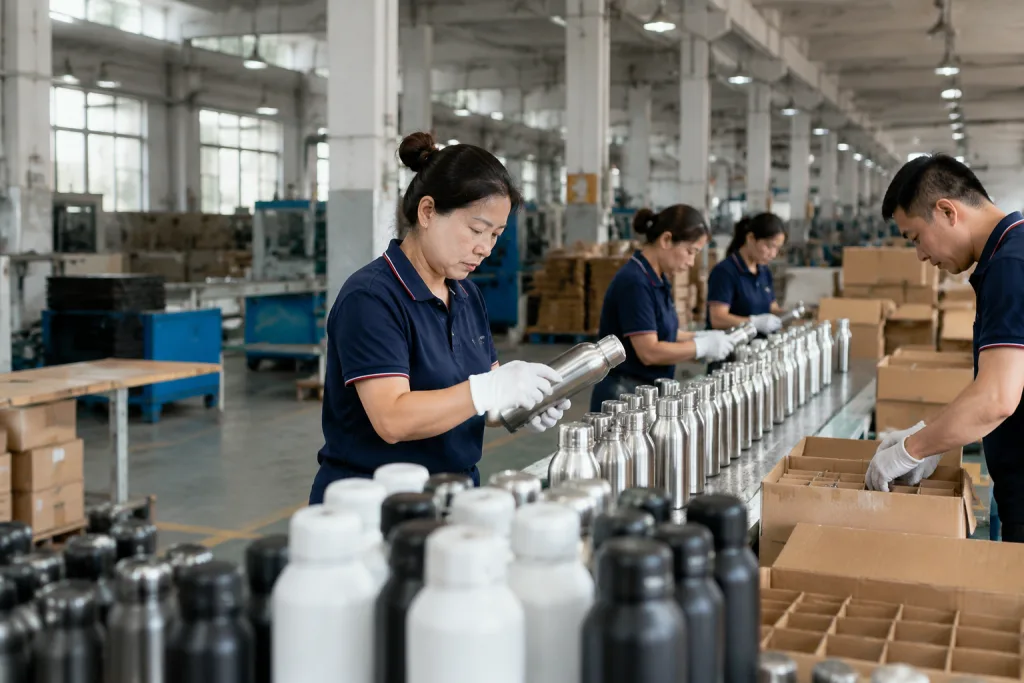
You just landed a 5,000-piece order for a German trade fair. The brief is straight: double-wall vacuum-insulated thermal bottle, 500ml, laser logo on the front, delivery in 45 days. New buyer. First China source. The first question is not brand polish. It is whether the line can hit the date. QC pulled the sample and checked the lid gap at 0.8 mm; that is where late jobs start to slip.
This article follows the job the way we run it in Zhejiang: product spec, factory check, MOQ talk, lead time, QC, then packing and shipping. We ship this kind of order every week, and the buyer usually flags the same points first. The math does not work if you skip the factory check. If you are a distributor or brand owner sourcing a promotional thermal bottle for Deutschland, this is the working guide. A PO typo on "500ml" versus "50ml" has burned a full day on our side before, so we keep it practical.
Specifying Your Promotional Thermal Bottle
Start with the spec sheet. For a promotional thermal bottle Deutschland order, German buyers usually ask for 304 or 316 stainless steel in a double-wall vacuum build. We run 0.4 mm to 0.5 mm on the inner and outer shells; go thinner and QC pulled the sample after one drop test because the dent showed up fast. Capacity usually sits at 350ml to 750ml, and 500ml moves best at trade shows.
Choose the closure early. Flip-top, screw-cap, or push-button all work, but for promo jobs we ship a screw-cap with a stainless steel or Tritan inner lid most often. It is simple. It holds up in transit. The buyer flagged one PO because the lid note just said "plastic cap," and the math does not work when LFGB migration is on the table. The lid has to be BPA-free and pass LFGB migration tests.
Color comes next. Powder coating and electrolytic coloring are the two routes we use on the line. Powder coating adds $0.30–$0.50 per unit at a 5,000-unit MOQ. Electrolytic coloring costs $0.50–$0.80 more and gives better wear resistance, which is why we see fewer complaints after 12 days in a test rack versus 18 days for cheaper finishes. For Germany, matte black or white are safe; a custom Pantone match is still doable, but it brings a $150–$250 tooling fee and a buyer pushback we hear often: "why pay for color if the logo carries the message?"
Do not skip the bottom ring. A silicone or rubber ring keeps the bottle from scuffing and gives it a cleaner hand feel on receipt. Most canteen manufacturers in Zhejiang include it as standard, but we still check the thickness with a caliper at 2 mm minimum. We have seen this go sideways when a PO typo read "1.2mm" and the first cartons came back with loose bases.
Vetting Canteen Manufacturers in Zhejiang
You’ll find dozens of canteen manufacturers in Zhejiang, mostly around Yongkang and Hangzhou. The paperwork is the hard part. We had one German buyer flag a PO because the silicone said “food grade” and there was no test number beside it. Ask the canteen supplier for these three documents before you price the order:
- REACH and LFGB test reports for the stainless steel and silicone parts. If they cannot send them, budget $300–$500 for third-party testing at a lab like SGS or Intertek. QC pulled the sample on a 500 ml bottle and found the lid seal had no matching report.
- Factory audit report (BSCI or SMETA). German importers ask for it. If the factory does not have one, plan a visit or pay a third-party auditor $800–$1,200 per audit. We ran into this on a 12,000-piece order, and the buyer stopped the file at first review.
- Sample of a similar thermal bottle with your logo applied, by laser engraving or silkscreen. Ask for a pre-production sample before you commit to the full order. A clean PO is not enough; one typo on the artwork line can hold the line for 3 days.
Check monthly output, not just the sales pitch. A solid canteen factory should handle 50,000–100,000 units per month for thermal bottles. If they quote 45 days for 5,000 units, that is normal. If they say 60+ days, the workshop is either packed or too small. We see this go sideways when a buyer chases the lowest MOQ and ignores the machine count on the line.
When you compare quotes from different canteen vendors, do not stop at FOB price. Add compliance testing, samples, and freight to the math. A $0.20 unit gap can vanish fast if the factory’s files are thin. That is the wrong question to ask. Ask what the shipment will cost after the lab report, carton mark, and one round of sample changes.
Negotiating MOQ and Lead Time
For a custom canteen with laser engraving, most canteen suppliers in Zhejiang quote MOQ at 1,000 to 3,000 units per design. We run this on the line all the time. A buyer asks for 5,000 pieces with one logo, then adds two lid colors, and the numbers break because each variant takes its own MOQ. QC pulled the sample on a 600 mm cart once and flagged the split order before cartons were even booked.
Lead time for a 5,000-unit order of double-wall thermal bottles is usually 30 to 40 days from deposit. For a Germany promo run, that is the number to plan against, not a hopeful guess. Breakdown:
- Tooling and sampling: 7 to 10 days. The factory cuts the logo mold for laser engraving or burns screens for silkscreen; a buyer once sent a PO with the brand name misspelled by one letter, and the proof had to be redone.
- Production: 15 to 20 days. Bottle forming, welding, vacuum sealing, surface treatment, assembly. We ship in batches, and a 304 stainless coil shortage on one run pushed the line by 3 days.
- QC and packing: 5 to 7 days. Final inspection, individual polybagging, carton packing. AQL 2.5 checks are where bad packing habits show up fast.
If you need rush delivery, some canteen manufacturers can cut the schedule to 25 to 28 days for an expedite fee of 5% to 10% of the total order value. The buyer usually pushes back on this, and fair enough. This is the wrong question to ask if the stock is not there. The real gate is raw material stock—304 stainless steel coils and pre-formed vacuum tubes on hand, not a promise on paper. Ask before you pay the deposit.
For the German market, sea freight from FOB Shanghai or Ningbo takes 25 to 30 days to Hamburg or Rotterdam. Air freight takes 5 to 7 days, but the freight bill jumps to $3 to $5 per kg versus $0.10 to $0.20 per kg by sea. For 5,000 bottles at 300g each, sea freight comes to about $150 to $300; air runs $4,500 to $7,500. The buyer flagged the air option on one quote, and he was right to do it—the math does not work for a promo bottle unless the launch date is fixed.
Laser Engraving vs. Silkscreen for Logos
Your buyer wants a logo on the bottle. Two routes matter: laser engraving and silkscreen printing. For a promotional thermal bottle Deutschland order, we usually run laser on the line because it stays put, does not peel, and still reads clean after 3,000 openings. At 5,000 units, the cost lands around $0.15–$0.30 per unit, plus a one-time $100–$200 fixture fee for the bottle holder in the laser machine.
Silkscreen printing is cheaper at $0.05–$0.10 per unit, and that math only works when the logo is simple and the body is flat or nearly flat. On a curved thermal bottle, we have seen the buyer flag wear after a few months, especially at the grip zone where the ink gets rubbed every day. Full-color artwork points to silkscreen or pad printing. One-color logos? Engraving wins.
Ask the canteen factory for a sample with both methods on the same 500 ml bottle. QC pulled the sample with a coin test, and engraving held up while silkscreen showed marks. Check the depth too: 0.05mm–0.1mm is the sweet spot; go deeper and you start risking the stainless steel wall.
If you're ordering a custom growler with 1L+ capacity, engraving is standard as well. Same process, same fixture logic. The holder usually costs a bit more because the body is larger, and the PO typo we see most is a 1.0L line written as 10L. We have seen that go sideways fast. For fit and finish, this is the wrong question to ask.
Quality Control: AQL and Testing
Don’t skip QC. On a 5,000-unit run, we lock the plan before the line starts, not after cartons are stacked. For custom drinkware, the usual call is AQL 2.5 (Acceptable Quality Limit), which means a small defect rate can still pass. For a premium promo order, we move to AQL 1.0. The math changes fast once the buyer is handing bottles to retail buyers in Germany. This is the wrong question to ask at the end.
Watch the defects the customer sees first: vacuum loss, dents, surface scratches, logo shift, leaking lids. Minor issues sit in another bucket. A 0.5 mm print offset or a small scuff on the carton is one thing; a bottle that will not hold temperature is a line stop. QC pulled the sample on a run where the buyer flagged one lid that spun too loose, and that batch went back for recheck.
Third-party inspection is standard. We use SGS or Bureau Veritas when the order is 5,000 pcs or more, and the visit usually lands around $350–$500, plus $50–$100 per sample test. They pull a random lot, often 200 bottles from 5,000 units, open cartons, check logos, caps, and pack-out, then issue pass/fail. We’ve seen buyers push back on the fee, but skipping it costs more than one bad container.
Ask for a vacuum retention test. Fill the bottle with 95°C water, close the lid, and check the temperature after 6 hours; it should still be at least 60°C. For cold retention, run iced water and hold the same 6-hour check below 10°C. We run this on a bench with a calibrated probe, not a phone app. Some canteen manufacturers include the report at no charge; others charge $50–$100 per test, and the buyer usually only cares once the first sample misses spec.
German importers often ask for LFGB compliance on food-contact parts. The factory should hold test reports for the stainless steel, including heavy metal migration, and for the silicone, including volatile compounds. If the papers are missing, budget $200–$300 for a full LFGB test at TÜV or SGS. We had a PO typo where “silicone” came through as “silicon,” and that kind of slip slows customs and burns a day.
Logistics and Customs for Germany
For Germany shipments, we usually load from Shanghai or Ningbo. Both ports are about 2 hours by truck from most canteen factories in Zhejiang. Sea freight to Hamburg usually takes 25 to 30 days. On a 5,000-unit PO, the carton plan normally lands at 2 or 3 pallets, and QC pulled the sample stack to check the outer cartons stayed under 1.2 m after strapping.
FOB is the standard term. You pay ocean freight, cargo insurance, and import clearance. If you are new to importing, CIF to Hamburg is easier to handle because we book the vessel and cover insurance, while you take customs on arrival. The extra cost is usually 5% to 10% on unit price. The math does not work if you want the lowest sticker and full control at the same time; we have seen buyers take the cheap term, then miss the booking window by 3 days.
For customs in Germany, use a broker. Budget about $150 to $300 per shipment. The file needs a commercial invoice, packing list, bill of lading, and a REACH compliance declaration from the factory. On stainless steel and silicone bottles, there is no special duty line; the standard tariff for stainless steel drinkware is 6.5% (EU) plus VAT (19% in Germany). We once had a buyer flag a PO typo on the HS code, and the broker held it for a day while the line waited for the corrected invoice.
If you're a canteen distributor serving several clients, combine orders where you can. A 20-foot container takes about 15,000 to 20,000 thermal bottles, depending on the carton spec. Split a container with another buyer and the freight bill drops fast. Landed cost is the number that matters. We ran a 20-foot load last month and the weighbridge showed 11,480 kg, so the margin was still there after customs.
Cost Breakdown for a 5,000-Unit Order
Put the numbers on the table. For a 5,000-unit order of promotional thermal bottles Deutschland from a Zhejiang canteen manufacturer, this is the cost stack we run on the line:
- Unit price (FOB): $3.50–$4.50 per bottle for double-wall 304 stainless, 500ml, powder-coated, with laser engraving. At 5,000 units, $3.80 is the number we usually land if the buyer does not push the cap past what the lid tool can hold.
- Tooling and sample: $200–$400 one-time for the laser engraving fixture and pre-production sample. QC pulled the sample twice on one job because the logo sat 1.2 mm off-center.
- Packaging: Individual polybag plus color box: $0.30–$0.50 per unit. White box, no print: $0.15–$0.25. The carton spec sits at 5-ply, 58 x 38 x 32 cm, so the box choice changes freight too.
- Third-party QC inspection: $400–$600. We booked a 20-point check on one batch after the buyer flagged a dent at the seam, and that saved a rework fight.
- LFGB testing (if not provided): $250–$400. If the test report is missing, we do not guess; the lab invoice is cheaper than a held shipment.
- Sea freight (FOB to Hamburg): $200–$400 for LCL, not a full container. A 1.8 m3 shipment is normal at this size, and the math does not work if someone prices it like FCL.
- Customs clearance and duties (6.5%): ~$1,235 if FOB value is $19,000. One PO came through with "Hamburg" typed as "Hambrug"; the broker still laughed, then fixed it.
- VAT (19%) paid upfront, reclaimable: ~$3,800. The buyer usually hates this line on the PO, but the customs desk does not care.
Total landed cost per unit lands around $5.50–$6.00. For a German client, I would not sell below $8.00–$10.00 unless you are fine with a thin margin and a noisy after-sales week.
If you are a canteen distributor placing repeat orders, ask for tiered pricing straight away: $4.00/unit at 1,000 units, $3.60 at 5,000, $3.20 at 10,000. We have seen this go sideways when the buyer sends a PO with a typo on the MOQ, so check the sheet before the line starts. Most canteen suppliers quote that structure, and MOQ is the first number we confirm before we book the print screen.
Common Pitfalls with Custom Drinkware Orders
We run hundreds of custom drinkware orders out of Zhejiang, and the same mistakes keep showing up on the line. Three hit again and again.
1. Assuming the factory's sample matches production. Ask for a pre-production sample (PPS) after the mold is ready and before bulk run. A hand-made sample can look clean, then the line shifts 1.5 mm on the shoulder or moves the logo 3 mm. QC pulled the sample with a caliper, and the buyer flagged it. Catch it there.
2. Ignoring lid compatibility. Thermal bottles from different factories often use thread specs that look close and fail in real use. If you are ordering lids as spares, lock the thread pitch first, such as 48mm or 53mm, and ask for a gauge check at the cap station. Once the bottles ship, replacement lids turn into a headache. We've seen that go sideways.
3. Underestimating lead time for compliance testing. LFGB or REACH testing takes 2–3 weeks, and that clock starts when the lab gets the raw material, not when the carton is packed. If you wait until finished bottles are ready, the math does not work. Send the material swatch first and build in 1–2 extra weeks; we had one 12-day plan slip to 18 days after the lab asked for a second cut. The lab does not care about your PO date.
One more point: if you are sourcing customizable canteens for a promo run, pad the order by 5–10%. You will burn units on defects, freight damage, and late client changes, and a PO typo like “5000 pcs” when the buyer meant “5,000 pcs” can slow the booking. Most canteen vendors keep the same unit price on a small overrun. That is the practical move.
Ready to Source Your Promotional Thermal Bottles?
Contact our team in Hangzhou for a free compliance checklist and sample quote for your custom canteen order.
Frequently asked questions
What is the typical MOQ for a promotional thermal bottle from a Chinese canteen manufacturer?
For a double-wall vacuum-insulated thermal bottle with custom laser engraving, the MOQ from most canteen manufacturers in Zhejiang is 1,000–3,000 units per design. If you need multiple colors or logo variants, each variant counts toward the MOQ. Some factories accept 500 units for an additional 20–30% surcharge per unit. For a standard 500ml bottle with silkscreen printing, MOQ can drop to 500 units, but laser engraving requires a fixture that justifies a higher minimum.
How long does it take to produce a custom canteen order of 5,000 units?
Lead time is typically 30–40 days from deposit. This includes 7–10 days for tooling and sampling, 15–20 days for production, and 5–7 days for QC and packing. If the factory has raw material in stock (304 stainless steel coils), they can sometimes compress to 25–28 days for an expedite fee of 5–10%. Shipping by sea from Ningbo to Hamburg adds 25–30 days, so total time from order to delivery is about 55–70 days.
What compliance certifications do I need for thermal bottles sold in Germany?
For the German market, you need REACH compliance for the stainless steel and silicone components, and LFGB testing for food contact safety. The factory should provide test reports from an accredited lab (SGS, TÜV, Intertek). If they don't, budget $250–$500 for third-party testing. Also ensure the bottle is BPA-free (common for Tritan lids) and that the vacuum insulation meets EU standards for temperature retention (at least 60°C after 6 hours with hot water).
What is the difference between laser engraving and silkscreen for custom canteens?
Laser engraving is permanent, scratch-resistant, and ideal for single-color or monochrome logos. Cost is $0.15–$0.30 per unit at 5,000 units, plus a $100–$200 tooling fee. Silkscreen printing is cheaper ($0.05–$0.10 per unit) but can wear off over time, especially on curved surfaces. For promotional thermal bottles, laser engraving is preferred for durability and premium feel. Silkscreen is better for full-color logos or short-run promotional items.
Can I get a sample before placing a bulk order for custom drinkware?
Yes, most canteen manufacturers provide samples for a fee of $30–$80 per unit, including shipping via DHL or FedEx (3–5 days). The sample will be a standard bottle without your logo, or they can apply your logo for an additional $50–$100 tooling fee. Always request a pre-production sample (PPS) after the mold is made but before full production — this ensures the logo placement and color match your expectations. Deduct the sample cost from your first order if the factory agrees.