Key Takeaways
- A workable promotional thermal bottle american order usually starts at 1,000-3,000 pcs with FOB pricing around USD 3.20-6.80 depending on 304 stainless, lid, and finish.
- For U.S. promotions, double-wall vacuum bottles commonly target 12-24 hours hot and 18-30 hours cold, with 0.4-0.6 mm inner wall thickness.
- AQL 2.5 major / 4.0 minor is standard for mass promo programs; ask for drop, leak, and dishwasher-marking checks before shipment.
- Laser logo, silk screen, and 1-color pad print change cost and durability; the wrong decoration choice can add 7-12% to reject risk if the artwork is not prepared properly.
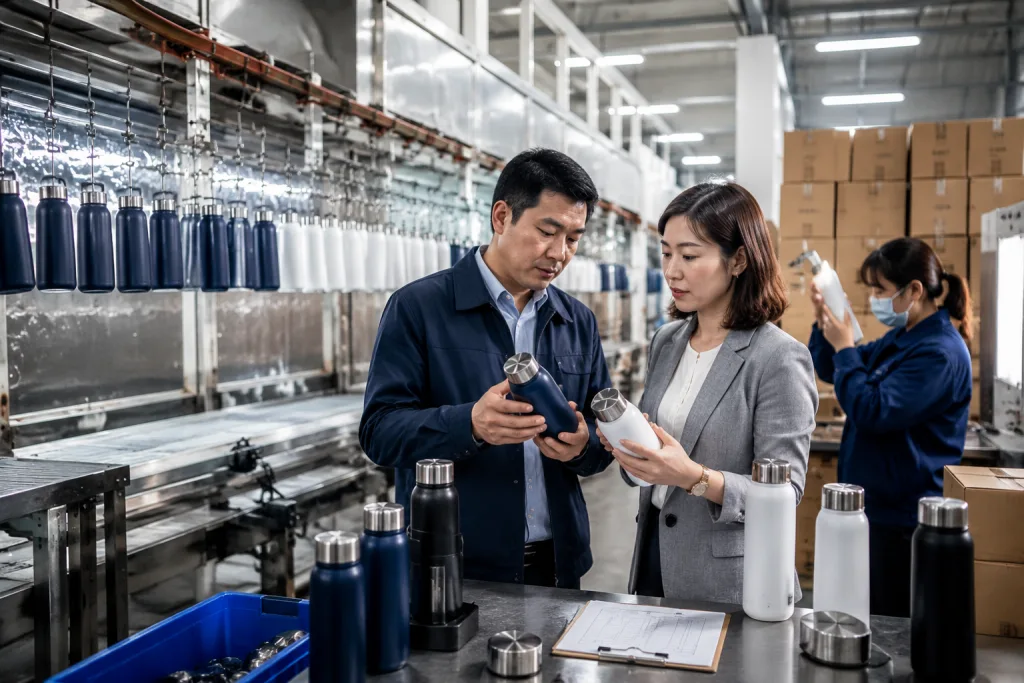
You are not buying a desk mug. You are buying a promotional thermal bottle american that has to survive ocean freight, pad printing, and daily use in the US market. If the bottle leaks, dents on first drop, or the logo peels after two washes, the campaign looks cheap in a week.
The right way to buy is to treat it like a small production run, not a gift order. We see this every week in Zhejiang: a buyer sends a logo file and a target landed cost, then we run the numbers on wall thickness, lid style, decoration method, and test data. QC pulled a 500 ml sample on the line last month and found a 1.2 mm seam variation; that kind of miss turns into claims later. The math does not work if the factory cannot explain it cleanly.
Start With the Campaign Use Case
Before you ask for samples, lock the use case. A promotional thermal bottle american for a trade show handout does a different job from a distributor drinkware SKU built for retail replenishment. One needs a 1-color logo, a low FOB, and insulation that passes a basic hot-fill check. The other needs a tougher cap, a barcode on the carton, and a clean unboxing line. Skip that step and the quote gets messy fast. We saw it on a 3,000-piece PO last month: the buyer wrote “retail” in the email, then flagged the box spec two days later.
For the U.S. market, 500 ml to 750 ml, or 17 oz to 25 oz, is the range we ship most. It fits most car cup holders and keeps freight sane. A 28 oz body looks good in a deck, but the math doesn't work once you stack cartons. If the program is for outdoor brands, gyms, or corporate onboarding, a stainless steel thermal bottle is easier to place than a glass bottle or a thin-wall plastic canteen custom piece. Keep the brief tight: target user, temperature claim, budget, artwork count, and whether you need individual gift boxes. QC pulled the sample with a caliper and a drop test on the cap, then the line knew exactly what to make.
- Corporate giveaway: keep unit cost down and make the logo read fast
- Distributor canteen program: hold SKU consistency and repeatability
- Retail-style custom drinkware: protect finish, carton strength, and barcode labeling
Pick the Body Before the Logo
The body spec decides whether a bottle feels premium or just does the job. We run 18/8 stainless on most of these jobs, and the paperwork may show SUS304 or an ASTM-style callout. For a standard promotional thermal bottle american order, I would not go below 0.4 mm on the inner wall of the vacuum body. We had a buyer flag a USD 4 FOB target last month, and the first place the price moved was the wall, then the lid liner, then the box. The math does not lie.
Matte powder coat hides fingerprints and gives the logo cleaner contrast than raw brushed steel. Gloss looks sharp on a sample shelf, then the line picks up scuffs after a few handlings. For a canteen customized for the U.S. market, check the body height against bag pockets and car holders before you approve art. A 25 oz bottle at 275 mm can turn awkward fast if the cap adds another 35 mm, and we have seen buyers send a PO with the height typed as 257 mm by mistake. That typo cost a day. The better quote names dimensions, gauge, net weight, and finish, not just capacity.
Ask for the actual net weight and wall thickness, not just “premium stainless.” QC pulled the sample at 0.45 mm once and found a 0.38 mm spot near the shoulder, so if the supplier will not put 0.45 mm or 0.5 mm in writing, you are guessing.
Choose the Cap That Fails Least
Lids drive more returns than the print. For a promotional thermal bottle american order, pick the cap for abuse tolerance, not for looks. A plain screw lid with a silicone gasket is the safest call. We had a buyer push a push-button top on a 3,000-unit run, then QC pulled the sample after the spring started sticking at cycle 800. Simple wins. The line hates extra parts.
If you need a customizable canteen for a distributor canteen program, ask for a lid open-close cycle test of at least 5,000 cycles. That number is not magic, but it catches weak springs and brittle seals before we ship. We run hot-fill checks at 85 C too. A bottle that holds temperature and leaks on opening is dead on arrival. Add a cap instruction card when the closure is not obvious. It costs cents. We once saw a PO typo swap the lid spec, and the buyer flagged it after approval. The math does not work any other way.
- Best for low risk: screw lid with silicone gasket
- Best for gym use: wide-mouth lid with carry loop
- Best for premium campaigns: insulated cap with clean laser logo
Decide on Decoration by Volume
Your logo method should match the order quantity, not your ego. For a 1,000 to 5,000 pcs run, silk screen is usually the cheapest call for one-color art on a flat panel; we run that on the line all the time. Laser engraving looks clean on stainless bodies and holds up under abrasion, but it leaves a metal-tone mark. Fine for one buyer, wrong for the next.
In Zhejiang, we price logo work by setup count and fixture time. A one-color silk screen often adds USD 0.08-0.20 per piece at volume, while laser sits around USD 0.15-0.35 depending on area and clamp position. Multi-color art or wraparound print can lift the order value by 7-15% once proofing, tooling, and extra QC are in the quote. QC pulled the sample on a 60 mm wrap because the buyer flagged edge bleed. Send vector artwork and Pantone references early for a U.S. campaign. A low-resolution JPEG just creates guesswork, and that is the wrong question to ask at quotation stage.
If you are building a custom canteen or custom growler line, keep the decoration zones the same across SKUs. That cuts rework on reorders and stops art proofs from drifting. We have seen this go sideways when one PO typed the logo position as "centered" and the next one said "middle left" -- same art, two different fixtures. A good canteen vendor will tell you where the mark cannot go because of seams, welds, or dishwasher wear.
Price the Order Like a Buyer
There is no clean answer to “what does it cost” until the spec is frozen. A 500 ml stainless promotional thermal bottle american unit with powder coat, one-color print, and carton insert usually lands around USD 3.20-4.30 FOB at 3,000 pcs. We ran a sample on a 0.2 mm powder coat gauge last month, and the buyer flagged a cheap quote that turned out to be thinner steel, weaker insulation, and plain packaging. Add a better lid, gift box, and dual-color decoration, and you move into the USD 4.80-6.80 range fast. The math does not work any other way.
Use the same discipline when comparing canteen suppliers or canteen distributors. Ask whether the quote includes sampling, mold charges, logo setup, inner carton, master carton marks, and spare gaskets. QC pulled the sample on a PO typo last week because the carton mark said 24 pcs but the packing list said 20; that kind of mismatch burns time. Freight to the U.S. can swing total cost by 12-28% depending on carton size and season, so a low FOB price does not mean a strong landed price. For distributor drinkware programs, the best quote is the one that shows every add-on before you place the PO. A canteen manufacturer that ships export work should give you a line-by-line sheet, not a vague pro forma.
One practical rule: under 1,000 pcs, decoration and packing overhead matter more than raw material savings. Above 5,000 pcs, lid yield and carton efficiency take over. We see this go sideways when a buyer chases a 2 cent body saving and ignores a $0.14 lid or a loose 3 kg master carton target.
QC the Sample Like a Shipment
Sample sign-off is where a buyer stops paying for factory mistakes. Check the threads with a plug gauge, the gasket seat, and coating hardness, then run a hot-fill inversion test for 30 minutes. We had a lid pass a clean tabletop check and still seep at the seam after the third tilt. For a promotional thermal bottle american order, I pull three random pieces for a heat-retention check on the bench. One good sample means nothing. If the bottle claims 12 hours hot, get start temp, room temp, and the test rig written on the sheet. The math does not work any other way.
On the line, ask the canteen factory for an in-process inspection plan and the final AQL callout before the PO is locked. AQL 2.5 major and 4.0 minor is a normal baseline for custom drinkware. For a retail-facing account, buyers push hardest on print alignment and surface marks; the buyer flagged a logo sitting 2 mm off-center on one run, and QC pulled that sample fast. Have QC record dent checks, lid color consistency, pack integrity, and the carton code. If the order includes distributor canteen cartons, check master carton compression and do a drop test. We ship boxes, too.
Useful checks before approval
- Leak test after 24 hours at room temperature
- Drop test from 1 meter on each side and base
- Logo rub test with alcohol and mild detergent
- Carton mark verification against FNSKU or buyer label
Handle Compliance and U.S. Labels
For the U.S. market, compliance starts before booking. We run food-contact checks first, then material control for caps, gaskets, and coatings; if the route also touches Europe, we keep REACH files ready too. A buyer once flagged a PO because the silicone ring had no batch trace. Fair call.
If you ship promotional thermal bottle american stock into Amazon or retail-adjacent channels, the label work gets specific fast. FNSKU labels, master carton marks, country of origin, and case pack count all need to match, or QC will pull the sample at packing. We have seen 24-piece cartons turn into a mess over one typo on the carton number. This is the wrong question to ask: the brand line matters, but the shipping label matters more when the pallet is on the dock. Decide early whether the order ships under your brand, the buyer’s brand, or as plain distributor drinkware; that choice sets the barcode, the outer box print, and the doc pack. A line that looks fine at 8 a.m. can fail at 4 p.m. when the labels do not line up.
Plan Reorders Before the First PO
The second order is the easy one. If you want a reusable custom drinkware program, do not treat the first shipment as a one-off. Lock the CAD drawings, Pantone codes, lid part numbers, and carton specs before mass production. We had a buyer flag a 2 mm lid gap on the first run, and that one detail saved the reorder. With the files fixed, a repeat order can move in 15-25 days instead of starting from scratch. A Zhejiang canteen factory should keep your bottle, cap, and print files on record and repeat the same spec with little drift.
This is where custom canteen and customized drinkware programs start making more money than one-off promotions. Once the tooling is stable, you can add a custom growler size or a lightweight canteen promotional version without re-qualifying the whole product. The right canteen vendor talks about reorders in yield, packaging stability, and artwork retention. We run those checks on the line, not in a slide deck. Ask how many units per month the factory can reserve, what the MOQ stays at on repeat orders, and whether they can hold your reserved cartons in Hangzhou or ship from stock in China when timing gets tight. The math doesn't work if they only say “no problem.”
That is the point where the product stops being a promo item and becomes a supply program. QC pulled the sample, measured the carton at 58 mm over spec, and we fixed it before the next PO hit the line.
Get a production-ready bottle spec today
Send your target price, capacity, and artwork. We will turn it into a clean quote, sample plan, and QC checklist for China production.
Frequently asked questions
What MOQ should I expect for a promotional thermal bottle american order?
For a standard promotional thermal bottle american SKU, a common MOQ is 1,000 pcs per color and 3,000 pcs if you need custom packaging plus multi-color branding. Some canteen manufacturers in Zhejiang will accept 500 pcs for a stock body, but the unit price usually rises by 12-20%. If you want powder coating, laser logo, and printed carton marks, budget closer to 1,000-2,000 pcs for sensible pricing. Reorders can sometimes stay at 500-1,000 pcs if the tooling is already set and the canteen factory has your components in line.
How do I compare FOB prices without getting misled?
Compare only after you lock capacity, steel grade, lid type, decoration, and carton spec. A 500 ml bottle at USD 3.20 FOB can be more expensive landed than a USD 4.10 quote if the cheaper option uses a larger carton, weaker lid, or extra rework. Ask every canteen supplier to state whether the price includes logo setup, inner box, master carton, and spare gasket. For U.S. imports, freight can add 12-28% to landed cost depending on carton size and season, so FOB alone is not enough.
Which decoration method is best for custom drinkware?
For one-color corporate branding, silk screen is usually the lowest-cost choice and works well on powder-coated bodies. For stainless steel bodies where wear resistance matters, laser engraving is cleaner and more durable, though it usually costs USD 0.15-0.35 per piece at volume. UV print is better when you need full-color artwork, but it adds setup and curing complexity. If you are building a canteen customizable program for reorders, pick one method and keep the placement consistent so the canteen vendor can repeat it with fewer errors.
What QC checks should I insist on before shipment?
At minimum, ask for leak tests, drop tests, logo rub tests, and AQL inspection records. AQL 2.5 major and 4.0 minor is a normal baseline for custom drinkware, but promotional orders with a visible logo often need tighter cosmetic control. For a hot-and-cold thermal bottle, verify the retention claim with a defined test setup, not just a marketing line. A good canteen manufacturer should be able to show sampling photos, carton drop results, and a final inspection report before booking the freight.
Can one factory handle canteen customized and growler-style orders?
Yes, if the factory has the right tooling and finishing line. A canteen factory in China that runs stainless bodies, vacuum welding, powder coating, and logo decoration can usually handle a canteen customized bottle, a custom growler, and a distributor drinkware reorder under the same program. The key is whether they can keep the body mold, lid parts, and carton spec stable. Ask about monthly output, because a plant that runs 300,000 units per month can usually support both promotional and repeat business without losing consistency.