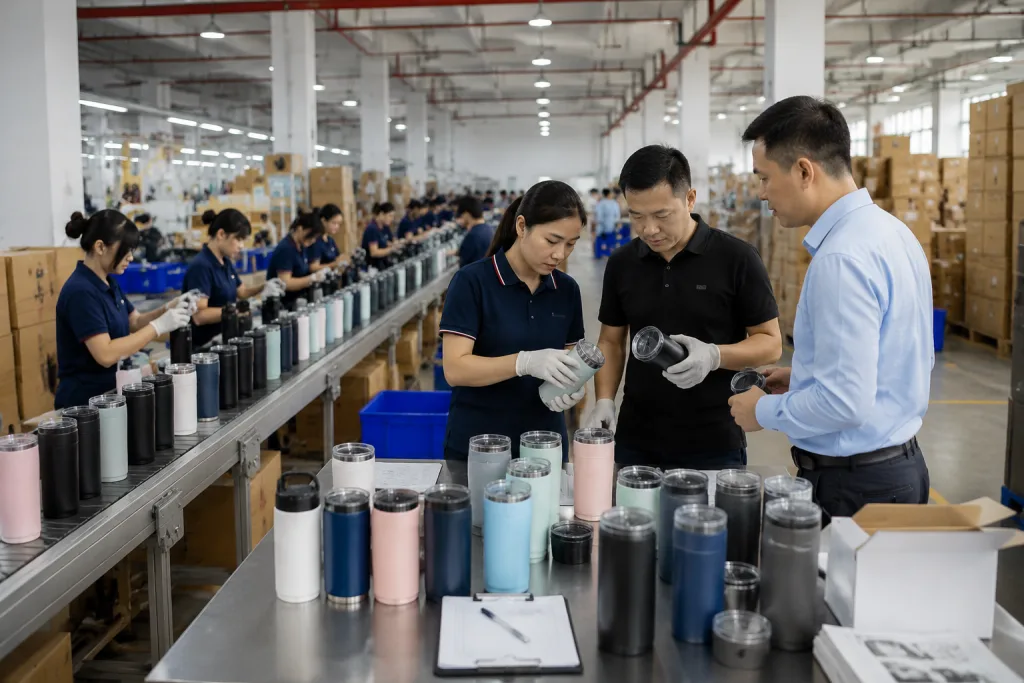
Key Takeaways
- Start with a detailed RFQ including wall thickness (0.4mm–0.6mm) and finish type to get accurate quotes from canteen manufacturers.
- Request 3–5 samples from shortlisted canteen suppliers and test for vacuum insulation performance (hold temperature for 6 hours).
- Bulk orders from Zhejiang factories typically require 30–45 day lead times and a 30% deposit; plan your campaign calendar accordingly.
- Use AQL 2.5 inspection with a sample size of 125 units per 1,000-piece lot to catch defects before shipment.
You need a promotional stainless steel tumbler for your next campaign. The sourcing process shouldn't feel like a maze. But RFQs get ignored, samples arrive with scuffs, and bulk shipments slip past the deadline. That gap between your product idea and the factory floor in Zhejiang? We see it every day. This guide walks each step — from your first inquiry to final container loading — so you skip the costly mistakes we've watched buyers repeat.
Whether you're a distributor or a brand owner, the real question is: what actually happens at each stage? Let's break it down with numbers that stick. MOQs run 1,000 units. Lead times land between 30 and 45 days. FOB price for a standard 12oz tumbler: $2.50 to $4.00 per piece. You'll learn to evaluate canteen factories — not by the website photos, but by the QC reports sitting on the desk and the tooling they keep on the line. We'll cover sample requests that actually get you answers, and inspection criteria like AQL 2.5. No fluff — just the practical steps to source promotional stainless steel tumblers without getting burned.
Step 1: Define Your Tumbler Specs Before RFQ
Before you send an RFQ, nail down your tumbler specs. Most buyers mess this up—they fire off "need a stainless steel tumbler" and get generic quotes back. We've seen this go sideways: a buyer once sent a one-line email and got 12 different quotes, none of which matched what they actually needed. Instead, define these parameters upfront:
- Capacity: Common promotional sizes: 12oz, 16oz, and 20oz. A 12oz tumbler fits coffee or tea; 20oz handles water and iced drinks. We run 16oz most often for branded giveaways.
- Wall thickness: Ask for 0.4mm to 0.6mm inner and outer walls. Thinner walls drop cost but compromise durability—QC pulled a 0.35mm sample once and it dented in the drop test. For a premium feel, specify 0.5mm.
- Finish: Choose between brushed, matte, or glossy. Brushed hides fingerprints well, so it's our go-to for promotional giveaways. Matte looks sharp but shows smudges after a day of use.
- Lid type: Sliding lid, flip lid, or straw lid. Sliding lids are cheapest but less leak-proof—a buyer flagged a batch where the slider popped off during shipping. Flip lids add $0.15–$0.25 per unit.
- Printing method: Silkscreen, laser engraving, or pad printing. Silkscreen works for large logos but fades after 50 dishwasher cycles; laser engraving is permanent and adds $0.10–$0.20 per piece. The math doesn't work for silkscreen if the client wants the logo to last.
Once you have these specs, send an RFQ to 5–10 canteen suppliers in Zhejiang. Include your target FOB price (say, $2.80 for a 12oz tumbler) and MOQ (typically 1,000 units per color). A good canteen manufacturer will respond within 48 hours with a detailed quote including tooling costs, if any. We had one supplier quote back in 12 hours—they had the spec sheet ready.
Step 2: Evaluate Canteen Manufacturers and Suppliers
Here's the checklist we use when a new buyer wants samples. It filters out the factories that look great on Alibaba but can't hold a production line. We've seen it happen.
- Production capacity: Demand a number—monthly output on the tumbler line, not "we can do it." In Zhejiang, a mid-size plant runs 200,000–500,000 units/month. If they claim less than 50,000, you're talking to a trading office that's brokering the order. Margin-killer.
- Certifications: Don't accept "we have all certificates." Ask for PDFs dated within 12 months. For US buyers, ASTM F2669-19 on vacuum insulation is non-negotiable—we've had a full container held at Long Beach over a missing test report. EU orders need LFGB or the specific EU food-contact doc—REACH alone doesn't cover it. BSCI is the floor for social compliance, not a bonus.
- Client references: Three to five names in your region, with contact info. A factory that's run promotional campaigns for a brand you recognize will have case photos and ship records. No references in your market? Walk.
- Factory audit: Send a third-party inspector or go yourself. Two things to eyeball: dust control in the spray-paint booth (overspray on a 10,000-piece order is an expensive rework) and the number of QC stations on the final assembly line. A line running 3 QC checkpoints is bare minimum. 5 is what you want.
A solid canteen supplier absorbs weird specs without blinking. We run a lot of custom canteen orders where the buyer wants a 68mm mouth for ice cubes—standard tooling is 48mm. That's a new die set. Ask upfront: is the tooling fee amortized over the PO or billed separately? Some factories bury a $1,200 charge in the unit price and hope you don't reverse-engineer the math.
Step 3: Order Samples and Test Rigorously
Never skip the sample stage — we’ve seen buyers try to save $50 and lose $5,000 on a single container. Order 3–5 samples from your top 2–3 factories. Each sample runs $10–$25 plus roughly $30–$50 DHL shipping. Here is what we test on the line:
- Vacuum insulation: Fill with hot water at 95°C, measure after 6 hours. Minimum 65°C or the vacuum layer is thin. For cold: ice water at 4°C, check at 6 hours — should stay below 10°C. QC pulled a batch last month where the inner wall was 0.3mm too thin; temps dropped to 52°C.
- Leak test: Fill with water, flip upside down for 30 seconds. Zero drops from lid or base seam. One buyer flagged a lid gasket that was 0.2mm undersized — leaked after 15 seconds. We run this test on every sample before we ship.
- Print quality: Wipe the logo with a damp cloth 10 times. If ink smudges, the silkscreen process is poor. For laser engraving, check depth with a caliper — must be at least 0.05mm. Anything shallower fades after 200 dishwasher cycles.
- Dimensional accuracy: Measure height and diameter with a caliper. Variation must stay within ±1mm. We had a PO where the outer diameter was 0.8mm off — the tumbler wouldn't fit the buyer's custom lid mold. That was a $3,000 mistake.
Document every result in a spreadsheet. Share feedback with each factory. A responsive manufacturer adjusts the sample based on your notes. If they ignore your feedback, move on. This step saves you from bulk disasters — the math is simple: $75 in samples vs. a $15,000 rejected shipment.
Step 4: Negotiate Bulk Order Terms and PO Line Items
Once the samples pass QC, move straight into bulk terms. No fluff. One typo on the carton count can add a 12-day slip, and we have seen that go sideways enough times to call it a real risk.
- Quantity: 1,000–5,000 units per color is the normal range. At 3,000 units, we usually land at $2.65 each; at 1,000 units, the same tumbler sits near $2.80. Smaller lots feel safer, but the math does not work. We run that number on the line before we quote.
- Unit price (FOB Shanghai or Ningbo): State whether the quote covers bulk pack or retail pack. Color box packaging adds $0.30–$0.50 per unit, and the buyer flagged this on a 304 stainless order after the first PO left packaging blank. That blank field turns into a fight later.
- Payment terms: Standard terms are 30% deposit and 70% before shipment. Some factories will do 50/50. For orders over $50,000, a letter of credit is the cleaner route; we see fewer payment disputes that way. The math works better.
- Lead time: Plan for 30–45 days from deposit confirmation. That covers production on the line plus sea freight at 15–25 days. If the buyer asks for a 20-day promise, we push back. The heat press alone needs time to settle.
- Inspection: Specify AQL 2.5 for major defects. A third-party inspector costs $300–$500 per day and checks 125 units per 1,000-piece lot. QC pulled the sample with a 0.8 mm lid gap once, and that batch never left the factory. Tight spec, no drama.
Ask for a customizable drinkware quote with the exact shape notes, neck size, and artwork placement in writing. We ship better when the contract is specific. A solid canteen supplier should send back a signed contract with the MOQ, unit price, and packing method on one page. The PO should match that page word for word.
Step 5: Manage Production and Quality Control
Keep close contact with the factory while the line runs. We ask for weekly photos or short videos, and we want the dull stuff too: coil labels, weld racks, carton counts. That is where the problems show up. One lot we ran had a coil tag marked 304, but the mill cert carried a different heat number. The buyer flagged it on day 9. That is the kind of miss that turns into a claim.
- Day 7–10: Raw material lands. Check the stainless grade, 201 or 304, against the mill cert and the incoming label. 304 is the better call for promotional drinkware. We check the coil with a handheld thickness gauge and count the incoming pallets, because one missing bundle on the floor turns into a missed ship date fast.
- Day 15–20: Forming and welding. Look at the seam under a light and ask for a straightness check; a 0.5 mm gap is enough to become a leak complaint later. QC pulled one sample at the weld rack and found a 0.6 mm offset at the rim. That is not a small detail. We have seen this go sideways on the first field use.
- Day 25–30: Printing and assembly. Pull a pre-shipment sample (PSS) from the first lot, and compare it with the approved artwork. A buyer once flagged a logo shift because the PO had one digit wrong, and the pad printer followed the typo. The line kept running anyway.
Do the final inspection at the factory or at the port. For 5,000 units, we inspect 200 units under a random sampling plan. Reject the lot if more than 7 units show major defects, such as dented walls or peeling logos. QC pulled one batch at AQL 2.5 and found three bad lids; the math does not work if you ship that. A solid canteen distributor or canteen vendor will accept rework or a price cut when the defect count is clear. We have seen buyers skip lid torque checks on the assembly table, and that one choice can cost a week.
Step 6: Arrange Shipping and Customs Clearance
Once QC clears the lot, we book the truck and move the cartons. Simple, but not casual. At the dock we run a double count with 2 hand tally clickers, and the loader signs off only after the pallet wrap is tight and the carton labels match the packing list.
- Sea freight: A 20-foot container usually takes 20,000–25,000 units. West Coast freight lands around $2,500–$4,000. Transit is 15–20 days door to port, and a 3-day slip can kill a launch if the buyer misses the sailing cutoff. This is the normal route.
- Air freight: Use it for rush orders. The cost is 5–10x sea freight, so the math does not work for normal replenishment. We only ship this way for small lots under 500 units, and the forwarder checks gross weight against the packing list on a digital scale, line by line.
- Customs documentation: The factory should issue the commercial invoice, packing list, bill of lading, and certificate of origin. For the US, you may need FDA Prior Notice for food contact items. QC pulled one sample file last month, and the buyer flagged a typo on the consignee name, so we fixed it before the container hit the port.
Use a freight forwarder that knows customs clearance. Tariffs for stainless steel drinkware from China usually sit at 3–6% under HTS code 7323.93, and we ask buyers to look at a real export doc set before we book space. The PO, carton marks, and invoice total must match; if one digit is off, customs will hold the file. We have seen that go sideways at the port.
Step 7: Plan Your Promotional Campaign Logistics
Once the tumblers land, they still have to move. We plan the handoff the same way we plan packing. Plain job. Easy to miss.
- Lead time for printing: If the logo goes on after arrival, set aside 5-10 days for local silkscreen or laser engraving. Last spring the buyer flagged a PO typo on the logo size, and QC pulled the sample before the line started. Good catch.
- Storage: Tumblers are light, but they eat space. A pallet of 1,000 units takes about 2 cubic meters, and a 20-foot carton stack can choke a small warehouse fast. We measure the rack first, then place the cartons. No guesswork.
- Distribution channels: For corporate gifts, pack each piece in a polybag or gift box. For trade shows, use display stands and keep the cartons near the hall door, not across the floor. A forklift turn in a 12 mm aisle goes sideways fast, so this is not the place to be casual.
A customizable canteen or custom drinkware campaign works best when the tumbler color matches the brand and the logo method fits the use case. Matte black with laser engraving works for a tech giveaway. Bright red with silkscreen fits a sports event. We run the timeline from arrival to outbound shipping in 2-3 weeks, and the math does not work if the buyer wants full kitting in 3 days. We've seen that go sideways.
Step 8: Build Long-Term Relationships with Canteen Factories
The suppliers worth keeping are the ones we run with on the second PO. After the first shipment lands, check the numbers and the paperwork. Skip the sales talk. We look at the dock receipt and the packing list first.
- On-time delivery: Did the factory ship on the agreed lead time? If the contract said 18 days and the truck left on day 22, that is a 4-day slip. Plain numbers. The buyer flagged it, and the math does not bend.
- Quality consistency: Compare bulk units to the approved sample. QC pulled the sample on the line with a 0.2 kg scale, and any shift in color, finish, or weight shows up fast. One carton at 0.43 kg and the next at 0.47 kg tells you the line is drifting.
- Communication: Did the canteen manufacturer reply within 24 hours, and did they tell you about a crack, dent, or carton mix-up before the buyer flagged it? That saves a shipment. We have seen this go sideways when nobody speaks up. A missed typo on the PO, like 3040 instead of 304, can burn a week.
If the factory holds the line, ask for repeat-order terms that make sense: 20% deposit instead of 30%, or a 5% discount once the order passes 10,000 units. The math works only after the supplier has proved they can ship 12 days, not 18, on the same carton spec. A steady canteen distributor relationship can also get you exclusive shapes, like a custom growler profile or a custom drinkware line that is not open to other accounts. Over time, the risk drops, QC stays tighter, and the margin stops leaking. We run this test with the same caliper, 0.01 mm resolution, on every reorder.
Ready to source your promotional stainless steel tumblers?
Contact our team in Hangzhou for a free RFQ template and sample request checklist.
Frequently asked questions
What is the typical MOQ for a promotional stainless steel tumbler from a Chinese factory?
Most canteen manufacturers in Zhejiang set an MOQ of 1,000 units per design per color. Some factories may accept 500 units for an additional per-unit cost of $0.20–$0.50. For custom growler shapes or unique sizes, MOQ can rise to 2,000 units due to mold tooling. Always confirm MOQ in writing before ordering samples.
How long does it take to get samples from a canteen supplier in China?
Sample production typically takes 7–15 days after you approve the design and pay the sample fee (usually $10–$25 per piece). Shipping via DHL or FedEx adds 3–5 days to most destinations. For rush orders, some canteen factories can deliver samples in 5 days if you pay an expedite fee of $50–$100.
What certifications do I need for promotional stainless steel tumblers sold in the US or Europe?
For the US, you need FDA compliance for food contact materials and ASTM F2669-19 for vacuum insulation. For Europe, require LFGB or EU Regulation 1935/2004. BSCI certification is often requested by retailers. Always ask your canteen supplier for copies of these certifications before placing a bulk order.
Can I get a custom canteen with my logo printed in multiple colors?
Yes, most canteen factories offer silkscreen printing for up to 4 colors. For more colors, pad printing or UV printing is used. Silkscreen costs $0.10–$0.20 per color per unit. Laser engraving is single-color (silver or black) but permanent. Request a mockup from your canteen vendor before production.
What is the best way to handle quality issues after shipment?
Include a quality clause in your contract. For defects found after arrival, negotiate a discount (e.g., 5–10% off invoice) or a partial refund. Most reputable canteen manufacturers will rework defective units if you cover return shipping. Always keep 5–10% of the order value as a retention until you inspect the full shipment.