Key Takeaways
- Most school programs land at MOQ 3,000 units and FOB USD 1.15-3.80 per bottle depending on material and print.
- For daily use, 430-500 ml is the practical range; smaller sizes get lost, larger ones are too heavy for younger kids.
- A 0.6-0.8 mm wall in stainless or a 2.0-2.4 mm Tritan body gives better impact resistance than the cheapest thin-wall builds.
- A normal custom kids water bottle lead time from a children water bottle supplier in Zhejiang is 25-35 days after sample approval.
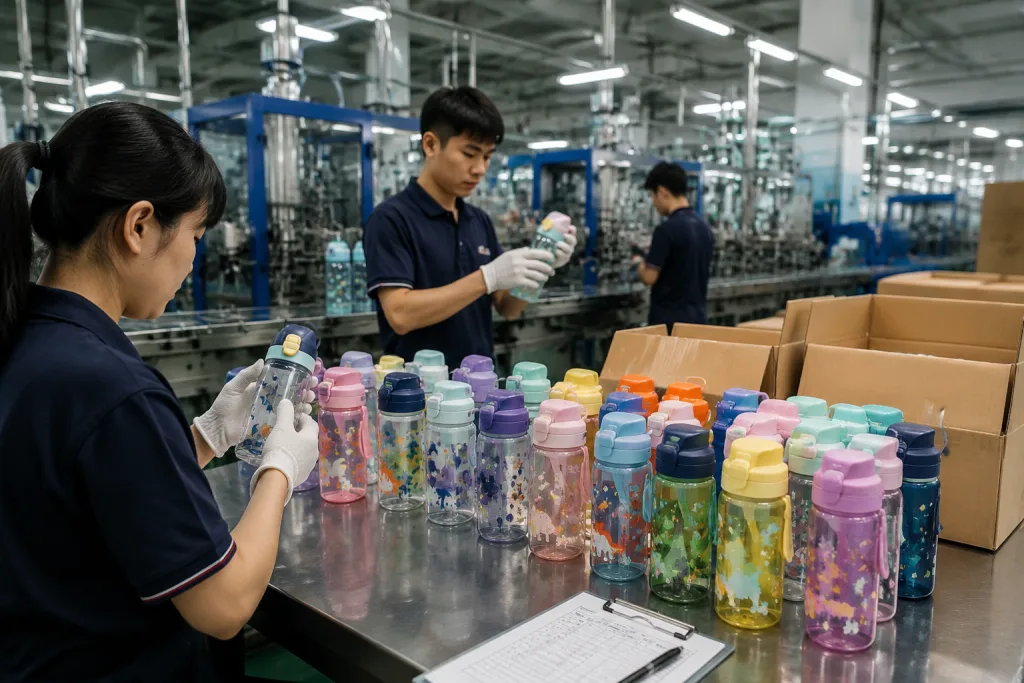
If you are buying a promotional school water bottle for a district, fundraiser, or kids retail program, the bottle is not the hard part. The hard part is getting a cap that survives a backpack drop, a print that still looks clean after 30 dishwasher cycles, and a unit price that works at 3,000 to 20,000 units. QC pulled the sample on the line and found lids cracking at the hinge after three drops from 1.2 m. Cute does not pay for a reprint.
The better way to buy is to match the bottle to the school use case first. A bulk children water bottle for kindergarten is a different job from a bulk school water bottle for middle school sports. We run this split every season in Zhejiang, and the same mistake keeps showing up: the buyer flags the art first, then the cap, then the math does not work. China can make this category well, but only when the spec sheet says what the bottle has to survive.
How to rank the five options
Do not start with color or logo. Start with the checks that decide whether a promotional school water bottle survives a school day. We rank the five options on five points: daily durability, spill resistance, print hold, unit cost at MOQ 3,000, and how easily it clears school procurement. On our line, a 0.3 mm wall-thickness miss shows up in drop tests fast. That is the right lens for a district buyer or a children water bottle distributor who cannot eat returns.
A real children water bottle manufacturer in Zhejiang should run 300,000 to 500,000 units per month across plastic and stainless lines, with samples in 5-7 days and mass production in 25-35 days. We have seen buyers get stuck when a PO typo changed 3,000 to 30,000, and the math stopped working on day one. If a supplier will not state those numbers cleanly, you are probably talking to a trading shop, not the factory that owns the molds and the QC bench.
What we look for:
- Leak rate: a screw cap with gasket, or a flip lid with a lock we have already pressure-tested
- Material: PP, Tritan, or 304 stainless with food contact papers on file
- Decoration: silkscreen, laser, pad print, or wrap label matched to wash cycles
- Carton strategy: 24 or 48 pcs/master carton, with FNSKU if you ship to Amazon
- Compliance: REACH, LFGB where needed, and traceable QC under AQL 2.5
If you are buying children water bottle customizable programs for schools, rank them by use, not by trend. The buyer flagged it before. We have seen that go sideways. A lid that looks good but fails after 200 open-close cycles is the wrong bet.
1. Tritan flip-top school bottle
If you need a balanced promotional school water bottle for elementary and middle school, Tritan is the one we ship most often. A 450-500 ml body gives solid impact resistance, clear walls, and less carry weight than stainless steel. That matters for a 6-year-old. Once you add a steel base and a complex lid, a full stainless bottle gets heavy fast.
We usually run Tritan at 2.2-2.4 mm wall thickness, with a PP lid and silicone gasket. At MOQ 3,000, a clean unit price often sits at USD 1.65-2.60 FOB, depending on print area and whether the lid is one-piece or two-piece. The buyer flagged a typo on one PO last month, and that kind of thing changes nothing on paper but can stall a run. For a custom logo kids bottle, one-color silkscreen on the body is still the cheapest clean option. Wrap labels work for more artwork, but they do not hold up as well as direct print.
This is the right fit when you want a bulk kids bottle that looks modern, stays light, and survives drop testing without denting. Make sure the flip-top has a positive lock. We have seen that go sideways. No lock means wet backpacks and complaints. QC pulled the sample on one line because the latch opened at 3.2 kg instead of holding shut. If a children water bottle factory will not show cycle test data, the math does not work.
2. 304 stainless steel bottle
For rough school use, 304 stainless is the safer call. Plastic starts to crack at the corners after a few weeks in a bus bag; a 304 stainless promotional school water bottle takes dents and stays in service. It does weigh more. That is the tradeoff. For younger children, 350-450 ml is the better size; a 500 ml bottle ends up on the classroom shelf or in the playground dirt.
On the line, we run 0.6-0.8 mm inner wall stainless with a PP or stainless outer shell, depending on the lid and print plan. At MOQ 3,000, FOB pricing often sits around USD 2.10-3.80, and laser engraving adds about USD 0.10-0.25 per unit versus single-color print. The buyer flagged a faded logo on one PO because the art was too small. That is the wrong question to ask if the school wants the mark to stay clean after a semester. We have seen that go sideways before.
Ask for drop-test proof from 1.2 meters onto plywood or concrete-backed surfaces, and check that the lid seal can be replaced. QC pulled the sample and found a loose gasket after 18 open-close cycles. Small fault, big headache. A children water bottle supplier in Zhejiang should show spare gasket options and the lid assembly, no hand-waving.
3. Budget PP squeeze bottle
If the budget is tight and the bottle is for field day, PE day, or one-off student kits, a PP squeeze bottle is the cheapest route. We run this style for school giveaways every season. It holds water and sports drinks without drama. Clean, simple, shipped.
At MOQ 5,000, FOB usually lands around USD 0.55-1.05, and the spread comes from the mold, cap style, and print setup. On the line, we check a 1.3-1.8 mm wall with a caliper; thinner than that, the bottle goes soft after one warm truck run and the buyer flags it fast. A loose cap kills the batch. We’ve seen that go sideways.
This is the right pick when you need children water bottle wholesale pricing and distribution volume matters more than a premium hand feel. It is also the fastest format for a children water bottle vendor to push through. Do not skip the material declaration. QC pulled the sample once and the trace code was missing one digit on the PO, which slowed customs and made the math ugly for a children water bottle distributor serving multiple districts.
4. Insulated bottle for older kids
For middle school teams and sports clubs, an insulated stainless bottle earns its price. A 12 oz to 18 oz double-wall body keeps water cold through the school day, and kids feel that by period 5. We run 304 stainless on this line for a reason. It is a premium custom school water bottle, not a giveaway.
FOB usually sits around USD 3.60-6.50 at MOQ 3,000, depending on body finish, vacuum pull, and lid structure. The weld and vacuum hold matter more than the print. QC pulled a sample that failed a 48-hour leak check, and the buyer flagged it before we shipped. That is the real test. A reliable children water bottle manufacturer should quote the vacuum leak spec and the insulation window, such as 6-12 hours cold retention under controlled conditions.
This is the right pick for buyers who want a custom children water bottle that feels retail-grade, not like a freebie. It works for boosters, teams, and welcome packs. Packaging changes the math fast. A molded pulp tray or individual box can add USD 0.12-0.45 per unit, and we have seen a PO typo on box style turn a clean quote into a mess.
5. Wide-mouth bottle with carry loop
The wide-mouth bottle with a carry loop sits in the last slot. Fine. It covers a tighter brief: older kids, after-school clubs, school field days. The 58 mm mouth makes wash-up easier, takes ice without a fight, and lets a child top up at a fountain without splashing the desk. We ran one district order on this spec with a 2.8 kg carton limit, and QC pulled the sample after a cap grit check on the line. That was enough for that buyer. This is the right bottle for one use, not every classroom.
For this style, we usually quote 500-600 ml in Tritan or stainless at FOB USD 1.90-4.20, depending on the lid build and print method. The carry loop earns its keep. If the hinge is soft, that is where it fails first. We ask for a hinge cycle test at 3,000 to 5,000 open-close cycles, then we check thread wobble after torque testing because one buyer flagged a PO typo on the cap spec and the rework math did not work.
This is a practical pick for children's water bottle promotional programs when the client wants something that looks useful, not toy-like. It also leaves a clean print panel for a custom logo kids bottle, which gives school sponsors a clear mark without crowding the body. We ship these with a straight pad-print area on one side and keep the loop clear; a 35 mm logo usually lands better than a full wrap, and we've seen a full wrap go sideways when the art file tries to do too much.
What school buyers should check first
Check the bottle spec before you approve artwork. We see custom kids water bottle orders go sideways when the buyer signs off on graphics before the lid, seal, and carton size are fixed. The render looks clean. The bottle leaks in a school bag.
Start with these points:
- Capacity: 350-450 ml for younger grades, 500-600 ml for older kids
- Lid type: flip-top for quick drinking, screw cap for leak control
- Seal: food-grade silicone gasket with spare part option
- Artwork: one-color silkscreen if you need the lowest cost; laser for stainless
- Testing: leak, drop, dishwasher, and odor checks before shipment
If you buy from a children water bottle factory in Zhejiang, ask for pre-production samples with your logo, not blank stock. QC pulled the sample with a 1.2 mm print shift on the shoulder. That is the kind of miss a blank bottle hides. Ask for the exact sample code and carton mark. The buyer flagged mixed SKUs once because the PO had one typo in the lid color, and we had to recheck the whole line.
For districts and distributors, this is where the gap between a children water bottle wholesale quote and a program that ships clean shows up fast. The cheapest quote often leaves out the gasket cost, the spare cap, or the extra packing step. The math does not work. We have seen it go sideways on a 10,000-piece run when the carton insert was quoted at 0.08 RMB and the buyer thought it was included.
Compliance and testing that matter
For North America and Europe, compliance is not paperwork theater. A promotional school water bottle gets checked against food-contact rules, REACH, and district purchase specs. On one school order, QC pulled the sample and found a missing resin declaration on the PO. Small miss, big delay. If you run stainless steel, ask for traceability on the 304 sheet, plus proof that any coating or paint stays within the migration limits. If you run PP or Tritan, get a resin declaration and a food-contact statement for the masterbatch before the line starts.
We tell buyers to lock in AQL 2.5 for major defects and 4.0 for minor defects on final inspection. That is normal for children water bottle manufacturers shipping export work. The math does not work if you skip it. For school orders, add carton drop strength and inner packing checks. We have seen a bottle pass lab testing and still arrive scuffed because the divider was 2 mm too thin and the bottles moved in transit.
If the shipment is going to Amazon, write FNSKU labeling and carton barcodes into the PO. A children water bottle distributor selling through schools and online needs that sorted before production starts, not after the booking is done. One buyer once flagged a PO typo where the carton count was off by 12; we caught it at the packing table, not at the warehouse dock. The factories in Zhejiang that handle this cleanly ship every week, and that rhythm shows up in fewer mistakes.
How to order without wasting time
Send a tight spec sheet, and the quote gets cleaner. For a custom children water bottle RFQ, list size, material, lid type, target age group, print method, quantity, target FOB price, carton pack, and destination port. Leave one item out, and the children water bottle vendor starts guessing. We see that go sideways all the time.
For a first order, a lot of buyers start at 3,000 to 5,000 units, then move to 10,000 to 20,000 once the design holds up. That is normal. A steady children water bottle supplier will split sample cost, mold cost if needed, and lead time on the quote. If they jam everything into one line, the math does not work. In our Hangzhou factory, QC pulled the sample on a caliper and the cap tolerance stayed within 0.3 mm. We run 5-7 days for samples and 25-35 days for production, with monthly output above 400,000 units across kids and sports lines. That keeps a school order on track before term starts.
When you compare children water bottle manufacturers, price is only one line. Check what is included, whether the artwork file gets checked for print safety, and whether the supplier can hold the same cap color on repeat orders. We had a buyer flag a PO typo once, “blue” on the sample sheet and “green” on the carton mark, and that kind of slip costs a day on the line. The real split is simple: one-off buying, or a children water bottle customized program that ships the same way every time.
Send your bottle spec and get a real quote
We will price your custom school bottle by material, lid, print, and carton setup, then match it to school or retail use.
Frequently asked questions
What is the usual MOQ for a promotional school water bottle?
For most factory-direct orders, MOQ is 3,000 units for standard molded bottles and 5,000 units for budget PP squeeze styles. If you need a new lid mold or a special color match, the MOQ may rise to 8,000 or 10,000 units. A children water bottle factory in Zhejiang will usually quote lower MOQs for stock shapes and higher MOQs for custom shapes. For school districts, 3,000 to 5,000 units is the realistic band if you want decent FOB pricing and proper print setup.
Which material is better for school use, Tritan or stainless steel?
Tritan is better when you want a lighter bottle, lower price, and clear body with a clean logo panel. Stainless steel is better when you want impact resistance and a more premium feel. For younger students, 450 ml Tritan is often the most practical promotional school water bottle. For older kids and sports programs, 350-450 ml stainless works well. At MOQ 3,000, Tritan often lands at USD 1.65-2.60 FOB, while stainless usually runs USD 2.10-3.80 FOB.
How durable is the print on a custom kids water bottle?
That depends on the decoration method. Silkscreen on Tritan is fine for simple logos, but it can wear faster if the bottle sees frequent dishwasher cycles. Laser engraving on stainless is the most durable because it does not peel. Pad print is useful for small icons or tight curved areas, but it is not the best for long-term school use. If you want a children water bottle customized for repeated washing, ask for wash test data and confirm how many cycles the logo should survive.
What compliance documents should I ask for?
At minimum, ask for a food-contact declaration, material specification, and test reports relevant to your market. For Europe, REACH-related confirmation is common; for food-contact reviews, LFGB or similar migration documentation may be requested depending on the buyer. For stainless, ask for 304 material traceability. For plastic, ask for resin grade and color masterbatch details. A proper children water bottle supplier should also support AQL 2.5 final inspection and provide carton packing details, especially if the order is moving through school procurement or retail channels.
How long does production take after sample approval?
For a standard children water bottle wholesale order, plan 25-35 days after sample approval. If the order needs new molds, special packaging, or a complicated multi-color print, it can stretch to 40-50 days. In a Zhejiang factory with stable output, samples usually take 5-7 days. If your delivery window is tight, say before back-to-school season, you should freeze artwork early and avoid late cap-color changes. Those small changes can push the schedule by a week or more.