Key Takeaways
- MOQ for custom promotional protein shakers typically starts at 3,000 units per design, but can drop to 1,000 with stock molds.
- FOB Zhejiang prices for a 500ml Tritan shaker with silkscreen logo range from $1.80 to $3.20 per unit, depending on quantity and complexity.
- Lead time for a full custom canteen (new mold) is 45–60 days; stock-design shakers with custom logos ship in 25–35 days.
- AQL 2.5 is the industry standard for drinkware quality inspection; insist on a pre-shipment inspection report from a third-party agency.
Your marketing team wants a custom protein shaker that looks sharp at trade shows. Budget is tight—we hear that every week. Timeline is eight weeks. You're a procurement manager, and every supplier you find online offers vague MOQs, unclear lead times, and sample photos that look nothing like production units. You need a practical guide—not a listicle—that answers real questions: What wall thickness works for a shaker? How do you avoid mold fees that blow your budget? Which factory metrics actually matter?
This guide is written from the perspective of an export sales engineer at BottleForge Industrial, a drinkware manufacturer in Hangzhou, Zhejiang. We ship 500,000 units per month across stainless steel, Tritan, and glass drinkware. Last week, our QC team flagged a batch of shaker lids—bad gate marks from the injection mold. We caught it before shipping. The math doesn't work if you're comparing 2.5mm sidewalls to 1.8mm and expecting the same price. Here, we break down the sourcing process for promotional protein shakers and custom canteens, using specific numbers and real-world constraints. No fluff, no competitor name-dropping—just honest answers to help you make a smart buying decision.
What Defines a Promotional Protein Shaker?
Before you call a canteen manufacturer, nail down what you're buying. A promotional protein shaker isn't a bottle with a lid. It has a mixing mechanism—wire whisk ball or built-in blending grid—plus a leak-proof seal. Material is almost always Tritan copolyester (BPA-free) or double-wall vacuum-insulated stainless steel. Glass? Rare. We've seen too many shards in gym bags.
For custom drinkware buyers, the real differentiator is customization depth. Stock shaker with a silkscreened logo? Fastest route, 15 days. Fully custom canteen—unique shape, custom mold, proprietary lid—runs 6–8 weeks and costs $2,000–$5,000 in mold tooling. Most B2B buyers pick the middle: stock shape, Pantone-matched color, debossed or laser-engraved logo. Branded look, zero tooling cost. We ran one last month where QC pulled the sample because the engraving depth was 0.2 mm off spec—that's the level of detail you want.
From our factory floor in Zhejiang, two use cases dominate: trade show giveaways (high volume, low per-unit cost) and employee wellness programs (mid volume, higher quality). Know which you need before you ask for a quote. Want a canteen customizable with multiple color options? Expect a 10–15% price premium over single-color runs. The buyer who asked for six colors on a 500-piece order learned that one the hard way.
How to Choose Between Stock and Custom Molds
This is the first real fork in the road. A stock mold shaker means we already own the tooling—the steel's sitting on the shelf in our Hangzhou shop. You pick from our catalog, choose a color, add your logo. MOQ for stock molds lands at 1,000–3,000 units. At BottleForge, our stock shaker molds start at 1,500 units per design. Price on a 500ml Tritan shaker with silkscreen: $2.10 FOB Zhejiang.
A custom mold gives you a shape that's yours. Canteen-style body with a wide mouth that actually fits ice cubes. A growler silhouette for 900ml capacity. Molds run $3,000–$8,000 depending on cavity count, undercuts, and whether the lid integrates into the body tooling. MOQ for custom sits at 5,000–10,000 units—you need volume to amortize that tooling cost. Lead time: 50–65 days from mold approval. We had a buyer last year who approved the mold on a Friday, then emailed Monday asking to change the lid thread pitch. QC pulled the sample off the line. That revision cost him $1,200 and pushed delivery by 12 days. Friday-to-Monday, $100 a day for second thoughts.
If you're a canteen distributor ordering for a one-time campaign, stick with stock molds. If you're a brand owner planning repeat orders over two years, invest in custom tooling. Here's the math that matters: per-unit cost drops 15–20% after the first 10,000 units because the tooling is paid off. At 20,000 units, a custom mold pays back the tooling and saves you roughly $0.30 per unit compared to stock. Multiply that across three SKUs and you're looking at real money.
One trap we've seen repeatedly: some canteen vendors quote a low mold fee and bury the cost in the unit price. Always ask for a line-item breakdown—tooling cost separate from unit price. A factory worth working with gives you both numbers in the first quote. We had a distributor in California sign a $2,000 mold fee, no breakdown, then discovered the unit price was $0.50 above market. He flagged it on the PO and walked. Get the full math before you sign anything.
Material Options: Tritan vs. Stainless Steel vs. Glass
Material choice changes weight, durability, and perceived value. Here's what we tell buyers who call asking for the "best" option—there's no winner, just trade-offs.
- Tritan copolyester: Lightweight—120g for a 500ml bottle, shatter-resistant, dishwasher safe. Best for gym giveaways where you want something people actually use, not a paperweight. Price: $1.80–$2.50 per unit. The catch: it scratches after 6 months of daily use, and it's not insulated. One buyer flagged it after their logo faded on a test run—our pad printer had to adjust the cure temperature.
- Stainless steel (double-wall vacuum insulated): Heavier—280g for 500ml. Keeps drinks cold 12 hours, hot 6 hours. Ideal for premium corporate gifts where the recipient will actually keep it on their desk. Price: $3.50–$5.00 per unit. Different lid design—most use a push-pull cap instead of a mixing mechanism. QC pulled a sample once because the mixing ball didn't fit the neck—the inner diameter was off by 2mm.
- Glass: Rare for shakers. Heavy—350g+, fragile. Only suitable for desk-use or stationary promo items. Price: $2.00–$3.00, but breakage rates in shipping hit 5–8%. We ran a test batch and 6 out of 100 arrived cracked. The math on breakage alone kills the budget.
For most B2B buyers, Tritan is the sweet spot. It's customizable canteen-friendly—easy to silkscreen, pad print, or laser engrave. Stainless steel works if your brand message is about durability or sustainability. Avoid glass unless you have a specific premium niche—we've seen this go sideways for a buyer who didn't account for extra packaging foam.
One metric to demand from any canteen manufacturer: BPA-free certification (third-party lab test, not a PDF they wrote themselves). Also ask for REACH and FDA compliance if shipping to Europe or North America. Our factory provides these documents with every order over 5,000 units—we've had them on file since 2019. A buyer once sent us a PO with a typo on the cert number—we caught it before the line ran.
What MOQ and Lead Time Should You Expect?
Every procurement manager asks this first. Here's what our production schedule actually looks like—pulled from the last 200+ PO runs on our shaker line.
- Stock mold, custom logo only (silkscreen or pad print): MOQ 1,500 units. Lead time 25–30 days after artwork approval. We run the logo on the existing body shape. No mold delay. No color matching. Straight to the line.
- Stock mold, custom color + logo: MOQ 3,000 units. Lead time 30–35 days. The extra 5–7 days aren't optional—color matching a Pantone to a curved PP surface needs a first-shot sample, and QC will reject it if the delta E is over 1.5. We've had buyers push back on this, but skipping the sample is how you get 3,000 units in the wrong shade.
- Custom mold, full design: MOQ 5,000 units (10,000 recommended). Lead time 50–65 days including mold sampling. The 5,000 MOQ covers the steel for the mold cavity but not the per-unit margin we need. At 10,000, the math works. Mold sampling alone eats 15–18 days: first T1 sample, feedback loop, T2 revision, final sign-off. We ship the mold from our tooling shop in Yuyao to our Hangzhou assembly line—that's another 2 days transit.
- Rush order (stock mold, existing color): MOQ 3,000 units. Lead time 18–22 days. You pay a 15–20% premium because we're bumping other POs off the line and running overtime on the pad-print station. We did this for a UK distributor last quarter: 3,200 units, 20 days, landed on time. Premium was 18%.
If you're a canteen distributor with a hard launch date, order stock molds at least 40 days before your deadline. Custom molds need 75 days minimum. We've seen too many buyers assume 30 days covers a custom shaker. It doesn't. By day 30, the mold is still in Yuyao getting polished.
One more number: shipping time. FOB Zhejiang to Los Angeles by sea takes 18–22 days. Air freight takes 5–7 days but costs 4–5x more—on a 5,000-unit order, that's the difference between $1,200 and $5,500 in freight. The wrong question to ask is "can you make it faster." The right question is "what's the air freight surcharge, and does my launch justify it." Factor that into your timeline before you sign the PO.
How to Evaluate Quality: Wall Thickness, Leak Tests, and AQL
Judge a shaker by the sample? Not safe. Production runs shift. Here's what we check at the line:
Wall thickness: For Tritan shakers, we spec 1.2mm minimum at the thinnest point—usually the shoulder. Under 1.0mm, we've seen cracking on a 1.2m drop test. For stainless, inner and outer walls need 0.4mm (400 microns) each. A buyer once brought in a cheap canteen showing 0.3mm steel. Dent city after one tumble. Our caliper reads directly on the pour spout edge.
Leak test: Fill the shaker, close the lid, shake hard upside down for 10 seconds. No drips. Then leave it inverted on a paper towel for 2 hours. Dry towel = good seal. We demand this from every supplier before they ship. Last month QC pulled a sample that passed the 10-second shake but leaked at 45 minutes. The math doesn't work if you skip the second test.
AQL (Acceptable Quality Level): Industry standard for drinkware is AQL 2.5. For a 5,000-unit order, that's 125 defective units max. Want tighter control? Specify AQL 1.0. Expect a 5–10% price bump—the factory runs 100% inspection on critical points like thread fit and lid seal. We've seen this go sideways with buyers who skipped it and got 400 leakers out of 3,000 pieces.
Hire a third-party inspection agency for your first order. SGS or Bureau Veritas works. Cost: $300–$500 per day per inspector. They'll check dimensions, color, print alignment, and leak performance. Cheap insurance against a bad batch—and we've seen plenty of those.
Customization Options: Silkscreen, Laser Engraving, and Pantone Matching
Your logo is why you're ordering these. Here's what we actually run on the line:
- Silkscreen: Most cost-effective for large volumes. Setup fee $50–$100 per color. Best on flat or slightly curved surfaces. Durability: moderate—scrub it with a green pad and it'll fade. We ran 50,000 units last month for a gym chain; the buyer approved the sample on the first try.
- Laser engraving: No ink, no fade. Works on 304 stainless and some Tritan grades. Cost: $0.15–$0.30 per unit extra. Gives a premium look. Don't expect full-color logos. A buyer from a pharma company wanted a QR code engraved—we had to tell them the resolution wouldn't scan reliably below 10 mm.
- Pad printing: Good for curved surfaces like the lid or bottom. Setup fee $80–$150 per color. Durability similar to silkscreen. We use this when a buyer's logo sits right on the dome. One client's logo had a fine line that kept breaking during pad transfer—we switched to a harder pad and it held.
- Debossing: Indented logo, no color. Works on stainless steel. Gives a tactile, upscale feel. Tooling cost $200–$500. One buyer last year wanted this for a hotel chain—looked sharp until QC pulled a sample and found the depth was off by 0.2 mm. We fixed the die.
For a canteen promotional campaign with a full-color logo, silkscreen is the standard. If your logo has more than three colors, consider a shrink sleeve label instead—it wraps the entire bottle and can include gradients. Cost is $0.10–$0.20 per unit extra. We shipped 12,000 units last quarter with a sleeve for a sports drink brand—no complaints. The buyer asked for a matte finish; the sleeve supplier had to order a special film, which added 5 days to the lead time.
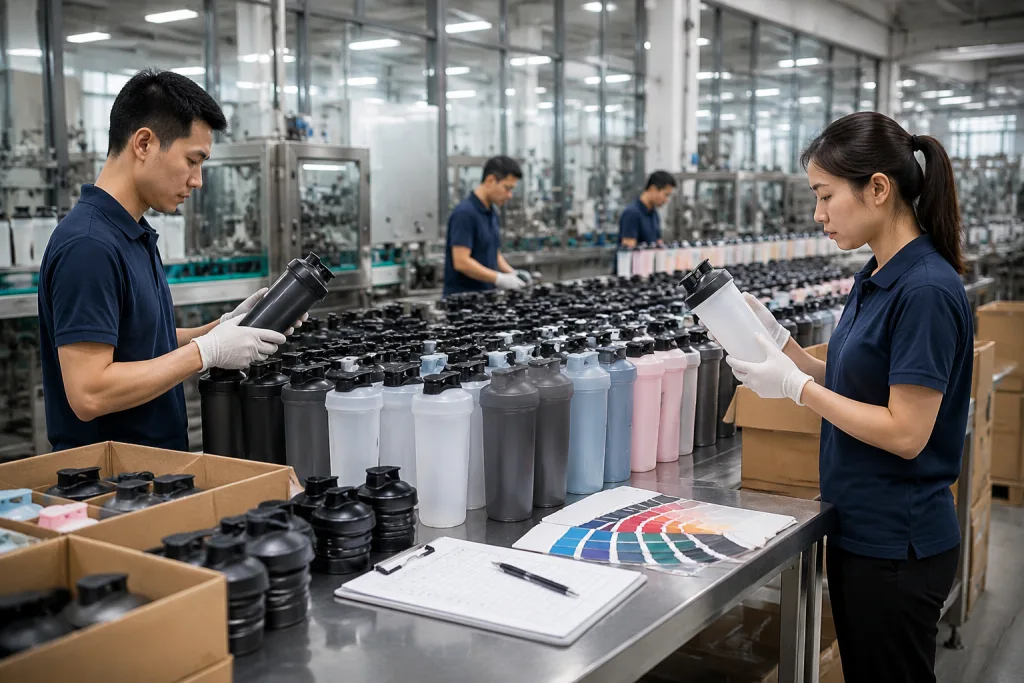
Pantone matching is where most buyers trip up. A reputable canteen supplier will ask for your Pantone codes and provide a color chip sample before production. Expect one round of color adjustment at no charge; additional rounds may cost $50–$100 each. We've seen this go sideways when a buyer sent a hex code instead—got the color wrong in the first proof. Send Pantone, not a screenshot. One buyer sent a JPEG of their logo and said "match this"—QC spent two hours trying to eyeball it. The math doesn't work on that approach.
Checklist: 7 Questions to Ask Before Placing Your Order
Use this checklist when vetting a canteen vendor or canteen factory:
- What is the MOQ for stock vs. custom molds? Get both numbers in writing. Watch for hidden per-unit increases at lower quantities. We’ve seen buyers quoted 3,000 for stock but 10,000 for a custom mold — and the per-unit price jumps 30% at 5,000.
- What is the lead time including sample approval? Ask for a timeline with milestones: mold sample, print sample, production start, inspection, shipping. For a standard Tritan shaker, we run 35 days from deposit to FOB. Custom molds add 18 days. If they quote "45 days" without breaking it down, the math doesn't work.
- What is the wall thickness of the shaker body and lid? Demand a spec sheet. For Tritan, 1.2mm minimum. For stainless steel, 0.4mm per wall. QC pulled a sample last month from a new supplier — lid was 0.8mm, cracked on the first drop test. Don't skip this.
- Do you have BPA-free, REACH, and FDA certifications? Ask for lab reports dated within the last 12 months. If they hesitate, walk away. One buyer flagged a vendor who sent a report from 2019 — the supplier had changed their resin supplier since.
- What is your AQL standard? Insist on AQL 2.5 or better. Get it in the contract. AQL 4.0 means you accept 7 defects per 315 units. That's a lot of bad shakers in your container.
- Can I see a pre-production sample before full production? A good canteen manufacturer will send you a sample for approval. Expect to pay $50–$150 for sample shipping. We've seen buyers skip this to save a week, then rework 20,000 units because the logo color was off. Don't be that buyer.
- What is your defect/return policy? Reputable factories replace defective units up to the AQL limit. Some also offer a 2% extra for breakage during shipping. If they say "we don't do returns," move on. There are dozens of canteen manufacturers in Zhejiang alone. The right one will treat you like a partner, not a transaction.
Why Source from Zhejiang for Custom Drinkware?
Hangzhou, Yiwu, Yongkang—over 60% of China’s stainless steel and Tritan bottle production sits within a 150km belt here. Walk into any decent canteen factory and the procurement radius tells the story: Tritan pellets from a compounder 40km east, 304 stainless coils from a mill 50km south. That’s 6–8 days shaved off raw-material lead time versus a factory in Guangdong pulling the same inputs from three provinces away.
For custom drinkware buyers, the density means you can hit four factories in two days. We had a German client do exactly that last November—visited our line on a Tuesday, audited two other shops Wednesday, placed a PO Thursday. Competition here is sharp enough that you can push on MOQ and tooling amortization. Our own setup: 12 Haitian injection molding machines for Tritan shakers, 8 deep-draw presses for stainless bodies, 500,000 units a month out the door. Custom logo MOQ sits at 3,000 units. We’ve run 2,000 for repeat buyers who didn’t blink at a small surcharge, but 3,000 is where the unit economics make sense without anyone subsidizing dead stock.
One thing that trips buyers up: a lot of “factories” in this region are trading offices with a showroom and a WeChat contact list. Ask for a live video walkthrough of the production floor—specifically the mold storage area and the QC station. If they stall or send you a polished 3-minute promo clip, walk. We once took over a project from a UK brand that had spent four months going back and forth with a middleman who couldn’t even confirm whether the Tritan was Eastman or a generic copolyester. The mold cavities were wrong, the threads leaked, and the shipment got rejected at Felixstowe. A 20-minute video call with someone standing next to an injection press would have caught it before tooling started.
Ready to source your promotional protein shaker?
Contact our team for a quote with real MOQ, lead time, and FOB pricing—no hidden fees.
Frequently asked questions
What is the minimum order quantity for a custom logo protein shaker?
For a stock mold shaker with a silkscreen logo, most canteen manufacturers in Zhejiang set a MOQ of 1,500–3,000 units per design. At BottleForge, our MOQ is 1,500 units for stock shapes. For a fully custom canteen with a new mold, expect MOQ of 5,000–10,000 units. If you need a lower MOQ (e.g., 500 units), you will pay a per-unit premium of 30–50% and may be limited to existing stock colors without Pantone matching.
How long does it take to produce a custom promotional shaker?
Lead time depends on customization depth. Stock mold with custom logo: 25–30 days after artwork approval. Stock mold with custom color and logo: 30–35 days. Full custom mold: 50–65 days. Add 18–22 days for sea freight to North America. For rush orders, we can ship in 18–22 days for stock molds at a 15–20% premium. Always add 5–7 days for sample approval to your timeline.
What is the typical cost per unit for a promotional protein shaker?
For a 500ml Tritan shaker with silkscreen logo, FOB Zhejiang prices range from $1.80 to $2.50 per unit at 3,000 quantity. A double-wall stainless steel shaker with laser engraving costs $3.50–$5.00 per unit at similar volume. Custom mold tooling adds $3,000–$8,000 upfront. Prices include standard packaging (polybag + inner box). Premium packaging (gift box, sleeve) adds $0.30–$0.80 per unit.
How do I ensure the quality of custom drinkware from a Chinese factory?
Use a three-step quality plan: First, request a pre-production sample and test wall thickness (1.2mm min for Tritan, 0.4mm per wall for stainless steel), leak performance, and print adhesion. Second, specify AQL 2.5 in your contract and hire a third-party inspector (SGS, Bureau Veritas) for the final shipment. Third, ask for BPA-free, REACH, and FDA lab reports. A reputable canteen supplier will provide these without pushback.
Can I get a custom color match for my brand?
Yes. Most canteen manufacturers offer Pantone color matching for a fee of $50–$100 per color. The process takes 5–7 days for the first color chip sample. Production colors are visually matched under D65 daylight. Note that color may vary slightly between plastic (Tritan) and metal (stainless steel) due to material absorption. For best results, order a color chip sample before committing to full production.