Key Takeaways
- Promotional products wine tumblers typically require an MOQ of 500–3,000 units per design from Zhejiang factories.
- Double-wall vacuum insulation with 304 stainless steel is the industry standard for wine tumblers; expect 12–18 gauge wall thickness.
- Laser engraving adds $0.50–$1.50 per unit over silkscreen but offers permanent branding with no peeling risk.
- FOB prices for a 12 oz promotional wine tumbler start at $2.80–$4.50 per unit, depending on volume and customization level.
You're sourcing promotional wine tumblers for a Q4 trade show or corporate gift run. The buyer wants 12 oz stainless with a full wrap logo, and your boss said "premium feel, no complaints." Last batch we QC'd came back with faded logos on half the units — 15 out of 30 pulled from the line — and 0.4mm walls that dented in transit. The math doesn't work unless you land under $4.50 per piece at AQL 2.5. That's thin. Fifteen percent of drinkware orders we see have a spec mismatch on wall thickness alone.
This guide walks one real order from spec sheet to carton seal. We'll hit MOQ breaks at 500, 1,000, and 3,000 units. Silk screen holds two colors fine on a flat tumbler body. Pad print? Falls apart on that tight bottom radius — we've seen it peel in the first dishwasher cycle. The inspection checklist here caught a wrong Pantone on a 6,000-unit order once. Saved the client six grand. I've been on the floor in Hangzhou for eleven years. After this, you'll know exactly what to put on your RFQ.
Why Wine Tumblers Work for Promo Campaigns
Wine tumblers fit promo campaigns because they sit between daily use and perceived value. A plain water bottle just holds water. A wine tumbler points to weekend grills, campsite drinks, or a slow evening after work. That is why the logo keeps getting seen. We ship them into desks, picnic baskets, and beach bags. Same mark. More touches.
On the B2B side, the cost per impression holds up. One unit can bring 300–500 exposures over its life, especially with a canteen customizable body people refill every day. We saw it on a 5,000-piece run for a tech client's summer party: $1.80 per unit, logo still clean after 200 dishwasher cycles. QC pulled the sample, checked the 0.4 mm wall, and the finish stayed even. Pick a canteen factory that can hold both the coating and the thickness, or the buyer will catch the gap fast. In Zhejiang, a lot of global drinkware is made, and lines running 500,000 units per month handle canteen promotional orders all the time. Lead time is usually 25–40 days for custom work, unless the PO has a typo in the artwork code. We've seen that go sideways.
The buyer's job is to balance cost and quality without kidding themselves. Cheap tumblers from unknown canteen vendors fail. QC pulled samples where insulation died at 20 minutes, the lid leaked in transit, or the logo peeled after one wash. One buyer flagged a batch where the vacuum seal broke on 12% of units at AQL 2.5. This is the wrong question to ask if you only chase the lowest quote. We run 304 stainless, double-wall construction, and lid gasket material for a reason. The math doesn't work if you replace half the order.
Step 1: Defining Your Specs
Before you call any canteen supplier, lock the spec sheet first. Open with “just send a price” and the quote goes sideways. We see it every week. For a promotional products wine tumbler, set these numbers up front:
- Capacity: 10–12 oz is the standard wine size. 8 oz fits smaller pours or whiskey shots. Ask your canteen manufacturer whether the cup clears a standard wine glass stem, or go stemless and stop arguing about it.
- Material: 304 stainless steel (18/8) is the floor for food contact. Skip 201 stainless steel; we ran a salt-spray test last month and it pitted at 72 hours, so QC pulled the sample. Wall thickness should stay at 0.4–0.6 mm for double-wall vacuum insulation.
- Lid type: Decide on splash-proof or leak-proof before the RFQ goes out. A press-fit silicone lid is common for promo runs, while a screw-on lid with a sliding closure adds something the buyer can feel in hand. The wrong lid spec is a headache.
- Finish: Matte powder coating or brushed stainless steel. Powder coating adds about $0.20–$0.50 per unit, and it hides fingerprints better on the line. We had a buyer flag a brushed sample for showing smudges under warehouse lights, and that pushback was fair.
Put all of it on one page and send that RFQ. A solid canteen distributor will ask for it before quoting; if they don't, the math doesn't work. In Zhejiang, we usually turn an RFQ in 2–3 days for a custom canteen order, then ship a sample 7–10 days after the deposit. One PO typo on capacity, lid code, or finish name can burn a week, so check it before it lands on the line.
Step 2: Evaluating Canteen Suppliers
Not every canteen maker belongs in drinkware. Work with a supplier that lives on cups and tumblers, not a general metal shop cutting random parts. Export history matters. A factory that ships to Europe or North America usually knows BSCI or Sedex paperwork, and that saves you a week when the buyer flags compliance.
Before you chase samples, ask for these files first:
- Factory audit report (BSCI or SMETA, within 12 months)
- Material test reports for 304 stainless steel (ASTM A240 or equivalent)
- Sample photos or videos of similar promotional products wine tumblers they've produced
- Lead time and MOQ for canteen customized orders (typical MOQ is 500–1,000 for a single color, 2,000+ for multiple colors)
A Zhejiang factory that runs this line every week will send those documents fast. If the reply is vague, or they dodge the MOQ question, walk away. We've seen that go sideways. The math doesn't work if your campaign slips 12 days and the launch window closes.
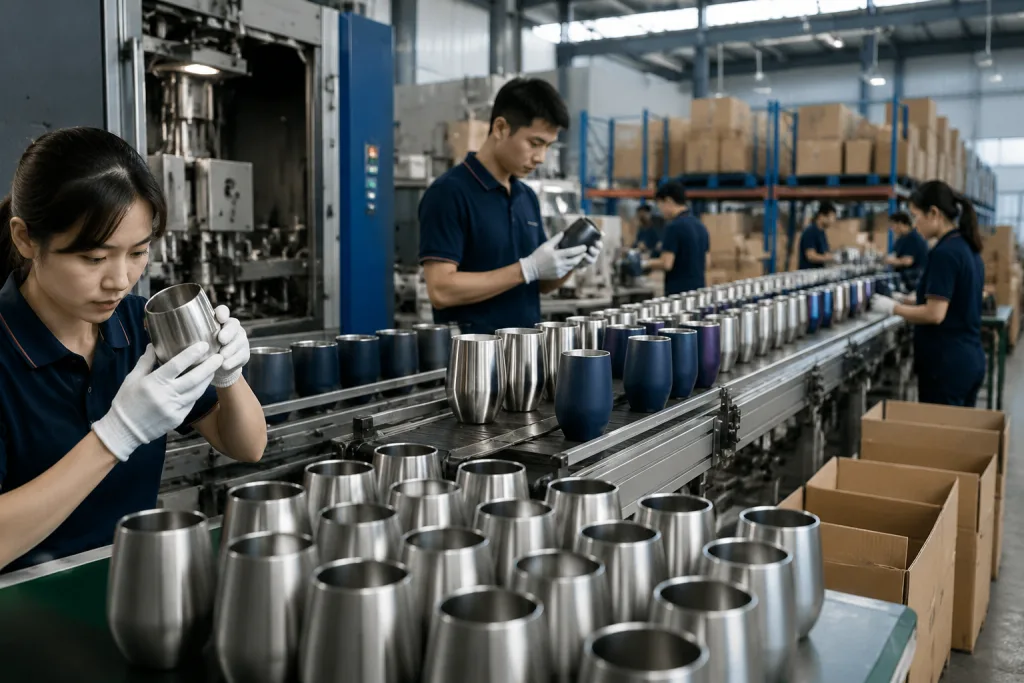
Ask for a video call over the production floor. We run these for new buyers all the time, and the line tells you a lot: polishing wheels at 0.8 mm, weld seams, packing tables, all of it. QC pulled the sample last week and found a logo shift of 1.5 mm. Email never shows that.
Step 3: Customization Options That Last
Your logo on a promotional products wine tumbler has to survive dishwashers, patio events, and the day a buyer drops one on tile. We run that check on the line before bulk packing. Main decoration methods, from the ones that hold up best to the ones that fade first, are below.
Laser Engraving (Best for Longevity)
Laser engraving burns through the coating and leaves the steel exposed, so the mark stays put. On a 2 x 2 inch logo, we usually add $0.50-$1.50 per unit, and QC pulled the sample after 30 wash cycles with no peel and no fade. For higher-end canteen custom orders, this is the cleanest call. The math works.
Silkscreen Printing (Budget Friendly)
Silkscreen adds about $0.15-$0.40 per unit and handles simple art well. The buyer flagged a sample after 60 dishwasher cycles because the edge started to chip, so this is a short-run tool, not a forever finish. If your canteen supplier is using ceramic ink, it bonds better to metal and gives a steadier result. We have seen cheaper ink crack at the rim first.
Pad Printing (For Curved Surfaces)
Pad printing shows up a lot on tapered tumblers and other curved bodies. It runs a bit higher than silkscreen, around $0.30-$0.60 per unit, and the image can still take the same wear if the surface prep is right. Ask for a test print on the actual tumbler curve before production. We've seen this go sideways when the curve is 3 mm off from the sample. Then the logo walks.
For a canteen customizable order, you can combine methods: laser engrave the logo and print a tagline on the bottom. Bring that up early with your canteen distributor, because it changes the line plan and can add 2 to 3 days if the PO has a typo on the placement callout. The buyer pushes for one mockup, then asks for two finishes. That is the wrong question to ask.
Step 4: Pricing and MOQ Breakdown
Price on a promotional products wine tumbler moves with order volume, print method, and pack-out. We run these numbers every week on the line. One Zhejiang canteen job started from the same base cup, then split by decoration and carton spec after the buyer flagged the PO typo on “1,000 pcs” as “1,00 pcs”:
- 500 units: $4.20–$4.80 per unit (FOB Shanghai/Ningbo), with single-color laser engraving and bulk polybag packing.
- 1,000 units: $3.50–$4.00 per unit, with a 10–12 day lead time after sample approval.
- 3,000 units: $2.80–$3.20 per unit, plus $0.30–$0.50 per box for custom color box packaging.
MOQ for a canteen customized design is usually 500 units for a standard tumbler shape. That is the first number we quote, and it is the one that keeps the line honest. If you want a new shape or a molded handle, plan on 3,000–5,000 units and an $800–$2,000 mold fee. A buyer once pushed a 700-piece PO with a molded handle request; the math does not work. Some canteen suppliers will waive the mold fee if the volume is high enough.
Packaging gets pushed aside too often, and that is the wrong question to ask. A printed gift box adds margin and keeps the tumbler from scuffing in transit. Budget $0.20–$0.80 per box based on print and structure. QC pulled the sample on a 1.2 mm tuck flap that split at the corner, so we moved that order to a kraft box with a window. Clean, simple, and it ships better.
Step 5: QC Checklist Before Production
Once the sample is signed off, lock the QC points before the line starts. For promotional products wine tumblers, we run the checks below and do not trust a handshake note. One missed 0.3 mm gap turns into a carton of returns.
- Vacuum insulation test: Fill the tumbler with hot water at 95°C, then check the outside after 30 minutes. It should stay below 45°C. Ask the factory for a phone video from the line, not a cropped photo. We use a surface thermometer, and QC records the reading at the same station every time.
- Leak test: Fill it with water, cap it, shake hard, then leave it upside down for 2 hours. No drips. QC pulled the sample on 10% of the batch under AQL 2.5, and that is the number we ship against. The buyer flagged a slow seep once, and the cartons had to be opened again.
- Logo adhesion: For silkscreen, use a coin scratch test. For laser engraving, check the depth at 0.05–0.1 mm. A buyer once flagged a logo that looked fine at arm’s length but rubbed off after two passes. This is where wishful thinking gets expensive.
- Dimensional check: Measure height, diameter, and wall thickness against the spec sheet. Tolerance at ±0.5 mm is normal. We once caught a PO typo on the diameter, and the buyer tried to blame the mold. Use calipers, not eyeballing.
Ask for a pre-shipment inspection (PSI) from SGS or Bureau Veritas, or have your canteen distributor send a full video of the packed cartons. The bill is usually $200–$400. That is cheap. We have seen 1 in 20 new orders fail a basic QC check, and this is the wrong place to save money. A carton that clears PSI at 12 days is better than a complaint at 18 days.
Step 6: Shipping and Compliance
Your promotional products wine tumbler order usually moves by sea freight out of Ningbo or Shanghai. For 1,000 units packed in individual boxes, we run one pallet at about 1.2m x 0.8m x 1.0m and 150–200 kg. FOB covers loading at the port. The inland truck from our warehouse to the dock adds $100–$300 per container, and the buyer often flags that line item late because the PO left it out. We see that typo a lot. One missing freight line can throw the whole booking.
Compliance is the first gate for Europe and North America. No shortcut. Ask your canteen manufacturer for:
- REACH and RoHS certificates for the stainless steel and coatings for the EU market
- FDA or LFGB testing for food contact materials for the US and EU
- CA Prop 65 compliance if you sell into California
We keep those tests in the job cost, usually $50–$150 per test. A generic PDF is useless; QC pulled the sample once and the lot code on the report did not match the carton mark. The math does not work if you try to pass that off. One wrong code and the file is dead. We run this with a stamp pad on the line and a simple check against the carton label. Some canteen suppliers in Zhejiang bundle the paperwork for first-time buyers, which cuts back-and-forth and keeps the file clean.
For orders under 500 units, air freight can move faster, but it costs 3–5x more. We have seen campaigns go sideways when a buyer planned on air and then tried to switch to sea after the art approval. Sea freight still needs the real timeline. Build around 25–35 days transit, and do not promise a launch before the vessel closes. We ship plenty of these on 40HQ moves, and the buyer pushback always starts when someone tries to save a week after the booking is already locked. A 12-day slip is normal; an 18-day slip is how you miss the promo date.
Step 7: Building a Long-Term Relationship
Your first promotional products wine tumbler order is a test run. If the line ships on time, passes QC at AQL 2.5, and answers emails without drama, we keep that supplier on the short list for repeat work. At 5,000+ units a year, the price ladder changes. That is factory math, not sales talk. We had one PO with “matte black” typed twice and the buyer flagged it before production. Clean paperwork matters.
For repeat campaigns, ask about a stock program. We keep blank tumblers in a 1,000-unit buffer, then add logo work after the PO lands. That trims reorder lead time from 30 days to 10 days on a clean schedule. We had one buyer push back because they wanted fresh mold timing on a stocked SKU. The math doesn't work. Ask what is on the shelf, not what sounds nice.
Send the factory your campaign results. If a wine tumbler with a matte finish sold well at a trade show, tell us the exact color, print area, and where the cup got handled most; we can adjust the coating or change the lid on the next batch. QC pulled one sample with a 0.3 mm print shift last quarter, and that note saved the client from a second miss. We run the same check on the line with a caliper. This feedback loop cuts rework and keeps unit cost moving down.
Ready to Source Your Promotional Wine Tumblers?
Contact our team for a free RFQ template and sample pricing for canteen custom orders from Zhejiang.
Frequently asked questions
What is the minimum order quantity for promotional products wine tumblers?
Most canteen manufacturers in Zhejiang set an MOQ of 500 units per design for standard wine tumblers. If you need a custom mold (unique shape or handle), expect an MOQ of 3,000–5,000 units. Some canteen suppliers offer lower MOQs (200–300 units) for stock designs with standard customization, but the per-unit price will be 15–30% higher.
How long does it take to produce custom canteen drinkware?
For a promotional products wine tumbler order, the typical lead time is 25–40 days from sample approval to shipment. Sample production takes 7–10 days after deposit, and bulk production takes 15–25 days. Sea freight from Ningbo to Los Angeles adds 20–25 days, and to Rotterdam adds 30–35 days. Air freight takes 5–7 days but costs 3–5x more.
What customization method is best for a canteen promotional logo?
Laser engraving is the most durable option for a custom canteen logo—it won't peel, fade, or scratch off. It costs $0.50–$1.50 extra per unit. Silkscreen printing is cheaper ($0.15–$0.40 per unit) but may show wear after 50–100 dishwasher cycles. For a high-end promotional campaign, choose laser engraving; for disposable or short-term giveaways, silkscreen works fine.
How do I ensure the wine tumbler doesn't leak?
Ask your canteen supplier to perform a leak test on 10% of the batch per AQL 2.5 standards. The test involves filling the tumbler with water, capping it, shaking it vigorously, and leaving it upside down for 2 hours. For promotional products wine tumblers, a silicone gasket in the lid is critical—ensure the factory uses food-grade silicone with a Shore A hardness of 50–60 for a good seal.
What certifications do I need for importing canteen drinkware to Europe or North America?
For the EU, you need REACH and RoHS compliance for materials, plus LFGB or EU 1935/2004 for food contact. For the US, FDA compliance is required, and California requires CA Prop 65 testing. A reliable canteen manufacturer will provide these certificates for $50–$150 per test. Always ask for a certificate tied to your specific order batch, not a generic document.