Key Takeaways
- A 500 ml promotional products vacuum flask usually lands at USD 3.80-6.20 FOB at 1,000 pcs, depending on lid and finish.
- For daily retail or field use, 18/8 stainless steel and 0.4-0.5 mm wall thickness are the safe baseline.
- Laser engraving is cleaner for long-term branding; silkscreen is cheaper, often USD 0.12-0.35 per color.
- A Zhejiang thermos factory with 300,000 units/month can support repeat programs, but your lead time is still usually 20-35 days after sample approval.
Most buyers start with a logo and end up with a headache. A promotional products vacuum flask looks simple until you compare steel grade, lid sealing, coating, and whether the thing can survive repeat use in a bag, car, or warehouse. We have seen buyers approve a sample on Monday, then find dents and smudged decoration after one week in transit. That is the wrong question to ask. If you are buying for outdoor retailers or promotional brands, the bad choice shows up fast: dented bodies, weak insulation, blurred print, and returns that chew through margin.
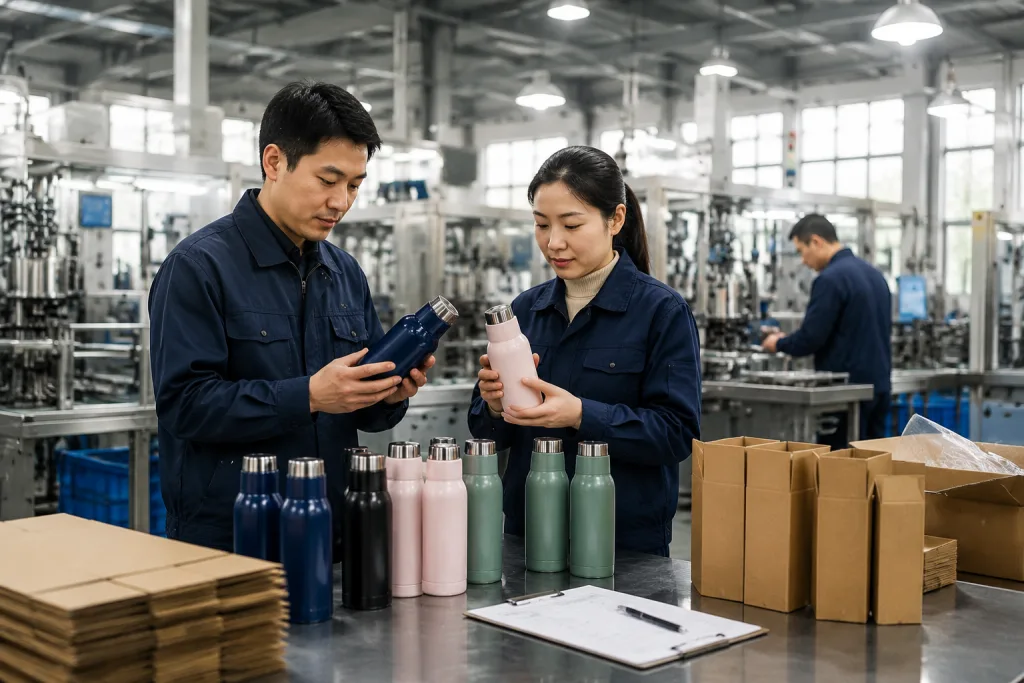
We run thermos export orders from Zhejiang, China, and the pattern is familiar. The models that move are not the fancy ones. They are the ones matched to a real use case, with a clear spec table, a sane MOQ, and a decoration method that fits the budget. A 500 ml custom thermos with 18/8 inner steel, 304 outer steel, 0.4-0.5 mm wall thickness, and a 24-hour thermal claim is the practical starting point. QC pulled the sample on the line at 18 hours and the buyer flagged the lid torque, not the bottle. Anything else needs a reason.
What the spec table should tell you
Buyers burn time on glossy photos when the spec table is where the real decision gets made. If you are sourcing a promotional products vacuum flask, the table should spell out the numbers that move cost, durability, and user experience: steel grade, capacity, insulation time, lid type, coating, decoration area, carton count, and test standard. That is the part that matters. The rest is just dressing.
Use a head-to-head format and keep the criteria practical:
- Steel: 304/18-8 inside and outside for most bulk thermos programs
- Wall thickness: 0.4-0.5 mm for a balanced weight-to-cost ratio
- Vacuum performance: 12-24 hours hot, 24 hours cold depending on structure
- Decoration: laser, silkscreen, UV print, or wrap label
- Compliance: LFGB, REACH, FDA contact expectations, and carton drop testing
A distributor thermos should not be judged on unit price alone. A USD 4.10 factory thermos that passes lid torque, leak, and thermal retention tests can cost less than a USD 3.60 bottle that comes back in batches. The math doesn't work any other way. We run this comparison all the time in Zhejiang, and the factories that keep repeat orders are the ones that can show test records, not just product photos. QC pulled the sample, the buyer flagged a lid leak at 90 degrees, and the line fixed it before the PO moved.
Compare the main thermos types
For promo brands, the choice is not about looks. It is about fit. A straight stainless thermos, a handled flask, and a travel tumbler solve different buying problems. For a thermos promotional item tied to a trade show, a straight-wall bottle is easier to print and usually cheaper. We ship those with a 45 mm pad-print zone and fewer setup headaches. For outdoor retail, the buyer cares more about a grippy body and a lid that survives drops than saving USD 0.20.
Here is the simple use-case fit:
- Office and travel: 450-500 ml vacuum flask, leakproof screw lid, compact profile
- Outdoor retail: 600-750 ml, powder-coated body, wider mouth, durable carry loop
- Corporate giveaway: 350-400 ml, lower FOB, broad logo area, gift box
- Premium merch: double-wall stainless with cup lid or tea infuser insert
A thermos manufacturer in China may put twelve silhouettes on the table, but three or four are worth quoting for most channels. The math does not work on the rest. We run into this on the line when a buyer wants a novelty body and a tight carton count at the same time. QC pulled the sample, checked the 1.2 m drop result, and the odd-shaped body failed fast. If your buyers are distributors or field teams, skip shapes that pack badly and drive damage rates up. A thermos distributor usually needs stackable cartons, 25-40 pcs per master carton, and a decoration zone that stays stable after powder coating. That is the whole game.
Use-case ranking by buyer type
Rank it by the job, not by looks. That is the right question. Outdoor retailers do well with a 500-750 ml insulated stainless thermos, matte powder coat, and laser engraving. Promo brands usually want a 350-500 ml customizable thermos with a wide print panel and gift box. Corporate distributors need the model that cuts complaint risk and keeps cartons intact in transit.
Best for outdoor retail
Use a vacuum flask with a tougher coating, at least 0.45 mm outer steel, and a lid that survives repeated opening on the line. Buyers in this channel check abrasion, grip, and whether the bottle survives a drop from a car seat or trail pack. We ask for a 1.2 meter drop test and a leak test under inverted pressure. QC pulled the sample, and the cap showed a scratch after 12 drops, so we changed the finish. That is plain factory math.
Best for promo programs
If the order is for events, trade shows, or seasonal mailers, price and logo hit rate matter more than long heat retention. A promotional thermos with 1-color silkscreen or laser marking and a basic box usually lands in the USD 3.20-4.80 range at 1,000 pcs. The bottle still has to meet REACH and food-contact requirements. The buyer flagged a PO typo on the print area once, and the carton art had to be redone before we shipped. Cheap does not excuse bad compliance.
Best for repeat distribution
A distributor thermos program needs consistency, not cleverness. Once the lid color, coating, and carton spec are locked, reorder speed matters more than new looks. A factory thermos from Zhejiang with an MOQ of 500-1,000 pcs per model and a 20-35 day lead time after sample approval is usually workable for that channel. We have seen this go sideways when a buyer tried to swap carton inserts after approval; the line stopped for two days. Keep the spec tight.
Decoration changes the economics
Logo method is where buyers often stare at the wrong line item and miss the one that drives repeat orders. A custom thermos only pays back when the mark still reads after 3 months in a laptop bag. For brushed or powder-coated steel, laser engraving is the cleanest option. It costs more than basic silkscreen, but it will not peel. If the brief calls for a bigger, brighter logo on a promotional thermos, silkscreen or UV print gives stronger shelf pop at lower cost. We run this comparison on the line all the time.
Typical decoration tradeoffs:
- Laser engraving: clean, durable, usually USD 0.15-0.45 per unit depending on size
- Silkscreen: best for flat color logos, usually USD 0.12-0.35 per color
- UV print: useful for full-color graphics, but check abrasion resistance
- Wrap label or paper insert: good for campaign messaging, not a substitute for body branding
If you are comparing thermos custom options, ask where the logo sits against the curve. A mark that crosses a shoulder radius can look fine in artwork and ugly on the bottle. We have seen that go sideways. One buyer flagged a PO typo on the logo width, and the jig had to be reset before we could run 5,000 pieces. QC pulled the sample again after 500 units, because coating thickness and fixture pressure had moved the print by 1.2 mm. The right checkpoint is a decoration mockup, not a promise from the sales sheet.
The wrong question is which logo method looks best in isolation. Ask which one survives the line, the carton, and the customer’s desk. On a 304 stainless vacuum flask, a mark that holds for 12 days in transit is not the same as one that still looks sharp after 18 days and a few hard drops. That gap changes the economics fast.
For promotional runs, we usually push buyers to match decoration to the bottle finish first, then to the campaign budget. Powder coat and brushed metal take laser well. Bright campaign art needs silkscreen or UV print, but only if the abrasion test passes. If the buyer wants a wrap label, fine. Just don’t call it body branding.
One more detail from the floor: fixture pressure matters. A 1.2 mm shift is enough to make a logo look off-center once the shoulder starts curving. That is why we check the first 500 units, not after the pallet is full.
Materials and compliance you can audit
For stainless drinkware, material claims need to be plain and provable. The inner liner should be 304 or 18/8 stainless steel. For a premium thermos custom program, 316 on the inner liner is fine only when the margin supports it. We saw one buyer push 316 for a 5,000-piece giveaway run, then the unit cost jumped and the math stopped working. Most promotional products vacuum flask orders do not need it. The outer shell can be 304, or 201 on the outside in a cost-driven program, but make that call on purpose. The line does not forgive a vague PO.
Ask for the papers that matter: material certificates, REACH declaration, LFGB or FDA-relevant contact test support, and a quality plan tied to AQL. A normal visual inspection level for mass drinkware might be AQL 2.5 major and 4.0 minor, but lock your own standard before production starts. If you sell into Europe, check packaging inks and coating claims too. We run this check on a 0.5 mm sample stack before sealing cartons. Zhejiang factories that export every week know the drill, but you still want it in writing. The real gap is usually documentation discipline, not the ability to make the flask.
“The cheapest bottle is the one that passes inspection the first time and reorders without drama.”
That sounds plain, because it is. A thermos supplier that can show steady wall thickness, vacuum sealing records, and salt spray or adhesion test results is worth more than a glossy catalog. If your buyer base includes distributors, ask for carton compression and drop test data too. QC pulled a lid sample once and found a 1.2 mm dent after transit testing; the order looked fine until the warehouse opened the case. A dented lid is a small defect on paper and a margin problem in your stock room.
MOQ, pricing, and lead time
The commercial side usually closes faster than the design side. For a standard promotional products vacuum flask, MOQ starts at 500 pcs for a stock shape with a custom logo, and 1,000 pcs or more for custom lid colors, custom box art, or a special coating. We run this every week on the Zhejiang line. The buyer asks for a “small test qty,” then wants three print positions and a matte finish. The math does not work. The cap press and laser engraver move fast, but a fixture change still takes time, and that shows up right away on the schedule. For a clean order plan, count on sample turnaround in 5-10 days and mass production in 20-35 days after sample approval.
Indicative FOB pricing from China for common sizes:
- 350 ml: USD 3.20-4.40 at 1,000 pcs
- 500 ml: USD 3.80-6.20 at 1,000 pcs
- 750 ml: USD 4.60-7.40 at 1,000 pcs
The gap comes from lid structure, coating, engraving, and packaging. A plain thermos bulk run with one-color logo and kraft box stays near the low end. A custom thermos with gift box, sleeve, and tighter vacuum spec moves up fast. Ask straight whether the quote includes export cartons, inner boxes, and FNSKU or retail barcode labeling if you sell into Amazon or a similar channel. We have seen a PO typo on the barcode line hold a 12-day ship slot. A 15-cent unit difference does not rescue that order.
A factory thermos line in Hangzhou or nearby in Zhejiang usually handles repeat replenishment if you lock the spec. That is the real reason buyers come to China at scale: price only matters when supply stays steady, and QC pulled the sample before we ship a repeat run. If the vacuum drop test shows 12 hours instead of 18 hours, we stop there and fix it. No drama.
How to avoid expensive mistakes
Most stainless flask sourcing problems are self-inflicted. A buyer signs off one sample, then changes the lid, the coating, or a second logo position and still expects the same price and lead time. That is not how a thermos line runs. One lid change can shift vacuum sealing, pad-print setup, packing count, and even carton size.
Watch these failure points:
- Wrong mouth size: affects cleaning, ice loading, and lid compatibility
- Thin steel: looks fine in photos but dents easily in retail handling
- Poor coating adhesion: chips after a week in a commuter bag
- Overcomplicated lid: raises leak risk and spare-part issues
- No pre-production approval: leads to logo placement drift and color mismatch
If you are a thermos distributor, lock the acceptance sheet before PO. Put the logo artwork, Pantone reference, carton markings, and AQL levels on one page. We run into trouble when this is left loose. A factory in China can work fast, but only if the buyer stops moving the goalposts after the 12 mm cap drawing is confirmed. QC pulled the sample, the logo sat 3 mm off center, and that became a rework bill. The math does not work any other way.
For a custom thermos shipment, ask for one sealed pre-production sample, one golden sample for archives, and one master carton sample. Basic discipline. On a recent run, the buyer flagged a PO typo on the carton count, and that would have cost a full reprint if we had missed it.
What a useful spec sheet looks like
A spec sheet for a promotional thermos needs to stay short enough to read and complete enough to quote. If the sheet is vague, the quote comes back vague too. The right sheet lets a manufacturer, supplier, or vendor answer in the first round instead of dragging it through five revisions. We run into this on the line all the time.
Include these lines:
- Capacity: 350 ml, 500 ml, or 750 ml
- Steel: 304/18-8 inner, 304 or 201 outer
- Thickness: 0.4 mm, 0.45 mm, or 0.5 mm
- Decoration: laser, silkscreen, UV, or wrap
- Packaging: white box, gift box, or mailer
- Testing: leak, thermal, drop, coating adhesion, and AQL plan
If you are comparing thermos customized options, note whether you need a tea infuser, handle, cup lid, or car cup compatibility. Those details change tooling and final price. QC pulled a sample with the wrong lid thread before, and the buyer flagged it on day one. That is the wrong question to skip. A serious thermos manufacturer will want that detail up front. The better factories in China prefer clear specs because it cuts trial runs and protects the schedule. For outdoor retailers and promotional brands, that is the difference between a clean seasonal launch and a shipment that lands 12 days late instead of 18.
Request a quote on your thermos spec sheet
Send capacity, logo method, carton count, and target FOB. We will map the right vacuum flask structure, MOQ, and lead time from Zhejiang, China.
Frequently asked questions
What is a realistic MOQ for a promotional products vacuum flask?
For a standard stock shape with a custom logo, MOQ is usually 500 pcs. If you want custom lid color, special coating, or gift box printing, 1,000 pcs is more realistic. In Zhejiang, many factories can sample within 5-10 days and ship bulk in 20-35 days after sample approval. Smaller orders are possible, but unit price climbs quickly. For example, a 500 ml bottle at 500 pcs may be USD 4.60-6.80 FOB, while 1,000 pcs may drop to USD 3.80-6.20 depending on decoration and packaging.
Which is better: laser engraving or silkscreen on a custom thermos?
Laser engraving is better when you want the logo to survive hard use, especially on outdoor retail or field distribution. It usually adds about USD 0.15-0.45 per unit. Silkscreen is cheaper, often USD 0.12-0.35 per color, and gives you stronger visual presence for campaigns. The tradeoff is durability. If the bottle is a true promotional thermos used daily, laser is the safer long-term choice. If it is a short-run event item, silkscreen can be the better commercial decision.
What steel grade should I request for a thermos bulk order?
Ask for 304 or 18/8 stainless steel on the inner liner at minimum. That is the normal baseline for a custom stainless thermos. For the outer shell, 304 is ideal, while 201 can be used in some budget programs if your quality target allows it. A practical wall thickness is 0.4-0.5 mm. Anything thinner can feel light and cheap, and you usually pay for that later in dent rates and complaints. Always request the material certificate, not just the sales claim.
How do I check if a thermos supplier is serious about quality?
Ask for a written quality plan with AQL levels, leak test details, thermal retention data, and coating adhesion test results. A good supplier thermos team should also provide carton packing details and a pre-production sample. If you are selling into Europe, ask about REACH and packaging compliance. In China, serious thermos suppliers can usually show production records and inspection flow without hesitation. If the answer is vague, the factory may still be able to make the product, but you are taking on more risk than necessary.
Can I use one thermos design for both retail and promotional programs?
Yes, but only if you design around the more demanding channel first. For both retail and promo use, a 500 ml insulated stainless thermos with 304 steel, 0.45 mm thickness, and a matte powder coat is a solid middle ground. Keep the logo area wide enough for a clean promotional version and the body durable enough for outdoor retail. That way, you can offer a thermos custom program to brands and a simpler thermos promotional version to event buyers without changing the core mold or packing system.