Key Takeaways
- Most promotional products travel tumbler orders land at 500-3,000 units MOQ, with factory-direct quotes from USD 2.40 to USD 7.80 depending on steel grade, lid, and decoration.
- A basic laser-logo bulk coffee travel mug usually adds 3-5 days to production; full-color wrap print or custom packaging can add 7-12 days.
- For 18/8 stainless steel, 0.4-0.5 mm wall thickness is the normal commercial range; double-wall vacuum models cost more but hold temperature far better.
- A Zhejiang coffee mug factory with 300,000 units/month can usually ship standard bulk coffee mug orders in 25-35 days after sample approval.
You can buy a promotional products travel tumbler at almost any price point, but the low quote usually hides the real cost: print setup, lid choice, packaging, freight, testing, and the 7 extra days you burn when the spec is loose. If you buy coffee gifts or run corporate programs, that is where a simple item turns into a delayed PO and a margin problem. We had one PO last quarter with “mat lid” typed instead of “matte lid”; QC pulled the sample, and the file sat for 7 days.
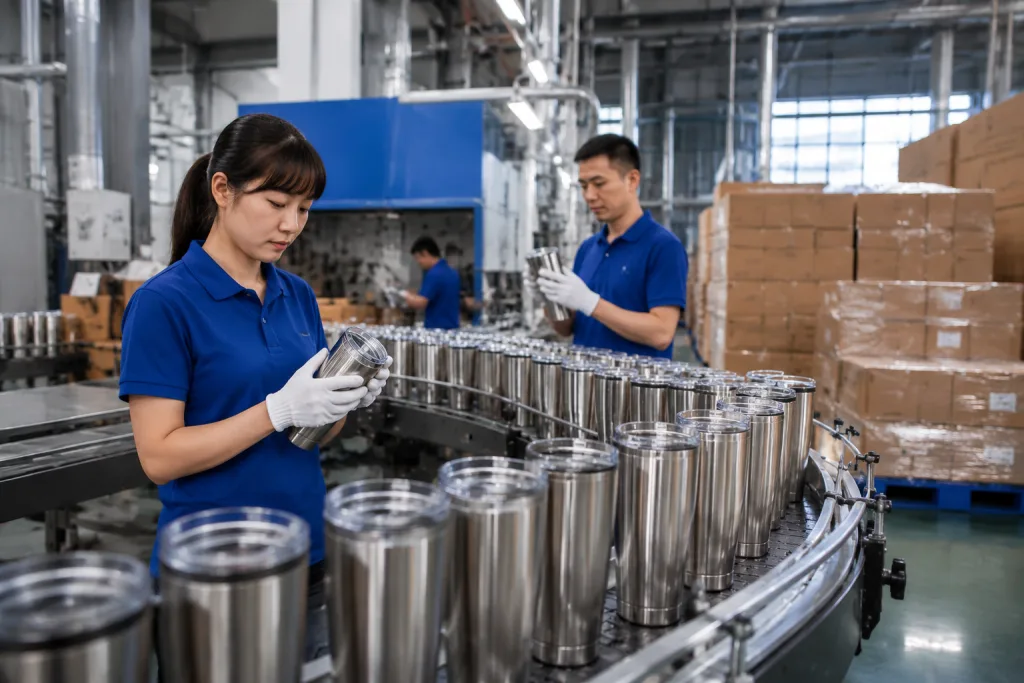
At our Zhejiang factory in China, we see the same thing every season. Buyers ask for a bulk coffee tumbler, then learn that a 300 ml matte cup, a 500 ml stainless steel travel mug, and a powder-coated insulated tumbler sit in different cost bands. The right way to buy is to split the order into material, decoration, MOQ, and lead time. That is what decides whether your bulk travel mug lands on time and leaves room for resale. The line runs that way for a reason; 0.2 mm on the lid fit can shift the whole order, and the math does not work if you ignore it.
What drives the unit price
The first number on a promotional products travel tumbler quote is never the full number. We run the line this way every week. Price moves with body material, lid structure, finish, and decoration method. A straight-wall single-wall PP cup can sit around USD 0.80-1.40 at 1,000 units, while an insulated 304 stainless steel bulk coffee tumbler with a sliding lid and matte powder coat usually lands around USD 3.20-6.50. Change to 316 stainless, add a bamboo lid, or ask for a soft-touch coating, and the quote jumps another 8-25%.
Most buyers spend too much by freezing the spec on day one. That is the wrong question to ask. If the order is a branded giveaway, a simpler bulk travel mug with a one-color logo and stock lid is the cleaner buy. If the plan is retail, the coffee mug customizable details matter more: wall thickness, vacuum performance, lid feel, and whether the finish still holds after 50+ dishwasher cycles. QC pulled the sample on a 0.35 mm wall callout once, and the buyer flagged it because the hand feel changed. We saw a PO typo on "matte" as "mate" and had to stop the plate file. In Zhejiang, the quote moves fast when you ask for custom pantone spray, multi-position printing, or retail-ready gift boxes. The math doesn't work any other way.
- Stock PP or PS travel mug: lower unit price, 7-10 day lead time, one-color print on a basic screen
- 304 stainless insulated tumbler: steady balance for promotion and resale, usually the line we ship most, standard MOQ 1,000 pcs
- 316 stainless or premium finish: higher margin, tighter MOQ control, extra surface process and a thicker box insert
MOQ tiers that make sense
Most buyers ask "what's your MOQ" and treat the answer like a threshold to negotiate down. That's the wrong question. Start with what the decoration actually requires. A stock tumbler with a single-position laser logo? We ship 300–500 pieces routinely. Add custom molding, a Pantone-matched powder coat, and a private-label gift box, and the floor jumps. 500 units is the practical entry point for a simple promotional tumbler. Plan a full private-label line across three colors with mixed lids, and you're at 1,000–3,000 units before the factory even schedules the mold.
Here's the spread we quote when a buyer asks for a ballpark:
- 500 units: stock tumbler body, one logo position, plain brown carton
- 1,000 units: custom print or wrap, minor packaging tweaks, the unit price starts making sense
- 3,000 units: custom color, custom box with UPC sticker, freight per piece drops enough to notice
- 5,000+ units: program pricing. This is where distributors stop asking about MOQ and start talking about quarterly delivery schedules.
Digging through a supplier directory, don't assume every listing can hold the same MOQ. A trading company might quote you 500 pieces and then scramble to place the order at a factory that needs 2,000. A real OEM manufacturer with in-house injection molding and a spray line will tell you straight: this we run here, that we outsource. In Zhejiang, that candor matters. I've had a buyer hand me a spec sheet asking for 500 units with a custom mold — the math doesn't work. A factory that's honest about what it can't do saves you the revision loop, the delayed sample, and the email chain that drags on for two weeks.
Lead time from sample to ship
Lead time is where a bulk coffee mug order stops being a quote and becomes cartons on a pallet. On a normal promotional products travel tumbler job, we run 3-7 days for sample sign-off, 7-12 days for tooling or color matching if the Pantone is off, 15-25 days for production, and 5-12 days for export freight by route. If the cup is stock and the logo is a clean one-color mark, ship in 20-25 days. If the buyer wants new lid parts or retail packaging, plan on 30-45 days. The line does not bend for bad artwork.
For planning, we split it like this. Simple. Fast. Clear. QC pulled the sample on a 500 ml tumbler with a 1.2 mm lid wall, and that one measurement told us the tooling was fine.
Stock cup + laser logo: 12-18 days after deposit and artwork approval
Custom print + custom box: 20-30 days
New mold or special lid: 35-50 days
A factory in China with stable lines and around 300,000 units/month can hold those dates, but only if the buyer keeps moving. We had one PO with the lid code typed wrong, and that cost two days before the first test run. That is the wrong question to ask: lead time is usually lost on the buyer side, not on the molding machine. We have seen it go sideways on slow logo approval, missing FNSKU labels for Amazon, or a box insert change after sampling. One client changed the insert three times. The math does not work. For a campaign date, work backward from delivery, not from the PO date. Sea freight to North America still takes 20-35 days after it leaves Ningbo or Shanghai. We ship six days a week, and clean files move faster than phone calls.
Decoration changes the economics
Decoration is not a cosmetic detail. It changes yield, scrap rate, and packout time on the line. Laser engraving is usually the cleanest route for a bulk travel mug because the mark is stable and the cycle is short. We ship a simple logo at about USD 0.12-0.35 per unit, and that number moves with logo size and laser time. Silkscreen can come in a bit lower on a flat wall, but once the body curves, the edge quality drops and QC pulls more rejects. A four-color wrap print or full-surface UV print adds setup, and the math gets ugly fast on high-gloss cups.
If your buyer asks for coffee mug customizable branding, push them to choose by use case. That is the right question. For corporate gifts, a single-position laser logo on a matte 18/8 stainless body looks clean, and a 0.2 mm shift in logo placement is enough for the buyer to flag it. For coffee mug promotional products in retail or subscription bundles, full-color print can earn its keep, even with an extra USD 0.25-0.80 per unit. If the tumbler will move through e-commerce, we run an abrasion check in transit cartons, then test logo adhesion, surface rub resistance, and dishwasher exposure. ISO-style discipline matters here, even if the buyer never reads the report. Decoration should protect margin, not chew it up.
Materials and build quality
Buyers ask for the cheapest bulk coffee travel mug, then the line shows the result: a shell that feels tinny, sweats on the sleeve, and picks up dents before it reaches the warehouse. That is a spec mistake. For insulated models, 18/8 stainless steel is the normal commercial grade. We run 0.4-0.5 mm on the inner and outer shells. Go below that and rigidity drops fast; push thicker and you add cost and weight with no payoff. For lids, PP is standard, Tritan sits one step up, and silicone seals need the right compression or they start weeping after 3 heat cycles. QC pulled the sample and measured the gasket seat at 1.2 mm; the buyer flagged it when the lid snapped shut too loose.
For import programs into the US and Europe, ask for REACH-compliant inks and materials, and keep food-contact declarations on file. Some buyers ask for ASTM-style impact or thermal language in the spec sheet. Fine, but this is the wrong question to ask if the carton fails first. If the tumbler is a coffee mug private labeling program, the box matters. A weak inner box turns a clean unit into a damage claim. We have seen it go sideways on a 3-layer export carton with a crushed corner after a 1.2 m drop test. A proper coffee mug factory should give drop-test guidance, leak testing, and vacuum retention checks. For coffee mug in bulk, the gap between a decent tumbler and a return-heavy one is often 0.1 mm of steel and a gasket that seals at the right load.
Packaging and freight costs
Packaging moves landed cost fast. We see it on the packing table every week. A plain polybag and egg-crate carton usually adds USD 0.08-0.18 per unit. A printed color box with inserts, barcode labels, and carton marks can add USD 0.35-1.20 per unit. For Amazon or distributor routes, you may also need FNSKU labels, master carton marks, and drop-test-ready packs. That is not overengineering. It is the cost of keeping claims and chargebacks off your desk.
Freight needs its own sheet. A buyer once pushed back on our FOB quote for 2,000 insulated tumblers, then compared it with delivered cost and the math changed fast. Sea freight is usually the better move above 1,000 units; air freight only works for urgent replenishment or a small high-margin run. We ship from Zhejiang with the carton count, gross weight, and CBM on the same quote, because one typo on a PO can swing the freight bill by a few hundred dollars. If packaging adds 15% to product cost but cuts claims by 50%, take the packaging. Cheap cartons break. We have seen that go sideways too many times.
How to brief the factory
A clean brief saves time. We see it on the line every week. If you send a coffee mug custom made request with only a logo file and no dimensions, QC has to guess the wall thickness and lid fit, and that guess burns 3 to 5 days. Give the supplier the body size, target capacity, lid style, finish, and whether the order is retail, gift, or promotional. State your target price band too. A coffee mug promotional order under USD 3.00 does not carry the same build as a USD 6.50 retail tumbler. The buyer flagged one PO with a typo: 20 oz became 200 oz. The math does not work. If you are comparing coffee mug manufacturers, send the same spec sheet to each one so the quotes line up.
A useful RFQ should include:
- Capacity: 12 oz, 16 oz, 20 oz, or 24 oz
- Material: 304 or 316 stainless, or PP for non-insulated
- Logo method: laser, silkscreen, UV print, or wrap print
- Packaging: bulk pack, printed box, or gift box
- Incoterms: FOB Ningbo, FOB Shanghai, or DDP if needed
If you work with a coffee mug supplier directory, filter for factories that show process depth, not just product photos. We run a 0.2 mm gauge check on sample cups before quote lock. Zhejiang has a lot of factories. The real split is simple: can they hold samples, pass AQL 2.5 inspection, and repeat the same result on the next 10,000 units without three middlemen changing the story? We've seen that go sideways. That is what coffee mug factory direct sourcing is supposed to solve.
Which buyer profile fits which tumbler
Not every promotional products travel tumbler gets bought the same way. A seasonal coffee brand usually wants a bulk coffee tumbler with strong decoration and retail packaging; we ran a 24,000-piece order last month, and the buyer flagged the lid art before the line started. Corporate-gift buyers usually take a midweight insulated bulk travel mug, a clean logo, and a lid that closes without drama. Distributors need the math to work: MOQ, repeatability, and price staying flat over 2 or 3 reorder cycles.
For quick sorting, use this ranking:
- Best for corporate gifts: 16 oz insulated tumbler, laser logo, gift box
- Best for retail bundles: 20 oz powder-coated tumbler, full-color box, barcode ready
- Best for price-led campaigns: stock body, one-color print, bulk pack
- Best for repeat programs: same mold, same lid, reorder-friendly packaging
The wrong buy tries to cover every channel at once. A coffee mug custom made for gifts can land 18% over budget for mass promo, and a stripped-down bulk coffee mug can look cheap next to a premium shelf set. We saw this go sideways on a 1,200-unit PO with a typo in the carton count. A good coffee mug manufacturer in China will say that out loud. That is the right kind of pushback from Zhejiang.
Request a factory-direct tumbler quote today
Send your target price, quantity, and artwork. We’ll map the right spec, MOQ, and lead time before you waste a week on bad assumptions.
Frequently asked questions
What is a realistic price for a promotional products travel tumbler?
For a normal 16 oz or 20 oz promotional products travel tumbler, expect USD 2.40-4.20 for stock insulated models at 1,000 units, and USD 4.50-7.80 for premium finishes or custom packaging. Single-wall non-insulated cups can start near USD 0.80-1.40. Laser engraving usually adds USD 0.12-0.35 per unit. Freight, labels, and cartons are extra, so always ask for FOB China and landed cost separately.
How low can the MOQ go for custom travel tumbler orders?
A simple logo on a stock tumbler can often start at 300-500 units. Once you ask for custom color, printed box, or private-label packaging, 1,000 units is the more practical floor. For a true coffee mug private label program, 3,000 units is usually where pricing becomes stable. Smaller orders are possible, but the per-unit cost rises quickly because setup and inspection are spread across fewer pieces.
How long does production usually take in China?
For a standard bulk coffee travel mug, plan on 20-35 days after sample approval and deposit. If the order uses a stock body and simple laser logo, 12-18 days is possible. Custom color, custom box, or a new lid can push the lead time to 35-50 days. Add 5-12 days for air or express freight, or 20-35 days by sea depending on destination and port congestion.
What should I ask a coffee mug factory before placing the order?
Ask for material grade, wall thickness, lid material, leak test method, logo process, carton count, gross weight, and whether they can support AQL 2.5 inspection. If you are buying coffee mug factory direct, also ask for samples, REACH or food-contact declarations, and whether the factory is BSCI audited. A proper supplier should give you a spec sheet that matches the quote line by line.
Is laser engraving better than printing for bulk coffee tumbler orders?
For most business buyers, yes. Laser engraving is durable, clean, and less likely to fade after handling. It usually costs about USD 0.12-0.35 per unit and works well on stainless steel. Printing is better when you need strong brand color or a full-wrap design, but it carries higher setup risk and can add USD 0.20-0.80 per unit depending on complexity. For promotional products, laser is often the safer commercial choice.