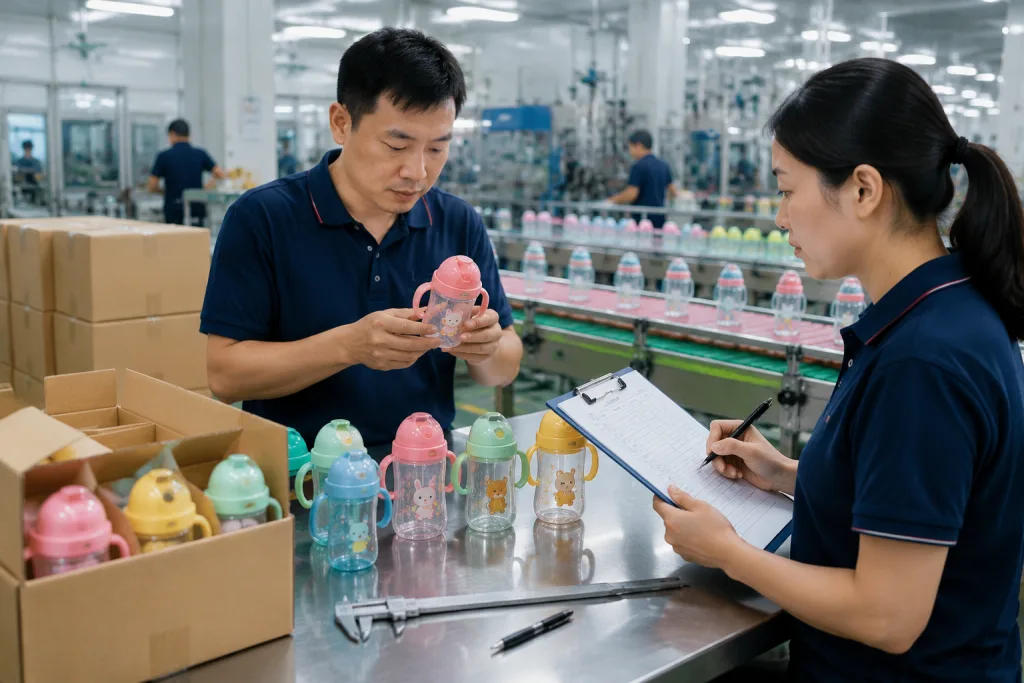
Key Takeaways
- A toddler bottle order can fail at 6 points: lid seal, straw path, print, carton pack-out, compliance, and drop testing.
- For promotion use, ask for BPA-free PP, food-contact silicone, and AQL 2.5 for critical defects, not just a nice mockup.
- Expect MOQ around 3,000 pcs and 25-35 days lead time from a canteen factory in Zhejiang or broader China.
- If you need custom logo durability, specify 500-cycle dishwasher resistance or use laser or molded branding instead of soft ink.
Source a promotional products toddler bottle — the cute shape is the easy part. The real problem is stopping the failures that turn a 5,000-unit order into 800 complaints: lids that leak in transit, straws that hold milk film, print that lifts after two washes, carton counts off by 12 pieces, and materials that fail on arrival in Europe or North America. We have seen it on the line. Weak specs cause it.
We build custom drinkware in Zhejiang, China, and the pattern is plain. Buyers send a visual brief, QC pulls the sample, then production starts chasing one issue after another. That burns time. This is the wrong question to ask: where can the bottle look nice? Ask where it can fail instead, at cap torque, seal geometry, drop resistance, decoration method, and paperwork. If you are a canteen distributor, canteen supplier, or promotional buyer, the same discipline applies whether the order is a custom canteen, customized drinkware, or a toddler bottle with a logo. We run 300,000 units a month, MOQ is usually 3,000 pieces, and lead time is 25-35 days after sample approval.
Where toddler bottles fail first
The first failures are boring, so buyers miss them. A toddler promo bottle usually gives up at the lid, the straw valve, or the neck finish. Make the seal groove 0.3 mm too shallow and seepage starts by wash five. Make the straw too soft and a kid chews it flat; flow drops to a dribble. Thread pitch drift is just as bad. The cap torques fine on day one, then cross-threads by week two. We had a 5,000-unit run in Hangzhou bounce at AQL 2.5 because the groove tolerance moved to +0.4 mm. QC pulled the sample, and the buyer flagged it at inspection, not from a product photo.
Do not approve a sample because it looks clean on camera. Run 20 pieces through the real checks: inverted leak for 30 minutes, side-drop from 1 meter, and 3,000 lid open/close cycles. That is where a canteen customized program earns its margin. A usable spec sheet calls out PP body wall thickness at 1.8–2.2 mm, the silicone grade, and the torque window in N·m. We run that on the line, and we have seen the math go sideways when a PO typo changes the neck finish code by one digit. The line supervisor in Zhejiang put it bluntly: “The spec sheet is either a contract or a suggestion.”
What to specify
- Leak test: 100% on finished assembly, 30 minutes inverted
- Drop test: 1 meter, 6 faces, no cap split
- Cycle test: 3,000 openings minimum
- Seal tolerance: +/- 0.2 mm on critical grooves
Material choices that age badly
Material choice is where promotional toddler bottle orders go sideways. We see it on the line every month. A toddler bottle is not a grown-up tumbler. It needs impact resistance, low odor, and parts that stay flat after hot washing at 90 C. The usual stack is a Tritan body, PP cap, and food-grade silicone seals. For a tight MOQ, I would take a plain PP bottle before chasing a fancy look, because the mold runs cleaner and the buyer can replace a lost unit without a headache. A custom growler style has no place here unless you are pushing the same press into adult drinkware. We ship enough of these to know the math does not work.
Do not let a supplier sell brittle resin just because the wall looks clearer. Clarity is the wrong question to ask if the shell stress-whitens after three drops from a stroller tray. We had a buyer flag a sample for that exact problem, and QC pulled the same part with a caliper at 1.8 mm wall thickness; it still cracked on impact. Ask for REACH and LFGB support for Europe, and FDA food-contact compliance for North America. If you buy from a canteen manufacturer or canteen factory in China, ask for resin traceability by lot number. That is how you keep a bad PP masterbatch from turning into odor, haze, and a headache on a 20,000-piece PO. We have seen this go sideways on a 12-day line slot and an 18-day rework.
Practical rule: if the bottle cannot survive 10 controlled drops in QC without cosmetic failure, it will not survive a month in a family bag.
Decoration that survives real use
Decoration is where a lot of promotional products toddler bottle orders start looking cheap after 2 weeks. We run this every season. The line looks fine at packing, then the buyer flags a lid after dishwasher testing. Screen print only works when the ink matches the resin and the cure is right. On PP, the wrong ink flakes fast. On Tritan, adhesion is the fight, not color. Put the decoration method in the PO. A mockup does not hold up when QC pulled the sample and found the logo lifting at the edge.
For plastic toddler bottles, pad print, heat transfer, or in-mold decoration are the usual calls. Laser engraving is better on stainless parts, but that is not the main body here. This is the wrong question to ask: “Can you print it?” The real question is whether it survives use. Ask for 500 dry rub cycles and 100 wet rub cycles before approval. We saw a buyer reject a 1,200-piece run after the first carton because the logo shifted 2 mm off-center. For a distributor program with 6 or 8 SKUs, keep the print zone fixed so the same art moves across canteen distributor assortments without a redraw. The math works only when the setup stays simple.
- Best for low MOQ: pad print
- Best for durability on metal: laser
- Best for premium plastic branding: in-mold or molded logo
Compliance is not paperwork fluff
Compliance is where weak buyers lose 2 to 3 weeks. We ship toddler bottle jobs for Europe against REACH, food-contact migration limits, and packaging rules; if the straw, valve, or valve cover is off, the test set is wrong before QC even starts. Last month the buyer flagged a one-page declaration on a 300 ml run, and he was right. That paper did not match the resin, the cap, or the line build.
In Zhejiang, a factory can make a clean-looking bottle and still fail on documents. We run into this on the line. Ask for test reports tied to the exact SKU, not a factory certificate from 2022 with the wrong color code. ISO 9001 on the factory side is standard; BSCI matters if your retailer asks for it; and the report should match the lot we pulled from the packing bench, not a sample from another mold. The math does not work when someone says, “the bottle looks fine.” Looks do not pass customs. QC pulled the sample at the bench, and the paperwork still missed the mark.
Paper you should ask for
- REACH or SVHC statement for EU-bound orders
- Food-contact test report for the exact resin and colorant
- Factory quality certificate, ideally ISO 9001
- BSCI or equivalent audit if your retail channel requires it
MOQ, pricing, and factory math
Pricing for promotional products toddler bottle runs is simple only after you stop treating every quote like the same job. A 3,000-piece order with a one-color logo, PP body, and basic color box will not price like a 10,000-piece run with custom tooling and premium packaging. We ran a 3,200-piece batch last month, and the buyer flagged a missing artwork note on the PO before QC pulled the sample. On a clean China FOB build, you will usually see USD 1.20-2.10 per piece, depending on material, lid structure, and print method. Add custom packaging, and USD 0.15-0.45 each disappears fast. The math does not move in your favor. A 3-cavity lid mold can look cheap on paper and still eat margin if the carton spec changes mid-run.
What matters is whether the factory can hold the run. A canteen factory in Zhejiang with 300,000 monthly capacity can run several styles, but the line still needs mold time and print time booked ahead. Ask for the production schedule and the machine hours behind it. That is the real question. If you are a canteen distributor or distributor growler buyer who cross-buys into kids’ drinkware, ask how they handle split shipments, because one promo campaign can need three warehouse drops. We ship that way all the time, and the difference between 2 pallets and 12 pallets is usually the carton count, not the bottle itself. We have seen buyers push for a 15-day promise on a 5,000-piece MOQ; the line will not fake that.
Typical sample lead time is 7-10 days if no new mold is needed. New tooling can add 20-35 days before mass production. We once saw a PP lid sample slip because the drawing called for 38 mm and the buyer wanted 36 mm after approval; that kind of typo burns a week. That is the real clock, not the date on the first quote. A caliper on the sample bench catches that in 2 minutes, which is why we always check the neck finish before we talk delivery.
Packaging breaks more orders than the bottle
Packaging breaks more orders than the bottle. We shipped one 38 mm lid that passed, then the carton corner split on the line and the buyer still called it a defect. For a promotional products toddler bottle, I write the pack spec as 1-piece or 2-piece inner pack, then add the drop-test target, carton count, inner bag thickness, and whether we ship assembled or in parts. QC pulled one sample where the PP sleeve was 0.03 mm too thin, and that tiny miss turned into a loose rattle. The math does not work if the assembly step lives in somebody's head.
For e-commerce and Amazon-type distribution, carton labels need to be exact, especially when FNSKU stickers sit in the flow. For retail and giveaway programs, a kraft box and barcode can be enough. We tell the buyer about compression risk upfront: a thin outer carton on a 40-foot ocean run from China gets crushed, and a crushed box drives returns even when the bottle is clean. We had one PO with a typo on the carton mark, and the buyer flagged it before production; that saved a reprint. Packaging is part of the product. Not an extra.
- Specify carton strength, not just size
- Require inner bag or sleeve thickness
- Confirm assembled vs flat-packed shipment
How to brief the factory cleanly
The fastest way to get a usable custom canteen or toddler bottle quote is a narrow brief. Start with age band, capacity, material, decoration method, target compliance market, and pack-out. Do not ask the canteen vendor to read a sketch and guess the lid style. We had one buyer send a PO with "300-400ml" typed as "300-4000ml" and the line caught it before quote release. If you want a canteen customizable SKU for promotion, give the factory the minimum spec: 300-400 ml capacity, BPA-free resin, leakproof lid, one-color logo, and carton requirement. Clean input cuts sample loops and keeps the quote honest.
For China sourcing, I ask buyers to request three things in the first round: a technical drawing, a costed BOM, and one physical sample or pre-production sample. That is enough to expose most weak points. We run into this every week: QC pulled a sample at 18.2 mm wall thickness when the drawing called for 1.8 mm, and the buyer flagged it fast. If the supplier is a serious canteen manufacturer or canteen supplier, they will talk about mold split lines, gate marks, and color masterbatch tolerance without hand waving. If they dodge those points, trouble is already in the carton. This is the wrong question to ask: "Can you make it?" The better question is, "What exact spec are you quoting against?"
Good briefs make average factories look better. Bad briefs make good factories waste your time.
Send your bottle spec for a real quote
We’ll check mold fit, compliance, packing, and print risk before production starts. That saves time, scrap, and a lot of back-and-forth.
Frequently asked questions
What MOQ should I expect for a promotional products toddler bottle?
For a standard promotional products toddler bottle, MOQ is usually 3,000 pieces per color or per artwork set. If you need a new mold, some canteen manufacturers in China will ask for 5,000-10,000 pieces to justify tooling. For simpler stock tooling, 1,000-2,000 pieces is possible, but unit price rises fast. A normal sample lead time is 7-10 days, and mass production is often 25-35 days after approval. If you need mixed colors, confirm whether the MOQ is by color or by total order, because that changes pricing and inventory risk.
Which material is safest for toddler use?
For most promotional drinkware programs, PP with food-grade silicone is the practical choice for a toddler bottle. It is light, impact-resistant, and easier to keep cost-controlled. Tritan is a stronger premium option if you want more clarity and better scratch resistance, but it usually costs more. Whatever you choose, ask for BPA-free confirmation, food-contact documentation, and material traceability by lot. If the product is going to Europe, request REACH-related support. For North America, make sure the exact resin and colorant combination is covered by the test paperwork, not just the factory in general.
How do I stop logo wear on plastic bottles?
Use the right decoration method for the substrate and the use case. On plastic toddler bottles, pad print is common, but you should specify ink adhesion and rub resistance in writing. Ask for at least 500 dry rub cycles and 100 wet rub cycles during approval. If the logo must last through repeated washing, a molded logo or in-mold decoration is more reliable than soft surface ink. For stainless parts, laser engraving is usually the better answer. The point is to match the logo method to the material, not the other way around.
Can I combine toddler bottles with canteen or growler orders?
Yes, if the factory has a broad custom drinkware line. Many canteen suppliers in Zhejiang produce both custom canteen and bottle programs, and some also handle custom growler or distributor growler items on similar molding and printing equipment. That said, you should not assume one QC standard fits all. A toddler bottle needs stricter leak testing and small-part checks, while a growler needs different closure and thermal specs. Combining SKUs can help on shipping and artwork setup, but keep the technical spec separate for each product.
What QC standard should I ask for before shipment?
Ask for AQL inspection, usually AQL 2.5 for major defects and 4.0 for minor defects, plus 100% leak testing on assembled units. For promotional products toddler bottle programs, I also recommend a drop test, cycle test on the lid, and carton drop test if you are shipping long distance. If you are working with a canteen factory or canteen distributor in China, ask for a pre-shipment report with photos, defect counts, and carton labels. The factory should be able to show the exact lot and production date for traceability.