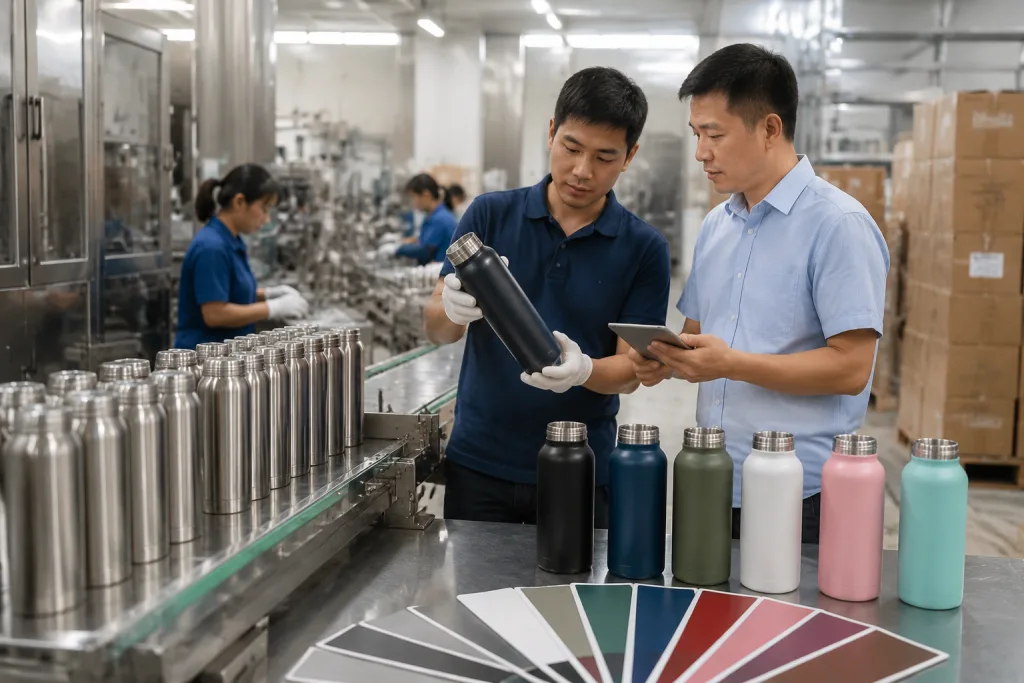
Key Takeaways
- Most promotional products thermos orders start at 500-1,000 units MOQ, with 18-35 day lead times after sample approval.
- A 304 stainless body is standard for a bulk thermos; 316 is worth asking for when the use case is salty, acidic, or premium.
- Laser logo, silkscreen, and heat-transfer change cost by about USD 0.08-0.60 per unit depending on area and color count.
- A factory in Zhejiang can usually quote FOB China faster if you send capacity, packaging, and FNSKU details up front.
If you are buying a promotional products thermos for outdoor retail or a branded giveaway program, the hard part is not finding a bottle. The hard part is getting the stainless build, finish, print method, and freight terms right before you pay for mistakes the RFQ should have caught. A 500 ml vacuum flask can look fine in a sample photo and still fail on lid torque, condensation, or logo wear when you place 5,000 units.
We build drinkware in Zhejiang, China, and the buying pattern stays the same every season: a buyer sends the logo mockup, then wall thickness, 304 versus 316, and packing spec set the landed cost. QC pulled one sample at 1.2 mm, and the cap still backed off after the drop test. Clean sample. Bad run. That is the wrong question to ask. The line has to repeat it at your MOQ, not just the sample room once, and we have seen that go sideways on a 20,000-piece PO with a typo on the carton mark.
Start with the use case
Before you ask for a quote, pin down how the promotional products thermos will be used. A trekking buyer cares about heat retention and a lid with a solid grip; a trade-show giveaway lives or dies on packed weight and carton count. We ran one 750 ml sample through a 1.2 m rub test, and the logo scuffed. The buyer flagged it the same day. Skip this step and the RFQ turns muddy fast.
Write the job in one sentence: daily commute, camping, team gifts, club merch, or distributor thermos stock for resale. Then lock three basics: capacity, finish, and closure style. Common capacities are 350 ml, 500 ml, 750 ml, and 1,000 ml. For a custom thermos line, 500 ml is usually the safest middle ground. We ship it often. It packs clean, sits well in a carton, and the line keeps moving.
What to define in the first RFQ
- Capacity in ml or oz
- Body material: 304 or 316 stainless steel
- Lid style: screw cap, flip cap, cup lid, or handle cap
- Target decoration: laser, silkscreen, UV print, or wrap
- Packaging: white box, color box, or gift set
A tight brief saves time. We had one buyer send a PO with “500ml” in the body and “550 ml” in the note field; QC pulled the sample, and that typo burned two extra days. A factory thermos quote with those five points is enough to move straight to sample order without three rounds of email ping-pong. This is the right question to ask. The math does not work on a cheap quote that ignores line setup, carton count, and print loss.
Build the RFQ like a buyer
A serious RFQ is not a one-line email. It should read like a draft purchase order. Send the thermos manufacturer the quantity by SKU, target FOB port, logo area, and whether you need retail-ready cartons. We run this split on the line every week. If you are comparing thermos manufacturers, use the same RFQ structure for all of them. The math does not work any other way.
For promotional thermos sourcing, these are the line items that matter:
- Product name and capacity
- Stainless grade and wall construction
- Lid type and gasket material
- Logo method and size in mm
- Inner box, master carton, and carton quantity
- Testing requirement: LFGB, FDA, REACH, or ASTM-related checks
- Incoterm: FOB Ningbo, FOB Shanghai, or DDP if your supplier offers it cleanly
A proper thermos quote should split tooling, sample charge, and unit price. QC pulled the sample on a molded lid job last month, and the buyer flagged a 2 mm logo gap that never showed up in the email. A special handle or lid usually adds USD 300-1,500 in tooling. Standard sample charges sit around USD 30-120, and they are refundable on bulk if the order is big enough. If a thermos supplier hides all of that in one number, the quote is not ready for procurement.
For outdoor retailers, ask for drop-test and cycle-test language. For promotional brands, ask for print durability and color match. Same product, different failure. One side gets dinged in transit; the other side gets a logo that rubs off after 200 washes. We ship to Europe and North America every week, and the buyer usually cares more about the test line than the sales pitch.
Choose the right stainless spec
The steel spec drives more than corrosion resistance. It changes weight, price, draw quality, and how the bottle sits in the hand. For most bulk thermos programs, 304 stainless steel is the default. We run 304 on the line because it stays stable, is food-safe when sourced right, and keeps scrap under control. 316 is the better call for acidic drinks, salty contents, or a buyer pushing a premium position. The wrong spec shows up fast in QC. We’ve seen that go sideways in 2 rounds, and nobody wants a rework after the first carton sample.
Do not skimp on thickness. A common outer shell is 0.4-0.5 mm stainless, with the inner liner at 0.35-0.45 mm depending on the build. One buyer flagged a PO typo that pushed the liner to 0.25 mm, and the sample felt tinny in hand. The math does not work. Thin walls dent faster and drag down perceived value, while vacuum performance matters more than a glossy finish for outdoor use. The line can fake shine; it cannot fake insulation. We check with a micrometer, and if the reading slips, the batch stops.
Ask for the following in writing:
- Inner and outer stainless grade
- Wall thickness in mm
- Vacuum seal method
- Retention target, such as 6 hours hot and 12 hours cold, or 12 hours hot and 24 hours cold
Those numbers need test records, not brochure language. A solid thermos factory can show lab sheets or internal records under ISO-style procedures, and QC pulled the sample before we shipped it when the retention claim looked weak. For the EU market, ask for REACH, then check whether the supplier can support LFGB or FDA requests. Buyers skip that step and then chase paperwork later; that is the wrong question to ask. In Zhejiang, better manufacturer thermos teams will show you the cost split, down to the 18/8 coil and the MOQ break on each spec.
Sample before you argue price
Do not argue unit price before the sample is in your hand. We have seen first-time buyers waste 5 to 7 days on that mistake. The sample shows whether the lid sits square, whether powder coat chips at the bottle neck, whether the straw or spout seals, and whether the logo stays sharp on curved stainless. It also gives you the real size. A 500 ml bottle can feel tight or bulky once we measure shoulder and base diameter with a caliper.
For a promotional thermos run, ask for two sample stages: a blank stock sample and a decorated pre-production sample. On our line, a stock sample usually takes 7-12 days if the mold is already there. New tooling or a new cap pushes that to 15-25 days. Sample charges often land around USD 30-120 per SKU, plus courier cost. That is the math. One buyer pushed back on a USD 42 sample fee, then came back after QC pulled a lid with a 1.5 mm gap.
Judge the sample like a retailer would, not like a designer would. If the lid squeaks, the print is off-center, or the base rocks on a flat table, bulk production will not fix it.
Use a check sheet the moment the carton opens: sealing, insulation claim, finish uniformity, logo alignment, carton strength, and any smell in the packaging. For distributor thermos programs, add barcode placement and pallet count. If you sell on marketplaces, confirm the case pack supports FNSKU or Amazon-style labels without hiding the logo. A sample sign-off that ignores packaging is not a real sign-off. We have seen this go sideways after a PO typo moved the carton qty from 24 to 42.
Price the bulk order honestly
A 500 ml 304 stainless vacuum bottle with one-color logo sits around USD 3.20–4.80 FOB at 1,000 units. Push to 5,000 units, the unit price drops 12–20%. Lid structure and finish swing the number more than most buyers expect. Last week QC pulled a sample with a 0.3 mm print shift—barely visible—but the buyer flagged the cap assembly as the actual cost driver. The print was fine. The cap had a silicone gasket change from the previous order that nobody caught. That's a USD 0.18 difference right there.
Every bulk quote should break into five line items:
- Unit price by tier
- Logo charge per color or per location
- Tooling or mold cost
- Packaging upgrade cost
- Inspection fee if you use third-party QA
Don't let the lowest quote win by default. A USD 0.25 gap disappears the moment you spec heavier cartons, tighten AQL, or require export-ready packaging. Ask for EXW and FOB side by side. That split shows factory margin versus shipping exposure. For Europe and North America, FOB Ningbo or FOB Shanghai is the cleaner starting point. One PO typo we catch constantly: carton size written as 45 × 45 × 35 cm while the line actually runs 44 × 44 × 33 cm. The freight math falls apart if that's wrong. We've had a container re-quoted over a 3 cm error.
Distributor buyers should push on repeat orders, not just the first run. A Zhejiang factory running steady monthly output can sharpen pricing after the initial 5,000 units—as long as the body, lid, and carton stay unchanged. We run tens of thousands of units a month. Repeat specs beat pretty quote sheets. That's where the margin lives. We shipped one program at 12 days on the reorder versus 18 days on the first run. The carton and insert were already locked. No tooling tweaks, no sampling round. Just production.
Print logos that survive handling
Decoration is where promotional thermos projects look easy and then become annoying. A logo that looks fine on a render can fail when applied to curved powder-coated steel. For a straightforward promotional products thermos, laser engraving is the most durable option. It is clean, precise, and usually costs less over time because it does not fade. We run laser on most standard 304 steel bodies and it holds up through 500 wipe cycles in our abrasion test. Silkscreen is better when you need a solid spot color and a larger imprint area. Heat transfer or UV print works when the artwork is complex, but it must be tested for abrasion. QC pulled a sample last month where the UV print peeled at the rim curve — the buyer flagged it before we shipped.
Ask your supplier to quote by logo size and print color count. A small laser mark may add only USD 0.08-0.20 per unit. A multi-color silkscreen or wrap can add USD 0.25-0.60, sometimes more if registration is tight. For a custom logo on a promotional thermos, request a decorated sample on the exact production finish, not on a random blank body. We've seen this go sideways when a buyer approved a logo on a smooth painted sample, then the powder coat made the dots appear fuzzy at 1.5mm line width.
Practical decoration rule
If the bottle will be handled daily, choose the finish that survives wiping, not the one that photographs best. That is why many manufacturers thermos projects default to laser on powder coat and silkscreen on smooth paint. The math is simple: a logo you can't wipe clean is a logo that fails after 12 days of field use.
Check also the placement. A logo too close to the seam or base can distort — we had a run where the seam weld lifted the silkscreen edge by 0.3mm. Ask for the artwork in ai, pdf, or vector format and confirm Pantone references early. A thermos supplier in China that works with export clients should be comfortable translating brand files into production marks without guessing. This is routine work, not a design exercise. If they ask you to "just send the JPEG," that's a red flag.
Write the PO line by line
The purchase order is where guesswork stops and we build to a real target. A PO that only says “500 ml stainless thermos, logo print, 5,000 pcs” leaves too much open. We’ve seen that go sideways on the line when QC pulled the sample and the buyer flagged a Pantone miss after the cartons were already booked.
Write the line items like this:
- Item name and SKU
- Capacity and stainless grade
- Decoration method, color, and placement
- Packaging spec and carton count
- Unit price, tooling, and sample deduction terms
- Lead time in days after deposit and sample approval
- Inspection standard, such as AQL 2.5/4.0
For bulk thermos runs, 18-35 days after final sample sign-off and deposit is normal. New mold? Add 10-20 days. If a supplier says 7 days for a custom thermos with branding, tooling, and retail packaging, the math does not work. We run 304 stainless and gift-box jobs in Zhejiang every week, and a 0.2 mm print shift can still break the schedule.
Put the inspection point in the PO. If you want third-party QC, write it before production starts. AQL 2.5 for critical and major defects is standard on promotional thermos orders. For retail shelf stock, tighten the carton drop test and print check, then spell it out. One PO typo on carton count can burn a full day of rework, and that is the wrong place to save three minutes.
Inspect, pack, and ship cleanly
The last step is where custom thermos jobs go sloppy. The bottle can pass, then the cartons, labels, or pallet pattern blow up at destination. We saw one PO with a 12 mm carton-height typo, and the whole stack plan missed the truck booking. For Europe or North America, ask for master carton photos before dispatch. Confirm carton dimensions, net and gross weight, and whether the pack format fits your warehouse or 3PL pallet pattern.
If you sell on Amazon or through mixed retail channels, check whether each unit needs an individual barcode, FNSKU, or warning label. This is not decoration. It is fulfillment. A distributor thermos order can bounce on receipt if a label is off by 2 mm. If the buyer wants shelf-ready packs, lock the insert card, polybag, and gift box layout before mass production starts. QC pulled the sample once and found the warning text cut off at the fold.
Before shipment, require these checkpoints:
- Final inspection report with defect photos
- Carton drop and compression checks if requested
- Moisture protection for powder-coated finishes
- Spare gasket or lid counts if the program needs them
A good supplier thermos partner does not treat packing as an afterthought. We run the line, then we ship the cartons, and the paperwork still has to match the real load. One buyer flagged a 3 kg gross-weight mismatch, and customs held the pallet for a day. That is the wrong question to ask after cargo leaves Zhejiang. Check the pack job first, then the container booking.
Request your thermos RFQ checklist today
Send capacity, logo file, packaging, and target quantity. We will quote the right factory thermos spec, not a guessed price.
Frequently asked questions
What MOQ should I expect for a custom promotional products thermos?
For most stainless promotional thermos programs, the MOQ is 500-1,000 units per design and per decoration. If you need a new lid mold or special handle, the MOQ can climb to 2,000 units because the factory wants to spread tooling over volume. In Zhejiang, established factories can sometimes split colors within one body style, but they still count each print setup. If you need mixed SKUs, ask early whether the MOQ applies per color or per carton pack. That detail changes your cost faster than the bottle price itself.
How much does a bulk thermos cost from a China supplier?
A standard 500 ml 304 stainless bulk thermos with one-color logo typically lands around USD 3.20-4.80 FOB China at 1,000 units. At 5,000 units, the same spec can often drop by 12-20%, depending on lid style, coating, and packaging. Add USD 0.08-0.20 for laser engraving, or USD 0.25-0.60 for more complex print. A gift box can add USD 0.20-0.80. If a quote is far below that band, check whether the wall thickness, vacuum quality, or carton spec has been reduced.
What lead time is normal for a customized thermos order?
For a standard customized thermos with existing mold and normal print, expect 7-12 days for samples and 18-35 days for mass production after sample approval and deposit. If you need new tooling, add 10-20 days. Shipping time is separate: sea freight from China to Europe or North America often adds 20-40 days depending on port and service level. A serious thermos manufacturer should state production lead time and transit time separately so you do not confuse factory work with logistics.
Should I choose 304 or 316 stainless steel?
For most promotional products thermos orders, 304 stainless is the right balance of cost and durability. It handles water, coffee, and general daily use well. Choose 316 if your customer is in marine, outdoor, or high-acid applications, or if you want a more premium spec. Expect 316 to add noticeable cost, often 8-15% on the body side depending on market conditions. Ask the supplier for material certificates if you need documentation for compliance or internal QA records.
What documents should my thermos supplier provide before shipment?
At minimum, ask for the commercial invoice, packing list, booking details, and final inspection report. For Europe, request REACH or LFGB-related material support if required by your importer. For North America, ask whether the product can meet relevant FDA food-contact expectations. If you are selling through marketplace channels, add carton labels, FNSKU details, and pallet count. A good thermos supplier in China will also provide photos of the packed goods and outer cartons before the vessel leaves port. That saves you disputes later.