Key Takeaways
- A 500ml double-wall stainless thermos at 0.40mm wall thickness costs $4.80–$5.60 FOB Zhejiang for a 5000-unit custom order.
- Laser engraving your logo adds $0.08–$0.12 per unit; silkscreen is cheaper but wears faster. Budget for both.
- AQL 2.5 inspection with 5000 units means sampling 200 pieces; reject if more than 7 critical defects appear.
- Lead time from a factory thermos specialist in Zhejiang is 35–45 days including tooling, production, and sea freight to LA.
You are launching a promo run for outdoor retailers and need a branded thermos people keep in a truck, not toss in a drawer. The hard part is not finding a supplier. It is getting a 5000-unit run of 500ml stainless vacuum bottles with laser-engraved logos, pricing that still leaves room for distribution, and QC that does not ship leaking lids or scuffed paint. We saw one buyer anchor on a $4.20 FOB quote, then get hit with custom cartons, REACH files, and AQL 2.5 inspection outside that number.
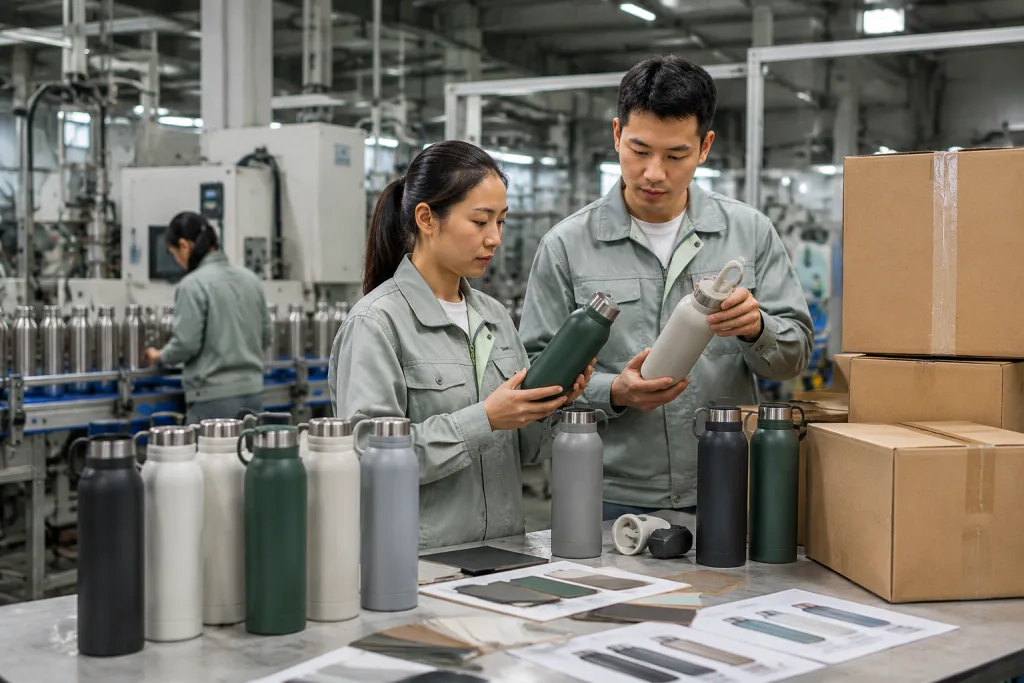
This article follows one order path: spec, sample, production, and QC for a promotional products thermos flask from a Zhejiang factory. We run this type of job every week. QC pulled the sample on a 500ml unit, and the buyer flagged the same thing at the start: the math does not work if the quote skips packaging or the engraving setup fee. By the end, you will know what to ask for and where these orders go sideways.
Specifying the Thermos Bulk Order
You need a 500ml stainless steel thermos. First decision: wall thickness. A 0.40mm inner and outer wall holds heat 4–6 hours—enough for a day hike. A 0.50mm wall pushes that to 8–10 hours but adds $0.60–$0.80 per unit at FOB. For a promotional thermos flask meant for trail use, 0.40mm is the sweet spot: coffee stays hot through lunch and your FOB price stays under $5.50. We've had buyers spec 0.50mm for a give-away, then balk when the unit cost hit $6.20. The math doesn't work for a freebie.
Next, the lid. Push-button with a silicone seal is standard for outdoor use. You want one-hand opening and a seal tight enough to pass a 24-hour leak test. Ask the thermos manufacturer for a drawing showing the seal cross-section. If that silicone gasket is less than 2mm thick, walk away. QC pulled a sample last month where the gasket was 1.6mm—it leaked after 12 hours. You will also need a carry loop: nylon webbing, 25mm wide, rated to 15kg pull. That runs $0.15 extra per unit.
Body finish: powder coat is the most durable for promotional use. It resists scratches from being tossed into a backpack. Matte powder coat adds $0.10 per unit over gloss. Color matching to your brand palette costs a one-time $80–$120 for a Pantone match sample. That sample takes 7 days from the factory thermos vendor and is non-refundable, but it is the only way to avoid a color miss on a 5000-unit run. We had a buyer skip the sample and the production run came out two shades off—they had to re-coat 3000 units at their own cost.
Laser Engraving vs. Silkscreen Logos
Your logo sits on every outdoor retailer's shelf. Laser engraving burns through the powder coat to expose raw stainless underneath. Permanent. Doesn't fade. At 5000 pieces we charge $0.08–$0.12 each. The catch: it only works on flat or gentle curves. Push a thermos with a severe taper and the laser head ghosts on you—we've seen it happen on a 19mm radius. Ask us for a photo of a similar curved surface we've already run.
Silkscreen runs $0.04–$0.06 per unit and prints on any surface. But it starts peeling after 100 dishwasher cycles. For a promo flask that gets tossed in a truck for 5 years, laser engraving pays off faster. Need a full-color logo? Silkscreen is your play—just spec UV-cured ink that passes a 72-hour abrasion test. We'll send the adhesion certificate before you sign the PO. One buyer insisted the math didn't work on a 2000-piece order; we showed them the peeling results at 150 cycles and they swapped to laser.
MOQ and Pricing Breakdown
A 500ml double-wall stainless thermos with 0.40mm wall, powder coat, laser engraving, and nylon carry loop: FOB Zhejiang port, $4.80–$5.60 per unit at 5000 MOQ. That includes the bottle, lid, loop, engraving, and a white paper sleeve. Want a full-color gift box? Add $0.50–$0.80 per unit. The custom thermos MOQ for a box is 3000 units, and the box die-cut tooling runs $200–$300 one time.
Here is a line-item breakdown from a recent 5000-unit order we ran:
- Bottle body and lid: $3.60
- Powder coat (matte, custom color): $0.60
- Laser engraving: $0.10
- Nylon carry loop: $0.15
- White paper sleeve: $0.15
- Packing and palletizing: $0.20
- FOB total: $4.80
If you bump to 0.50mm wall, the bottle body cost jumps to $4.80, pushing the FOB total to $6.00. For a promotional thermos flask, the math on that extra cost is hard to justify — we've seen buyers push back hard — unless your client specifically requires 8-hour heat retention. QC pulled a 0.50mm sample last month and measured 0.49mm on the micrometer; the 0.40mm wall holds hot coffee for 6 hours, which covers 90% of promo use cases.
QC Inspection: What to Check on 5000 Units
You are not flying to Zhejiang to inspect every bottle. Hire a third-party QC firm for an AQL 2.5 inspection at the factory. For 5000 units, the sample size is 200 pieces. The inspector checks three defect levels. Critical: leaking lid, broken loop, missing engraving. Major: scratches over 5mm, color mismatch off by 2 Pantone shades, dented body. Minor: uneven engraving depth, slight powder coat orange peel.
Over 7 critical defects in the sample, the whole lot is rejected. Hard rule. You can negotiate a reduced price for major defects — critical defects are non-negotiable. The thermos manufacturer should let you inspect on-site at no extra cost. If they charge for it, find another vendor. We had a buyer pay $300 for a QC visit and still got a bad batch. That math doesn't work.
Test 10 random samples for vacuum retention. Fill with 95°C water, cap, and measure temperature after 6 hours. Acceptable range is 55–65°C. If any sample drops below 50°C, the vacuum seal is compromised. The factory thermos supplier should provide a vacuum test report for the batch. If they cannot, request a re-test at their cost. One batch we shipped hit 48°C — QC pulled the sample, and we had to rework 1200 units. The buyer flagged it before it left the line.
Compliance Paperwork for Europe and North America
Your promotional products thermos flask ships to Europe and North America. REACH covers the stainless steel, silicone, and powder coat. FDA handles the US side. Your Zhejiang vendor hands over a REACH declaration for the 304 stainless (18/8 grade) and a silicone FDA 21 CFR 177.2600 certificate. If they blink or ask "what for?", walk. We had a buyer last year who waited 6 weeks for a declaration — we told him to cut the PO.
US market: if the thermos targets kids under 12, you need a Children's Product Certificate. CPSC requires lead content testing for the paint and powder coat. Expect $150–$250 per color, 10 days turnaround. Budget for it — one color skip can block customs release. EU side: General Product Safety Regulation (GPSR) plus CE mark. Your manufacturer should have the CE technical file ready in their drawer. If they ask what GPSR is, move on. We watched a buyer lose a 2000-unit order because the vendor had no tech file — QC flagged it at final inspection.
Lead Time and Shipping from Zhejiang
A 5000-unit custom thermos order runs 35–45 days from signed PO to FOB Zhejiang port. Breakdown: 7 days for tooling and sample sign-off, 20 days on the line, 5 days for QC inspection, 3 days for palletizing and loading. Sea freight to LA takes 18–22 days; Rotterdam hits 28–32. Need air freight? Add $2.50–$3.00 per unit and plan for 5–7 days transit.
Ask the thermos distributor for a shipping schedule with a 7-day buffer baked in. When the factory runs at 80% capacity—standard in Q3—expect a 5-day slip. Without that buffer, your campaign launch date gets tight. Confirm the pallet config too: 5000 units of 500ml thermos fit on 10 standard pallets (500 per pallet), each roughly 450kg. The FOB price covers palletizing and shrink wrap. We saw one buyer skip this step and their shipment hit the dock with loose cartons—don't be that guy.
Choosing Between a Factory Thermos and a Distributor Thermos
You have two paths: buy direct from a factory thermos in Zhejiang, or work through a distributor thermos that keeps generic bottles on the shelf and adds your logo. The factory route gives you control over specs, 304 stainless, lid structure, and QC, but it comes with a 5000-unit MOQ and a 35-day lead time. The distributor route gets you 500 units in 10 days, but you pay $6.50–$8.00 per unit and the bottle stays standard. No real customization. We saw one buyer flag a "custom" distributor sample that was just old stock with a fresh pad print, and that is the wrong question to ask if you care about brand fit.
For a promotional campaign with a budget of $25,000, the factory route saves you $8,500 against the distributor. The math does not lie. Time and risk decide it. If your campaign can wait, run the factory line. If you need bottles in 2 weeks for a trade show, go distributor, then ask whether they can swap the cap from push-pull to flip-top without changing the neck finish. The best thermos manufacturers in Zhejiang will also offer a hybrid option: a stock bottle with custom laser engraving, at a 1000-unit MOQ, for $5.20 FOB. That middle ground is worth a look. QC pulled a sample from one distributor lot and found the inner seam was 0.3 mm off; we would have caught that at pre-production on our line.
Testing the First Sample Before Full Production
Before you sign off on 5,000 units, pull 3 to 5 samples from the thermos vendor and run a 7-day check. We fill them with boiling water, log shell temperature after 1 hour, drop them from waist height onto concrete, and run one through a dishwasher cycle. On a recent run, QC pulled a sample with a 2 mm lid gap at the spout, and the buyer flagged it fast. The lid must stay dry. The powder coat must stay on. The vacuum has to hold.
If a sample misses any of those checks, send it back and ask for a new version. A solid thermos supplier will change the mold, tweak the gasket, or adjust the coating and resubmit a sample; you usually only pay freight. We have seen this go sideways when a supplier argues over a basic fix. The math does not work. This is the wrong question to ask after PO placement. The sample stage is where we catch the ugly stuff before the line runs 5,000 pieces.
Request a Quote for Your Custom Thermos Run
Send your specs—volume, wall thickness, logo type, and quantity—and we will reply within 24 hours with FOB pricing and a sample timeline.
Frequently asked questions
What is the typical MOQ for a promotional products thermos flask with a custom logo?
For a factory thermos in Zhejiang, the MOQ is 3000–5000 units for a fully custom bottle with laser engraving and custom color. If you use a stock bottle and only add a logo, the MOQ drops to 1000 units. The FOB price for a 1000-unit stock bottle with laser engraving is $5.20–$5.80 per unit. For a promotional campaign, 5000 units is the sweet spot for cost efficiency.
How long does a custom stainless thermos order take from a Chinese manufacturer?
A 5000-unit order takes 35–45 days from signed PO to FOB Zhejiang port. This includes 7 days for tooling and sample approval, 20 days for production, 5 days for QC inspection, and 3 days for packing. Sea freight to Los Angeles adds 18–22 days. If you need air freight, add 5–7 days and $2.50–$3.00 per unit.
What wall thickness should I choose for a promotional thermos flask?
For a promotional thermos flask used by outdoor retailers, 0.40mm wall thickness is the best balance of cost and performance. It provides 4–6 hours of heat retention and keeps the FOB price under $5.50 per unit. A 0.50mm wall gives 8–10 hours but adds $0.60–$0.80 per unit. Unless your client specifically needs 8-hour retention, 0.40mm is sufficient.
What compliance documents do I need for selling promotional thermos in Europe and North America?
For Europe, you need a REACH declaration for the 304 stainless steel, a silicone FDA 21 CFR 177.2600 certificate, and a CE mark under the General Product Safety Regulation. For North America, you need FDA compliance for the silicone and a Children's Product Certificate if marketed to kids under 12. The thermos manufacturer should provide these documents. If they cannot, find another vendor.
How do I QC a bulk order of custom thermos bottles from China?
Hire a third-party QC firm to perform an AQL 2.5 inspection. For 5000 units, sample 200 pieces. Check for critical defects (leaking lid, broken loop, missing engraving), major defects (scratches over 5mm, color mismatch, dents), and minor defects (uneven engraving, orange peel). Reject the lot if more than 7 critical defects appear. Also test 10 random samples for vacuum retention: fill with 95°C water and measure temperature after 6 hours—acceptable range is 55–65°C.