Key Takeaways
- A workable promotional products tea bottle usually starts at 1,000 pcs MOQ and lands around USD 2.20 to 6.80 FOB depending on material and print.
- For hot tea, 304 stainless with 0.5 mm to 0.7 mm wall thickness and a tight PP or stainless lid is the safest commercial choice.
- Glass looks better for premium campaigns, but breakage risk rises unless you use 2.5 mm to 3.0 mm borosilicate and packed cartons rated for export.
- Ask for AQL 2.5 major / 4.0 minor, REACH or food-contact declarations, and a sealed sample before you place a mixed color or custom logo order.
Buying a promotional products tea bottle looks simple until the logo passes and the bottle starts failing on the line. The cap, liner, and print method drive the complaint rate. We saw one buyer sign off a clean sample, then flag the first bulk lot after a 12-day, 40°C hold test because the seal slipped. If you ship into Europe or North America, REACH, food-contact rules, and a tight check on infusers, gaskets, and print position do the real work.
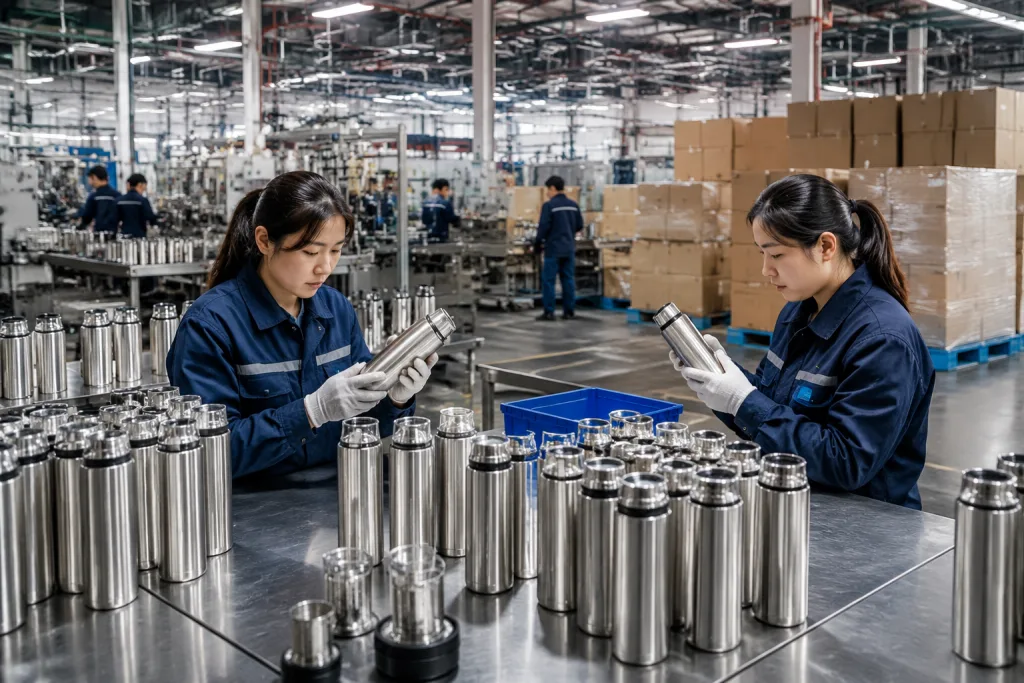
Lock four points first: who will use it, how they brew tea, the FOB target, and how much lead-time risk you can carry. At our Zhejiang factory, we run 120,000 units a month across stainless and glass drinkware, and our tea bottle MOQ starts at 1,000 pieces with 25 to 35 days after sample approval. QC pulled the sample on a 0.2 mm lid gap before packing. This is the wrong question to skip. Only then should you compare canteen custom options, customizable drinkware, or a custom growler-style bottle for events.
Start With the Use Case
The first decision is use case, not decoration. A promotional products tea bottle can be a commute bottle with a tea filter, a desk infuser bottle, or a giveaway for a trade show. Those jobs do not share the same build. Office buyers ask for easy cleaning and a straight sip path. Commuters want leak resistance and one-hand opening. Event buyers push for the lowest landed cost, which usually means simpler custom drinkware, not a loaded spec. We split a 5,000 pcs order that way last spring, and the buyer flagged the lid after QC pulled the sample on the line.
Get specific before you ask for quotes. If the tea bottle will take loose leaf, we spec a fine-mesh infuser basket at 30 to 60 mesh, a wide mouth of 48 mm or more, and a lid that does not trap steam. If it is for fruit tea or herbal blends, a simple strainer tube is enough. If the campaign is premium, a double-wall stainless model in 350 ml to 500 ml is the safer call than a thin plastic canteen for the same audience. The math does not work the other way. A buyer once sent a PO with a 42 mm mouth and asked for whole-leaf oolong; we pushed back because that would have clogged on the first pour.
Rule of thumb: choose the drinking experience first, then the factory spec. If you do it backwards, you end up with a canteen promotional item that looks fine in photos and disappoints in use.
Pick the Right Body Material
Material drives cost, shelf appeal, weight, and breakage rate. For a promotional products tea bottle, we quote stainless steel, glass, and BPA-free copolyester or Tritan-style plastic. Stainless is the default for B2B buyers who want a custom canteen that ships clean and survives rough handling. A 304 stainless body with 0.5 mm to 0.7 mm wall thickness holds up on the line, and standard decoration usually lands in the USD 2.80 to 5.90 FOB range. One buyer pushed back on the vacuum add-on. The math was simple: insulation adds 25% to 45%.
Glass is straightforward. It looks premium, shows tea color well, and wipes down easily. The catch is packing. We saw a 1.2 m drop test turn a good bottle into carton scrap because the divider spec was 3 mm too loose. For a canteen manufacturer in China, borosilicate glass at 2.5 mm to 3.0 mm wall thickness is the normal base. This is the wrong question to ask for a cheap giveaway run. It fits boutique launches, hotel sets, and distributor drinkware programs with margin to protect. We ship it with double-wall cartons and 6-corner inserts, or the loss rate climbs fast.
Plastic still has a place, especially for a light canteen custom order for fitness, outdoor, or low-cost internal promos. But if you want a canteen customizable enough to pass for retail, the resin grade and mold polish matter. QC pulled a sample with a dull matte finish last month, and the buyer flagged it in two seconds. A clear bottle with weak plastic can haze after a few washes. We run into that all the time. Most experienced canteen suppliers push serious buyers toward stainless or glass unless the target price is tight. On the line, we watch mold polish at 800 grit; below that, the body looks cheap even before printing starts.
Choose the Brewing Mechanism
The brewing system decides whether a tea bottle stays on the line or gets boxed out after week one. We usually pick between a removable infuser, a built-in filter, or a two-chamber layout. For promo orders, the removable basket is the safe call. It rinses faster, packs easier, and gives us a tighter tolerance window. For loose tea, 60 mm to 100 mm basket depth is common, and a fine perforation pattern keeps leaf bits out of the cup. We had a buyer flag a PO because the drawing said "laser cut" but left out the burr limit, and QC pulled the sample on that point.
Integrated filters look tidy, but they turn into a headache if the mesh is too tight or the clean-out path is awkward. For promotional use, simple wins. The buyer should get it in 10 seconds flat. If they need a manual to brew tea, the bottle sits on a desk and gets forgotten. We run a lot of these programs, and the ones that ship cleanly keep the action obvious: fill, steep, remove, drink. This is the right question to ask, not how clever the mechanism looks in a catalog shot. One bad knob design can sink the whole run.
For cold brew or fruit infusion, a wider chamber gives the tea or fruit room to move. For hot tea, the vent path has to stay safe. If steam builds under a tight lid, splash risk goes up fast. Ask the canteen manufacturer to show the lid seal and the vent behavior on a real sample, not a render. We saw a 12-day delay turn into 18 days on one order because the buyer approved from photos and then changed the lid spec after tooling. The math does not work. One typo on the PO, one changed gasket, and the line stalls.
Logo Methods That Hold Up
Decoration is branding, yes, but the real job is wear resistance, color stay, and whether the mark survives freight. For a promotional products tea bottle, we run silkscreen, pad print, UV print, laser engraving, and heat transfer, and each one acts differently on the line. If the bottle gets handled every day, laser engraving on 304 stainless is the cleanest long-term call. It does not peel. For a premium metal tea bottle, that is the least risky route. QC pulled the sample after a 48-hour salt spray check, and the mark still read clean.
Silkscreen is still the workhorse for a simple logo or a two-color mark. Fast. Low cost. It keeps FOB pricing in line, but the setup fee still bites, and the math does not work below a sensible MOQ, usually 1,000 pieces. UV print gives sharper graphics on smooth plastic or coated bodies, yet we saw one sample pick up scratch marks after a 20-rub check. For canteen customized orders where the buyer wants heavier brand impact, we ask for a 50-cycle rub test or a taping test before we sign off. A buyer pushing for 300 pieces with full decoration is asking for trouble.
Be exact on placement tolerance. On a curved body, 2 mm to 3 mm can pass, but only if the artwork was built for that shift. If the logo sits too close to the seam or lid line, the buyer flagged it as a reject before we even started packing. We have seen that go sideways. A good canteen supplier will say it straight, because the line can hit the print spec and still lose the order on a typo in the PO or a logo too near the weld.
Price, MOQ, and Lead Time
Buyers often ask for the cheapest quote first and the sample later. Wrong order. We run the numbers from the spec first, because a tea bottle that looks cheap in the inquiry can jump once you add 304 stainless, an infuser, or a two-stage lid. For a basic custom drinkware tea bottle in stainless steel, FOB China starts around USD 2.20 to 3.40 for a simple single-wall unit with one-color print at 1,000 pcs. A double-wall insulated version with infuser and laser logo usually sits around USD 4.80 to 6.80 FOB. Glass can land in the middle, but one cracked inner tray in a 48 cm export carton wipes out the margin fast. This is the wrong question to ask if the spec is still loose.
Lead time matters as much as unit price. Standard production from a Zhejiang canteen vendor is usually 25 to 35 days after sample approval and deposit. If you need mixed colors, special lids, or gift boxes, add 7 to 12 days. We had one buyer flag a PO typo on lid color, and the line had already loaded the wrong cap bins. That kind of miss burns time. Urgent orders are possible, but rush work raises the chance of cosmetic variation. A serious canteen distributor should ask for a schedule that covers bottle forming, printing, assembly, packing, and pre-shipment inspection. If a factory cannot name those steps, it is not set up for repeat business. QC pulled the sample at the cartoning station before release.
The commercial sweet spot for a lot of promotional campaigns is a 1,000 to 3,000 piece run. That covers setup cost without filling a warehouse. We shipped a 1,200 pcs order last month where QC pulled the sample at AQL 2.5, and the buyer still pushed back on carton marks. Fair point. For Amazon or channel distributors, larger runs make sense, but then carton count, FNSKU labeling, and pallet rules sit in the quote, not on the side. The math does not work any other way.
Compliance and Test Evidence
For Europe and North America, compliance is not paperwork theater. It keeps the carton moving. A promotional products tea bottle needs the right food-contact declaration, REACH status where it applies, and clear material callouts. On stainless, we ask for 304 or 316 confirmation by heat lot. On plastic parts, we check BPA-free status and the test route the buyer wants, usually ASTM or LFGB depending on the market. Last month a buyer flagged a missing material line on the PO, and that one typo stalled release by 3 days. The factory should not blink when you ask for this.
QC has to be measured on the line. For a normal promotional run, AQL 2.5 major and 4.0 minor is a fair starting point, but the inspection points matter more than the label. We check lid seal, logo position, vacuum hold if insulated, and leak rate after upside-down testing. On glass, we check wall thickness at 2.8 mm, mouth finish, and crack rate after thermal shock. On a canteen custom project with mixed lids, we run the fit on every color variant before mass packing. This is the wrong question to ask if someone says, “Do you have a certificate?” Ask for the actual test result and the batch tied to it.
At BottleForge Industrial in Zhejiang, we treat compliance as part of production, not a side favor. QC pulled the sample at 9:20, logged the lot code, and held the shipment until the files matched the packed SKU list. That is how a canteen manufacturer should work if it wants repeat orders from Europe and North America.
How to Brief Your Factory
Weak briefs cause most sourcing problems. A logo file and “premium tea bottle” is not a brief. Send the exact capacity, body material, lid type, color code, decoration method, carton requirement, and destination market. If the buyer wants a custom canteen for a distributor program, we also need target retail price, target FOB ceiling, plus hangtags or retail boxes. The line cannot guess its way to a clean sample. We learned that after a PO typo changed “500 ml” to “50 ml” and QC pulled the sample before print.
A solid brief for a canteen supplier should include:
- Capacity: 350 ml, 500 ml, or 650 ml
- Material: 304 stainless, borosilicate glass, or Tritan-style plastic
- Finish: matte, gloss, powder coat, or clear
- Print: silkscreen one color, laser engraving, or UV print
- Packaging: bulk pack, color box, or gift box with insert
- Testing: leakage, drop test, and food-contact documents
If you are comparing canteen manufacturers, ask for a pre-production sample, not a shelf sample from the rack. One is built to your spec. The other is just a random unit. That is the wrong question to ask if you want export work done right. On our side, we run pre-production checks with calipers on lid threads and carton size, and the buyer usually flags the mismatch before we ship 1,000 pieces.
Send Your Tea Bottle Spec Sheet Today
We can quote FOB, confirm MOQ, and build a sample that matches your market, your compliance needs, and your packaging target.
Frequently asked questions
What is a realistic MOQ for a promotional products tea bottle?
For most export orders, 1,000 pieces is the practical starting point. A basic stainless tea bottle with one-color logo often prices best at 1,000 to 3,000 pcs. If you need a custom lid, special box, or mixed color run, the MOQ can move to 3,000 pcs because the factory has to recover setup and packing costs. Smaller runs are possible, but unit price usually rises 15% to 35%.
Should I choose stainless or glass for a tea bottle campaign?
Choose stainless if you care about durability, lower breakage, and broader market acceptance. Choose glass if the campaign is premium and you want the tea color visible. A 304 stainless body with 0.5 mm to 0.7 mm wall thickness is the commercial default. Borosilicate glass at 2.5 mm to 3.0 mm can look better, but you need stronger cartons and a lower tolerance for transit damage.
Which logo method lasts longest on custom drinkware?
Laser engraving usually lasts the longest on stainless surfaces because it does not peel or fade like ink. For a promotional products tea bottle that will be washed often, laser is the safest choice. Silkscreen is still fine for simple logos and lower budgets, especially if you only need one or two colors. UV print works when you need more graphic detail, but you should ask for abrasion testing before approving mass production.
What compliance documents should I ask a canteen manufacturer for?
Ask for material confirmation, food-contact declaration, and the test reports that match your destination market. For Europe, REACH-related declarations and LFGB-style food-contact evidence are common asks. For North America, you should still verify food-safe materials and any applicable ASTM or state-level requirements. If the bottle includes plastic, request BPA-free confirmation. If it is insulated, ask for leak and vacuum performance data too.
How long does production take in China?
A standard custom tea bottle order from China usually takes 25 to 35 days after sample approval and deposit. Add 7 to 12 days if you need gift boxes, multiple print colors, or complex inserts. If the factory is in Zhejiang and already runs export lines, the schedule is often more predictable because tooling, printing, and packing are handled in-house. Freight time is separate and depends on sea or air.