Key Takeaways
- PP shaker bottles usually start around MOQ 3,000 pcs, while stainless custom drinkware often needs 1,000-2,000 pcs
- FOB China pricing for a basic 600 ml shaker can sit at USD 1.05-2.20 depending on lid, print, and insert
- A practical leak test target is 3-5 minutes inverted under room-temperature water, then shake-again
- For promotional products protein shaker orders, 15-25 days is realistic for standard tooling and 35-45 days for new molds
If you are buying a promotional products protein shaker, start with cap fit, print hold, and landed cost. Freight, duty, decoration, all of it. We run this on the line every week, and QC pulled a sample last Tuesday with a 2 mm cap gap that would have turned into leakage after a few weeks in a gym bag. Two shakers can look the same in photos and split on the mixer ball, wall thickness, or a logo that starts fading after 50 wash cycles.
For B2B buyers, the decision comes down to four points: material, closure style, branding method, and supplier control. Miss one and the buyer flags leakage, the launch slips by 12 days, or the margin stops working. That is the wrong question to ask if you only chase unit price. We have seen a PO with “shaker cup” typed as “sheker cup” and the artwork approval got held for a week. Get the spec right and you have a custom drinkware item that moves through distributors, gyms, wellness brands, and corporate programs without hand-holding. A solid Zhejiang factory should quote cleanly, pull the sample fast, and hold a 30,000 to 80,000 units/month plan without guessing.
Start with the use case
Most buyers start with shape. That is backwards. We run the line the other way: use case first, construction second. A promotional products protein shaker for a supplement booth handout does not need the same build as a retail shaker on a canteen shelf or in a distributor catalog. For events, we keep it light, trim freight, and spec a lid that flips open with one hand. For retail, the finish has to be cleaner, the color match tighter, and the carton has to survive a 12-day truck move, not a 3-day local drop. We saw a buyer push back on this last month, and the math did not work any other way.
For a pure promo run, polypropylene is the workhorse. On a simple 600-700 ml spec, we usually land around USD 0.95-1.80 FOB. For premium campaigns, Tritan or stainless steel pushes it to USD 2.80-6.50 FOB, and the buyer sees that gap fast. QC pulled the sample on one PO after a lid code typo, before the line started. Start with volume, handout channel, and target MOQ. Then decide whether you need custom drinkware for broad distribution, or a smaller run of customized drinkware for a tighter brand campaign. Shape comes later.
- Event giveaway: lowest cost, 2-4 week lead time, plain carton, 600 ml or 700 ml
- Retail promo: cleaner print, drop-tested packaging, tighter color control, 0.2 mm print tolerance
- Fitness bundle: better seal, mixing insert, sweat resistance on the bottle wall, MOQ 3,000 pcs
Material decides margin
Material decides margin fast. PP sits at the low end: light, cheap, and easy to run on the line. Tritan costs more, but buyers pay for clearer walls and a cleaner shelf look, which matters when the order has to pass as customizable drinkware instead of a giveaway. Stainless looks strong on paper. We still check weight, dent risk, and any insulation claim before we quote it. For a shaker, insulation is dead cost.
Do not stop at the sales sheet. Ask for wall thickness on the drawing, then check the mold cavity notes. A PP shaker body usually runs 1.6-2.2 mm, and QC pulled the sample once at 1.4 mm; it felt flimsy and twisted after hot wash. At 2.5 mm, the resin bill climbs and the gain is small. Same on a canteen custom order: the material and thickness have to fit the channel, whether we ship a canteen customized promo line or a heavier SKU for canteen manufacturers selling through distributors. The buyer flagged a vague "food grade" claim on one PO. This is the wrong question to ask. We need resin grade, mold steel, and shrinkage, not slogans.
Practical rule: if your target sell price is under USD 8 retail, do not overbuild the shaker. Better closure and better print beat fancy structure.
Pick the closure before the logo
The lid is the part that creates complaints. A promo shaker can look perfect and still fail if the cap pops open, the flip top loosens, or the thread line is sloppy. Test the closure first, then choose branding around it. For basic gym campaigns, a screw-on lid with a flip cap is standard. For premium custom canteen or custom growler programs, buyers sometimes prefer wider mouths, stainless caps, or a more rigid drinking system. That is a different category — forcing one construction into another is a mistake we've seen go sideways.
A good supplier can show you three leak-related data points: thread engagement, gasket material, and closure cycle testing. You want a silicone or TPE gasket that does not harden after repeated washing. You also want a cap that still locks cleanly after at least 1,000 open-close cycles. For a promotional products protein shaker, I would ask for a basic inversion test at room temperature, then a manual shake test with 300-400 ml of water. That is not lab-grade, but it catches the obvious failures before production. If the supplier cannot discuss those details, they are acting like a canteen vendor rather than a real canteen factory. Last month QC pulled a sample where the gasket measured 2.1 mm instead of the spec'd 2.5 mm — that 0.4 mm difference leaked in the first inversion test.
- Flip cap: fast use, lower cost
- Screw cap with insert: better sealing, slightly slower use
- Wide-mouth premium cap: better cleaning, higher mold complexity
Branding should survive washing
Decoration is where buyers burn margin. We have seen clients add 40% for UV print on a shaker that gets hand-washed three times a week. Silk screen usually does the job and keeps the line moving. On dark bodies, a sharp logo line needs the right method; laser engraving works on stainless steel, not on most plastics, because the beam melts polypropylene. UV print can carry fine artwork, but the price climbs fast, and QC pulled samples where the ink lifted after one dishwasher cycle because the coating cure was off. For a promotional products protein shaker, the print choice should follow real use, not the deck from the meeting.
Put print durability in writing. A proper screen print holds through routine hand-washing if the ink system matches the substrate — we run polypropylene at 150°C cure temperature. Dishwasher exposure is a separate test. One buyer flagged a logo that faded after 12 cycles; we traced it to an off-spec thinner from their printer, and the math was done before anyone checked the tape test. If you sell through Amazon, packaging and carton labeling still need to fit FNSKU placement and inbound checks. That matters for distributor canteen and distributor growler programs too. A carton with weak corners or a barcode printed 2mm off center can stop the shipment, even when the bottle itself passes inspection. At BottleForge in Zhejiang, the cleanest jobs come when buyers specify logo size, Pantone reference, print position, and matte or glossy finish. Don't leave decoration vague.
One more point: customizable canteen and customized canteen projects fail when the logo was drawn for a flat sheet, not a curved body. The math doesn't work. A 60mm logo wrapping a 75mm diameter bottle distorts the text. Ask for a cylinder preview or a 3D proof before approval. We have seen this go sideways on a PO with one extra space in the logo name.
Know your factory checks
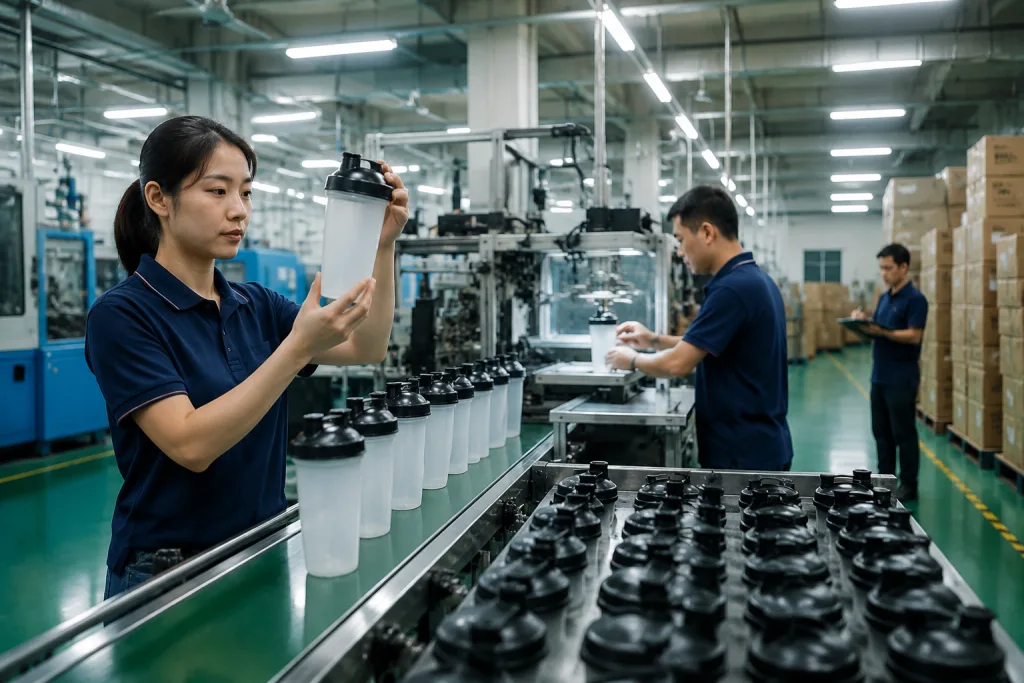
For B2B sourcing, the factory matters more than the brochure. A serious canteen manufacturer or canteen supplier should show process control, not just samples. We run incoming checks on resin pellets and stainless parts with a caliper and a durometer, then QC pulls the sample for cap torque and seal fit. In Zhejiang, I expect the paperwork on the table. A line that says AQL 2.5 for major defects and 4.0 for minor defects on standard promo runs is the baseline. Without it, you are buying risk, not drinkware.
Ask where the molds are, how many cavities the tool has, and whether the factory can support your forecast. A 4-cavity mold behaves differently from an 8-cavity mold, and the output math changes fast. A facility making 30,000 to 80,000 units/month usually splits work across 2 lines, sometimes 3. That is fine. The real question is stable lead time. For a basic PP shaker, 15-25 days after sample approval is a normal range; for a new mold or a more complex custom canteen, plan on 35-45 days. We had one buyer push back on a 20-day promise, and he was right to do it—the math does not work when the tool is still being tuned. Check current REACH papers, food contact declarations, and if the supplier says ISO 9001 or BSCI, ask for the live certificate, not a PDF from last year.
- Incoming QC on resin, lids, and gaskets
- Inline checks on fit, color, and print placement
- Final AQL sampling before carton close
MOQs and pricing in China
You need the breakpoints before you send a PO. A basic promotional products protein shaker in PP usually starts at MOQ 3,000 pcs in one color, with unit pricing around USD 1.05-1.60 FOB depending on size and decoration. We ran one 600 ml sample with a 57 mm lid, and the line held that number only after the buyer dropped the metallic effect. Add a custom mold, metallic finish, or multi-part lid and the MOQ climbs to 5,000 pcs or more. This is where the math starts talking back.
For a canteen customizable program, ask for a clean split between tooling, product cost, and decoration cost. If the supplier gives you one number, the margin is a guess. We ship better quotes in three lines: plain blank body, one-color logo, full-pack retail pack. That lets you compare direct and distributor channels without hand-waving. A canteen factory should also state whether color-matching changes the MOQ. A stock black or white body might stay at 3,000 pcs, while a custom Pantone match can jump to 5,000-10,000 pcs depending on pigment and cavity count. QC pulled the sample on one run because the logo shifted 1.2 mm off-center. These breakpoints matter more than a pretty render.
For stainless or premium custom growler orders, the economics are different. You may pay USD 4.50-9.00 FOB depending on gauge, finish, and cap structure. A buyer once pushed back on a USD 0.18 packaging bump, then the carton failed drop test and the claim wiped out the savings. That is the wrong question to ask. The channel has to carry the price, or the order sits.
Packaging changes the real cost
Buyers treat packaging like the last line item. Wrong question. A shaker going into retail or distributor stock needs a cap that stays shut, film that does not scuff the bottle, and a barcode that reads on the first scan. We run that on the packing bench with a 500 g drop test and a caliper check on carton width. A plain polybag works for a booth handout, but stacked cartons heading to a 3PL need tighter control. If the outer box crushes, the logo is dead on arrival. For Amazon or marketplace programs, carton size and prep rules hit freight and FBA fees hard, especially on a tall, narrow bottle.
For a customized growler or a premium canteen custom line, I ask for drop-test targets and carton ECT, not a pretty sleeve. The math does not work if packaging adds USD 0.15-0.45 per unit and nobody catches it until 20,000 pcs are already on the books. We had a buyer flag a PO typo once: 12 mm turned into 21 mm on the insert spec, and QC pulled the sample before the line started. A solid canteen supplier should quote retail box, PDQ tray, and bulk pack without blinking. If they only know bulk pack, they can handle rough canteen giveaways, not a distributor program that needs shelf-ready cartons.
Packaging also drives returns. A scuffed cap or scratched body usually starts with loose internal spacing, not a bad bottle. We saw this go sideways on a run with 24 pcs per inner carton; the divider sheet shifted, and the cap ring marked three units out of every 200. On a clean plant floor, packaging is part of the product. Not an afterthought.
Use the right sourcing path
There is no single best route for every buyer. For a test run, we ship faster through a factory-direct canteen manufacturer that can turn a sample in 3 to 5 days and stay tight to the spec. If you already have a distributor network, a canteen distributor or canteen vendors setup makes more sense because it handles mixed SKUs, quick reorders, and carton labels for local markets. Match the path to the business model. That is the job.
For large seasonal runs, I prefer a canteen factory that also runs custom drinkware across more than one product line. That gives us cleaner mold control, steadier print registration, and simpler consolidation when the order needs a promotional products protein shaker plus a custom canteen or custom growler in one shipment. In Zhejiang, plenty of factories say they can do it; fewer keep the same standard on every line. Ask how many SKUs they run at once, what the changeover looks like on the line, and whether they can show re-order records from the last 12 months. A canteen manufacturers list does not tell you that. QC pulled the sample, checked the 0.3 mm print shift, and the buyer flagged the carton mark on the PO. That is the gap between a vendor and a supplier we can keep.
For most B2B buyers, the practical path is plain: one clear spec, one sample round, one production audit, then a repeat-order plan built on real demand. We saw this go sideways when a buyer guessed volume and the MOQ was off by 2,000 units. The math does not work.
Get a quote built around your channel
Send the spec, target price, and order volume. We will price the shaker, packaging, and logo properly for your market, not just the sample.
Frequently asked questions
What MOQ should I expect for a promotional products protein shaker?
For a standard PP promotional products protein shaker, a realistic MOQ is 3,000 pcs per color with one logo position. If you add a custom lid color, metallic print, or retail box, the MOQ often moves to 5,000 pcs. For premium Tritan or stainless versions, 1,000-2,000 pcs may be possible, but unit pricing will be higher. In China and Zhejiang, the factory usually links MOQ to mold cavities, color change time, and packaging complexity. Ask for a written MOQ by option so you can compare apples to apples.
What is a fair FOB price for a basic shaker?
For a simple 600-700 ml PP shaker, FOB China pricing commonly lands at USD 1.05-1.60 with one-color decoration and bulk pack. Better lids, extra inserts, or retail boxes can push that to USD 1.80-2.20. Stainless or Tritan versions usually start higher, often USD 2.80-6.50 depending on finish and tooling. The number that matters is not just the bottle price. Freight, carton count, and decoration can add 15-30% to landed cost. Always ask the supplier to separate base item, print, and packaging.
How do I check whether the shaker will leak?
Do a basic but strict test. Fill the shaker to normal use level, close it fully, invert it for 3-5 minutes at room temperature, then shake it 20-30 times. Watch the lid threads, the flip cap, and any gasket line. A good supplier should also tell you the gasket material, cap cycle target, and whether the lid has been tested after repeated washing. For promo use, that is enough to catch obvious failures before production. If the supplier cannot explain the seal structure, they are not giving you enough control.
Which branding method lasts longest on plastic shakers?
For most plastic shakers, silk screen printing gives the best cost-to-durability ratio if the ink system is matched to the resin. UV print can handle more detail, but it costs more and needs the right substrate. Laser engraving is mainly for stainless, not standard plastic bodies. If your order is going into retail or ecommerce, ask for print abrasion expectations and a wash test. On a promo shaker, a clean one- or two-color logo is usually better than a complicated full-wrap graphic that weakens over time.
How long does production take in Zhejiang, China?
For a standard shaker with existing tooling, 15-25 days after sample approval is normal. If you need a new mold, custom color matching, or retail packaging, plan for 35-45 days. Shipping time depends on destination and freight mode, but your production plan should leave room for QC, carton labeling, and any rework. A capable canteen factory in Zhejiang should give you a real schedule, not a guess. Ask for milestone dates: sample approval, pre-production confirmation, mass production start, final inspection, and ex-factory ready date.