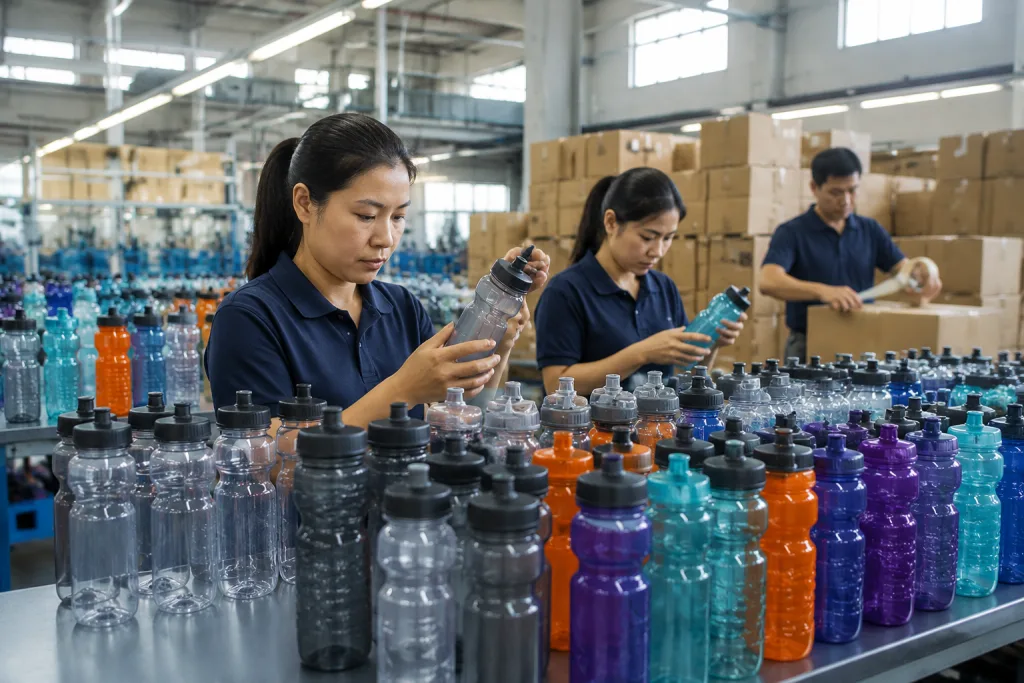
Key Takeaways
- Polypropylene bottles cost $0.30–$0.80 per unit FOB Zhejiang at MOQ 3,000 pcs, depending on volume and decoration.
- Screen printing and pad printing are the most cost-effective decoration methods for PP; laser engraving is not viable on this material.
- A reputable canteen factory will provide REACH, FDA, and BSCI reports within 48 hours—if they hesitate, walk away.
- Lead time for a custom PP bottle with a single-color logo is 25–35 days from sample approval; two-color adds 7–10 days.
You are sourcing promotional products polypropylene bottles for a Q2 campaign, and your procurement checklist is longer than your supplier list. PP is food-safe, dishwasher-safe, and cheap. Clean on paper. On the line, it gets messy fast. We have seen a 1.5 mm logo pad print blister after one wash, then QC pulled the whole batch at the drop test bench. You need a canteen manufacturer that can run custom logos, pass REACH and FDA, and ship on time without blowing the margin.
This guide answers the questions procurement teams actually ask when buying PP bottles from China. We cover MOQ, usually 3,000 pcs for silk screen, decoration picks like pad print and heat transfer, material grades such as homopolymer and copolymer, and the checks we run before a first PO goes in. One buyer sent us a purchase order with “polypropelene” typed three different ways. The math does not work. Whether you are a canteen distributor looking for a steady canteen vendor or a brand owner planning a custom growler run, this checklist saves time and keeps returns down.
Why Polypropylene for Promotional Drinkware?
PP is what we run when a promotional campaign needs bottles that survive dishwashers and cost under $0.80 landed. Top rack, 100°C, 300+ cycles—we've pulled samples at 500 and the print still holds. Tritan costs 2.3x more and doesn't buy you anything here. PET warps in a microwave; PP handles 60-second reheats without a dent. No BPA, no phthalates. A buyer once asked if we could hit the same price in Tritan. The math doesn't work.
On the floor, PP injection-molds fast. Tooling in our Hangzhou shop runs $1,200–$2,500 per mold depending on cavity count—single-cavity pushes 800–1,200 units a day, two-cavity doubles that with a 22-second cycle time. For a 10,000-unit canteen order, mold amortization lands at $0.12–$0.25 per bottle. We've shipped campaigns where the mold paid for itself inside the first container.
Decoration is where PP earns its keep. Screen printing, pad printing, heat-transfer—all fine. But IML is the move for promotional polypropylene bottles. The label fuses into the part wall during molding. Zero air gap. We ran 500 dishwasher cycles on an IML-decorated PP bottle and pulled it out looking like day one. No peeling, no lifting, no customer complaint sitting in your inbox six months later. QC flagged a batch once where the label registration was off by 0.3 mm—we caught it before it left the line. That's the difference between a promo that builds your brand and one that ends up in a drawer.
MOQ, Pricing, and Lead Time Breakdown
Here’s the quote stack we run for a 500 ml PP sports bottle with a screw cap and loop handle:
- MOQ: 3,000 units on a stock mold. New mold? 5,000 units is the floor. A buyer pushed for 2,000 units once, and the line said no because the setup loss does not wash out.
- Unit price (FOB Shanghai): $0.45–$0.65 at 3,000–5,000 pcs; $0.30–$0.42 at 10,000+ pcs. At 3,000 pcs, the math is tight. At 10,000 pcs, the run starts to work. We’ve priced that sheet enough times to know it. A 300 mm carton change can move the freight line more than the bottle itself.
- Mold cost: $1,500–$2,500 for a single-cavity mold. Spread that over 5,000 units and you land around $0.30–$0.50 per bottle. QC pulled the sample once and found a 0.6 mm gate mark, so we do not guess on tooling.
- Sample lead time: 7–10 days after mold completion. If the PO has a typo in the logo file, add one more round. That burns days fast. We caught a buyer file that said “loop hangle” instead of “loop handle,” and the proof stalled until they cleaned it up.
- Production lead time: 20–25 days from sample approval. Add 5–7 days for sea freight to a US West Coast port. We ship faster when the carton mark and color code are signed off on day one, and the buyer knows it. A loose color code sends the line back to the ink room.
If you need a custom PP growler at 1,000–2,000 ml, plan on an MOQ of 2,000 units and unit prices 15–20% higher because the walls are thicker and the mold is larger. Ask for a FOB quote that shows mold cost spread into the first order. Some suppliers bury that number in the bottle price, and the buyer flags it later when the sheet does not add up. We’ve seen that go sideways on a 2,500 kg shipment.
Customization Options: What Works on PP
PP does not forgive bad decoration. The resin has low surface energy, so ink lifts if the line skips corona or flame treatment. We run dyne pens on incoming samples, and if the bead test looks weak, QC pulls the sample before we quote. A vendor should name the pretreatment method up front, not after the buyer flags a print failure on a 0.5 mm edge.
Screen Printing
Best for 1–3 color logos on flat panels or a light curve. At 3,000 pcs, we usually see $0.05–$0.12 per color per unit. On our wash test rack, good screens hold up about 200–300 dishwasher cycles before fading shows. The squeegee pressure has to stay even, or the edge breaks up and the buyer sees it at first glance. Simple job. Clean result.
Pad Printing
Use it on concave spots or textured areas, like the neck ring or base recess. The cost is usually $0.08–$0.15 per color. Durability tracks close to screen printing. We had one PO typo with a 6 mm logo area instead of 60 mm, and that is the kind of thing that kills pad print clarity fast. We check the cliché size before the line starts, because this is where small artwork files turn into scrap.
In-Mold Labeling (IML)
This is the toughest option. The label goes into the mold before injection and ends up inside the bottle wall. Cost runs $0.15–$0.25 per unit, MOQ 5,000 units, and it suits full-wrap graphics without edge lift. For promotional products polypropylene bottles that need years of daily use, this is the right call; the math does not work any other way. We have seen cheaper print jobs go sideways after a few hundred washes. The mold insert locks the label in, so there is no peel edge for the line to fight.
If the spec is a brand name plus a simple logo, screen printing gives the cleanest cost line. If the buyer wants a full-color gradient, IML is the only route that stays put. A plain 2-color mark is one thing; a photo-style wrap on PP is another, and we tell buyers that straight.
Compliance and Testing: What to Request from a Canteen Supplier
For EU or US custom drinkware, ask for the compliance file before you place the PO. We ship enough canteens to see the pattern: the clean supplier sends the packet in 24 hours, the line stays moving, and nobody has to chase basic paperwork after sampling. If the papers show up after the order, the buyer flags it and the whole file gets harder to close.
- REACH (EU) – SVHC screening for 200+ substances.
- FDA 21 CFR 177.1520 – US food-contact compliance for PP.
- BSCI audit report – Social compliance for European buyers.
- ISO 9001 – Quality management system (not mandatory but a strong signal).
- AQL 2.5 – Acceptable Quality Level for visual defects. Most canteen manufacturers in Zhejiang work to AQL 2.5 for major defects, 4.0 for minor.
Ask for test reports on migration of heavy metals (lead, cadmium, mercury) and total migration (overall migration limit of 10 mg/dm² for food contact). The math does not work any other way. On our bench, QC pulled the sample and checked the lot number against the inkjet mark, and when a supplier needs more than 48 hours to send those papers, we start looking at recycled or off-grade PP. We run in-house migration checks on every batch and keep the third-party reports on file. That is the part that saves time.
5 Questions Every Canteen Distributor Should Ask
Before you send a PO to a canteen vendor, ask these five questions. The answers tell you fast whether you are talking to a real manufacturer or a trading desk with a price sheet. We run the line every day, and the split shows up in the first 200 bottles. A caliper reading at 1.8 mm says more than any sales talk.
- “Do you use virgin PP or regrind?” Virgin PP, like Borclean or LyondellBasell grades, costs 20–30% more, but it holds color, wall thickness, and impact resistance. Regrind is where stress cracking starts. QC pulled the sample at 1.8 mm and the buyer flagged the haze. Skip this question and you buy trouble.
- “What is your scrap rate on injection molding?” A clean shop stays under 2%. Once it climbs past 5%, the math doesn't work, because you start paying for lost resin, extra sorting, and late cartons. On one 304 stainless-style schedule, a typo on the PO turned 8,000 pcs into 80,000 pcs on paper, and that kind of mess usually hides a weak scrap record. We check the hopper logs before we quote.
- “Can you share a video of your corona treatment line?” If they cannot, the logo prep is weak and your print will peel after a few washes. We check the dyne pen on the line at 38 dynes, not by guesswork. We have seen this go sideways when a supplier skipped treatment to save 12 minutes per batch. Bad trade.
- “What is your typical lead time for a 10,000-unit order of promotional products polypropylene bottles with IML?” Expect 30–35 days. If someone says 15 days, the line is either underloaded or the promise is loose, and both end with quality trouble. For one OEM run, we shipped in 12 days vs 18 days only after the mold was tuned and the MOQ was locked at 5,000 pcs. The mold room sets the pace.
- “Do you offer drop-shipping to Amazon FBA warehouses?” A lot of canteen suppliers now pack to FNSKU requirements, but not all of them do it cleanly. If they do not, budget 7–10 days for relabeling and carton checks. The buyer pushed back on a 500 kg pallet mix, and we had to rework the carton labels before the shipment could move. One wrong carton code stalls the whole pallet.
We answer all five with factory tour videos and hard numbers. That is the standard. A canteen factory that shows its injection machine model, treatment readings, and packing detail is one you can trust. Ask for the Atlas machine plate, the dyne log, and the carton count.
Checklist: Vetting a Canteen Factory in Zhejiang
Keep this checklist open on the video call. Print it if you need to. We’ve seen a buyer catch a PO typo on line 3 and save a week of back-and-forth.
- Mold ownership: Ask who owns the mold steel and the cavity records. If they outsource tooling, control slips fast. We run our own molds, and QC can pull the sample in 15 minutes.
- Injection molding machines: Look for Haitian or Engel machines with 80–200 ton clamping force for PP bottles. Ask the machine age too. Once a line passes 8 years, temperature control and cycle stability start to drift, and scrap shows up.
- Surface treatment equipment: A corona unit or flame treatment unit should be visible on the line. If the seller cannot point to it, walk away. We’ve seen buyers accept “pre-treated” claims, then the ink wiped off in 3 rubs.
- Quality lab: At minimum, you need a thickness gauge, a Shore D hardness tester, and a drop test rig with a 1.5 m drop onto concrete. Ask for the last test record. One cracked lip at 1.5 m tells you more than a polished sample ever will.
- Sample policy: They should send 5–10 production samples, not hand-made prototypes, before you approve mass production. This is the wrong question to ask if they want to talk price only. Production samples show what we ship, not what a skilled tech can patch by hand.
- Payment terms: Standard is 30% deposit, 70% before shipment or against BL copy. Be wary of any canteen supplier asking for a 50%+ deposit. The math does not work for a normal PP bottle order, and we’ve seen that setup go sideways when the buyer is still waiting on artwork approval.
- Communication: You want an English-speaking sales engineer who can explain wall thickness tolerance, cycle time, and cavity number without reading a price list. Ask one technical follow-up and watch the answer. If they cannot explain why one bottle runs 12 days in trial and another takes 18, move on.
We meet these checks. Our Hangzhou plant runs 24 injection molding machines, ships 800,000 units per month, and keeps AQL inspections on every order. QC pulled a sample on the 80-ton line this morning, and the wall thickness held within spec.
Shipping, Logistics, and Amazon FBA Considerations
For canteen distributors shipping to Amazon, Walmart, or retail shelves, packaging and freight matter as much as the bottle. A polypropylene bottle is light; a 500 ml unit runs about 35–40 g, and sea freight to the US West Coast usually lands around $0.08–$0.12 per bottle. The math does not work if you ignore carton size. QC pulled one carton at 12.8 kg gross, and that small swing changed the pallet count by 4 cartons.
If you are a canteen vendor using Amazon FBA, your supplier needs to keep the line clean on three points:
- Print FNSKU labels at the factory or apply them before carton close.
- Use polybag or box packing that matches Amazon’s Frustration-Free Packaging rules.
- Ship to multiple Amazon fulfillment centers, such as ONT8, FTW1, and MDW2, with pallet labels done right.
We handle FNSKU labeling here and can ship to up to 5 Amazon warehouses per order. For a custom drinkware run of 10,000 units, we tell buyers to add 10% extra for inbound defects and returns; 500 labels can disappear fast on a mixed pallet, and we have seen this go sideways when the PO had a typo in the warehouse code and the buyer flagged it after pickup.
Comparing PP to Other Materials for Promotional Bottles
If you are choosing between a custom growler and a canteen in another material, the PP math is simple. We run this comparison on the line every week, and the buyer usually asks the same thing: where does the cost break? On a 500 ml sample, the answer shows up in the PO. The caliper does not lie.
- PP vs. Tritan: Tritan looks clearer and takes impact better, but it runs 2–3x higher per unit and it is not microwave-safe. A 500 ml unit can swing the quote fast. For a budget promotional products polypropylene bottle, PP wins on landed cost. The math does not work the other way.
- PP vs. Stainless Steel: Steel is heavier, at 250–350 g for a 500 ml bottle, and the FOB is usually $1.50–$3.00. PP ships lighter and cheaper. Steel gives better insulation with double-wall vacuum, so this is a temperature-retention call, not a style call. We had one buyer flag a 12-day vs 18-day delivery plan because the steel cartons pushed carton weight over their target. We checked the carton scale at 14.8 kg, and that was the end of the argument.
- PP vs. PETG: PETG is clearer and prints fine detail under screen printing, but it is not dishwasher-safe. PP handles daily wash cycles better, and QC pulled the sample after the cap thread held up through repeated opening and closing on a torque tester. We've seen this go sideways when the buyer wants display clarity and kitchen use in the same bottle. That is a bad mix.
For a canteen promotional campaign used in gyms, offices, or outdoor events, PP is the practical pick. It is 100% recyclable with resin code 5, which gives you a clean sustainability line without forcing a premium material choice. This is the right question to ask. The buyer can keep the budget, and we still ship a bottle that holds up.
Ready to Source Promotional PP Bottles?
Request a quote with your logo artwork and target quantity. We reply within 24 hours with FOB pricing, sample lead time, and compliance docs.
Frequently asked questions
What is the minimum order quantity for a promotional products polypropylene bottle with a custom logo?
Most canteen manufacturers in Zhejiang set a MOQ of 3,000 units for stock mold designs. If you need a custom mold (unique shape or size), the MOQ typically rises to 5,000 units. Some canteen suppliers offer lower MOQ (1,000–2,000) for screen printing on existing molds, but the unit price will be 30–50% higher. For a canteen customized with a two-color logo, expect to pay $0.55–$0.80 per unit at 3,000 pcs FOB.
Can polypropylene bottles be laser engraved?
No, PP does not respond well to laser engraving. The material melts rather than ablates, producing a rough, uneven mark. For a canteen customizable with a permanent logo, use screen printing, pad printing, or in-mold labeling (IML). IML is the most durable and is commonly used for promotional products polypropylene bottles that go through commercial dishwashers.
How do I verify that a canteen factory in China is legitimate?
Request a video call to walk the production floor. Look for injection molding machines with visible brand labels (Haitian, Engel), a quality lab with testing equipment, and a separate warehouse. Ask for their business license, export license, and third-party audit reports (BSCI, ISO 9001). A reliable canteen supplier will also provide references from other canteen distributors. We offer all of the above and can arrange a virtual tour within 24 hours.
What is the typical lead time for a custom PP bottle order?
For a standard 500 ml promotional products polypropylene bottle with a single-color screen print, lead time is 25–30 days from sample approval. This includes 7–10 days for sample production, 15–20 days for mass production, and 5–7 days for sea freight to the US. Custom molds add 15–20 days for mold making. A canteen manufacturer with in-house tooling can reduce the mold lead time by 5–7 days.
Are polypropylene bottles safe for hot liquids?
Yes, PP has a melting point of 130–170°C and is safe for hot liquids up to 100°C (boiling water). However, PP bottles are not insulated—the exterior will become hot to the touch. For a custom growler intended for hot coffee or tea, consider a double-wall stainless steel bottle instead. For cold or room-temperature water, PP is ideal and will not leach chemicals even after repeated use.