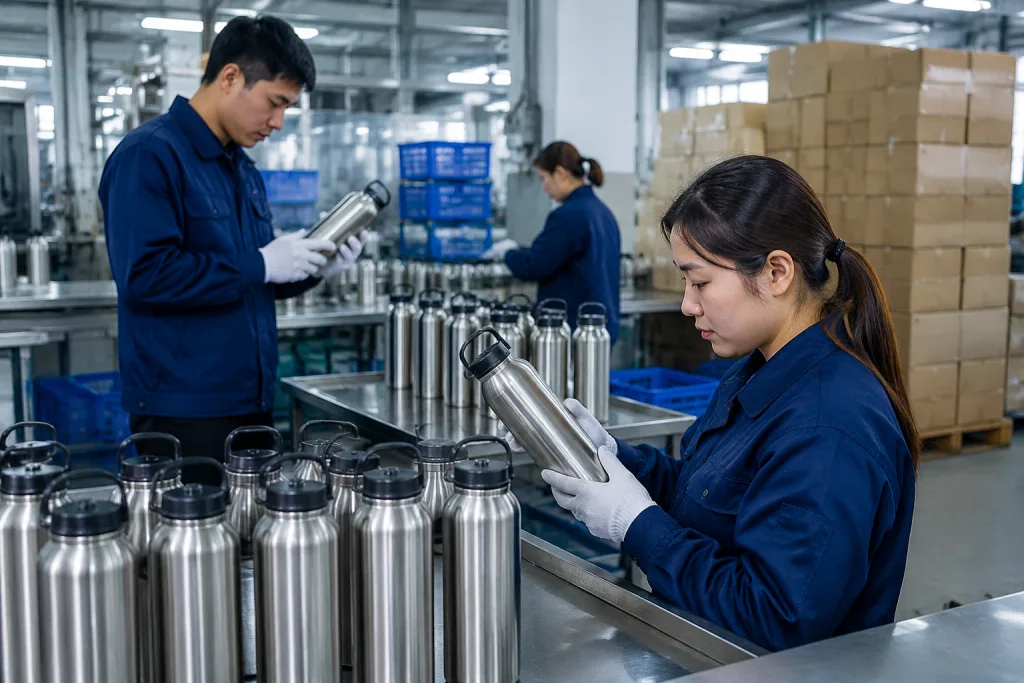
Key Takeaways
- A practical promotional products outdoor canteen order usually starts at MOQ 500-1,000 pcs and a 25-35 day lead time after sample approval.
- For most custom canteen jobs, stainless steel 18/8 with 0.4-0.5 mm wall thickness is safer for field use than thin single-wall plastic.
- Laser engraving is cleaner for premium canteen customized orders; silkscreen is cheaper at $0.15-$0.35 per color per piece.
- A serious canteen manufacturer should provide AQL 2.5/4.0 inspection, REACH documentation, and drop/leak test results before shipment.
You are not buying a mug with a logo. For a promotional products outdoor canteen order, you are buying a field-use item. It has to survive transport, 40°C swings, rough handling, and a client who will judge your brand by one leaking cap in a backpack. That is the first filter. Color is the wrong question. The buyer wants to know who carries it, for how long, and in what bag.
In Zhejiang, we run this order pattern every season. A distributor asks for 3,000 pieces for a sports promo. The brand team wants a cleaner premium look. Procurement wants a tidy FOB quote with no surprise carton charge. QC pulled the sample and checked the lid gap at 0.8 mm. The buyer flagged a loose cap after a drop test. We ship plenty of these. Lock function first, then print, then packing and QC. That saves 12 days versus 18 days on the back and forth. The math does not work any other way.
Start With the Use Case
Start with the use case, then talk decoration. A promotional products outdoor canteen for a hiking event rides in a pack, takes dust, goes through a 3-cycle wash rotation, and can sit in a parked car at 60°C. A trade-show canteen only has to look clean on day one. Different job, different spec. That changes the material, the cap, and the carton divider. We had a buyer once order a flat-packed canteen that failed its first drop test because QC never checked the inner supports.
For outdoor use, I narrow the spec to three paths. Stainless steel single-wall if weight matters and the drink does not need to stay hot past lunch. Insulated double-wall if the buyer wants a premium retail look; we run a 4-hour thermal retention test on that line. Tritan or food-grade PP if cost and freight are tight, but the heat limit and hand feel drop with it. The math does not work if you mix the wrong material with the wrong event. If you are building a custom drinkware program for a distributor, put the use case in the PO. Not in email. Not in WeChat. In the PO. One buyer once typed “outdoor camteen” on the order; that typo cost us a day because the sample room pulled the wrong cap spec.
Do not let the first call drift into artwork. Ask the canteen vendor for a recommendation tied to temperature retention, impact resistance, and carry weight. That is how you avoid a custom canteen that looks fine in render and falls apart in a pack test. We saw that go sideways last year: the buyer flagged the print as perfect, then the cap started leaking at a 30° tilt. QC pulled the sample back, checked the gasket with a 0.2 mm gauge, and the issue was obvious.
Choose the Body Material
Material choice drives scrap. For outdoor canteen orders, 18/8 stainless steel is still the workhorse. It takes abuse, resists corrosion, and clears customs paperwork without drama. We run single-wall bodies at 0.4 mm to 0.5 mm wall thickness and insulated shells at 0.5 mm to 0.6 mm. Go under 0.35 mm and dents show up fast, especially when cartons ride 7 layers high on a 40HQ pallet. QC pulled the sample on one German order last year and found a 12% damage rate from 0.3 mm test pieces. The math does not work.
Tritan has a place. A canteen customizable in clear Tritan comes in about 30% lighter than the stainless version, which helps when we ship 5,000 units to a race expo by air. For a rugged outdoor canteen, though, this is the wrong question to ask. Clear bodies pick up microscratches within a month of daily use, and budget polypropylene starts feeling flimsy after the 500-unit mark. Aluminum can work, but coating quality decides the result. We ask for the coating system, curing temperature, and dishwasher cycle rating on the first call. If they stall, the line is weak. On one run, the buyer flagged a lid that fit loose by 1.2 mm.
- Best for rugged outdoor use: 18/8 stainless steel
- Best for lower freight weight: Tritan or PP
- Best for premium gifting: double-wall insulated stainless
When we source from China, we skip the sales sheet and ask for material declarations with traceable heat numbers and a third-party test report. A solid canteen manufacturer sends the files over clean. One buyer once flagged a PO typo on the grade code, and we caught it before the mill cut 800 kg of wrong stock. We have seen this go sideways. The ones who write "standard quality" are telling you what their QC table looks like.
Lock the Branding Method
Branding is where orders slip. Buyers chase the lowest mark-up, then the logo lands thin and washed out. For a custom canteen, the decoration has to match the campaign value. If the job needs a premium look, laser engraving is the cleanest route. It does not peel, it holds through washing, and it works on stainless surfaces. Silkscreen gives you room for color logos and usually runs around $0.15-$0.35 per color per piece, depending on coverage and quantity. We checked that on a 1,200-piece run last month, and QC pulled three samples where the ink looked fine on the flat blank but softened on the curve.
For promotional products outdoor canteen programs, I send corporate gifting to laser, mass giveaways to silkscreen, and heat transfer only when the artwork is too busy for direct print. That split holds. If the buyer wants a full wrap or a gradient on a canteen custom order, lock the print tolerance before sample sign-off. A digital mockup is not the production piece. Ink density shifts, the body radius changes, and the logo can move 1-2 mm if the pad setup gets rushed. We had a PO with the artwork file name wrong by one letter, and the buyer flagged it after the first article came back. The math does not work if you fix that on the line.
Ask the canteen supplier for a decoration proof on the exact body shape, not a generic blank bottle file.
That one request saves days. It also shows whether the canteen suppliers you are dealing with actually run production, or just resell catalog stock. We ship proof plates off the laser machine before we greenlight mass printing, and that usually tells the story fast. On a 24-hour turnaround, the difference between a real factory and a middleman shows up in the proof, not the pitch.
Set the MOQ and Price Floor
Work backward from landed cost. That is the clean way. For a standard customized canteen in stainless steel, we usually set the MOQ at 500-1,000 pieces. QC pulled a 316 sample at 500 pcs last week, and the buyer pushed for 300; the math does not work, because the line setup and print screen fee do not shrink that far. Some canteen manufacturers will take a trial run below that, but the unit price jumps fast. For a basic single-wall stainless model, FOB China can start around $2.20-$3.80 depending on size, steel grade, and print method. Double-wall insulated models usually land in the $4.50-$8.50 range before freight. We run this every week, and 12 days vs 18 days at the same spec is usually the gap between a normal order and a forced rush.
Do not compare only the ex-factory number. A distributor canteen program with hanging tags, retail cartons, and shrink wrap can add $0.20-$0.60 per unit before you even book ocean freight. We had a PO once with a typo on the carton count, and the buyer flagged it after packing; that kind of miss burns time on the line. If you need serialized labels or Amazon prep, the cost climbs again because FNSKU stickers, polybags, and carton marks have to be controlled one by one. That is normal. This is the wrong question to ask if you only chase the lowest FOB; the margin is in the pack spec, not the headline price. A carton miscount on a 52 x 38 x 28 cm shipper can wipe out the spread fast.
When you ask a canteen distributor or canteen vendor for a quote, ask for four lines: body, print, pack, freight readiness. A serious offer from China should say FOB Ningbo, FOB Shanghai, or EXW Zhejiang. We ship on those terms every week, and a vague term usually means somebody has not checked the carton size, which was 52 x 38 x 28 cm on one recent order. If the term is vague, the price is not ready for procurement. QC pulled the sample at 0.8 mm wall thickness before we released the quote, and that saved a back-and-forth later.
QC the Sample Before Mass Production
Do not approve a sample because it looks fine on a desk. We had one buyer flag a cap that passed visual check, then failed after 20 minutes in a 70°C fill. For a promotional products outdoor canteen, the line should run a short test plan: seal first, finish next, drop last. On a stainless model, we run a leak test at full fill, a 1-meter drop on six faces, and a coating rub check after 100-200 dry wipes. If it is double-wall, add a temperature retention check under controlled room conditions. Simple. Weak samples show up fast.
Ask the canteen factory to run the same checks on the pre-production sample. A real factory will show process control records, not just a nice photo. Look for AQL 2.5 on critical defects and 4.0 on major defects in the shipment inspection plan. On a 5,000-unit order, third-party inspection before loading is the right call; the math does not work any other way. We ship enough orders from Zhejiang to know QC is paperwork, a signed sample, the artwork proof, and the packing spec locked before production starts.
If your buyer group includes a distributor canteen program across multiple channels, ask for one extra retained sample from each lot. That one sample saved us on a claim when a buyer came back three months later with a dent complaint and a typo on the PO. It is cheap insurance. QC pulled the sample, logged the lot number, and that was the end of the argument.
Check Compliance Early
Europe and North America do not treat compliance as paperwork you file later. A custom drinkware order can trigger REACH checks, food-contact files, and state packaging rules, depending on where it lands. We had a 5000-unit PO sit for 11 days because the carton said one thing and the insert said another. Stainless steel needs material declarations, and the cap or gasket needs food-contact test data, not a sales sheet with a green tick.
For a canteen manufacturer shipping from China, we run the file before final payment: commercial invoice, packing list, product photos, test references, and carton labels that match the PO line by line. QC pulled the sample with a 0.3 mm gasket offset once, and the buyer flagged it before it turned into a claim. If they ask for ASTM or ISO on leak, drop, or coating adhesion, ask for the exact standard code and the test lab name. The math does not work when a supplier says "we have it" and stops there.
School, sports, and public giveaway channels need packaging and warning text treated as compliance, not decoration. One missing sentence on a carton can hold a shipment at destination even when the canteen itself passes. We have seen that go sideways on a 20 kg carton mix, and this is the wrong question to ask whether the product "looks fine" if the label is wrong.
Plan Packing and Freight
Packing is where canteen margin gets squeezed out fast. A canteen has to keep the cap from deforming, keep the body off the finish, and survive the run from the line to the truck. We usually ship export orders from Zhejiang with 1 inner box per piece, then a 24-piece or 36-piece master carton. That gives us a clean count and better crush resistance. On a matte powder coat, QC pulled the sample and the scuff showed in 6 seconds under a desk lamp, so we add an inner sleeve or microfiber bag every time.
Freight planning matters just as much. A custom canteen packed at 800 g moves differently from a 180 g single-wall version, and on 10,000 units that gap can add several hundred dollars to ocean freight. The buyer flagged the carton size after we quoted unit price only. That is the wrong question to ask. We need carton size, gross weight, and pallet pattern before booking. If the channel is Amazon, tell us early so FNSKU placement and over-box rules are set before the goods leave Hangzhou; fixing it in the warehouse usually costs 12 days, not 2. The math does not work any other way.
Good export work is boring in the right way: clear carton marks, stable stacking, and a pallet height that stays under the limit. We saw this go sideways on a PO with one typo in the carton mark, and the whole batch sat in Ningbo for relabeling. Keep it plain. We ship better when the paperwork matches the pack-out sheet.
Choose the Right Factory Partner
You do not need the loudest pitch. You need a canteen factory that holds the same finish for 12 months without drift. Ask how many units they run each month, the MOQ on that exact model, and sample-to-mass-production time. At BottleForge Industrial in Zhejiang, one stable program runs at 300,000 units per month across drinkware lines, with samples in 5-7 days and mass production in 25-35 days after approval. We ship off those numbers, not brochure noise.
Compare factory control, not catalog size. Can they show weld consistency, coating thickness, cap torque checks, and carton drop test records? Can they keep a canteen customized order on the same material when the line is already loaded? Can they tell you whether one body can cover a custom growler style, a sports canteen, or a distributor growler promo without new tooling? QC pulled the sample on a 0.2 mm wall-spec mismatch once, and the buyer flagged a PO typo before we cut steel. That is the gap between a real canteen factory and a trading desk.
For buyers in Europe and North America, the better partner gives plain answers on day one. I would push back hard on polished samples without production proof. We've seen that go sideways at 8,000 pieces, and the deadline does not care. A good factory will show you the press, the torque tester, and the inspection sheet before you place the order. This is the wrong question to ask: "Do you have a nice sample?" Ask instead what the line can hold when the MOQ lands and the carton count starts moving.
Request a factory quote with real specs
Send your target quantity, material, logo method, and delivery port. We will quote the canteen, packing, and lead time with no guesswork.
Frequently asked questions
What is the usual MOQ for a promotional products outdoor canteen order?
For standard stainless or plastic models, MOQ is commonly 500-1,000 pieces. If you need a special cap, custom color, or full-wrap print, the MOQ may move to 2,000 pieces because of setup waste and packing changes. A trial order below 500 pieces is possible, but the unit price usually rises by 15-30%. For repeat programs, a canteen factory in China will often hold the tooling and packaging spec once the first run is approved.
How long does sampling and production take in Zhejiang?
A normal sample takes 5-7 days if the body and cap are already in the factory’s system. Custom molds, new colors, or special packaging can push that to 10-15 days. After sample approval and deposit, mass production is usually 25-35 days for a mid-size order of 3,000-10,000 units. If you need drop testing, third-party inspection, or carton redesign, build in another 5-7 days. Zhejiang factories can move fast, but only when the spec is stable.
Which print method is better for a canteen custom order?
Laser engraving is better when you want a durable, premium mark that will not peel or fade. Silkscreen is better when your logo needs color and the budget is tight. On stainless bodies, laser often looks cleaner after repeated washing. Silkscreen is usually cheaper by about $0.15-$0.35 per color per unit, depending on quantity and coverage. For a customized canteen used outdoors, I would lean toward laser unless the campaign needs strong brand color.
What compliance documents should a canteen supplier provide?
At minimum, ask for material declarations, food-contact related component information, REACH-related support if you are shipping into Europe, and carton labels that match the PO. If the order includes plastic parts, request BPA-free confirmation tied to the resin spec. For quality control, ask for AQL inspection terms, drop test references, and leak test records. A serious canteen supplier should also share product photos from the production run before shipment so you can compare them to the approved sample.
Can I use one design across custom drinkware and custom growler programs?
Sometimes, but do not assume the same body works for both. A custom growler usually needs a different neck, cap torque, and wall structure than a hydration canteen. You can often reuse artwork, color, and branding rules across custom drinkware lines, but the engineering spec should be reviewed separately. If you are building a distributor drinkware range, I would treat the canteen and growler as two product families and ask the factory to quote them separately so the pricing and QC are honest.