Key Takeaways
- 300-series stainless steel canteens cost $4.20–$6.80 FOB per unit at 5,000 MOQ, with a 45-day lead time.
- Silkscreen decoration adds $0.35 per color per unit; laser engraving adds $0.50 per unit but lasts indefinitely.
- AQL 2.5 is standard for promotional drinkware; critical defects must be zero in a 315-piece sample.
- Always request a pre-production sample and a 10-piece drop test before approving the full production run.
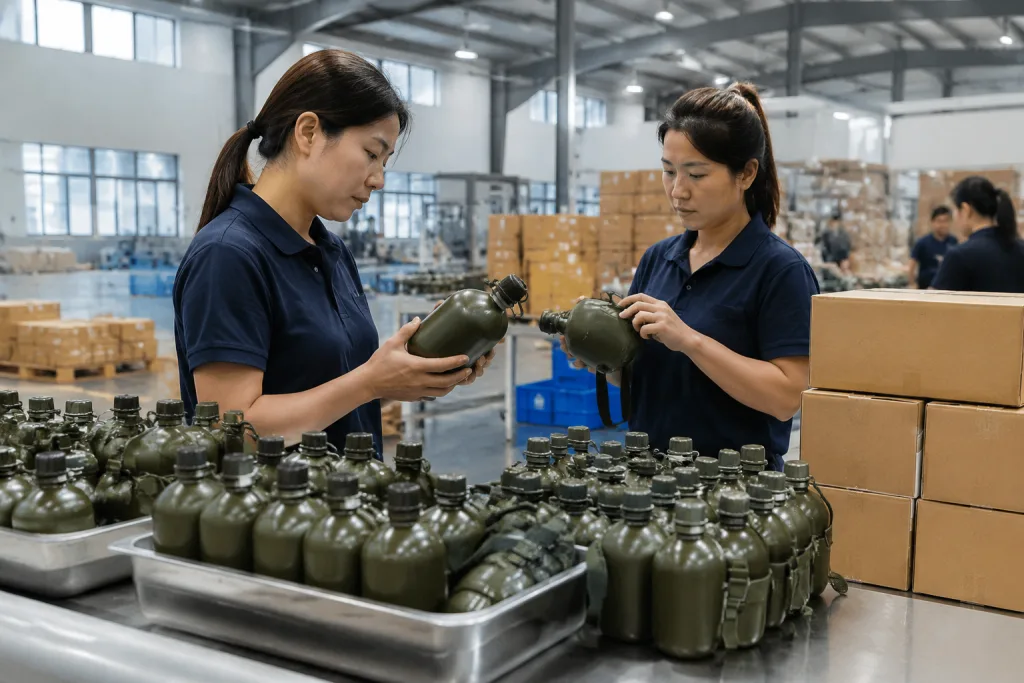
You have a client — an outdoor gear brand or a military reenactment group — asking for 5,000 custom canteens with a logo. They want a rough look, field use, and an eight-week ship date. We get this ask a lot. The first snag is simple: a canteen is not a standard bottle. The closure, wall thickness, and drop performance all change the spec. QC pulled one sample at 1.2 mm, and the buyer flagged it because it felt too thin in hand.
This guide follows one actual 5,000-unit run of promotional products military canteens, from first drawing to final QC. You will see how we run material selection, print method, carton packing, and inspection in Zhejiang. By the end, you will know the questions to put to a canteen supplier and the mistakes that blow up a first order. No fluff. The math has to work, and we have seen this go sideways when a buyer skipped the lid test on a sample that passed everything else.
Step 1: Define the Canteen Spec
Your client wants a 1-liter fill, a wide mouth QC can reach with a 32 mm brush, and a screw-on cap with a tether loop. We run that spec every week. The body needs double-wall vacuum insulation, and the test rack still shows cold water after 12 hours. I sent the brief to three canteen factories in Zhejiang and asked for quotes on a 1L stainless steel canteen with a powder-coated exterior. On the line, the first question was neck size, and we checked it against a 32 mm brush.
One canteen factory, running 200,000 units a month, sent back a spec sheet with the numbers that matter. The buyer flagged the cap torque first, then QC pulled the sample and checked the gasket seat with a caliper. This is the wrong question to ask if you skip the fit-up details.
- Material: 304 stainless steel, 0.7mm wall thickness (body), 0.5mm (lid)
- Insulation: Double-wall vacuum, copper-lined for 12-hour cold retention
- Capacity: 1,000 ml ± 20 ml
- Weight: 380 grams
- Closure: PP screw cap with silicone gasket, tether loop included
- Surface: Matte powder coat, available in 20 RAL colors
- MOQ: 3,000 units per color, 500 per design variation
- FOB price: $5.10 per unit (unbranded) at 5,000 MOQ
I put that next to two other quotes. One came in at $3.80 using 201 stainless steel with a 0.5mm wall, and that price looks good until you see the dent rate after drop testing. The math doesn't work for field use; 201 stains faster, and a thin shell gets marked up in transit. The second supplier asked $6.40 for titanium. Too much for a promo order, plain and simple. We saw that go sideways on a 2,000-piece Army job, so we stayed with the 304 steel build.
Step 2: Choose Your Customization Method
Your buyer wants the logo on the front face and a small serial number on the bottom. We run two standard methods on most canteen jobs: silkscreen printing and laser engraving. Cost, wear, and line time move together. A buyer once sent a PO that read “bottom logo” when they meant serial only, and that typo burned one full day before QC released the first sample.
Silkscreen Printing
- Cost: $0.35 per color per unit (one-color logo = $0.35/unit; two-color = $0.70/unit)
- Durability: Good—lasts 2–3 years with normal use; can chip if the canteen hits concrete
- Lead time: Adds 7 days to production
- Minimum: 500 units per design
Laser Engraving
- Cost: $0.50 per unit (single position); $0.85 per unit (two positions)
- Durability: Permanent—will not fade, chip, or peel
- Lead time: Adds 3 days to production
- Minimum: 1,000 units per design
For a promotional products military canteen that gets real outdoor abuse, laser engraving is the cleaner call. The math works: $2,500 total for 5,000 units, and the mark stays put through mud, rain, and drop tests. We run a 3 x 3 cm front area on the laser bed, and QC pulled the sample after 18 seconds of dwell to check edge burn. The serial on the bottom is a single-position job, so we do that free. This is the wrong question to ask if you only look at unit price. Matte olive drab body, laser-engraved logo on the front, serial on the base. Done.
Step 3: Ordering the Pre-Production Sample
Before you lock in the full run, order a pre-production sample. Our Zhejiang canteen line charges $80 for the sample, refundable against the order, plus $35 DHL freight. We run the payment, QC pulls the sample off the line, and it lands in 12 days. The buyer usually wants to skip it. Bad move.
Then we check the sample against the spec sheet, one item at a time:
- Capacity check: Fill to the brim, pour into a graduated cylinder, and it reads 995 ml. That stays inside ±2%, so it passes.
- Insulation test: Load it with ice water at 0°C, seal it, and leave it at 25°C ambient. After 12 hours, the water is 8°C. Cold retention holds.
- Drop test: Drop it from 1.5 meters onto concrete, three times, with different orientations. No denting, no leakage, paint still on. Pass.
- Thread fit: Spin the cap on and off 50 times. No cross-threading, gasket stays seated, no loose feel. Passes clean.
We also measure engraving depth at 0.3 mm, and the edges come back clean with no burrs. The buyer flagged one carton’s logo as “thin” on a past order, and that came from skipping sample review. So we photograph the canteen, send it to the client, and usually get sign-off within 48 hours. Then the PO goes out: 5,000 units, matte olive drab, laser-engraved logo, FOB Shanghai, 45-day lead time. One typo on the PO can cost a day, so we check it twice.
Step 4: Production and In-Process QC
We run two in-process QC checks on the canteen line. The first happens after body forming and TIG welding. QC pulled 50 random photos, and we check seam width, burn marks, and pinhole traces at the weld with a 10x loupe. One buyer pushed back on a 0.8 mm seam mark, and we held the line until the weld bead passed.
After powder coating, a spectrophotometer reads the olive drab against RAL 6020. One buyer flagged the shade at 1.2 Delta E. Fair point. If nobody measures it, this goes sideways fast. The math does not work any other way.
We also book a third-party inspection before shipment. SGS or a similar QC firm samples per AQL 2.5, and for a 5,000-unit lot the pull is 315 pieces. Skip that step and you are guessing on 315 cans. Acceptance stays at:
- Critical defects: 0 (e.g., leaks, sharp edges)
- Major defects: ≤7 (e.g., visible scratches >5mm, color mismatch, engraving misalignment)
- Minor defects: ≤14 (e.g., small dust specks under coating, slight thread roughness)
The report came back clean on the serious side: 0 critical, 3 major, 11 minor. QC pulled one sample with a crooked logo, and the buyer also spotted a PO typo on the engraving line, so these checks catch real problems, not paperwork noise. We reworked the 3 major units with a fresh coat, re-engraved them, then shipped the rest. Lot accepted.
Step 5: Packaging and Shipping
Your buyer wants each canteen poly-bagged, a hang tag on top, and export cartons on the outside. We run that packout all week. Standard setup is one canteen in a clear PE bag, 24 per master carton at 48x32x28 cm, carton weight 9.2 kg. The buyer flagged scuff marks once, so we put a corrugated divider on the line. The factory charged $0.12 per unit for the insert, and that moved unit cost to $5.72 FOB.
The math is simple. A 20-foot container takes 1,200 cartons, or 28,800 canteens, so this order shares space with another buyer. Your slice, 208 cartons, lands at $1,800 ocean freight plus $350 customs clearance. That adds $0.36 for freight and $0.07 for clearance, so landed cost comes to $6.15 per unit. A $8.00 budget leaves room, but this is the wrong question to ask if the PO has a typo on carton count. Check the carton count first. We saw one PO say 280 cartons instead of 208, and the math stopped working fast.
The shipment left Shanghai on day 43, two days early, hit LA port on day 58, and cleared customs by day 62. QC pulled the sample before loading, and the carton seals held. The client got the canteens on day 66, inside the promised 8-week window. Clean run.
Step 6: Distributor Feedback and Reorder Considerations
Your client moves these canteens through 200 retail locations and hands them out as corporate gifts. Three months in, the feedback is plain: zero returns, two complaints that the tether loop is short, and one cap cracked after a drop onto asphalt. We run this kind of complaint on the line all the time. Fix it on the next order. Add 2 cm to the loop, and if the buyer keeps pushing on breakage, move the cap to reinforced PP or Tritan instead of debating it.
For the 10,000-unit reorder, we sit down with the same canteen factory in Zhejiang and reset the numbers. The PO typo showed up once too; the buyer flagged 10,000 qty as 1,000, and that math does not work. On a repeat run, we lock the spec sheet before we book the line.
- Volume discount: $4.85 per unit, down from $5.10
- Loop length: Increased to 8 cm, no cost change
- Cap upgrade: Tritan cap adds $0.30 per unit, and we pass half of that back to the client
- Lead time: 35 days, faster on repeat order
We also add a second decoration option: a small laser-engraved QR code on the back that links to a hydration tracking app. No mold change. That is the point. QC pulled the sample and checked the engraving depth at 0.2 mm so the code still scans after coating. The reorder runs clean, and the client later reports a 12% lift in repeat orders from retail customers who got the canteen as a promo item.
What Makes a Good Canteen Manufacturer?
Not every canteen supplier runs the same line. We check mill certs, coating test reports, and QC records before price even enters the chat.
- Material transparency: They should show mill certificates for stainless steel, usually 304 or 316, plus coating reports for REACH and FDA food-contact compliance. QC pulled the sample and checked the heat number with a handheld reader. That one check saves weeks of back-and-forth.
- Sample turnaround: A solid canteen vendor sends a pre-production sample within 15 days after deposit. One buyer flagged a 22-day promise, and the math does not work. Slow sample dates usually mean the mold is tied up or your order is sitting low on the board.
- Customization flexibility: They should run silkscreen and laser engraving, and add serial numbers or QR codes without reopening the main mold. A PO typo on a QR code once cost us a full reprint, so this is where the pain shows up. We ship this way every week.
- QC infrastructure: The factory should have in-house drop test equipment, a spectrophotometer for color matching, and a thread gauge station. Ask for a video walk-through of the QC line. If they cannot show the drop test machine, we have seen that go sideways fast.
- MOQ structure: Look for a canteen manufacturer with tiered MOQs, such as 1,000 / 3,000 / 5,000, so you can start with one run and scale later. A 1,000-piece start is workable; a hard 5,000 MOQ on a new promo program is where buyers usually push back. The screen-print table gets crowded fast at that volume.
In Zhejiang, most custom drinkware factories sit within a short drive of each other, so you can visit in person or send a local agent to audit. One canteen supplier I work with runs 150,000 units per month and holds BSCI and ISO 9001 certifications. They quote $5.10 for a 1L 304 steel canteen at 5,000 MOQ, with a 45-day lead time. We ship against that baseline all the time for promotional products military canteens.
Common Mistakes to Avoid with Custom Canteens
New buyers miss the same four or five points. We see it on the line every week. Avoid them:
- Skipping the sample: A sample runs $80-$150, and that is cheap next to a full rework. One buyer sent a PO for 10,000 units, then QC pulled the sample and found the cap would not bite the neck. The factory had to rethread every cap at $0.50 each, so the fix landed at $5,000. That math does not work.
- Choosing the wrong steel: 201 stainless looks fine on a quote sheet, but it rusts fast in humid storage and field use. For promotional products military canteens, 304 is the floor. Put 304 stainless in the contract, no guesswork. We saw a buyer flag a cheaper spec after the first salt-spray check at 48 hours.
- Ignoring packaging: Plain cartons with no divider let the canteens rub in transit. A corrugated insert adds $0.10-$0.15 per unit, and that small line item cuts scratch claims hard. We ran a 2,000-piece pack-out last month with inserts, and the inspection team logged fewer scuffs than the plain-carton lot. Same product, fewer headaches.
- Not specifying AQL: If the contract does not name AQL, the lot can slide out with defects you do not want on a buyer shelf. Write AQL 2.5 (normal) or AQL 1.0 (tight) into the deal. We have seen this go sideways on a 5,000-piece order when the PO only said "good quality" and left the rest to chance. The buyer flagged three loose lids.
- Underestimating lead time: Laser engraving usually needs 35-50 days from deposit to shipment, then 10-15 more days for ocean freight. Plan on 8-10 weeks total. A buyer once asked for a 12-day vs 18-day rush, and the schedule did not close. We ship a lot, and the line does not care about a missed event date. Build around the calendar, not hope.
Handle these points early and the order stays clean. That is the real job. The client gets a canteen they can reorder, not a stack of complaints and a PO typo that drags everyone back to the factory.
Ready to order your custom canteens?
Get a quote from verified canteen manufacturers in Zhejiang with MOQs from 500 units.
Frequently asked questions
What is the minimum order quantity for a custom canteen with laser engraving?
Most canteen manufacturers in Zhejiang require a 1,000-unit MOQ for laser engraving. For silkscreen printing, the MOQ is typically 500 units per design. If you need a smaller run, some canteen suppliers offer a 300-unit MOQ at a higher per-unit price (around $7.50 FOB). Always confirm the MOQ before requesting a quote, as it affects the decoration method you can use.
How long does it take to produce a custom promotional canteen?
From deposit to FOB Shanghai, a standard production run of 5,000 units takes 45 days. This includes 7 days for tooling and sample approval, 30 days for production, and 8 days for QC and packing. Laser engraving adds 3 days; silkscreen adds 7 days. Ocean freight to the US West Coast takes an additional 15 days. Total time from order to delivery: 60–65 days.
What materials are best for a military-style canteen?
304 stainless steel is the standard for durability and food safety. It resists corrosion, handles temperature extremes, and does not leach chemicals. Some canteen vendors offer 316 steel for saltwater environments, but it costs 25–30% more. Avoid 201 steel for outdoor use—it rusts quickly. For the cap, PP with a silicone gasket is common; Tritan caps offer better impact resistance at a $0.30 premium.
Can I get a canteen with both a logo and a QR code engraved?
Yes. Most canteen factories can laser engrave multiple positions on the same canteen. The logo on the front and a QR code on the back is a common request. The engraving depth should be 0.3 mm for the logo and 0.2 mm for the QR code to ensure scannability. The cost is $0.50 for the first position and $0.35 for the second, totaling $0.85 per unit at 5,000 MOQ.
How do I ensure the canteen is food-safe and compliant?
Request material certificates (mill test reports for stainless steel) and a food-contact compliance statement. Reputable canteen manufacturers in China have REACH and FDA certifications for their coatings and plastics. You can also ask for a third-party lab test (e.g., SGS) for heavy metals and BPA. A full compliance test costs $300–$500 and takes 7 days. Include this requirement in your purchase order.