Key Takeaways
- MOQ for custom logo kids bottles typically starts at 3,000 units per SKU from Zhejiang factories.
- Lead time for a first bulk order with custom printing averages 35 days from deposit to FOB Shanghai.
- AQL 2.5 normal level II is the standard inspection for bulk kids bottle shipments under 50,000 units.
- Tritan copolyester and 304 stainless steel are the two most common materials for promotional products kids bottle orders.
You need 5,000 custom kids water bottles for a school district wellness program. Budget is tight — $3.10 per unit FOB Ningbo. Deadline is eight weeks out. Client wants a BPA-free, dishwasher-safe bottle with a two-color logo. We've sourced small-run kids bottles before, but 5,000 pieces with ASTM F963 and California Prop 65 compliance? That changes the math. One missed certification and QC pulls the entire batch.
Here is the real order path: spec the bottle, pick a material that won't crack at 2.2 mm wall thickness, negotiate MOQ down from 10,000 to your number, approve a sealed sample before production, and run a final AQL 2.5 inspection at the factory. We ship from Hangzhou. This is what a reliable manufacturer looks like — and the traps that cost buyers six weeks and $8,000 in rework.
Define Your Specs First
Before you call a factory, nail down three specs: capacity, material, closure. Get these wrong and you'll be sitting on a shipment of bottles nobody wants.
For school district giveaways, we run 420–500 ml. 400 ml is too small—kids finish their drink and the bottle sits empty. 500 ml holds a full lunch portion but still fits in a backpack side pocket. One buyer pushed us to 350 ml and came back six weeks later asking for a reorder at 480 ml. Wide mouth matters. 48 mm minimum. Anything narrower and you can't get a sponge inside, let alone ice cubes. We've had QC flag mold buildup in 38 mm necks on two separate inspection visits.
Material sets your price floor and compliance path. Tritan copolyester—shatter-resistant, BPA-free, top-rack dishwasher-safe. At 5,000 units, a 500 ml Tritan bottle with a push-pull cap lands between $1.20 and $1.80 FOB Zhejiang. 304 stainless double-wall runs $2.50–$4.00 FOB, same volume. Better insulation, heavier feel. But for promotional kids bottles, Tritan wins on weight and unit cost. The math doesn't work for stainless at giveaway budgets unless the brand wants a premium tier.
Don't skip closure testing. Flip-top straw caps work for kindergarteners—one-handed, no small parts to drop. But a screw cap with a tethered lid eliminates lost caps entirely. We've seen a buyer order 10,000 flip-tops for a pre-K campaign, then get complaints about straws chewed through in two weeks. Order samples of both closures. Hand them to actual kids. Watch what breaks. Better to find out before you pay for a custom mold.
Vet the Factory, Not Just the Price
You get quotes from three kids water bottle factories in Hangzhou. Ask each for their BSCI or SMETA audit, their ISO 9001 cert, and ASTM F963 test reports from the last 12 months. Any shop moving 500,000 units a month out of Zhejiang keeps these in a shared drive. Hesitation or a generic PDF—stop returning calls.
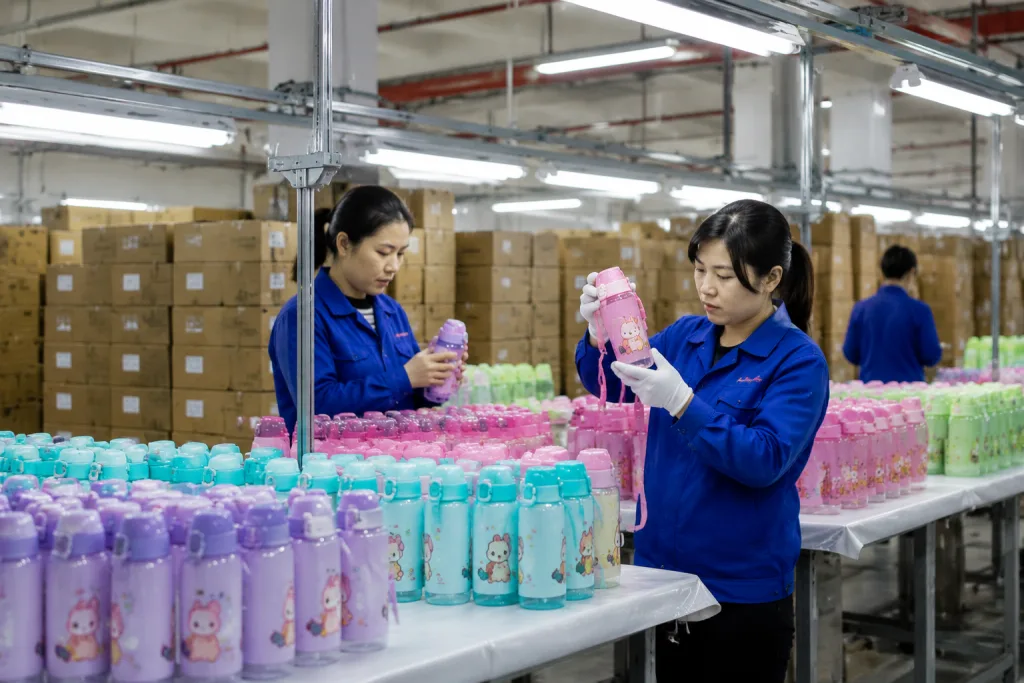
I walked a factory near Hangzhou last year running bulk kids bottles. Twenty-eight injection presses in the molding hall, running Tritan and PP in eight-hour cycles. QC pulled samples every shift and tested for impact resistance, cap torque, and BPA leaching. They quoted 3,500 units per SKU MOQ for a Pantone-matched cap and body. Lead time: 30 days first order, 20 days on repeats. That's the floor, not the ceiling.
Alibaba reviews are a starting point. Ask for a video call and watch the production line live—point the phone at the QC bench. Ask what happens to rejected units: rework or scrap? A factory that keeps a non-conformance log and shows it without hesitation. That's the one you ship with.
Sample Approval: The Three-Stage Process
Skip the sample stage and you'll regret it. For a custom children water bottle, we run three rounds: an unprinted sample to check fit and finish, a printed sample to confirm logo placement and color, and a production sample pulled from the first 500 units of the bulk run.
Round one costs $50–$100 plus shipping and takes 10 days. Check wall thickness — minimum 1.2 mm for Tritan — cap seal tightness, and overall weight. Round two adds your logo via pad printing or silkscreen. For two-color logos on a curved surface, silkscreen is sharper but slower. Pad printing works well for smaller designs. Confirm the ink adhesion with a tape pull test (ASTM D3359). We've seen this go sideways when a buyer skipped the tape test and the logo peeled after three dishwashers.
Round three is the most important. The factory pulls 10 bottles from the first production batch and ships them to you. Run a fill test, a drop test from 1.2 m onto concrete, and a dishwasher cycle. If any bottle leaks, cracks, or loses its logo, stop the order and demand root cause analysis. QC pulled a sample last month that cracked at the thread ring — the mold needed rework before we shipped a single case.
Pricing Breakdown for 5,000 Units
5,000 units of a 500 ml Tritan kids bottle with a two-color logo. Here is the real cost breakdown, FOB Shanghai.
- Unit price: $1.45 each
- Custom mold fee for cap and bottle: $2,800 (amortized over first order)
- Silkscreen setup (two colors): $350
- Packaging (individual polybag + 24-unit master carton): $0.18 per unit
- Total FOB value: $7,250 + $2,800 + $350 + $900 = $11,300
Shipping to a US West Coast port runs $1,200–$1,800 for a 20-foot container. Customs brokerage and duties add 3.5%–5.4% depending on the HS code — usually 3924.10 for Tritan bottles. One buyer we worked with got hit with 5.4% because the broker misclassified the lid as "other plastic articles." Check the code yourself. A QC pulled that PO and flagged the tariff line before it cleared Long Beach.
If you are a children water bottle distributor, negotiate the mold fee down by committing to a second order within 12 months. We have seen factories waive the mold fee entirely for 10,000+ units per SKU — but only if the bottle design is standard, not a custom shape. That $2,800 mold charge stings less when it is split across 10,000 bottles at $0.28 per unit. The math works if you run two SKUs off the same cap tool.
QC Inspection Checklist for Bulk Orders
Bulk order's on the dock. You need boots on the ground—your own QC or a hired third-party inspector. Standard protocol: AQL 2.5, normal level II, single sampling. For a 5,000-unit run, that means pulling 200 bottles off the pallet. Your pass/fail line: 10 major defects or 14 minor. Cross either one, and the lot's toast.
Here's what we check on every single order:
- Visual: scratches, sink marks, and color match against the signed Pantone card. We had a buyer flag a 0.5 delta E on a kids' print last month—barely visible under warehouse lights, but enough to fail the shade. We now run the spectrophotometer on every sample pull.
- Cap torque: 8–12 in-lb for child-resistant caps. We caught a batch at 6 in-lb last spring—the line supervisor had swapped tooling and didn't re-zero the torque driver. QC pulled the sample, shut the line, and we reworked 1,200 caps before lunch.
- Leak test: fill with room-temp water, cap it, invert for 2 minutes. One drip and it's a fail. We've seen gasket creep cause intermittent leaks that pass on the first flip but fail on the third—so we run three cycles per sample now.
- Drop test: 10 bottles from 1.2 meters onto ceramic tile. Zero cracks allowed. We use the same 300×300 mm tile the EN 14350 lab uses. A hairline at the base radius counts as a failure.
- BPA migration: lab report must match the raw material cert from the resin supplier. If the batch numbers don't line up or the detection limits differ, we push back before the container seals. We've rejected a lot over a mismatch in the third decimal place—buyer's brand spec, not ours.
Failure rate above the AQL 2.5 threshold? Reject the lot outright. Demand 100% sorting or rework, and don't let the factory talk you into a "discount for acceptance." A factory that knows kids' bottles covers the re-inspection cost themselves. That's how we run—if we shipped it wrong, we pay to prove we fixed it.
Lead Time and Shipping Realities
You have 8 weeks. That's tight but we can hit it. Here's what the line looks like from our side:
- Week 1: Quote, spec finalization, and deposit (30% of total)
- Week 2–3: Mold prep and first-sample run
- Week 4: Sample sign-off and PO confirmation
- Week 5–7: Bulk production and QC pulls
- Week 8: Packing, loading, FOB Shanghai
Sea freight from Shanghai to LA runs 14–18 days. If your event is locked, order 10 weeks out minimum. Air freight will shave days but adds $3–$5 per kg — that can double your cost on a kids bottle order. I've seen buyers panic at that line item.
School district buyers with fixed calendars: add a 2-week buffer for customs and last-mile. One district we shipped to flagged a typo on their PO and lost 4 days. Don't let a form field cost you the delivery.
Compliance Certificates You Must Collect
I keep a compliance checklist pinned on the corkboard above my desk. For any kids bottle order shipping to the US or EU, we collect these five documents from the factory—no exceptions:
- ASTM F963 test report — mandatory in the US for anything classified as a toy or children's product. If the bottle has a cartoon sleeve or a sipper spout, customs will ask for this.
- CPSIA General Conformity Certificate — the importer's signature goes on this, but the factory's lab data backs it up. Without it, a US shipment can get held at port.
- REACH and RoHS compliance statements — EU buyers need both. RoHS covers heavy metals in the plastic and coating; REACH covers the full chemical inventory. Two separate scopes, one folder.
- California Prop 65 test report — if even one unit ends up sold in CA, you need it. We run phthalates and lead screening. The threshold for lead in a kids bottle mouthpiece is 100 ppm under Prop 65, tighter than FDA's general 1000 ppm for adult drinkware.
- FDA food-contact material declaration — applies to any component that touches liquid: the inner wall, the lid underside, the straw, the spout gasket. We collect a per-material declaration, not a blanket "bottle is FDA compliant" letter—those blanket letters don't hold up in a retailer audit.
Ask for these before you cut a PO. If the factory can't show a third-party report within 48 hours of your request, walk. Some smaller workshops in Zhejiang will hand you a self-declaration stamped with their own chop. That's not worth the paper. A lab report from SGS, Intertek, or TÜV carries weight with a customs broker and a US retailer's legal team. A self-declaration gets you a raised eyebrow.
Budget $500–$1,000 for a full compliance test suite if your factory's reports are older than 12 months. We retest every material revision—even a new silicone gasket supplier triggers a phthalate recheck. I've seen a $0.03 gasket swap invalidate a Prop 65 certificate and hold a 5,000-unit shipment for three weeks.
For promotional kids bottle campaigns, having these certificates on file isn't just liability protection. When your client's legal team asks for documentation, emailing a complete folder in 10 minutes is what keeps you in the preferred-vendor slot.
Packaging and Labeling for School Distribution
Your bulk kids water bottle order usually goes straight into students' hands or teacher gift bags. Each bottle needs its own pack and a clear label. We run polybags with a hang tag for most schools. Cheap. Fast. The tag can carry bottle capacity, material like Tritan or stainless steel, a BPA-free claim, and a dishwasher-safe icon. Last year one buyer tried to skip the hang tag to save 3 cents a unit. QC pulled the sample and flagged the missing capacity spec before the line ran.
If the bottle has a straw or other small parts, add a choking hazard warning for children under 3. This is not optional. US law requires it on any children's water bottle with removable components. Print it on the hang tag or on the bottle itself. Trying to squeeze that warning onto a tiny sticker is the wrong move. It peels in the wash, and we've seen that go sideways during a CPSIA audit.
Master cartons should hold 24 units, with a gross weight under 15 kg. Above that, handling gets awkward and the injury risk goes up. One school district flagged this after a teacher hurt her back. Mark each carton with the PO number, SKU, quantity, and country of origin. A good children water bottle vendor will send carton photos before loading. Ask for them if they don't. We had a client once receive 500 cartons with "kids botle" on the outer label. Typo on the PO. We caught it in the photo, reprinted, and shipped on time.
Ready to spec your custom kids bottle order?
Contact our sales engineers in Hangzhou for a detailed quote and compliance checklist.
Frequently asked questions
What is the typical MOQ for a custom logo kids bottle from China?
For a standard Tritan or stainless steel bottle with a custom Pantone-matched color and two-color logo, the MOQ is usually 3,000 units per SKU from factories in Zhejiang. If you order a stock color bottle with a simple one-color silkscreen logo, the MOQ can drop to 1,000 units. For fully custom molds (shape and cap design), expect a 5,000-unit MOQ and a mold fee of $2,000–$4,000.
How long does it take to produce a bulk children water bottle order?
A first-time bulk order with custom printing takes 30–40 days from deposit to FOB Shanghai. This includes 10 days for sample production and approval, 15–20 days for bulk manufacturing, and 5 days for packing and loading. Repeat orders with the same specs can ship in 20–25 days. Add 14–18 days for sea freight to the US or EU.
What compliance tests do I need for selling kids bottles in the US?
You need ASTM F963 (toy safety standard), CPSIA general conformity certificate, and California Prop 65 test results for BPA and phthalates. If the bottle is made of stainless steel, also request FDA food-contact compliance. A third-party lab report from SGS or Intertek is best. Budget $500–$1,000 for testing if the factory doesn't have recent reports.
Can I get a custom shape bottle for a school promotional campaign?
Yes, but a fully custom shape requires a new injection mold, which costs $2,000–$5,000 per part (bottle body and cap). Lead time for mold creation is 15–20 days. The MOQ for a custom shape is usually 5,000 units per SKU. If your budget is tight, choose a stock bottle shape from the factory's catalog and customize only the color and logo.
What is the best material for a promotional products kids bottle that is dishwasher safe?
Tritan copolyester is the top choice for dishwasher-safe kids bottles. It withstands top-rack dishwasher temperatures up to 100°C without warping or leaching. Stainless steel bottles are also dishwasher safe but can dent if dropped. Avoid polycarbonate (contains BPA) and acrylic (cracks in heat). Tritan costs $1.20–$1.80 FOB per 500 ml bottle at 5,000 units.