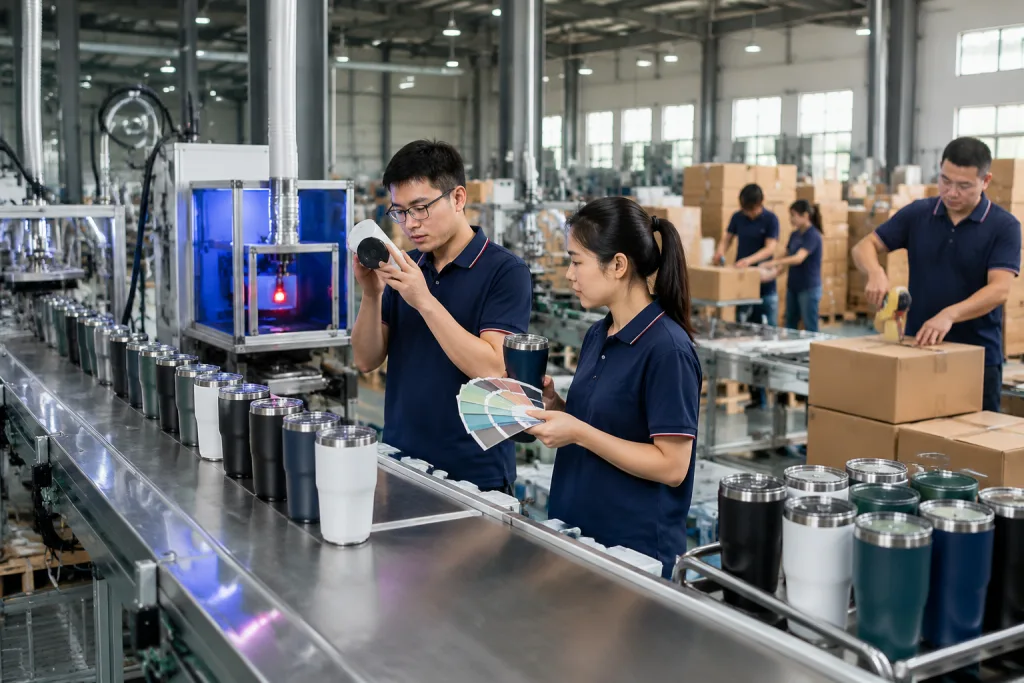
Key Takeaways
- Insulated tumblers from Zhejiang factories typically require a 1000-3000 unit MOQ per SKU, with FOB prices ranging from $3.50 to $8.00 depending on capacity and double-wall vacuum construction.
- Lead time for a first order of promotional products insulated tumblers averages 35-45 days, including 10-15 days for sample approval and 25-30 days for production.
- AQL 2.5 is the minimum acceptable quality standard for cosmetic defects; insist on ASTM or FDA-grade 304 stainless steel for food contact surfaces.
- Customization options like laser engraving, silkscreen, or pad printing add 5-10 days and $0.20-$0.80 per unit; full-color decals or wrap printing require higher MOQ and longer lead times.
You're sourcing a promotional products insulated tumbler for your next campaign. Trade show giveaway, corporate gift, or a retail SKU for your brand. You've seen the glossy catalogs. Now you need real numbers: MOQ, unit price, lead time, and proof the stainless steel won't leach or dent on first use. The problem is most suppliers treat you like a retail buyer, not a procurement manager who needs to hit a margin and a deadline.
We get these calls every week. Buyers want to know if our 18/8 stainless can pass FDA migration testing at 95°C, or how we hold the 0.5mm wall thickness across a 500-piece run. QC pulled a sample last month for a pinhole in the weld seam — we caught it before it shipped. That's the difference between a supplier and a broker who can't deliver. By the end of this guide, you'll have a checklist to vet any canteen manufacturer or canteen vendor in China. You'll know exactly what to ask when you request a quote for a customizable canteen or customized growler — starting with the right question: not "can you make it," but "what's your AQL on the vacuum seal?"
What Makes a Tumbler Truly Promotional-Grade?
A tumbler that cannot hold a logo is not promotion-grade. For this job, we run 0.4 mm to 0.5 mm wall thickness on both the inner and outer shells. QC pulled a sample last month and the print lifted after one dishwasher cycle; thin steel was the cause, not the ink. The math does not work. We use 304 stainless with a copper wrap on the inner wall, and the vacuum test report should show less than 5°C drop over 6 hours with 95°C water. Ask for that report before you approve the PO. If the factory cannot show it, you are guessing.
The lid is where weak suppliers save money. Standard spec is polypropylene (PP) with a silicone gasket, and we avoid metal springs inside because they rust after three washes. Check the BPA-free cert and a 24-hour leak test at 0.5 bar. For retail or distributor orders, ask for top-rack dishwasher testing at 65°C too. One buyer flagged us when lids warped after 12 cycles, so we switched to a thicker PP blend. It added 8 cents per unit, and the complaints stopped.
Customization Options: What Actually Works on Stainless Steel
For a custom canteen or customizable growler, decoration choice matters more than the mockup. We run samples on a 0.8 mm cup wall and the winner is usually the method that survives shipping, washing, and buyer pushback, not the prettiest proof.
- Laser engraving: Best on stainless steel. It is permanent, does not peel, and once the fixture is set there is no per-unit decoration cost. The mark sits slightly recessed; we can add black or white epoxy for contrast. Setup fee: $50-$100. Lead time: +3 days.
- Silkscreen: Good for logos with 1-3 colors. Each color needs a screen, around $30 each. Ink holds on powder coating, not on bare stainless. We do not recommend it for commercial dishwashers; QC pulled a test after 50 cycles and the edge fade was easy to see.
- Pad printing: Works on curved surfaces. Setup is $40-$80 per color. It fits small logos on the lid or bottom. Durability is in the same range as silkscreen. One buyer flagged a 12 mm logo on a domed lid and the line had to re-center the jig.
- Full-wrap decal: Strong shelf impact, thin adhesive film. Edges start to lift after repeated washing. Use it only for giveaway stock with a short service life. The math does not work for a retail tumbler.
For a canteen customized with a complex logo or photo, laser engraving with color fill is the most durable route. If you need a canteen customizable for multiple clients, ask your canteen supplier about a blank stock program. We hold unmarked tumblers in inventory and decorate after the PO lands, which cuts MOQ risk and keeps the line moving.
MOQ, Pricing, and Lead Time: The Real Numbers
MOQ, pricing, lead time — this is where deals live or die.
- MOQ: 1,000–3,000 units per color per SKU. Two colors? That's 2,000–6,000 units. Some shops will drop to 500 for a first run, but you'll eat a 20–30% unit premium. We've seen buyers sign off on that just to test a design — then reorder 5,000. The math on a 500-unit trial with tooling is ugly. Just plan for the full production MOQ.
- FOB (Shanghai/Ningbo): $3.50–$5.50 for 12oz, $4.50–$8.00 for 20oz or 32oz. That's single-color silkscreen. Multi-color or laser engraving adds $0.20–$0.80 per unit. Budget high if your artwork has fine lines — QC pulled a sample last month with a 0.1mm misalignment on a rush job. The whole lot got re-screened.
- Sample lead time: 7–10 days after design approval. You pay shipping — $50–$80 via DHL is normal. One buyer asked us to air freight samples on a Saturday. We did. They paid $110. The line ran a half-shift just for that.
- Production lead time: 25–30 days after sample approval. Then sea freight: 35–45 days to US West Coast, 45–55 to EU. Tight launch date? Air freight a partial batch. We just ran 200 units by air for a promo launch — landed 12 days after approval instead of 18 days by sea. The buyer's margin covered it.
Distributors miss one thing: compliance testing. EU market needs REACH and LFGB — roughly $300–$500 per SKU. US market, FDA and Prop 65, same range. A solid factory already has these reports on file for standard models. Ask before you commit. We keep ours in a shared folder. Buyers appreciate not having to chase.
Quality Control: What to Inspect and When
You will not stand by the line for every lot, so lock the QC gates before cartons close. That is how we run it here. Use this checklist for any canteen supplier or canteen vendor:
During Sample Approval
- Check vacuum insulation: fill with 95°C water, close the lid, then measure the outer wall after 1 hour. It should stay under 40°C. A buyer flagged a 42°C reading on one run, and QC pulled the sample; the inner wall was 0.1mm thinner than spec.
- Leak test: fill with water and turn it upside down for 30 seconds. No drips. No debate.
- Logo alignment: measure from the bottom edge to the logo center. Keep it within ±2mm. We’ve seen this go sideways when the silk-screen jig was off by 3mm, and 500 units went back through rework.
During Production (Mid-Inspection)
- Pull 20 units from the first 500 produced. Check scratches, dents, and color drift. On a recent 12oz tumbler run, we found an 8% dent rate in the first 200 pieces; the line was running a worn forming die.
- Verify stainless steel grade with a PMI (positive material identification) gun if you have one, or ask for the mill certificate from the steel supplier. The math does not work if you pay for 304 and receive 201.
Before Shipment (Final Inspection)
- AQL 2.5 for major defects, like leaks, dents, or a missing logo. AQL 4.0 for minor defects, like slight color variation or packaging scuffs.
- Drop test: drop one unit from 1.2m onto concrete. The tumbler should not dent or split at the seam. We run this on three units per pallet, not one. That catches weak welds.
- Packaging check: each unit should sit in a polybag, then a corrugated box with foam dividers. Carton weight should stay under 20kg or the freight team will charge extra. A PO once had a 22kg typo, and the shipping bill jumped 15%.
If you are working with a new canteen manufacturer, pay a third-party inspection company like SGS or Bureau Veritas for final inspection. It runs about $400-$600 per container. Cheap insurance. We have seen buyers skip it to save $500, then pay $3,000 for air freight when a leaky batch missed the boat.
Compliance and Certifications: Don’t Skip This Step
Promotional insulated tumblers sit under food-contact rules in every major market. If your canteen distributor or canteen vendor cannot show these papers, stop there:
- FDA (US): 21 CFR 175.300 for the stainless steel, 21 CFR 177.1520 for the PP lid. We keep Intertek and SGS reports on file, and one buyer flagged a lid resin typo on a PO because the test report and spec sheet listed different codes.
- EU (LFGB or EU 10/2011): Migration testing for heavy metals and overall migration. Germany asks for it, and plenty of EU buyers do too; QC pulled a sample at 95 mm mouth opening last month because the declaration pack was thin.
- California Prop 65: For lead and BPA. Even if you do not ship to California, a US retail chain may still ask for it, and this is the wrong question to skip because the math does not work later.
- BSCI or SMETA audit: Social compliance audit. If your brand has a supplier code of conduct, you need it; one audit file we sent took 12 days to clear because the fire drill record on the line was missing a signature.
We keep a binder of current test reports for every standard model we run. Ask for them, and a real tumbler factory should send them within 24 hours. If they stall, that is a red flag. Some suppliers say they will “do the testing for you” for an extra fee, then hand over a local lab report with weak standing. Ask for the lab name and check ISO 17025 accreditation. We ship this stuff every week, and the buyer usually catches the lab detail before we do.
How to Vet a Canteen Factory or Supplier
You’ve got a shortlist of canteen factories. Now separate the real manufacturers from the trading companies. Here’s how we run this vetting process:
- Check their location: Roughly 90% of insulated stainless steel drinkware production sits in Zhejiang and Guangdong. A canteen factory in Zhejiang has direct access to stainless steel coils, vacuum equipment, and lid molds. If a supplier claims to be in Shandong or Jiangsu, ask why. The supply chain math doesn’t work for most.
- Ask for a video call: Request a live walkthrough of their production line. A real factory shows you the vacuum pumping station, the welding area, and the packaging line. A trading company shows you a showroom or a warehouse with boxes stacked. One buyer we worked with called a supplier — they walked into a storage unit.
- Request a list of their top 5 customers: Not company names — industries. A canteen manufacturer that works with promotional product distributors, corporate gift companies, and outdoor brands is likely experienced. One that only sells to retail shops may not understand your needs for bulk packaging, compliance docs, or AQL 2.5 sampling.
- Ask about their minimum order for a custom color: For a custom Pantone powder coat, the MOQ is usually 3000-5000 units per color. If they say “no problem” for 500 units, they’re either lying or they’ll mix the color poorly. We’ve seen a batch come out looking like army green instead of forest green — QC pulled the sample immediately.
- Get a sample first: Always. Pay for the sample and shipping. If the sample is perfect, you have a baseline. If it’s not, you saved yourself a costly mistake. One client skipped this and got 10,000 tumblers that were a different shade of blue than the Pantone they approved. The sample is your contract.
The Real Cost of a Bad Custom Drinkware Order
Let’s put numbers on it. You place a 5,000-piece order for promotional products insulated tumblers with a new canteen supplier at $5.00 FOB, so the invoice starts at $25,000. A 30% deposit sends out $7,500 before the line even starts. Forty days later, QC pulled the sample and found 15% with a visible seam line, plus 10% lid leaks on a simple water-invert test. The buyer flagged it, and the supplier still called it “within range” because their internal standard was AQL 6.5, not AQL 2.5. The math does not work. You are out the deposit, the freight, and the campaign.
We see this more than buyers expect. The fix is plain: put the AQL level in the PO, and bring in a third-party inspector before balance payment. On a recent run, a 0.3 mm gap at the lid edge showed up in random checks, and the whole batch got held. That was a caliper job, not a debate. If you are buying from a canteen factory in Zhejiang, inspection costs a small fraction of the damage from one bad lot. We have seen buyers lose a full seasonal promo because they trusted a supplier with no real capacity or QC discipline. Don’t be that buyer.
Checklist for Your Next Custom Drinkware RFQ
Before you send a request for quotation (RFQ) to canteen suppliers, pin down the basics in the file so the quotes line up. One buyer left out lid type and got a 12-day gap on lead time. QC pulled the sample, saw the mismatch, and the whole round turned messy fast.
- Product specs: Capacity in oz or ml, wall thickness at 0.4mm minimum, lid type such as flip, screw, or straw, and finish like matte, glossy, or powder-coated.
- Customization: Decoration method, such as laser, silkscreen, or pad print, number of colors, logo size and placement, plus Pantone codes.
- Quantity: Total units and the split by color. If you can take a higher MOQ for a lower unit price, say it plainly. The math shifts fast on the line.
- Packaging: Polybag, color box, kraft sleeve, or barcode/FNSKU label. If you sell on Amazon, state that FNSKU labels must be applied at the factory.
- Compliance: Tell the supplier which market you ship to, US, EU, or both, and which certifications you need. Ask for current test reports, not old PDFs from a drawer.
- Timeline: Sample deadline, production deadline, and shipping method, sea, air, or express.
Send the same RFQ to at least three canteen manufacturers. Compare full landed cost, not just unit price. Tooling, samples, packaging, and freight can swing the quote by 15% or more. We’ve seen buyers chase the low number, then get hit with extra mold fees. Ask for references too. A canteen distributor that has stayed with the same factory for three years is a cleaner signal than a polished sales pitch.
Ready to source your custom drinkware?
Request a quote with your specs and we’ll send you a sample within 10 days.
Frequently asked questions
What is the typical MOQ for a promotional products insulated tumbler with a custom logo?
For a standard 12oz or 16oz double-wall vacuum tumbler, most canteen manufacturers in Zhejiang set a MOQ of 1000-3000 units per SKU per color. If you want a custom Pantone color for the powder coating, the MOQ rises to 3000-5000 units. Some canteen suppliers will accept 500 units for a first order, but you’ll pay a 20-30% premium. Laser engraving typically has no additional MOQ beyond the base product, while full-wrap decals may require a 2000-unit minimum due to the setup cost.
How long does it take to produce a custom canteen order from a Chinese factory?
From design approval to shipment, expect 35-45 days for a first order. This breaks down to 7-10 days for sample production, 3-5 days for sample approval and revisions, and 25-30 days for bulk production. Sea freight from Ningbo to the US West Coast takes 35-45 days, and to Europe about 45-55 days. If you need faster delivery, air freight is possible but adds $2-$4 per unit. For repeat orders, lead time can drop to 20-25 days if the factory already has the mold and materials in stock.
What certifications do I need for selling insulated tumblers in the US and EU?
For the US market, you need FDA compliance (21 CFR 175.300 for stainless steel, 21 CFR 177.1520 for plastic lids) and California Prop 65 testing for lead and BPA. For the EU, LFGB or EU 10/2011 migration testing is required. Many canteen factories also have BSCI or SMETA social compliance audits. Request these reports from your canteen supplier before ordering. Testing costs $300-$500 per SKU per market, and a reputable canteen vendor will have these on file for standard models.
Can I get a sample before placing a bulk order for a customizable canteen?
Yes, absolutely. Any reliable canteen manufacturer will provide a sample for a fee, typically $30-$80 plus shipping. The sample will be made from the same production mold and materials as the bulk order. You should always request a sample with your exact logo and color if possible. Lead time for a sample is 7-10 days. We strongly recommend you approve the sample before paying the production deposit. If the factory hesitates to send a sample, consider it a red flag.
What is AQL, and why does it matter for custom drinkware?
AQL (Acceptable Quality Limit) is a statistical sampling method used in quality control. For promotional products insulated tumblers, the industry standard is AQL 2.5 for major defects (leaks, dents, missing logos) and AQL 4.0 for minor defects (slight color variation, packaging scuffs). This means in a batch of 1000 units, a sample of 125 units is inspected, and the order is rejected if more than 7 major defects are found. Always specify AQL 2.5 in your purchase order. Some canteen suppliers use AQL 6.5 as their internal standard, which allows more defects. You want the tighter standard.