Key Takeaways
- Factory-direct infuser bottles from Zhejiang offer 30-50% lower unit cost than trading companies at 1000-piece MOQ.
- Custom logo infuser bottles with silicone bands or laser engraving cost $0.30-$0.80 extra per unit at 5000 MOQ.
- Bulk tea infuser bottles with removable infusers require strict QC on infuser mesh quality and seal integrity.
- Distributor fruit infuser bottle orders under 500 pieces typically add 20-40% markup vs factory direct.
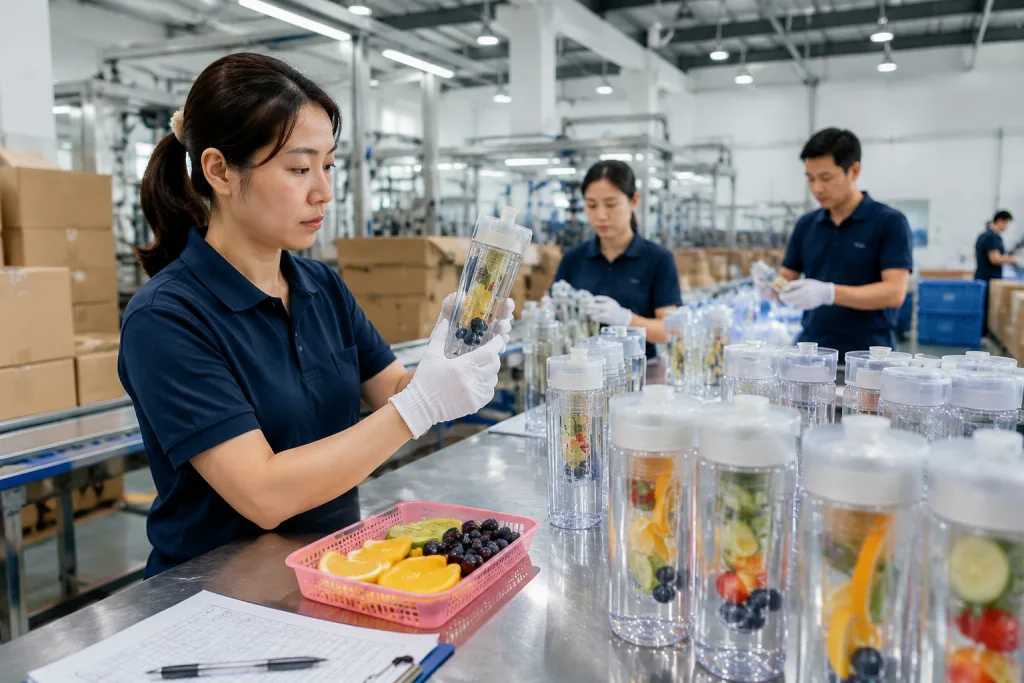
Promotional products infuser bottles look simple. A wellness brand or hydration startup will find a hundred suppliers claiming they can deliver. We see buyers chase the lowest unit price, then get stuck when QC pulls a sample with 0.4 mm wall thickness instead of the spec'd 0.6 mm. The infuser bottle category sits at a weird intersection: it's a hydration vessel that also has to handle fruit pulp and tea leaves without leaking. That makes it a strong giveaway for health expos or corporate step challenges — but only if the bottle actually works.
We ranked five sourcing options for custom infuser bottles by the numbers buyers actually ask about: unit price at a 1,000-piece MOQ, lead time in calendar days, how far we can push color matching and logo placement, material certs (BPA-free, REACH, FDA), and whether the supplier will flex on MOQ when the PO comes in 200 short. At BottleForge Industrial in Hangzhou, we run 200,000 custom drinkware units a month across stainless steel and Tritan lines. This guide is not a curated list of "best suppliers." It's what we've seen work and what has gone sideways for buyers who skipped the comparison framework.
Option 1: Factory-Direct Tritan Infuser Bottles
For wellness brands chasing clarity, durability, and BPA-free materials, factory-direct Tritan infuser bottles from Zhejiang manufacturers are the strongest choice. Plain and simple. Tritan copolyester gives you glass-like transparency with impact resistance—ideal for showing off fruit infusions on a retail shelf. At BottleForge, our standard Tritan infuser bottle (600ml, removable infuser basket) runs $2.85 FOB per unit at 2000-piece MOQ, lead time 35 days. Custom Pantone-matched colors add $0.20 per unit at 3000 MOQ. The infuser basket uses food-grade 304 stainless steel mesh with 0.8mm openings—that stops pulp leakage but lets flavor extract cleanly. QC pulled a sample last month where the basket weld had a 1.2mm gap; we caught it before the line ran.
Key compliance: Tritan is BPA-free by design, and our factory holds BSCI, REACH, and FDA certifications. For promotional products infuser bottle campaigns aimed at corporate wellness programs, this option delivers the premium look without the breakage risk of glass. One caveat: Tritan maxes out at 100°C, so no boiling water. Cold or warm infusions only. If your client needs hot tea, jump to Option 2—we've seen this go sideways when buyers assumed "heat resistant" meant boiling.
Option 2: Bulk Stainless Steel Insulated Infuser Bottles
For winter programs, a promotional products infuser bottle that also serves as a hot tea vessel needs double-wall vacuum-insulated stainless steel. We run a 500ml stainless steel infuser bottle in 304 grade, 18/8, with a removable infuser basket. FOB sits at $4.50 per unit at 1000-piece MOQ, and the lead time is 45 days. The vacuum wall keeps drinks hot or cold for 12 hours. Buyers ask for that number first. On the packing table, we ship 24 pcs per master carton, which keeps freight quotes cleaner for commuter programs.
Customization stays simple. Laser engraving is $0.50 per unit on 2000 MOQ, silicone band imprinting is $0.30 per unit, or full-wrap digital printing is $1.20 per unit. QC pulled the sample with the 40ml basket in place; it handled loose leaf tea and sliced fruit without choking the pour. The basket is 316 stainless steel, so acidic fruit does not eat into it as fast. ASTM and LFGB compliance is available. We have had buyers push for Tritan pricing on a steel body. The math does not work. Empty weight is 380g versus 180g for Tritan, so this is the wrong question if the campaign needs a premium feel under $5 per unit.
Option 3: Custom Glass Infuser Bottles with Silicone Sleeves
Glass infuser bottles move well with wellness brands that want a cleaner-looking promotional products infuser bottle program. We run borosilicate glass in 350ml or 600ml, add a silicone sleeve, and ship at $3.20 FOB per unit on a 3000-piece MOQ with a 50-day lead time. The insert is either a glass rod with a stainless steel mesh cap or a full-basket basket insert; that call depends on the mold, not on sales copy. Logo work goes on the sleeve by screen print, up to 4 colors at $0.25 each, or on the glass by etching at $0.60 per unit. QC pulled a sleeve sample last week and found a 1.5 mm print shift.
Glass does not hold flavor or odor, and it stays chemically inert. Pull the sleeve off and it can go in the microwave. The trade-offs are clear. Breakage runs 2-3% in transit, freight climbs with the weight, and the MOQ stays higher because we need corrugated dividers plus foam inserts on the line. It passes a 1.2m drop test under ISTA 2A. Under 2000 pieces, the math does not work for bulk fruit infuser bottle orders. This is the wrong question to ask if the buyer wants a cheap giveaway. Use it for a luxury promo gift, and the branded sleeve does the heavy lifting. We have seen buyers skip the carton spec and open a box of shards; the buyer flagged it, and the PO had the sleeve code typo on line 3.
Option 4: Distributor-Ready Infuser Bottles with Stock Colors
Stock-color infuser bottles solve a specific problem: your order is under 1000 units, or you need goods in three weeks. Most factories around us in Hangzhou keep 500ml Tritan infuser bottles in clear, blue, green, and pink on the shelf. At 500 pieces, pricing runs $3.50 FOB. Custom logo branding—pad printing or laser engraving—adds a $150 setup fee and $0.40 per unit.
This fits wellness brands testing a new market or running a short campaign, like a 3-month corporate wellness challenge. The catch: you're locked into 4-6 stock colors and the infuser basket is fixed. Last week a buyer asked if our stock bottles were BPA-free—they are, but we've seen factories that don't use virgin Tritan. Check the lids too. We had QC reject a batch last month for seal wobble. At BottleForge, we stock 3000 units of our best-selling infuser bottle each month and can ship within 7 days after logo application. Need FNSKU labels for Amazon FBA? We apply them at $0.10 per unit.
Option 5: Fully Customized Infuser Bottles with Mold Development
For brands shipping 10,000 units a year or more, a private mold starts to make sense. The math works at $8,000-$15,000 for mold development, then drops to $1.80-$2.50 per unit at a 10,000-piece MOQ. First samples usually take 60-90 days, then production needs about 30 days. On the line, the buyer waits 60-90 days up front, but the unit cost drops to $1.80—that's where the money comes back.
This is the right call when the bottle shape has to carry the brand, or when the infuser basket needs a twist-lock fit that keeps fruit from floating into the lid. We also build versions with a built-in muddler or a two-chamber body for separate infusion. QC pulled one sample at 0.8 mm wall variation and the buyer flagged it, so we hold the same tool steel spec across runs. Mold ownership lets you source from more than one factory, but we still push clients to stay with one partner for consistency. We ran 12 proprietary molds in the last 2 years, and payback usually lands around 15,000 units. For a one-off promo drop, this is the wrong question to ask.
Sourcing Checklist for Promotional Infuser Bottles
Run these five checks with your supplier before you cut a PO for bulk infuser bottles. I've seen a single missed step turn a 5,000-unit order into a warehouse full of returns.
- Material compliance: BPA-free, REACH, and FDA certs. No exceptions, no "we'll send them after production." For stainless, lock in 304 or 316 grade on the spec sheet. We caught a supplier trying to run 201 on a 10k order—QC pulled the sample, magnet stuck hard, whole batch rejected. For Tritan, demand the Eastman certificate with batch number. Generic "Tritan" without traceability fails UV and impact testing every time.
- Infuser mesh quality: 304 or 316 stainless, welded construction, not woven. Mesh openings between 0.5mm and 1.0mm. Woven mesh frays at the edges after 3–4 dishwasher cycles and leaves steel threads in the bottle. Quick field test: soak the infuser in 3% saltwater for 24 hours. Rust flecks mean the mesh is under-gauge or the wrong grade entirely. We reject at 0.3% surface rust in our inline checks.
- Seal integrity: The lid gasket must be food-grade platinum-cured silicone. Not peroxide-cured—that stuff leaches odor after hot-fill. Ask for the cyclic leak test report: 10,000 open-close cycles at 5 PSI, zero leakage. We had a distributor skip this on a 2,000-unit run. 12% leakers on arrival. The return freight alone ate their margin.
- Customization methods: Custom logo infuser bottle? Laser engraving for permanence on stainless. Silicone band for color pop and lower tooling cost. Screen printing if budget is the driver—but keep it under two colors. Pad printing on curved surfaces: fine for logos under 30mm wide. Go wider and the distortion reads cheap from three feet away. We've remade tooling twice for buyers who ignored that limit.
- Packaging: Branded boxes with insert trays add real perceived value. At 3,000 units, budget $0.50–$1.00 per unit for custom packaging. Drop below 2,000 units and the tray cost jumps to $1.20 per box—the die-cut MOQ kills you. We ship flat-packed trays to save freight; one buyer insisted on pre-assembled and paid 18% more in volumetric weight charges.
Our Hangzhou line runs AQL 2.5, normal level II, on final inspection. 2% defect allowance is standard. But if your buyer has a zero-defect clause in their campaign contract, request AQL 1.0. It adds $0.10 per unit to the inspection cost. Cheaper than a chargeback.
Cost Comparison: Factory Direct vs. Distributor vs. Stock
Here's what a 500ml Tritan infuser bottle with one-color logo actually costs in 2024. No fluff — just the numbers we quote buyers every week.
- Factory direct (2000 pcs): $2.85/unit FOB, 35-day lead time. This is our sweet spot for full custom color. We run these on the same line as our house brand.
- Distributor stock (500 pcs): $3.50/unit FOB, 15-day lead time. You're paying a premium for speed. One buyer flagged the price difference last quarter — he needed 800 units in 18 days and chose this route.
- Custom mold (10,000 pcs): $2.00/unit FOB + $12,000 mold cost. First order takes 90 days. Reorders hit 30 days. The math only works if you're building a SKU for 2+ years.
Shipping from Zhejiang to Los Angeles runs $0.40/unit by sea (20 days) or $1.20/unit by air (5 days). For fruit infuser bottle orders under 500 pcs, air freight avoids the MOQ headache. Our minimum for a custom logo infuser bottle with full customization is 1000 pcs. Stock colors? 500 pcs. Always request a pre-production sample before mass production. We charge $50 for the sample and refund it on the order. QC pulled one last month — the infuser cap threads were 0.2 mm off. That sample saved the buyer a 2000-piece headache.
Why Zhejiang Dominates Infuser Bottle Manufacturing
Zhejiang, especially the Hangzhou-Ningbo corridor, carries a big share of drinkware output, infuser bottles included. Injection molding, stainless steel forming, and silicone parts sit within about 50 km of each other, so we cut truck time and move samples fast. Our mesh supplier is 30 km from the plant; that knocked 5 days off the last prototype run versus pulling the same part from Guangdong. The math is plain. Shared resin and steel buying keeps bulk infuser bottle pricing 15-20% lower than in other provinces.
For promotional products infuser bottle buyers, that setup makes custom work easier. One factory can handle Pantone color, laser logo, and packaging inserts, so the buyer does not need to stitch three vendors together. We've seen brands shave 25% off landed cost by buying direct from Zhejiang instead of paying a trading company in the middle. This is the wrong question to ask: "Can the supplier quote?" Ask whether the line can hold the spec. Our 8,000 sqm plant runs 24/5 with 120 workers and 200,000 units a month across the line. QC pulled the sample at 2.0 mm wall thickness last week, and we welcome audits with BSCI or SEDEX reports on request.
Get a Custom Quote for Your Promotional Infuser Bottle
Send us your target MOQ, material preference, and logo artwork for a detailed FOB quote within 48 hours.
Frequently asked questions
What is the typical MOQ for custom fruit infuser bottles from a Chinese factory?
For a custom logo infuser bottle with your own color and packaging, the typical MOQ is 1000-2000 pieces per design. At BottleForge, we accept 1000 pcs for standard Tritan or stainless steel models, and 2000 pcs for glass due to packaging complexity. If you need a custom mold for a proprietary shape, MOQ rises to 10,000 pcs. For stock color infuser bottles with logo only, MOQ can be as low as 500 pcs. Prices range from $2.85 to $4.50 FOB per unit depending on material and volume.
How long does it take to produce a custom infuser bottle with my logo?
For a custom logo infuser bottle using an existing mold, lead time is 30-45 days from order confirmation and deposit. This includes 7-10 days for sample production and approval, then 25-35 days for mass production and QC. For stock color bottles with logo only, we can ship within 15 days after sample approval. Rush orders (20 days) are possible with a 10-15% surcharge. If you need a custom mold, first samples take 60-90 days, then production is 30 days.
What certifications should I require for a promotional products infuser bottle?
At minimum, request BPA-free certification (for plastic or Tritan), FDA food contact compliance, and REACH (EU) or Prop 65 (California) for US markets. For stainless steel, ask for 304 or 316 grade certificate and LFGB (Germany) if targeting Europe. Our factory provides BSCI social compliance reports and can test to ASTM F1313 for Tritan impact resistance. For bulk tea infuser bottles, request a migration test for heavy metals from the mesh. All certificates should be from ISO 17025 accredited labs.
Can I get a customized infuser basket design for my bulk infuser bottle order?
Yes, but it typically requires a mold modification or new mold for the basket, costing $1,500-$4,000 depending on complexity. Common customizations include changing basket volume (e.g., from 40ml to 60ml), adding a handle, or using a two-piece design for easier cleaning. At BottleForge, we can modify an existing basket mold for $2,500, with a minimum order of 3000 pieces. For simpler changes like mesh hole size (0.5mm to 1.5mm), we can adjust without new tooling at 2000-piece MOQ.
What is the best way to ship promotional infuser bottles to the US or Europe?
For orders under 1000 pieces, air freight is faster (5-7 days) but costs $1.20-$2.00 per unit. For 1000-5000 pieces, sea freight to Los Angeles or Rotterdam is cost-effective at $0.30-$0.50 per unit, with 20-30 day transit. We recommend using a freight forwarder who handles customs clearance. For Amazon FBA, we can apply FNSKU labels and ship to multiple warehouses. Always ask for a proforma invoice with Incoterms (FOB or CIF). Our factory can arrange shipping with DHL, FedEx, or ocean carriers.