Key Takeaways
- For promotional products hip flask orders, 304 stainless steel at 0.5 mm is the practical baseline; thinner walls bend and dent in transit.
- A typical factory MOQ is 3,000 pcs, with 20 to 35 days lead time after sample approval and deposit.
- Leak testing should be defined at 100% cap fit check plus 1 bar pressure sampling under AQL 2.5, not left to visual inspection.
- Laser engraving is usually cleaner than print for long-life canteen promotional programs, especially on brushed stainless steel.
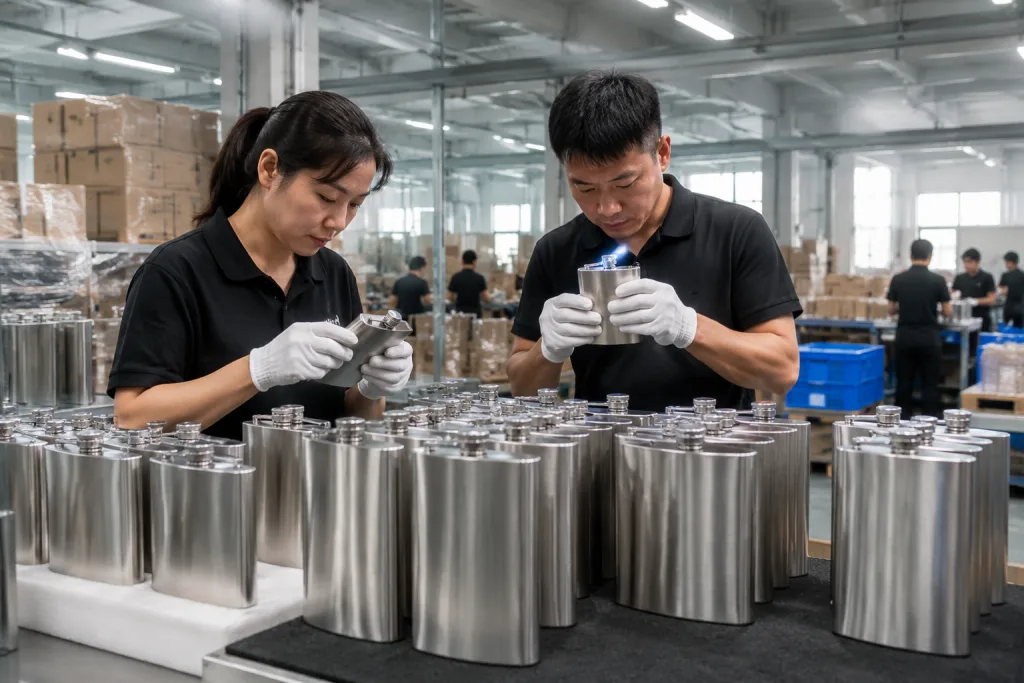
Most buyers start with logo placement and skip the part that causes the headache: steel grade, weld line, cap seal, and the finish that turns into complaints after delivery. A promotional products hip flask looks small. The failure modes are not. On one 200 pcs pre-production run, QC pulled the sample and found a cap leak after a 30 cm drop test. The buyer flagged the matte coat as scratchy. We stopped that line.
If you are sourcing custom drinkware for a campaign, think like QC, not like merch. We run flasks in Zhejiang at a 3,000 to 10,000 pcs MOQ, and the spec has to be locked before the laser file goes to the machine. One PO typo on engraving size can burn a day. The wrong question is, "Can you make it look good?" The math does not work. The real job is a customized drinkware item that gets through packing, transit, and end-user handling without eating your margin.
Why flasks fail in the field
Most buyers make the same mistake: they treat a flask like a flat giveaway. Wrong call. A promotional products hip flask is an 18 oz sealed piece with a hinge, a threaded cap, a welded seam, and a decorated face that all have to hold up on the line. QC pulled the sample at 8:40 a.m., and the cap spun loose after six openings. One weak part drags the whole order down. You see it at handout, not on paper.
The fail points are boring and repeatable. Caps loosen after 3 to 5 uses. Hinge pins open too freely or bind. Buffed stainless shows polish lines under retail lights. Silk print chips on corners. If the flask is sold as a custom drinkware premium, the buyer flags it fast. We had a PO typo once on the cap spec, 16 mm instead of 18 mm, and the math did not work. Ask for the defect list before the mockup. That is the real filter for a canteen manufacturer or canteen supplier in China.
What to challenge in the spec:
- Cap torque and closure feel
- Leak integrity after repeated opening
- Surface durability after abrasion
- Logo legibility on curved metal
Start with steel, not artwork
Artwork signs off fast. Steel decides whether the run ships clean or comes back with complaints. On a customized canteen or customized growler program, the base metal sets the product life. For promotional products hip flask runs, 304 stainless is our default pick. It handles corrosion, bends clean on the press brake, and keeps the unit price in a range buyers can take. If the brief is price only, some canteen vendors push 201 stainless. We have seen that go sideways after 6 to 9 months, with staining around the weld and a duller finish. For Europe and North America, 304 also matches what buyers expect for food-contact drinkware. The last 304 coil we ran was 0.5 mm, and that cut sample approval back-and-forth on the line.
Wall thickness matters more than most buyers want to admit. At 0.4 mm, metal cost drops, but dent resistance falls off fast. At 0.5 mm, the body feels steadier for printing, engraving, and carton pack-out. QC pulled the sample on one 250 ml hip flask job and the 0.4 mm shell showed a thumb dent after a light drop test from 80 cm. On larger custom canteen or custom growler projects, the logic stays the same: base material first, decoration second. Ask the canteen factory for the material certificate, not a sales promise. For retail-bound orders, we also ask for REACH and, where applicable, LFGB or ASTM-related compliance support from the canteen manufacturer. The math does not work the other way around. A buyer once flagged a PO that said “304” in the artwork note and “201” in the spec line; that typo cost us a week.
Buyers who approve artwork before material grade usually pay for a second sample round. Fix the substrate first.
Cap, hinge, and leak control
Most flask complaints start at the cap, not the body. We had one PO where the buyer flagged 12 caps that hit the first thread and stopped dead; those 12 pieces were already in a carton bound for a distributor, so this was not a paper issue. For a canteen customized for promo use, the cap has to seat the same way every time, with no death grip. If the closure uses a tether or hinge, the pin needs to sit clean. Loose pins make the piece look cheap. Tight pins snap early. We check that on the bench with a torque tester, not on hope.
Put numbers on the closure. State thread engagement, cap material, and the open-close cycle count in your spec sheet. We usually ask buyers for a 100% visual closure check, plus an inverted leak hold test, then a smaller pressure test on the batch if the program needs it. On one run, QC pulled the sample after 30 cycles and found seepage in 2 units out of 200; that is the kind of miss that shows up as a complaint later. A 1% leak rate sounds small until you are shipping 5,000 pieces to a canteen distributor network. The math does not work.
When a canteen vendor says the hinge is “standard,” ask for the pin diameter, hinge material, and pull test result. Standard is a loose word. We have seen it go sideways on 1.2 mm pins that passed hand feel but failed after the buyer's drop test, and the factory only caught it because the line operator wrote the wrong batch code on the traveler. If the vendor cannot repeat that hinge across batches, the spec is not finished.
Decoration that survives handling
On a promotional products hip flask, decoration has to survive pocket rub, clamshell pressure, carton scuffing, and 20 or 30 hand touches before the buyer even sees it. Surface choice is a production call. A brushed finish hides small marks better than mirror polish. We ran a 60 mm sample through the line with a coin in the pocket; the brushed face stayed presentable, the mirror one picked up hairline marks fast. Matte powder coating can look clean on day one, but if pretreatment slips or the cure is weak, chips show up on the cap edge and at the mouth. We saw that go sideways on a 3,000 pcs order.
Laser engraving is the safer decoration method for long-run custom drinkware because it cuts into the surface instead of depending on ink adhesion. Screen print can work on a curved stainless body, but only with a simple logo and a buyer who accepts tighter control on placement. One PO came in with the logo file fine, then the cap position was typed as 12 mm off center on the order sheet; QC pulled the sample, flagged the alignment, and we stopped the run before it turned into scrap. Ask for abrasion results, not a staged photo. A good canteen supplier in Zhejiang should show wear after 50 to 100 rub cycles, plus cold-humidity checks if the stock will sit in mixed climates.
Practical rule: if the logo has to stay clean after repeated pocket carry, use engraving or a finish with tight coating control. That is the right question to ask. For distributor canteen orders, the flask gets handed out, stuffed in a bag, and used hard; it is not sitting on a shelf for display.
Packaging is part of quality
People cut packaging first because it does not look like product. That is the wrong question to ask. On a 5,000-piece flask order last spring, we ran bare polybags to save a few cents, then QC pulled the sample after carton rub marks showed on the brushed finish. The line had a 1.2 mm scuff pattern on three out of ten samples. A bare flask can ship cheap, but if the outer carton gets loaded hard or takes a knock in transit, the marks land at the buyer’s warehouse. For a promotional products hip flask going into a premium campaign, we run an insert tray or a rigid gift box. The extra cost is usually USD 0.20 to 0.60 per unit. That math works when you count fewer claims and a cleaner unbox.
For China sourcing, lock the carton drop-test spec before mass production. Ask for master carton quantity, inner box size, and whether the factory can do barcode labels or FNSKU placement if the order feeds e-commerce. We had one PO where the buyer flagged a typo on the carton mark, one extra zero, and that ate half a day on rework because the labels were already printed. The box printer was already set at 300 gsm, so we had no wiggle room. A Zhejiang canteen factory should ship shelf-ready packs, gift packs, and export cartons without guessing at the end. If they cannot, you are buying a sample run with nicer paperwork.
QC numbers you should actually use
QC has to be plain enough for both sides to run it without guesswork. For a factory order of 3,000 to 10,000 pcs, we use AQL 2.5 for major defects and AQL 4.0 for minor defects unless the brand spec is tighter. That is the baseline. Major defects on a promotional products hip flask are leaks, broken hinges, off-center caps, and logo failure the buyer spots in one look. Minor defects are light polish haze, small color shift, or carton scuffs that do not touch function. QC pulled the sample on the line with a 0.2 mm feeler gauge, and that number beats loose words every time.
Ask for pre-production samples, first-article approval, and in-line checks. Stop there? No. A final random inspection alone misses too much. On a disciplined canteen manufacturer line, the buyer should get photos of sample sign-off, carton labels, and test results before we ship. We have seen this go sideways when the PO had a typo on the size code, and the factory only caught it after cartons were packed. If you work with canteen manufacturers in China on repeat, set a defect photo library. It makes claims faster and cuts the argument down. For canteen distributors, that discipline matters more than shaving one cent off the unit price, because replacement shipments are 12 days versus 18 days, and the math does not work. The buyer flagged it after we printed 5,000 pcs wrong once.
- Material confirmation: 304 stainless certificate
- Leak test: inverted hold and sample pressure check
- Surface check: scratches, dents, print alignment
- Packaging check: drop and carton compression readiness
Pricing, MOQ, and timeline reality
Buyers ask for a unit price before they lock the spec. Wrong question. A plain promotional products hip flask in 304 stainless with a basic laser logo usually sits at USD 1.20 to 2.20 FOB China at volume. Add a gift box, coating, and individual packing, and the number moves to USD 2.50 to 4.50. We had one buyer flag a USD 1.48 quote as "too high" because he was comparing it with a bare flask, no box, no insert, no bag. The math does not work that way.
MOQ from a Zhejiang factory is usually 3,000 pcs per design. For simple stock-body jobs, we have run 1,000 pcs when the decoration is standard and the ship date is loose. Lead time sits at 20 to 35 days after sample approval and deposit, and we have seen it stretch to 12 days vs 18 days once custom packaging and two logo methods are added. QC pulled the sample on one order and found a 0.8 mm gap at the lid seam; that is why rushing the line backfires. If you are planning a campaign, put that on the calendar early.
Good sourcing is not chasing the lowest canteen vendor price. It is finding a repeatable supplier who can hold your monthly reorder steady across China and Zhejiang production cycles, with the same carton count and the same finish every run. We ship to buyers who care about that more than a 5-cent swing, because a typo on a PO or a changed MOQ can blow up the reorder. Cheap looks good on paper. The factory floor tells a different story.
Spec your flask before you place the order
Send us your target MOQ, logo method, and packaging level. We can quote a production-ready custom drinkware flask with clear QC steps from China.
Frequently asked questions
What material should I specify for a promotional products hip flask?
For most B2B orders, specify 304 stainless steel. It is the safer baseline for corrosion resistance and export expectations. A 0.5 mm wall is a solid commercial choice for a promotional products hip flask because it resists dents better than 0.4 mm and still forms cleanly. If your buyer wants a lower price, 201 stainless can be discussed, but you should expect a narrower margin for finish quality and long-term appearance. Ask the canteen manufacturer for material confirmation and, if needed, supporting compliance documents for REACH or LFGB-related requirements.
What MOQ should I expect from a canteen factory in China?
For a custom drinkware flask, the usual MOQ is 3,000 pcs per design. Some canteen manufacturers in China will quote 1,000 pcs if the body is standard and decoration is simple, but unit cost rises quickly. If you need custom packaging, multiple finishes, or special inserts, 3,000 pcs is the more realistic number. Lead time is often 20 to 35 days after pre-production sample approval and deposit. If you are ordering for a canteen distributor network, confirm whether the factory can repeat the same color and logo position on reorders, because that matters more than saving 5% on the first batch.
Is laser engraving better than print for this product?
Usually yes, especially if the flask will be handled often. Laser engraving on brushed stainless gives you a permanent mark that does not chip or rub off like some inks can. For a promotional products hip flask, engraving is the lower-risk choice when the logo is simple and the surface is metallic. Print can still work, but it depends on coating adhesion, curing, and curvature. If the order is a canteen promotional run or a custom canteen used by field teams, engraving tends to survive better in real use. For multi-color graphics, you should test print abrasion before mass production.
How do I prevent leaks in production?
You prevent leaks by controlling the cap, thread, and welding quality, not by hoping final inspection catches everything. Require a 100% cap fit check and a sampled leak test on each production batch. Many buyers use inverted hold testing as the first filter, then add a pressure or soak sample check if the product design calls for it. Under AQL 2.5, leaks are a major defect and should be treated that way. If the canteen supplier cannot explain how the cap is torqued or how the seam is checked, that is a risk signal. A single leaking carton can damage a full distributor drinkware program.
Can I bundle this with other custom drinkware?
Yes, and it is often smarter to do so if you need a unified campaign. A promotional products hip flask can be combined with a custom growler, customizable growler, or custom canteen family under one artwork system, as long as you keep the specs separate by product. That makes it easier for a canteen vendor to control branding across SKUs while still respecting different wall thicknesses, cap systems, and packaging. For example, a flask may use 0.5 mm 304 stainless and laser engraving, while a growler may need thicker walls and a different closure. Keep each SKU’s QC plan distinct so one product does not drag down the others.