Key Takeaways
- A 304 stainless promotional products growler usually lands around USD 4.20-8.80 FOB China, depending on gauge, finish, and lid system.
- For leak control, specify a torque target, 24-hour inversion test, and 3-cycle thermal shock test; do not rely on visual inspection alone.
- If you need decorated canteen customizable units for retail or promo, plan on 1,000 pcs MOQ and 30-45 days from confirmed sample.
- AQL 2.5 for major defects and 4.0 for minor defects is a workable baseline for custom drinkware, but only if your critical checks are written down.
A promotional products growler can look clean on a spec sheet. On the line, it is less polite. Lids start weeping after a warm-cold cycle, coating rubs off in transit, logos fade after dishwasher runs, and one pre-production sample came back 0.4 mm off from the mass run. That is where a brand or distributor loses margin.
At BottleForge in Hangzhou, Zhejiang, we see the same failures on custom growler, canteen custom, and broader customizable drinkware orders. QC pulled a sample with a 0.3 mm gap at the cap seat, and the buyer flagged it before we ran 1,000 units. The wrong question is, “Can you make it?” The math does not work unless the spec, the test plan, and pack-out all hold together at scale. Our normal MOQ is 1,000 units, with a 30-45 day lead time depending on decoration and packaging. That volume is enough to catch bad assumptions before we ship them.
Where growler orders fail first
The first failure is usually not the bottle. It is the guess that a promotional products growler behaves like a generic bottle. It does not. Add a swing lock, silicone gasket, powder coat, or full-wrap print, and the line picks up new failure points fast. We had a buyer flag a PO because the lid spec said “stainless” but the sample came with a zinc hinge. Same name. Different risk.
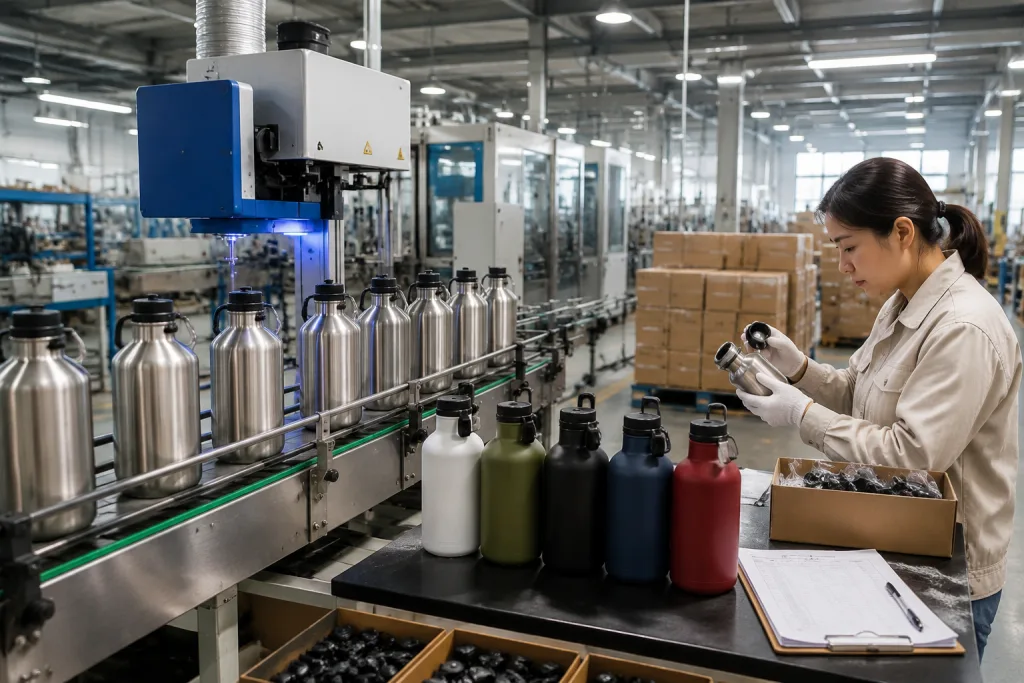
On the shop floor, the early misses are easy to spot. A 64 oz stainless custom growler will deform if wall thickness drops below 0.5 mm on a deep-draw body. QC pulled the sample and the caliper read 0.47 mm at the shoulder. A bamboo lid warps when moisture is not held under control. A printed canteen promotional order loses logo contrast when the base coat is too matte or the ink film is too thin. Ask for the process map, the oven curve, and the inspection point at each step. “Can you make it?” is the wrong question. If you buy from a canteen manufacturer or canteen vendor in China, that is the part that tells you whether we ship 500 clean pieces or 500 headaches.
Write the spec around the failures you cannot afford. A good minimum set is material grade, wall thickness, lid type, decoration method, pack-out, and test requirements. Without that, you are buying a sample, not a production standard. We run into this on MOQ 1,000 all the time, and the math does not work any other way.
Leakage is usually a lid problem
Leakage is the fastest way to turn a distributor growler program into a returns pile. Buyers point at the body first. Wrong question. On 8 out of 10 claims we see, the leak starts at the lid: gasket compression is off, thread pitch is uneven, hinge geometry is weak, or the cap lifts a hair under vibration. One PO said "swing top" and the sample was a screw-lid. The buyer flagged it on day 2. A growler for promo work has to be treated as a closure system, not a printed cylinder.
For a screw-lid growler, call out gasket material and hardness on the drawing. Food-grade silicone at 50-60 Shore A is standard, and we check it with a durometer on the line. If you want a swing-top, ask for 5,000 open-close cycles and a 24-hour inversion test with 1 bar internal pressure equivalent, or a fill-and-rest protocol both sides sign off on. We run a 50-degree incline shake test and a drop from 80 cm onto plywood in Zhejiang. QC pulled the sample after the first cap sprang back 2 mm. "Just make it tight" is how jobs slip.
- Ask for torque data on closure assembly, not just a visual fit check.
- Request lot-level gasket traceability so mixed materials do not slip into one shipment.
- Reject cap designs that cannot pass a 3-cycle hot/cold test from 4 C to 60 C.
If your buyer is a canteen distributor or a distributor drinkware team, mark leakage as a critical defect in the QC sheet. Do not leave it as a soft comment. We ship against AQL 2.5, and once the lid slips past inspection, the return rate climbs fast. We have seen 3 mm of lid lift turn into a full claim. The math does not work.
Decoration wears faster than you think
Most buyers look at the bottle and treat decoration like a line item. Wrong move. The logo is the first thing a customer touches, and it is often the first thing to fail. On a 500 ml growler run, we saw a clean mockup turn sloppy after 7 days in a dishwasher. For customized drinkware, the decoration method decides whether branding still looks clean after shipping, washing, and normal handling.
Silkscreen works for one- or two-color art, but poor surface prep will make it chip. We check the ink with a cross-hatch cutter on the line. Laser engraving stays sharp on 304 stainless and holds up in dishwashing, though the metallic contrast does not fit every brand. Powder coating gives better hand feel on a canteen customizable program, yet the edge can wear if cartons rub hard in transit. UV print carries more complex graphics, but it needs tight curing control. A canteen supplier should show abrasion results, not just artwork mockups.
For a promotional products growler, ask for an abrasion test at 500 cycles with a standardized cloth or tape method, and ask whether the logo runs on the same production line as the body or goes out for subcontract printing. QC pulled the sample and found a 1.2 mm shift on one side after transfer. We ship a lot of these from Zhejiang, and the buyer flagged it fast because outsourced decoration is where color drift and timing slips start. Ask this before approval. It saves rework.
Material choices change the risk
Not every custom growler carries the same risk. 18/8 stainless steel is the default for a reason: it forms cleanly, resists corrosion, and gives us fewer line surprises. We saw the wrong gauge turn into scrap on a 3,000-piece run. Single-wall build costs less and runs easier, but it misses the brief if the promo piece needs a premium hand feel.
For a 32 oz or 64 oz promotional products growler, we usually lock in 304 stainless steel at 0.5-0.7 mm wall thickness, depending on the body shape. Go thinner and dent claims show up after carton drop tests and retail handling. Go thicker and the math does not work unless the tooling is stable; QC pulled a 0.9 mm sample once, and the shoulder came out ugly. For coated units, ask for a salt spray check or corrosion test where it fits, plus REACH compliance on the coating chemistry for Europe.
Plastic and glass are separate jobs. Glass needs pack-out control and a breakage allowance; plastic needs odor checks and fit confirmation, and the buyer flagged a bad lid smell on a 500-unit PO once. If a customer wants a customizable canteen program across multiple SKUs, keep each material in its own spec and its own audit sheet. Mixing them is how shipments get held at the dock.
Fit, finish, and pack-out
We’ve seen a sample clear QC and still get wrecked in the carton. The buyer flagged three dents on a 3,000-unit run, and the reason was plain: the bottles knocked together in transit. That is a pack-out problem, not a finish problem.
Start with the neck and shoulder geometry. Tight radii look clean, but the line holds them less steadily, especially on deep draw parts. A deeper shoulder with a controlled transition usually gives steadier yield. Then pick the finish with carton fit in mind. Brushed stainless hides scuffs better than mirror polish, while matte powder coat looks premium but needs tighter insert packing. For FOB shipments from China, sloppy carton design can cost 2-4% of units to abrasion; the math does not work. We run this test with a 1.0 m drop board, and QC pulled the sample apart when the lid ring marked the body.
Use a simple pack-out rule: one bottle per inner box, dividers if the lid can move, and a master carton drop test at 1.0 m with no exposed damage. If the program is going to Amazon or retail, lock the FNSKU label position, barcode scan rate, and carton weight limit before the first PO. We once saw a PO typo that shifted the carton count by 12 pcs, and the whole pallet plan broke. This is the wrong question to ask after production starts; by then we are just shipping problems.
QC checks that actually catch defects
QC has to match the failure mode, or it turns into stage props. AQL by itself does not save a loose checklist. For a promotional products growler, we run a minimum acceptance plan around critical, major, and minor defects, with AQL 2.5 for major and 4.0 for minor. Critical defects get zero tolerance: leaks, sharp edges, unsafe odor, and coating contamination. The math does not work any other way.
Use these checks on the first production run. We learned that after a buyer flagged a 0.6 mm lid mismatch on the first PO, and QC pulled the sample before the line ran 500 pcs. That saved us a rework pile.
- Leak test: 100% of units or a clear sampling plan, filled and inverted for 2-24 hours.
- Dimensional check: neck finish, body height, diameter, and lid thread pitch against the drawing; we check with calipers and a go/no-go gauge.
- Adhesion test: cross-hatch or tape test for printed or coated surfaces.
- Drop test: packed sample from 80-100 cm, depending on export carton design.
- Odor test: hot-water hold for 30 minutes, then sniff check by trained QC staff.
A serious canteen factory in Zhejiang already has most of this gear. The real question is whether they report failures by lot, not hide them in a pass/fail summary. We have seen that go sideways fast when a 2,000 pcs run ships clean on paper and comes back with 18 cracked lids in one carton stack. QC wants a lot code on the tray, not a pretty report.
Price, MOQ, and lead time reality
Buyers usually start with artwork and end with a freight bill that eats the margin. That is the wrong order. Price first, then logo. We budget the custom canteen or customizable growler on the first call because 304 stainless, tooling, decoration, and packing all move the number. For a 32 oz stainless promotional products growler, FOB China pricing often sits around USD 4.20-6.50 for plain powder-coated units and USD 6.80-8.80 for lids with extra parts, laser branding, or retail-style packaging. Double-wall vacuum units climb from there. We run this every week. On a 500 pcs sample run, the buyer flagged it as soon as the lid spec changed from PP to 304 stainless.
MOQ follows setup time, not how clean the logo looks. A workable factory MOQ is usually 1,000 pcs per design and color, with mixed decoration sometimes possible if the total order is large enough. Lead time is usually 30-45 days after sample approval; add 7-10 days if you need new packaging or a special closure. If a canteen manufacturer promises 10 days on a fully customized drinkware build, ask whether they are quoting stock inventory. We saw a PO typo on a 500 pc order once, and QC pulled the sample before the line ran the wrong cap. That saved pain.
In China, the cheapest quote is often the one that left out test work, carton upgrade, or artwork correction. The math does not work twice.
For distributor drinkware programs, ask for a landed-cost breakdown by unit, carton, and pallet. That is the only clean way to compare one canteen supplier to another without guessing. A 1200 x 1000 mm pallet plan changes freight fast, and we have seen a 12-day gap turn into 18 days when the buyer pushed for a last-minute carton change.
Spec sheet template you can reuse
If you buy promotional products growler units more than once a year, stop writing one-off emails and standardize the spec. We run into the same problem on the line every week: one buyer writes 64 oz, another writes 64oz, and the sample room burns half a morning. A fixed template cuts the back-and-forth and lets a canteen supplier quote cleanly. It also keeps reorders moving when you source a canteen customized program through several canteen distributors or need a 12-day repeat instead of an 18-day scramble.
Your spec should list product type, volume, material, wall thickness, lid structure, finish, decoration method, color Pantone, logo size, print area, pack-out, compliance targets, and QC standard. Add the market destination too. Europe may need REACH awareness; North America may ask for food-contact paperwork, California Proposition 65 sensitivity on certain pigments, or ASTM-based test language in your internal file. If you sell through retail, write down barcode and carton labeling rules. If you sell to corporate promo, spell out blank-space rules for co-branding. The wrong question is “can you make it?” The real question is whether the sheet leaves no room for the buyer to guess. We had a PO last month where “logo area: big enough” came through in the notes. QC flagged it immediately. That order lost two days.
Keep a versioned drawing and a signed golden sample. We use a 0.2 mm thickness callout and a red pen mark on the master carton label, because that survives handoffs. In a canteen manufacturer relationship, that pair beats email threads every time. The drawing locks the geometry; the golden sample locks what QC pulled as acceptable. When you buy custom growler, canteen custom, or other customized canteen items from Zhejiang or elsewhere in China, that is how we keep the order repeatable. One buyer pushed back on the red-marked carton once. We kept it. The math does not work without it.
Send your growler spec and get a real quote
We quote from drawing, material, and QC details, not guesswork. If you need a dependable promotional run from Zhejiang, we can review the failure points first.
Frequently asked questions
What is a realistic MOQ for a promotional products growler?
For a true custom run, 1,000 units is a normal MOQ in China. If you need a new lid, special coating, or new carton, the factory may ask for 3,000 pcs to make the setup sensible. For simple logo work on a stock body, 500 pcs is sometimes possible, but the pricing usually rises by 10-20%. A canteen manufacturer in Zhejiang will usually quote faster if you provide a complete spec, because missing details create sample loops and slow the line.
How do I stop leak complaints on custom growler orders?
Treat leakage as a system failure, not a single part issue. Specify gasket material, lid torque, and a 24-hour inversion test. For a swing-top or screw lid, ask for cycle testing of 5,000 openings if the item is meant for retail. Use food-grade silicone around 50-60 Shore A. If the body is fine but the closure is not, no amount of carton protection will help. A canteen supplier should document every lid lot and gasket lot.
Is laser engraving better than printing for customized drinkware?
Not always. Laser engraving is durable on stainless steel and usually survives repeated washing, which makes it good for a branded custom canteen or custom drinkware program. But it gives a metallic contrast and is less flexible for color branding. Silkscreen is cheaper for one-color logos, and UV print allows more design freedom, but both need stronger QC on adhesion. For a promotional products growler, choose the decoration based on how the item will be used, not just on unit price.
What compliance documents should I ask for from a canteen factory?
For Europe, ask about REACH-relevant material declarations and food-contact suitability. For North America, ask for food-contact documentation and any ASTM or internal test references the factory uses. Also request a basic factory profile, BSCI status if applicable, and the QC plan tied to your order. If the product uses stainless steel, coating, or silicone, you want material traceability and the test report date. A reliable canteen manufacturer in China will not hide behind vague certificates.
What lead time should I plan for a custom canteen order?
For a standard promotional products growler with existing tooling, plan 30-45 days after sample approval. If the order needs new tooling, a custom lid, or new packaging, 45-60 days is safer. Shipping from China to Europe or North America adds transit time on top of that, so schedule backwards from your campaign date. If you are working with a canteen distributor and need multiple SKUs, add a few days for label and carton coordination.