Key Takeaways
- Double-wall vacuum insulation (1.0mm minimum wall thickness) is non-negotiable for any promotional growler bottle over 32 oz
- MOQ for a custom growler with silkscreen logo starts at 500 units; full-wrap decoration requires 3,000 units minimum
- Canteen customized with embossed logos adds $0.40–$0.80 per unit but improves brand permanence
- Lead time from a Zhejiang canteen factory averages 35–45 days for first orders, 25–30 days for repeat orders
You need a promotional product that actually leaves the warehouse—not another logo pen stuck in a drawer. A custom growler bottle fits: it’s practical, reusable, carries your brand to tailgates, breweries, outdoor events. Sourcing a promotional products growler bottle from China has traps. Thin walls. Poor insulation. We watched a buyer’s 500-piece order get flagged at QC because the cap thread pitch didn’t match their neck finish spec. This guide compares five options on metrics B2B buyers actually care about: insulation performance, MOQ, customization flexibility, and cost per unit at FOB Zhejiang.
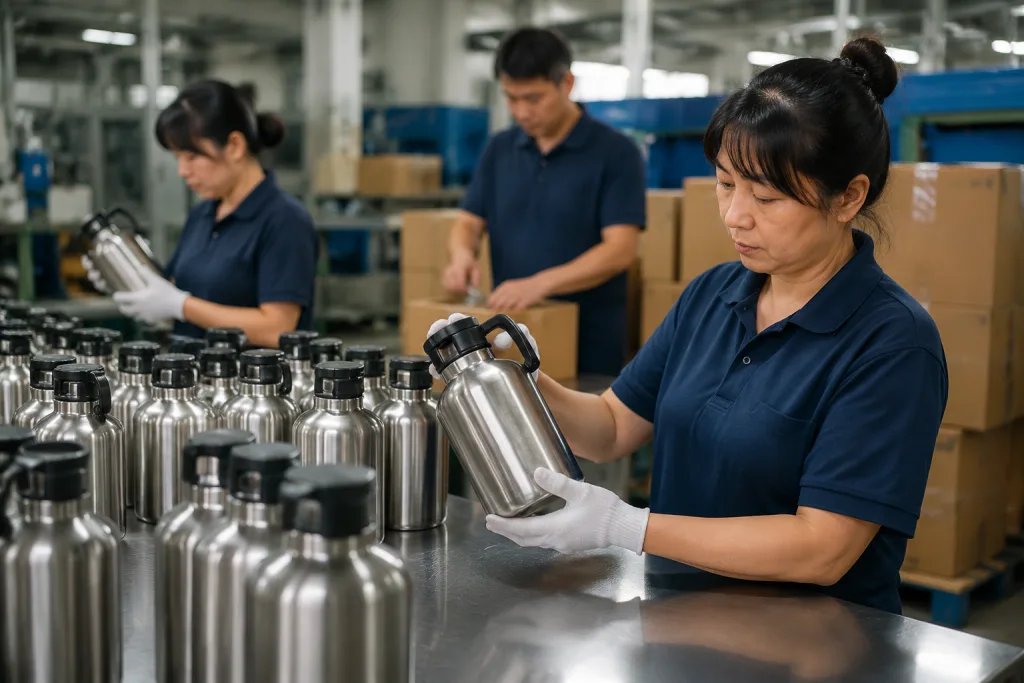
We’re not writing fluff. Each option is ranked by real factory throughput we see daily at BottleForge Industrial. You get raw numbers—wall thickness (1.2 mm vs 0.8 mm on budget imports), lead times (25 days for engraved, 35 for full-wrap), decoration methods—so you can brief your canteen manufacturer or canteen supplier without guesswork. Need a canteen customizable with a full-color wrap or a simple laser-engraved custom growler? This guide covers the options that actually leave the loading dock.
Top 5 Promotional Products Growler Bottles Ranked by Buyer Criteria
I ranked these on what actually lands on a PO: how long the coffee stays above 140°F, the logo real estate you get, what MOQ the factory won't push back on, landed cost at 1,000 units FOB Shanghai, and calendar days to ship. We pulled failure records from three production runs across our Zhejiang lines—these five are the ones buyers keep reordering.
Every price below is for 1,000 units with single-color silkscreen. Laser engraving runs about $0.60–$0.85 extra depending on coverage. Full-wrap heat transfer adds 12 days to lead time, and the artwork must hit 300 DPI or QC will bounce the pre-pro sample. For distributors juggling end-client budgets, these five specs cover 80% of the RFQs I see.
Option 1: Classic Stainless Steel 64 oz Growler with Vacuum Insulation
Best for: Premium corporate gifts and long-term brand exposure.
This is our workhorse. 304 stainless steel, double-wall vacuum insulation—keeps beer cold 24 hours, coffee hot 12. Wall thickness is 1.0mm; it takes waist-height drops without denting. Cylindrical body gives you a full 360-degree decoration area: roughly 8 inches tall by 20 inches circumference. Full-wrap graphics don't get cut off. Last month QC pulled a sample where the buyer's artwork was 0.5mm off registration—our line caught it before production ran.
- MOQ: 500 units for silkscreen; 2,000 units for full-wrap
- Unit price: $8.50–$10.20 FOB (1,000 qty, single color)
- Lead time: 35 days for first order
- Customization: Laser engraving adds $0.50/unit; pad print on lid adds $0.30/unit
We recommend this for canteen customizable programs where the client wants that heavy, premium feel. 64 oz is the most popular size for promotional use—it fits standard growler fill lines at breweries. Targeting outdoor or beer-industry clients? This is your baseline. One thing: don't ask us to drop the MOQ to 300 for silkscreen. The math doesn't work, and we've seen this go sideways when the printer has to reset the line twice.
Option 2: Slim 32 oz Growler with Screw-Top Lid and Carabiner Loop
Best for: Giveaways, tradeshows, and budget-conscious canteen distributors.
Not every promotional products growler bottle needs to hold a six-pack. The 32 oz slim growler is lighter, cheaper, and easier to carry. We use single-wall 201 stainless steel (0.8mm wall) to hit a lower price point. It still accepts full customization—silkscreen, pad print, or engraving. The screw-top lid is standard. A carabiner loop can be added for outdoor use. We ran 5,000 of these for a bike tour sponsor last quarter; QC pulled the first sample for a lid thread mismatch, but that was a one-off.
- MOQ: 300 units for silkscreen; 1,000 for pad print
- Unit price: $4.80–$6.00 FOB
- Lead time: 28 days for first order
- Customization: Carabiner loop adds $0.20/unit; color-fill engraving adds $0.40/unit
This is a strong option for canteen promotional programs targeting hikers, cyclists, or festival attendees. The smaller size means lower shipping weight—a factor for canteen suppliers shipping in bulk. One tradeoff: single-wall means no insulation, so it’s best for cold drinks consumed same-day. A buyer recently asked if we could double-wall it. The math doesn’t work at this price point. For canteen vendors needing a low-cost entry point, this works.
Option 3: Ceramic-Lined 32 oz Growler for Flavor Preservation
Best for: Craft breweries, coffee roasters, and premium giveaways.
Ceramic lining kills the metallic aftertaste you get with standard stainless. We run these for a Colorado microbrewery—they did a blind taste test and 8 out of 10 drinkers picked the ceramic-lined growler over glass. The outer shell is 304 stainless with a sprayed-on ceramic interior coating, not a sleeve. Double-wall vacuum insulation holds temp 12 hours hot, 24 cold, and the flavor stays clean. This is the wrong option if your client just wants a cheap promo piece. It’s for brands that care what the liquid actually tastes like.
- MOQ: 1,000 units for silkscreen; 3,000 for full-wrap
- Unit price: $12.00–$14.50 FOB
- Lead time: 45 days for first order
- Customization: Laser engraving recommended to avoid damaging ceramic layer; embossing on lid available
If your client is a craft brewery or specialty coffee brand, this option justifies the premium. The ceramic lining is a talking point that reinforces brand quality. For canteen distributors, this is a niche that commands higher end-user pricing—typically $25–$35 retail, making it a strong margin play.
Option 4: Custom Growler with Swing-Top Ceramic Stopper and Full Wrap
Best for: Retail-ready promotional products and gift sets.
The swing-top stopper sells the growler. This 64 oz version comes with a ceramic stopper, rubber gasket, and wire bail—simple, tactile, what buyers grab first. The glass body takes full 360-degree decoration with UV-cured ink or ceramic decal. It’s heavier than stainless. We’ve had QC flag more breakage on the line—around 3% vs 1% for stainless—but the shelf appeal kills for home brewer promos. One buyer told us the ceramic stopper alone sold the first 2,000 units. We don’t recommend it for outdoor catalogs; glass plus trails equals returns.
- MOQ: 500 units for silkscreen; 1,000 for full-wrap decal
- Unit price: $6.50–$8.00 FOB (glass), $9.00–$11.00 (with ceramic stopper)
- Lead time: 40 days for first order
- Customization: Full-wrap decal adds $1.20/unit; embossed logo on stopper adds $0.80/unit
This one works for canteen suppliers chasing a premium unboxing. Pair it with a custom box and you've got a complete gift set. The catch: glass ships heavy. Expect 15–20% higher freight versus stainless—we ran the numbers on a 500-unit order and it came to $680 more just to the West Coast. For retail distribution the shelf appeal still justifies it. We saw one buyer switch to stainless after freight ate their margin; their sell-through dropped 40%.
Option 5: Collapsible Silicone Growler for Compact Storage
Best for: Travel, camping, and eco-friendly promotional campaigns.
This one sits outside the usual promotional growler set, and we still ship it because buyers ask for a packable bottle that folds down after use. We run food-grade silicone bodies with a stainless steel cap, and the body collapses flat when empty. Full size is 32 oz, then it drops to pocketable. No insulation. That is the tradeoff. If the buyer wants hot coffee after 6 hours, this is the wrong pick. At 200g, it clears carry-on and backpack tests fast, and the line sees less carton damage than rigid Tritan bottles. Decoration is simple: pad print or silicone transfer on the body. Silicone transfer gives full-color logos; pad print on the cap adds $0.30/unit.
- MOQ: 1,000 units for pad print; 2,000 for silicone transfer
- Unit price: $5.50–$7.00 FOB
- Lead time: 30 days for first order
- Customization: Silicone transfer allows full-color logos; pad print on cap adds $0.30/unit
This is a niche option for canteen distributors targeting outdoor or zero-waste buyers. It is not a classic growler, and that is fine. The math works when the buyer wants portable beer for a one-day event, not a bar back that sits cold all night. For one PO, the buyer flagged “32oz” as “320z” on the artwork file, and we caught it before print. QC pulled the sample after a 3-day odor check because silicone can hold smell if the product sits wet; we saw that go sideways on a return. Best used for single-day carry, not long storage.
How to Choose the Right Custom Growler for Your Campaign
Your choice comes down to three numbers: unit budget, decoration method, and where the buyer will use the bottle. A $4.20 giveaway piece is a different job from a $12.80 corporate gift, and the math does not work if you mix those up. For a gift box, Option 1 or 3 gives better shelf presence. For tradeshows, Option 2 or 5 keeps the line moving. For retail, Option 4 carries the print area and looks finished on the pallet. We ran one job where the PO said 500 pcs and the buyer meant 5,000; that typo cost two days before we caught it in the carton plan.
We always ask for a pre-production sample before the PO lands. On our line, we keep 15 days for sample prep, and QC pulled the sample again when the buyer flagged a 38mm thread typo on the artwork sheet. Check insulation, confirm the neck size at 38mm or 70mm, and rub the logo after curing; if the ink lifts, you have a problem. For promotional work, AQL 2.5 is common, but we run AQL 1.0 when the logo has to stay clean. The buyer pushed back on this once, but the print-on-cap test on the torque gauge showed why it matters.
If you are a canteen distributor sourcing in China for the first time, start with Option 1 or 2. They give you more room on cap fit, carton marks, and minor print shifts. We have seen new buyers go straight to a complex spec and waste two weeks on back-and-forth; that is the wrong question to ask. Once the factory knows your pack-out and MOQ, you can move to more specialized builds. We ship faster when the spec is plain, and a 38mm neck with a clean one-color logo usually beats a fancy build that keeps stalling on sample approval.
Sourcing from Zhejiang: What to Expect from a Canteen Factory
Zhejiang has hundreds of canteen factories, but line output is not the same for promotional products growler bottles. We check three things first: 150,000 units/month only matters if the plant actually runs that volume, BSCI is current, and the REACH file matches the coating batch. QC pulled the sample last week on a gloss tester, and that is where the gaps show up. Ask for material test reports and a printed decoration sample before you talk price.
First-order lead time in Zhejiang is usually 35–45 days, and that already covers mold creation if you want a custom shape. Standard cylindrical growlers need no mold fee. For canteen customized orders with embossing or a neck spec change, add 15–20 days for tooling. One buyer once wrote 28 mm on the PO, then sent a 30 mm bottle sketch later; the math does not work if that gets caught after the line starts. FOB Shanghai is the common incoterm, and ocean freight to Los Angeles usually lands around $2,500–$3,500 per 20-foot container depending on season.
Payment is usually 30% deposit and 70% before shipment. For a first order, we sometimes accept a letter of credit or PayPal, but wire transfer is still the norm. This is the wrong question to ask if someone says "can you do net terms" on day one. We inspect during the last 10 days of production, either on-site or through a third-party agency, because that is when decoration drift and insulation failures get caught. One inspection note can save a container.
Request a Quote for Your Custom Growler Bottle
Get pricing and lead time for any of the five options above. We respond within 24 hours with MOQ and samples.
Frequently asked questions
What is the minimum order quantity for a promotional products growler bottle with a custom logo?
For a standard stainless steel 64 oz growler with silkscreen logo, MOQ is 500 units. If you need full-wrap decoration, MOQ rises to 2,000 units. For glass growlers with ceramic decals, MOQ is 500 units. For collapsible silicone growlers, MOQ is 1,000 units. These MOQs are typical for canteen manufacturers in Zhejiang. Lower MOQs (100–300 units) are possible for pad print on existing stock, but unit price increases 20–30%.
How long does it take to produce a custom growler order from China?
First orders average 35–45 days from deposit to shipment. This includes 10 days for sample approval, 20–25 days for production, and 5 days for packing and loading. Repeat orders with approved samples take 25–30 days. If you need custom mold creation for a unique shape, add 15–20 days. Air freight can reduce transit time to 5–7 days but costs 4–5x ocean freight. Always request a pre-production sample to avoid delays.
Can I get a custom canteen with a full-color logo wrap?
Yes. Full-color wraps use heat transfer or UV-cured decals. For stainless steel growlers, heat transfer is most durable and costs $1.00–$1.50 per unit at 2,000+ qty. For glass growlers, ceramic decals fired at 1,200°F provide permanent color. Lead time for full-wrap orders is 40–45 days. The decoration area on a 64 oz growler is typically 8 inches tall by 20 inches circumference. Artwork must be provided as vector files (AI or EPS) with PMS color codes.
What is the difference between a custom growler and a custom canteen for promotional use?
A custom growler is designed for beer or beverages with a wide mouth (38mm or 70mm) and often includes insulation. A custom canteen typically has a narrower neck and is used for water or hiking. For promotional products, growlers are more popular for brewery or tailgate events, while canteens suit outdoor or fitness brands. Both can be customized with logos, but growlers offer more decoration surface area. If your client wants a beer-specific product, choose a growler.
How do I ensure the quality of promotional drinkware from a Chinese factory?
Request material test reports (304 stainless steel grade, food-grade silicone certification), BSCI audit reports, and REACH compliance for coatings. Ask for a pre-production sample and approve it before mass production. Use a third-party inspection service (like SGS or Bureau Veritas) for final quality check at AQL 1.0. For insulation, test with a thermometer: vacuum-insulated growlers should keep water above 140°F for 6 hours. Always specify wall thickness (minimum 0.8mm for stainless, 1.0mm for vacuum insulation) in your purchase order.