Key Takeaways
- 304 stainless steel is the safest default; 201 can save about 8-12% on unit cost but usually trades away corrosion resistance
- A 12 oz to 16 oz bulk coffee tumbler usually needs MOQ 1,000 pcs and 35-45 days after sample approval
- Laser engraving typically costs USD 0.20-0.60 per location; 1-color silk screen often starts around USD 0.12-0.35
- For EU and North America, ask for REACH, LFGB where needed, and carton drop testing before you approve a coffee mug custom order
A promotional products coffee mug is never just a mug. It is a print job, a hand-feel check, and a shipment that has to clear pallets, customs, and the first real sip. If the spec is sloppy, the logo lands off-center, the lid weeps, or the cartons miss the window, the giveaway turns into dead stock fast.
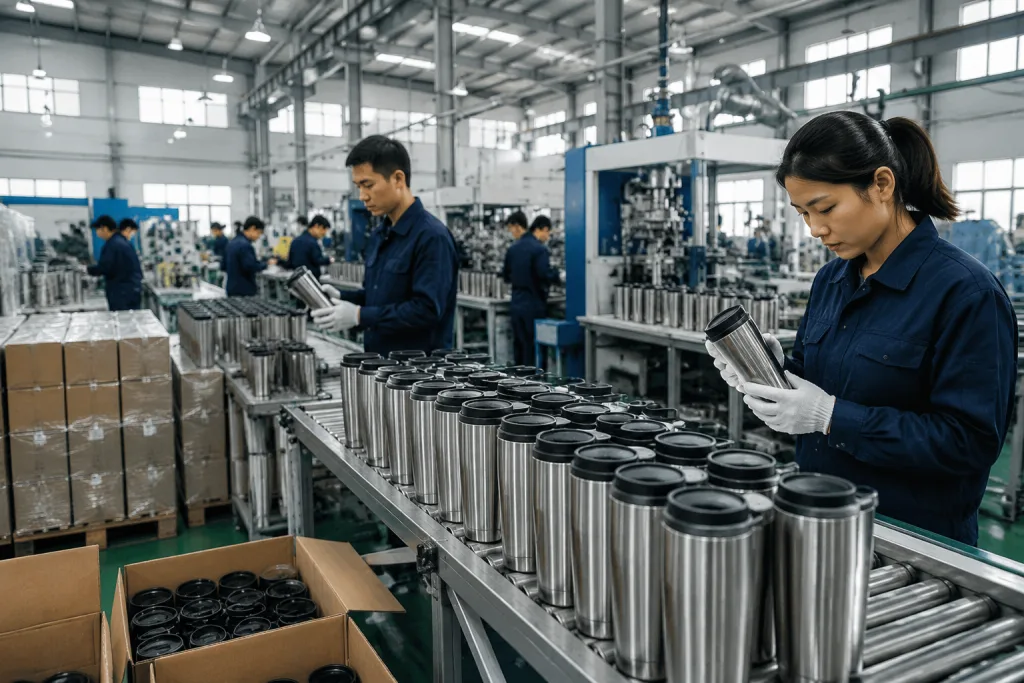
For coffee brands and corporate-gift buyers, the better question is not “what looks nice?” It is “what spec keeps the drink hot for 4 hours, prints cleanly, and still lands at a workable cost.” We run these in Zhejiang every day. A 304 stainless cup, a 201 body, and a powder-coated double wall are not cosmetic choices; they move margin, compliance, and the complaint count. QC pulled the sample on a 58 mm lid last week after the buyer flagged a 1.5 mm gap, and that is the sort of detail that decides whether a bulk coffee mug, bulk coffee travel mug, or bulk travel tumbler ships clean or goes sideways.
Start With The Drink Use
Start with drink use, not branding. A promotional products coffee mug for office coffee behaves differently from a bulk coffee travel mug for commuters or a bulk travel tumbler for road reps. On our line, a 12 oz to 14 oz straight-wall cup with a basic lid works for black coffee at a desk. If the drink is a latte in a car, you need a tapered body, a spill-resistant slider, and a lid that stays quiet when the driver brakes hard.
For corporate gifts, I push buyers to lock down three points before we quote: fill volume, carry style, and heating target. The math does not work if those are fuzzy. A 14 oz cup with double-wall vacuum insulation can keep hot coffee above 60 C for 4 to 6 hours in real use; we checked that with a probe on a 7:30 a.m. run. A single-wall coffee mug custom made with a sleeve looks clean in photos, but it has no thermal story to sell.
- Desk use: 12 oz to 14 oz, lower spill risk, lower cost
- Commute use: 16 oz to 20 oz, lockable lid, tighter seal
- Premium gift: powder coat, engraved logo, matched gift box
At the quoting stage, a coffee mug manufacturer in China should give you the actual cup height, mouth diameter, base diameter, and lid type. We had a buyer flag a PO typo on the mouth size once, and QC pulled the sample before the line ran. If the supplier cannot answer those numbers, they are not ready for private label work.
Material Choice Changes Everything
Material is where bulk coffee mug orders go off spec. For a coffee mug in bulk order, the body is usually 304 stainless steel, 201 stainless steel, PP, Tritan, ceramic, or glass. On the line, we still see buyers mix those up on the same PO. For travel tumblers, stainless steel does the heavy lifting because it gives insulation, durability, and print adhesion that holds through 3,000 cycles of wash testing. If you are sourcing from a coffee mug factory direct in Zhejiang, ask for the steel grade in writing. Do not accept “food grade stainless” as a complete answer.
304 stainless is the sensible default for most coffee mug promotional products because it balances corrosion resistance and compliance comfort. 201 stainless is cheaper and can work for dry climates or low-cost campaigns, but it is less forgiving with acidic beverages and finish wear. We had a buyer flag rust specks after lemon tea sat overnight in 201. The math does not work there. Wall thickness usually runs 0.35 mm to 0.5 mm on the inner and outer shells. Thicker walls feel better in hand, but they add weight and freight. A 0.05 mm change across a 5,000-piece order can move carton weight enough to change ocean freight and courier pricing.
Ask the factory to state steel grade, wall thickness, and coating method on the PI. If the answer is vague, your bulk coffee tumbler spec is incomplete.
If you want a coffee mug private label program with repeat orders, keep materials boring. Boring sells because it is predictable. Fancy materials create more QC questions than they solve. QC pulled the sample at 24 hours when the coating showed a pinhole near the seam, and that was enough to kill the run.
Lid Design Is A Risk Control
Lids are where complaints start. We shipped one pallet with a body that passed the drop test, then the lid warped after 18 days in a hot container and the buyer flagged it at receiving. That is why lid design sits in the risk column, not the style column. A push-on lid stays cheap and works for desk use. A slider lid feels better in hand, but it adds a spring, a stopper, and one more leak path. A threaded lid gives the safest travel read, though the thread pitch has to stay tight or the cap cross-threads and the seal goes soft.
For a bulk travel mug, I want a lid with a silicone gasket and a clear vent slot. QC pulled the sample and poured 90 degrees of hot water; the vent cut splash-back right away. If you are ordering coffee mug customized for a branded giveaway, spell out one-handed use, dishwasher safe, or cupholder fit on the PO. This is the wrong question to ask after production starts. North American cupholders usually sit around 70-75 mm at the base, so a tapered bottom is worth the extra mold work. We run that check with a caliper before first article, because 2 mm off and the buyer complains the cup rattles.
- Push-on lid: lowest cost, clean for office gifts, quick to pack on the line
- Slider lid: better user feel, needs tighter QC on the seal ring and spring
- Threaded lid: best leak resistance, slower to assemble, thread marks need checking
We see buyers order a strong body and then accept a generic lid. The math does not work. Save USD 0.10 here and you spend it back on returns, especially when the carton gets knocked and the lid edge takes the hit. We have seen that go sideways on a 5,000-piece order, so I push for the lid spec to be locked before the mold is cut.
Print Method Drives Brand Value
Logo decoration changes how the cup reads before the first sip. For a coffee mug custom program, the main options are silk screen, pad print, heat transfer, UV print, deboss, and laser engraving. Each one has its own cost and its own way to fail. Silk screen is the workhorse for flat color logos on bulk coffee mug runs. We run it all the time on 304 stainless and powder-coated bodies. It stays clean on 1-color or 2-color artwork. Laser engraving fits a premium coffee mug private labeling project better, because it wears hard and does not peel. The tradeoff is simple: bare metal shows through, and that does not fit every brand. We had one buyer flag a black-on-black logo and ask why the engraving looked silver. That is the wrong question to ask. On the line, a laser head set at 18W leaves a sharp edge, while a bad screen mesh at 120T blurs fast.
If you want a coffee mug customized for a conference, keep the decoration tight. A simple 1-color print on a matte powder coat usually looks stronger than a crowded multicolor print on gloss. On a 1,000-piece order, a basic 1-color silk screen logo may add USD 0.12-0.35 per unit. Laser engraving often lands around USD 0.20-0.60 depending on size and setup. The math does not work for chasing cheap decoration if the logo ends up weak on the table. We ship enough samples to know this. QC pulled one set at AQL 2.5 because the fine lines broke on a 75 mm curve, and the buyer saw it in five seconds. We’ve seen that go sideways plenty of times.
One practical point: curved surfaces distort fine type. If your logo has hairline strokes, ask the coffee mug manufacturer for a print proof at actual size. In Zhejiang factories that run high-volume OEM work, the better lines will send a PDF and a physical sample before production. A typo on a PO can cost a day, and a 0.3 mm line can disappear on the body. That is normal shop-floor discipline, not a premium service. We check the wrap angle with a steel ruler before the first sample is signed off.
Capacity And Dimensions Matter
Capacity looks simple until one factory calls the same cup 12 oz and another calls it 12 oz after a different fill line. We run this check on the line with a 250 ml measuring cup, and the gap shows up fast. One shop gives brimful capacity. Another gives working capacity. That 5-12% mismatch is enough to ruin a retail planogram or throw off a gift set. For coffee mug bulk sourcing, ask for brimful capacity and usable capacity in ml and oz.
The usual spec for a promotional products coffee mug sits at 350 ml to 500 ml, or about 12 oz to 17 oz. That range keeps carton weight under control and still feels right in hand. For travel use, we usually hold height between 145 mm and 190 mm so the cup clears a coffee machine and fits a bag sleeve. A desk mug with a wider mouth drinks easier. A narrow mouth ships better, but cleaning slows down, and the buyer will flag it if the brush misses the bottom.
Buyers who source coffee mug factory direct often skip the base diameter. That is the wrong question to skip. A base that is too wide misses car holders; too narrow tips on a desk. We target 68 mm to 74 mm for commuter tumblers, and QC pulled the sample on one order because a 76 mm base failed the holder test. Boring spec. Good repeat business.
Packaging And Carton Math
Packaging is not an afterthought. A coffee mug promotional order can look fine on ex-factory price and still bleed cash if the carton math is wrong. We ask for inner box, master carton count, carton size, gross weight, and whether the line runs bulk pack or gift box. For retail or Amazon FBA, barcode and FNSKU instructions need to be locked before mass production starts. QC pulled one sample last month with the wrong FNSKU on the sleeve. That order sat 12 days.
For coffee mug custom made programs, I prefer an individual white box for protection, then a 24 or 36 pcs master carton depending on cup size. A 16 oz insulated cup with box usually lands around 8 to 11 kg gross weight per carton, and that number moves freight fast. We had a buyer flag a PO typo once: “36 pcs” was printed as “63 pcs,” and the packing team nearly ran the wrong stack. If you are building a coffee mug supplier list for distributor channels, ask each factory for carton dimensions and pallet count. The math does not lie.
- Bulk pack: lowest packaging cost, higher damage risk
- White box: solid middle ground for corporate gifts
- Gift box: stronger shelf look, higher cubic cost
A coffee mug distributor program lives or dies on warehouse space. Pretty packaging that adds 15% more cubic volume is expensive packaging, not premium packaging. We ship by pallet, and a 1200 x 1000 mm footprint can change the freight quote overnight. This is the wrong question to ask: “How nice does it look?” Ask how many cartons fit on one pallet and what the warehouse will pay to move them.
Compliance You Actually Need
Compliance is where China factories split into real exporters and casual sellers. For Europe and North America, we ask buyers to check REACH test reports for coatings and contact materials, LFGB where food contact applies, and a plain BPA-free statement for plastic parts. Stainless steel is only one piece. The lid resin, gasket, ink, and paint need their own papers. We had one PO where the buyer flagged a lid color typo, and the test file had to match the corrected spec before we could run the line.
If the program is for retail shelves or corporate gifting in regulated channels, ask for ISO 9001 factory documents, BSCI if your procurement team requires social compliance, and a third-party test report dated within the last 12 months. A sample that looks clean at QC but has no traceable test data is a weak sample. The math does not work. We once saw a 20,000-unit tumbler order stall for 18 days because the distributor asked for the report after the cartons were booked, and that delay was avoidable.
From our side in Zhejiang, we keep the export file ready before mass production: material declaration, carton labels, inspection checklist, and pre-shipment photos. That is the baseline for a serious coffee mug factory. If a coffee mug manufacturer cannot hand over those documents without a scramble, they are not ready for repeat promotional products coffee mug work. QC pulled the sample, checked the 0.2 mm print shift, and signed off only after the file matched the batch.
Quote Like A Buyer, Not A Browser
The cleanest quote starts with a tight brief. Think like a sourcing engineer. A bulk coffee mug inquiry should list capacity, material, lid type, finish, logo method, order quantity, target market, and delivery term. We had one buyer send “16 oz 304 stainless steel bulk travel tumbler, powder-coated exterior, slider lid, 1-color laser logo, 3,000 pcs, FOB Ningbo, delivery to the US,” and the quoting desk priced it on the first pass. That is the standard.
On our line, MOQ is usually 1,000 pcs for a stock model and 3,000 pcs once you want private label details or custom packaging. Lead time after sample approval is 35-45 days for standard colors, and 45-60 days if the job needs new tooling or printed gift boxes. Ask the factory to split the price into mold, print, and packaging. The math does not work any other way. We run quotes this way because a 0.3 mm wall change or a typo on the PO can move the cost more than the logo. We saw that on a 12,000 pcs run last spring.
Good buyers do not stop at unit price. They check defect allowance, spare lid ratio, carton damage risk, and how fast the factory replies. QC pulled the sample on one 5,000 pcs order and found a loose slider after the drop test, so the buyer flagged the supplier before payment. A coffee mug manufacturer that answers in 24 hours and sends a marked-up drawing is worth more than a cheaper quote with holes in it. We have seen that go sideways too many times. The buyer was right to push back.
Request a spec-based tumbler quote today
Send your capacity, logo method, and target market. We will quote a factory-direct program from Zhejiang with clear MOQ, lead time, and export terms.
Frequently asked questions
What is a realistic MOQ for a promotional products coffee mug?
For standard stainless travel tumbler models, a realistic MOQ is 1,000 pcs per color or per logo version. If you want special packaging, custom tooling, or a new lid, 3,000 pcs is more common. Some coffee mug manufacturers will quote 500 pcs, but the unit price usually jumps by 15-25%. For a repeatable coffee mug private label program, 1,000-2,000 pcs is the practical starting point. That gives you enough volume to control print setup cost, carton efficiency, and sampling waste without tying up too much cash.
Which decoration method lasts longest on a bulk coffee tumbler?
Laser engraving is usually the most durable on stainless steel because it removes the top layer and does not rely on ink adhesion. It is a strong choice for a premium coffee mug custom order and typically adds USD 0.20-0.60 per unit depending on logo size. Silk screen is cheaper and looks clean on powder-coated finishes, but it can wear if the cup sees heavy dishwasher use. If you need color branding, use a proper cured coating or UV print and confirm abrasion resistance before mass production. Ask for a rub test and a sample photo under bright light.
What material should I choose for coffee mug promotional products?
For most buyers, 304 stainless steel is the safest choice. It gives good corrosion resistance, broad compliance acceptance, and a better resale story for coffee brands. 201 stainless is fine for low-cost campaigns, but you should know you are trading away some long-term finish stability. For lids and inner parts, PP or Tritan are common. If your audience is in Europe or North America, request REACH documentation and, if needed, LFGB reports. A coffee mug factory direct supplier in Zhejiang should be able to give you those documents before shipment.
How long does production take in China?
For standard coffee mug in bulk orders with existing tooling, plan on 35-45 days after sample approval and deposit. If you need new colors, special packaging, or a new lid mold, 45-60 days is more realistic. Shipping time is separate: ocean freight to the US or Europe often adds 18-35 days depending on port and season. A factory in Zhejiang with a monthly output of 300,000 units can still miss your deadline if artwork approval drags, so build in sample time early. Good buyers approve print proofs within 48 hours and keep the spec frozen.
How do I compare a coffee mug supplier list without wasting time?
Compare them on the same five points: exact material declaration, MOQ, lead time, test reports, and carton details. A coffee mug supplier directory is only useful if it helps you filter out vague quotes. Ask each supplier for unit price at 1,000 pcs and 5,000 pcs, plus sample charge, packaging option, and defect allowance. Then check whether they are a coffee mug factory, a trading company, or a coffee mug distributor. Factory direct is not automatically better, but it usually gives you more control on print, packaging, and reorders.