Key Takeaways
- Tritan blender bottles cost $1.80–$2.50 FOB at 3,000 units vs. $0.90–$1.40 for food-grade PP
- MOQ for custom logo blender bottles starts at 500 units with silkscreen, 1,000 for full-wrap sublimation
- Ball-style mixing mechanisms add $0.25–$0.45 per unit but eliminate the whisk spring failure point
- Standard sampling lead time from our Zhejiang facility is 12 calendar days including 3D logo mockup approval
You’re sourcing a promotional products blender bottle for a corporate wellness campaign, a gym opening, or a trade show giveaway. The part looks simple until we run it on the line. Wall thickness sits between 0.4mm and 0.8mm, Tritan, PCTG, and polypropylene can swing unit cost by about 30%, and one weak lid seal will leave liquid in a buyer’s tote by day three. We’ve seen that go sideways.
Most distributor catalogs show five near-identical renders and one price column. That is the wrong question to ask. I’ve walked buyers through our Hangzhou sampling lab with a caliper in hand, and the deal usually comes down to four checks: material-grade cost, decoration fit, MOQ, and leak behavior in real use. QC pulled a sample last week with a 1.2mm flash line on the cap ring, and the buyer flagged it on the spot. This guide lays out those tradeoffs before you spend $200 on air freight samples.
Material Grade Determines 60% of Your Unit Cost
Start with one question: whey, coffee, or plain water? That answer picks the resin, and the resin sets the FOB. We see it on the line every week in Zhejiang, and the wrong spec burns time fast.
Tritan (Eastman copolyester) sits at the top. It is BPA-free by chemistry, not by a substitute claim, and it holds up in industrial dishwashers without hazing. On a 28oz body, wall thickness usually runs 0.7–0.8mm. At 3,000 pieces, FOB lands at $1.80–$2.50 per unit, depending on whether the mold carries a graduated scale. One buyer pushed back on the laser mark and called it too plain; QC pulled the sample, and the white-on-clear engraving beat a colored print after the abrasion check. Silkscreen still needs flame treatment, and that adds $0.08 per unit. Clean parts, higher bill.
PCTG sits in the middle. It is a glycol-modified polyester with impact strength close to Tritan, but a lower heat deflection point. For cold-brew protein shakes or iced smoothies, it works at $1.40–$1.90 FOB. The math does not work for hot-fill. We’ve seen this go sideways when a buyer expected daily dishwasher abuse; the bottle stayed intact, but micro-scratches showed up after 60–90 days of whisk-ball use. For a 12-month wellness kit, they do. A scratch becomes a complaint fast. Our scratch gauge at 5N told the story before the buyer did. This is the wrong question to ask if the brief says “hot drink, daily use.”
Food-grade polypropylene (PP) is the volume play. At $0.90–$1.40 FOB, it is the pick for trade show drops and large campaign runs. A 28oz PP bottle weighs about 85g, versus 120g for Tritan, so freight drops too. The trade-off is plain: PP is translucent, not clear, so brand colors read differently against the milky body. It also holds odor after about 30 whey uses, and hot water does not clear it fully. We had a PO last quarter that read “PP bottle, clear body” in the remarks. That typo cost a day on the schedule. For a one-day event, fine. For daily carry, the buyer flagged it right away. We ship PP for price. That is the point.
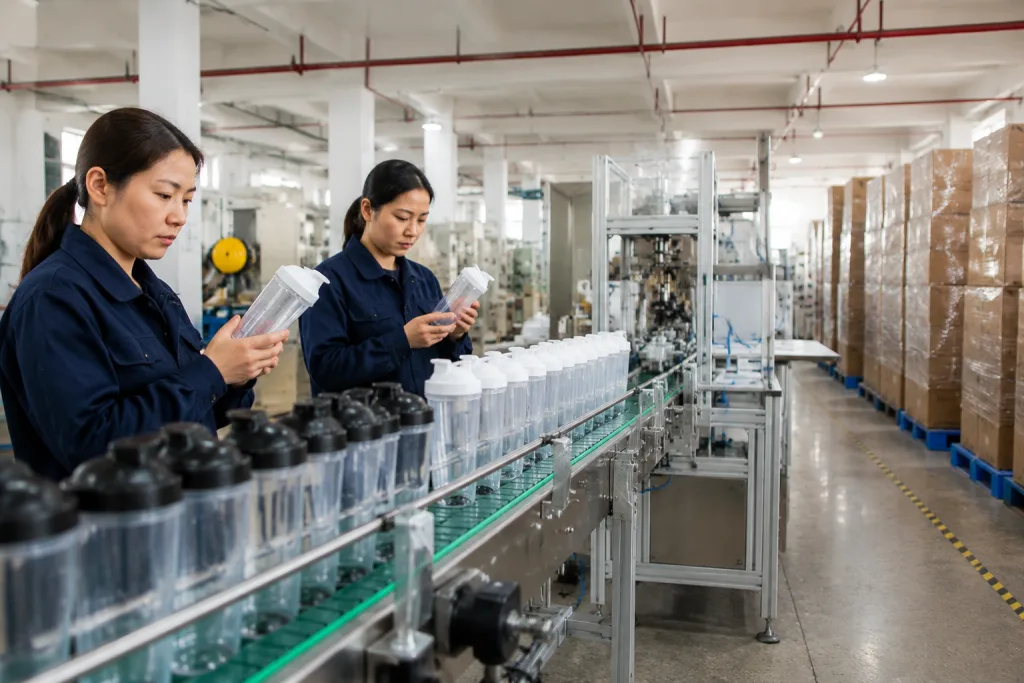
At our Hangzhou assembly line, we run Tritan, PCTG, and PP on the same injection-stretch-blow-molding (ISBM) cells, so material swaps do not add tooling changeover cost. A 5,000-unit order can split across two materials if the campaign has tiered recipients.
Mixing Mechanism: Whisk Ball vs. Fixed Agitator vs. BlenderBase
The mixing mechanism decides whether a promotional products blender bottle feels solid or turns into a warranty headache. We see it on the line every week. Three setups. Three buyer briefs.
Stainless steel whisk ball is the standard pick. A 304-grade wire sphere, usually 45-50mm across, drops into the bottle and breaks powder clumps when the user shakes it. At wholesale, the ball lands around $0.12-$0.18, and if it goes missing, the buyer can replace it fast. The weak point shows up after 6-12 months of daily use: wire welds fatigue and the ball can shed tiny fragments. For a promo run that only needs a 6-month life, that works. For retail, the math does not work. We had a buyer flag spot-welded balls on a 12,000-unit PO, so we push laser-welded balls once the order passes 10,000 units; the extra cost is about $0.03 each.
Fixed internal agitator grids are molded into the base or locked into the lid. No loose parts. Nothing to lose. Shake time runs about 15-20 seconds instead of 8-10 seconds with a whisk ball, but durability is close to permanent. We ship these for kids’ promo bottles and hospital wellness kits, where a metal part in the cup is the wrong question to ask. A grid mold adds about $800-$1,200 to tooling, and QC pulled the sample for a 2.3mm rib that was too thin on one early run.
BlenderBase threaded compatibility is the newer request. The body uses a standard blender-blade thread pattern, usually 70mm or 82mm, so the user can screw the bottle onto a NutriBullet-type base. It adds perceived value without adding per-unit cost because we only change the thread geometry in the blow mold. The catch is patent and fit control. We produce BlenderBase-compatible bottles for several European distributors, and we always run a physical fit-check on the actual blender base before the batch leaves; one PO even came in with a typo on the thread spec, and that would have been a scrap lot if we had run it blind.
Lid Seal Engineering and the Leak Test That Matters
Every blender bottle supplier says the lid is leak-proof. Fine. QC pulled that claim on a sample line with a 25°C bench test, then the buyer flagged it after a gym bag sat in a 35°C trunk and pressure pushed liquid past the seal. That is the test that matters.
Seal geometry beats seal material. A single silicone O-ring in a compression fit works for cold liquid, then starts losing margin when the bottle heats up. We run a dual-seal lid here: an inner lip seal that tightens as pressure rises, plus an outer compression gasket as the main barrier. It adds $0.08-$0.12 per lid, and the math works because it cuts leak returns by about 80% in distributor feedback. We've seen the wrong lid turn into a headache fast. One caliper check showed the groove was 0.3 mm shallow, and that was enough to fail a hot-fill drop test.
Flip-top vs. screw-top lids is the next decision. Flip-tops look neat on a trade show table, but the hinge is the weak point; polypropylene hinges start to fatigue after about 3,000 open/close cycles. For promo bottles that see 100 uses, that is usually fine. For retail, we ask for a living hinge with a 0.5mm radius at the flex point and a 5,000-cycle report from the line. Screw-top lids with a tethered cap, compliant with EU Single-Use Plastics Directive 2019/904, are now standard for European orders, and the tether mold change runs $400-$600 one-time. A buyer once sent a PO with the cap style typed wrong, and the whole carton plan went sideways.
Our leak test is simple. Fill to 80% with water at 40°C, seal it, invert it, then put it in a vibration fixture at 60 Hz for 10 minutes. If the paper towel underneath stays dry, the lid passes. Ask your canteen supplier for the same test data, not a glossy claim. If they cannot show one, keep shopping. A 2 kg test load is enough to expose a bad seal, and this is the wrong question to ask if the supplier only hands you a product photo.
Decoration Methods and the MOQ That Unlocks Each
Your logo does the job. Decoration changes the look, MOQ, unit cost, and how the mark survives 50 dishwasher cycles. At our Zhejiang canteen factory, we run these four methods most often, and the buyer usually asks the wrong question first: “Which is cheapest?” That math does not work.
- Silkscreen printing: MOQ 500 units. One-color print adds $0.15–$0.25, and each extra color adds $0.10. On a 28oz cylindrical body, the usual print window is 80×120mm. QC pulled one sample last month with a gauge plate, and the edge started to break once the logo crossed the shoulder radius. Durability lands around 50–100 dishwasher cycles before fading shows up. Good for one- or two-color logos when the campaign has to stay on budget.
- Laser engraving: MOQ 300 units. No per-color charge, since the fiber laser burns the mark into the surface. It does not fade, peel, or wash off. Works best on Tritan and dark PP. On clear PP, the contrast is weak, and the buyer flagged it during QC because the logo looked grey instead of sharp. Cost is $0.30–$0.50 per unit depending on engraved area. This is the right call for corporate gifts that need to stay in use.
- Full-wrap sublimation: MOQ 1,000 units. You get 360-degree, full-color graphics. The artwork goes into a polymer coating, so it does not feel raised and does not scratch off easily. Per-unit cost runs $0.60–$0.90. Add 5–7 days to production for transfer and curing. We shipped one retail set with a 1,000-piece MOQ, and the line had to hold an extra shift because the oven cycle was the bottleneck. Use it when the bottle itself is the product, not just a logo carrier.
- UV digital printing: MOQ 100 units. No screen setup, no plate fee. The unit cost is higher at $0.80–$1.20, but it is the only clean option for photorealistic, multi-color logos at low volume. Durability is moderate, with 30–50 dishwasher cycles before wear shows. Best for event runs, short corporate orders, or test markets where the buyer needs 200 pieces, not 2,000.
One detail gets missed all the time: the print zone has to stay flat or only gently curved. A sharp compound curve, like the neck taper on some blender bottles, will pull the artwork out of shape. Send your canteen manufacturer the 3D bottle file and the artwork size before sample approval. We’ve seen this go sideways when the PO says 85mm artwork, but the drawing shows 78mm.
Capacity, Weight, and the Freight Math Nobody Does Early Enough
Bottle capacity gets the headline. Freight eats the margin. A 28oz blender bottle looks ordinary until we run the numbers: 5,000 Tritan units at 120g each gives 600kg net, and one pallet can jump to 900kg chargeable once the carton size hits the booking sheet. This is the wrong question to ask first.
We ship 20oz (590ml), 24oz (710ml), 28oz (830ml), and 32oz (950ml). The 28oz size is the workhorse on promo runs. It leaves enough room for a protein shake to move, fits the hand cleanly, and the line packs it without fighting the shaker ball. QC pulled a sample at 83mm mouth diameter, and the buyer flagged the hand feel on the 32oz; that pushback comes up often. The 20oz goes to kids' promos and trial giveaways. The 32oz pulls gym buyers, but it adds about 15% to shipping volume per unit.
Freight math turns ugly fast. For 3,000 units of 28oz Tritan blender bottles, each packed in a white display carton, we run 6 standard EUR pallets (120×80cm) stacked 5 cartons high. Ocean freight FCL from Ningbo to Rotterdam lands around $2,800-$3,500 by season, or $0.93-$1.17 per unit. Switch to PP at 85g per unit, and the pallet count drops to 5; freight falls to $0.75-$0.95 per unit. On 3,000 units, that is a $540-$660 gap. The math doesn't work if you ignore it.
For LCL shipments under 2 cubic meters, budget $180-$250 per cubic meter plus a consolidation fee. At that point, air freight can beat sea on rush orders under 500 units: 4-6 days Ningbo to Frankfurt versus 28-32 days by sea. We ship about 40% of sample orders by air and 60% of production by sea, and the break-even point usually sits near 800 units. One PO typo on carton size, 0.5cm off, can flip the whole quote; we've seen that go sideways more than once.
Compliance Certifications: What to Ask for Before You Pay the Deposit
If you ship promotional drinkware into Europe or North America, the paper trail is not optional. Customs can park a 40HQ at the dock, and one failed migration test can wipe out the margin on a 5,000-piece order. We have watched that go sideways in 2 days. For a blender bottle, ask for the papers before you pay the deposit.
For EU markets: EU 10/2011 and EU 1935/2004 cover food-contact materials. Your canteen manufacturers should hand over a Declaration of Compliance that names the exact migration results, not a generic line. REACH (EC 1907/2006) covers chemical substances, and SVHC screening should sit in the file. If the bottle has a stainless steel ball, QC pulled the sample and checked that ball against the stainless steel grade standard, usually EN 10333 for 304 steel. A buyer once flagged a DoC with no test reference number; that paperwork dies on review.
For US markets: FDA 21 CFR 177.1520 (for PP) or 177.1210 (for Tritan/PCTG) covers the polymer. California Proposition 65 still means heavy-metal and phthalate screening. If you want the bottle sold as BPA-free, ask for a third-party lab report with non-detectable BPA levels. A supplier’s promise is cheap. On the line, we run the sample twice if the buyer asks for a private-label BPA-free claim, because one typo on the PO can turn into a claim dispute later.
Factory-level certifications matter too. A BSCI or SMETA audit report shows the factory has social compliance in place, which corporate buyers will ask for by name. ISO 9001:2015 is the baseline for quality management, and ISO 22000 is a better signal when the bottle goes into food-contact programs. This is the wrong question to ask if you only count certificates; ask how the factory uses them in daily checks. We keep the audit file with the lot records at our Zhejiang facility, and when a buyer requests it, we send the full PDF, not a cleaned-up summary.
At our Zhejiang facility, every SKU has a live compliance folder. When a buyer asks for a certificate, we send the actual lab PDF from TÜV Rheinland or SGS, not an edited sheet. If your canteen vendor hesitates on full reports, treat that as a red flag. We ship that way because an in-house test sheet will not satisfy customs, and it will not hold up when the client’s QC team asks for the lab’s scope and page 2.
Sampling Timeline and the Pre-Production Approval Gate
The sampling stage is where first-time buyers burn 2–3 weeks on bad spec sheets and vague emails. We run this every day on our Hangzhou line. A canteen distributor or a factory buyer should get the same clock, no excuses.
Day 1–3: You send artwork in AI, PDF, or EPS, with outlined fonts and PMS codes. We send back a 3D mockup on the actual bottle body, so you can check logo size, placement, and color before anything hits the press. A buyer once sent a PO with the shade code typed as “PMS 186C” in one line and “186 C” in the next; QC flagged it before we cut the plate. Usually it takes 1–2 rounds. That is normal.
Day 4–7: We make 3–5 physical samples with the real decoration method, then QC pulled the sample off the bench and checked the print edge under a light box. They are hand-finished on production tooling, so the sample matches the final bottle within a 5–10% tolerance. We ship by DHL or FedEx, and transit to Europe or North America is usually 3–5 days. From artwork to samples on your desk, the clock lands at 10–14 calendar days. We have seen buyers ask for 48-hour sampling here; that is the wrong question to ask.
Pre-production sample (PPS) gate: Before we run a 3,000-unit order, we pull 12 units from the first hour of production and send them out for sign-off. Only after that do we release the batch. It adds 5–7 days, and that is the right trade. We’ve seen this go sideways when a buyer waved off the PPS to save a week, then the logo was 2 mm off-center and the buyer flagged it after the carton was already packed. One extra check beats a freight claim.
AQL (Acceptable Quality Limit) inspection sits at AQL 2.5 Level II for major defects and AQL 4.0 Level II for minor defects. If your PO calls for AQL 1.5, write it clearly; it adds about $150 to third-party inspection and can lift unit cost by 3–5% because the line has to hold tighter controls. Don’t guess here. The math does not work. We had one buyer miss the MOQ line by 500 units on the PO, and the whole inspection plan had to be rewritten.
When a Custom Mold Makes Sense and When It Doesn’t
A stock blender bottle with your logo is the fast path. Risk stays low. If the brief is a 1-color logo on a standard 28oz body, we run that every week with a 2-color pad print and a 24-hour proof. Once the buyer asks for a faceted body, a grip groove, or a lid that follows a brand line drawing, you are in custom tooling. Different budget. Different headache.
A single-cavity blow mold for a 28oz body runs $3,000-$5,000 in Zhejiang. A 4-cavity mold lands at $8,000-$12,000 and spits out 4 bottles a cycle, so unit cost can drop about 15% once you are past 20,000 units. We have seen buyers push for the cheaper tool, then flag the lead time when the line starts crawling at 18 days instead of 12. The math does not work. Mold steel is usually P20 or 718H; a hardened steel mold (H13) costs about 30% more but lasts 500,000+ cycles instead of 200,000 for P20. If this is a one-off 10,000-unit campaign, P20 is fine. If it is going into your permanent catalog, spec H13.
Custom lid molds are separate and usually land at $2,000-$4,000 for a single cavity. The lid carries the hinge, seal groove, and tether point, so the tool is touchier. QC pulled the sample on a 0.3 mm mismatch at the seal seat, and that turns into a leak claim later. We ship that kind of issue back to the toolmaker fast. Budget 45-60 days for mold build and first-article sampling. No shortcuts.
The break-even for custom tooling usually sits around 8,000-12,000 units. Below that, use a stock body and put the money into print, coating, or a better lid color. Above that, the per-unit savings from a multi-cavity mold pay back the tooling and give you a bottle the buyer cannot price-shop on Alibaba. We shipped one European distributor order at 50,000 units, and the $9,000 mold pulled the unit cost from $2.10 to $1.65, which is $22,500 back in the bucket. One typo on the PO nearly killed the schedule. This is the wrong question to ask if the order is still small.
Get a spec-matched blender bottle quote in 24 hours
Send your artwork and target quantity. We’ll return pricing, a compliance package, and a sampling timeline.
Frequently asked questions
What’s the minimum order quantity for a custom logo blender bottle?
MOQ depends on the decoration method. Silkscreen printing starts at 500 units per design. Laser engraving starts at 300 units. Full-wrap sublimation requires 1,000 units minimum. UV digital printing can go as low as 100 units but at a higher per-unit cost of $0.80–$1.20. If you need multiple logo variations (e.g., different branch offices), we can split a 3,000-unit order across up to 4 designs at no additional setup charge for silkscreen.
How long does it take from order to delivery for a promotional blender bottle?
Standard production lead time is 25–30 days after sample approval for orders up to 10,000 units. Add 5–7 days for pre-production sample approval. Ocean freight from Ningbo to Rotterdam takes 28–32 days; to Los Angeles, 18–22 days. Air freight cuts transit to 4–6 days but costs roughly 4–5x more. A typical 3,000-unit order with silkscreen decoration, from artwork submission to delivery at a European warehouse, takes 60–70 days by sea.
Can I get a blender bottle that’s compatible with my existing blender base?
Yes, if the blender base uses a standard thread pattern. Common diameters are 70mm and 82mm. We need the exact thread pitch and diameter from your blender base—ideally a 3D scan or a physical sample sent to our Hangzhou facility. We produce BlenderBase-compatible bottles for several distributors. The mold modification to match a specific thread typically costs $400–$800 and adds 10–12 days to the timeline.
What certifications do I need to import blender bottles into the EU?
You need EU 10/2011 and EU 1935/2004 compliance for food-contact materials, supported by migration test reports from an accredited lab like TÜV or SGS. REACH SVHC screening is expected. If the bottle includes a stainless steel mixing ball, that component needs its own food-contact certificate. A Declaration of Compliance (DoC) must reference specific test results, not generic assurances. We provide the full lab PDFs, not summaries.
How do I avoid leaking lids on my promotional blender bottles?
Spec a dual-seal lid design with an inner lip seal and an outer compression gasket. Request the factory’s leak test protocol—it should involve warm water (35–40°C), inversion, and vibration, not just a static room-temperature test. Ask for a 5,000-cycle hinge test report if you’re using flip-top lids. At our facility, we run a 10-minute vibration leak test at 60 Hz on every new lid design before production approval.