Key Takeaways
- For a standard 12 oz double-wall beer tumbler, expect an MOQ of 1,000 units from a Zhejiang factory, with FOB pricing around $2.80–$4.50 per unit depending on finish and customization.
- Your lead time will typically be 30–45 days for first orders; reorders can drop to 20–25 days if the same tooling and artwork are used.
- Laser engraving costs a one-time $50–$80 setup fee per design, versus silk-screen printing at $30–$40 per color per screen, but engraving lasts the life of the cup.
- A simple QC check—weighing 5 random samples and verifying wall thickness with a caliper—can catch 90% of common defects before shipment.
You need a giveaway that stays in use on a desk, in a car, or in a lunch bag. A beer tumbler does that job: double-wall insulated, stainless steel, lid on top, and enough flat space for a clean logo. We run these in Hangzhou, and the first three buyer questions are usually the same: unit price, MOQ, and whether the print still holds after 50 dishwasher cycles. Fair questions.
This comes from a live order. QC pulled the sample off the line and checked wall thickness with a caliper at 0.6 mm, then the buyer flagged a typo in the PO before we loaded material. That saved 7 days. We go through the RFQ, the Zhejiang factory quote, the term pushback, and a basic carton check so you know what to ask a canteen manufacturer or drinkware supplier before you place the first order.
Specifying Your Beer Tumbler
You start with a blank RFQ. First call: material. We run 304 stainless steel on food-contact drinkware for a reason. It holds up against corrosion, does not leave a metal taste, and clears REACH and FDA checks. 201-grade looks cheaper on paper, but we watched it bloom rust after 3 weeks in a damp warehouse. That is the wrong place to save money.
Then capacity. A beer tumbler usually lands between 10 oz and 16 oz. For promo giveaways, 12 oz is the clean pick. It takes a standard can of beer or a 330 ml bottle, ships well in a 42 x 28 x 24 cm master carton, and still feels like a proper gift instead of a throwaway. On the line, we check 0.4 mm for the inner wall and 0.5 mm for the outer wall; go thinner, and the first dent shows up before the carton even reaches port.
Insulation comes next. Double-wall vacuum insulation is the baseline if the tumbler is supposed to keep drinks cold. Ask for a temperature retention test report, not a sales promise. We fill with 95°C water, cap it, and check the outer wall after 30 minutes; it should stay under 45°C. For cold use, we run ice water and check again after 15 minutes. If condensation shows up, QC pulled the sample and the spec went back to rework. We have seen that go sideways fast.
Finally, the lid. A press-fit silicone lid with a sliding closure is the common setup for beer tumblers. Make sure the silicone is food-grade and BPA-free. We ask for a lid drop test from waist height onto concrete, and the lid should stay on. One buyer once flagged a PO because the lid code was typed as “slied” instead of “slide” — tiny typo, big delay. A loose lid in a promo bag is dead simple to spot, and hard to explain away.
Pricing Structure and MOQ
You send the RFQ to three Zhejiang factories. We run this every week. For a 12 oz double-wall beer tumbler with powder coating and laser engraving, FOB Shanghai usually sits at $2.80 to $4.50 per unit, and MOQ is the first number that moves it. A mid-sized line usually stops at 1,000 units. Drop to 500 units and the math changes fast: expect $4.00 to $5.50 per unit, because setup gets spread over fewer cartons.
Here is the cost stack. Bare tumbler, no logo, runs around $1.80 to $2.20. Powder coating adds $0.30 to $0.50. Laser engraving adds $0.15 to $0.25 for a single-color logo. A printed cardboard sleeve adds $0.10 to $0.20. QC pulled the sample on a 0.8 mm coating check last month, and the buyer flagged a shade shift; that is not where you trim $0.05. The factory will also quote a one-time tooling fee for the laser template, usually $50 to $80, and we waive it on reorders if the artwork stays the same.
Freight is separate. A 20-foot container holds about 12,000 to 15,000 12 oz tumblers in individual sleeves, packed 60 per carton. Ocean freight from Shanghai to Los Angeles was about $1,200 to $1,800 per container in early 2025. That works out to $0.08 to $0.15 per unit. We ship cartons at 38 x 38 x 28 cm, and once the buyer asks for gift boxes the count drops fast. Total landed cost usually lands at $3.00 to $5.00 per unit, and MOQ plus finish drive most of that spread.
Payment terms are standard. Most factories in China ask for 30% deposit and 70% before shipment. For a new buyer, the full 30% deposit is normal. After a few orders, 30% deposit and 70% against a Bill of Lading copy is common. We saw one PO with "beer tumber" spelled wrong and the buyer still pushed for the same terms; that never helps. A clean PO moves faster. The line notices that in five minutes.
Customization Options That Matter
Logo placement is the first thing buyers check on a beer tumbler. We run laser engraving on promo orders when the mark has to survive dishwashers and repacks; the setup is one-time, then you pay per unit. Silk-screen printing costs less, but the math only works for a one-off event. QC pulled the sample after 60 wash cycles, and the print had already softened at the edges. For a cup that needs to carry a brand for months, laser engraving is the cleaner call.
Powder coating is the finish we ship most on stainless steel. Pantone matching is fine, but the first order usually needs a $50-$80 color-matching fee, and the buyer flagged that line on more than one PO. Standard colors like black, white, navy, and red usually stay free. Skip glossy. It shows fingerprints and scuffs fast. Matte or textured finishes hold up better in hand and on the line. We’ve seen glossy go sideways after a 3-day warehouse check.
Other customizations to consider:
- Bottom ring color: A contrasting silicone ring on the base adds color and keeps the tumbler from sliding. Cost: $0.10-$0.15 per unit.
- Custom lid color: Match the lid silicone to your brand color. Cost: $0.05-$0.10 per unit.
- Embossed or debossed logo on the base: A subtle stamp on the bottom of the tumbler. Cost: $0.08-$0.12 per unit, plus one-time die cost of $30-$50.
If you're a canteen distributor or canteen vendor handling several brand clients, ask for a blank inventory program. We keep unmarked tumblers in standard colors, then add laser engraving as orders come in. That usually cuts lead time to 10-15 days, and it lets you work with lower MOQs per design. One buyer once sent a PO with the logo position typoed as “bottom lazer” - we caught it before tooling. That saved a week.
Packaging and Branding for Distribution
Your beer tumbler leaves the factory in bulk cartons. Fine for pallet drops. If you ship direct to end customers, each piece needs its own pack. The cheapest setup we run is a single-color printed cardboard sleeve. It wraps the tumbler, carries the logo, a short tagline, and a QR code to the landing page. On a 1,000-piece run, that usually lands at $0.08–$0.15 per sleeve. QC pulled the sample on a 340g board, and the print held up cleanly.
For higher-end giveaways, a rigid gift box with a magnetic closure changes the outcome. The add-on is about $0.50–$1.00 per unit, and the buyer sees it on the table. A trade show attendee keeps the boxed tumbler; loose handouts get left behind. “Just a box” is the wrong question. We have seen this go sideways when the insert gap was 2 mm too wide and the tumbler rattled in transit.
For bulk packaging, ask for double-walled corrugated cartons cut to the tumbler size so the load does not shift. We ship export cartons in 5-ply, and 60 units per carton is the ceiling we use. Push past that and the handling weight starts causing trouble at the line. The carton should show the PO number, quantity, and “Made in China” in English. One typo on the PO, and the warehouse team spots it before the truck leaves.
If you are a canteen distributor or canteen supplier running multiple SKUs, ask for custom carton marking. The factory prints your company name and address on the outer carton, so your team skips relabeling at the warehouse. It sounds small. The math works. On one mixed-SKU job, that cut receiving time from 18 days to 12 days because the cartons landed already sorted by customer.
Quality Control: What to Check Before Shipment
You approved the pre-production sample. Good. Then the line starts running 2,000 tumblers, and that is where a clean sample can still turn into a bad shipment. We run a QC plan on every first order. One buyer flagged a sleeve size typo on the PO before packing, and that saved a 20 oz run from a mismatch.
Step 1: Visual inspection (AQL 2.5). Pull 125 random units from the lot. That is the normal AQL 2.5 count for a 2,000-unit batch. Check for scratches, dents, discoloration, and logos that sit 2 mm off-center. Do not accept more than 7 defective units. If QC finds 8, stop the lot and call for re-sorting. This is not a guessing game.
Step 2: Dimensional check. Use a digital caliper and check diameter and height on 20 random units. Keep tolerance at ±0.5 mm. We saw one tumbler come in 1 mm wider than spec, and it would not slide into the custom sleeve. That batch stayed at packing.
Step 3: Weight check. Weigh 10 random units on a 0.1 g scale. The target should stay within ±5 grams of spec. If the cup comes in light, the wall is thinner. The math does not work. We reject that lot before it reaches carton packing.
Step 4: Lid fit test. Fill 5 tumblers with water, cap them, and invert for 30 seconds. No leaks. Then drop each one from waist height onto a concrete floor. The lid should stay on. QC pulled the sample on a cracked epoxy floor once, and we found a loose thread on the lid ring after the second drop.
Step 5: Dishwasher test. Run 3 tumblers through one commercial dishwasher cycle. Check for logo fading, color shift, and lid warping. If the print starts peeling, the factory needs to redo the engraving or switch to a higher-temperature paint. We ship promo drinkware every week, and weak ink shows up fast on the line.
If you are buying from a canteen factory for the first time, pay for a third-party inspection from SGS or Bureau Veritas. It usually runs $300–$500 per day. That is cheaper than opening 2,000 bad tumblers at the warehouse door. We have seen this go sideways on an 18-day order, and nobody wants that bill.
Lead Times and Shipping Realities
Your first order usually runs 30–45 days from deposit to shipment. We quote it by stage because the line does not move on one clock: laser template check, printed proof sign-off, then tooling. I watched a buyer lose two days over a 1.2 mm logo shift, so here is the real timeline:
- Days 1–5: Artwork approval and tooling setup, including the laser template and pantone drawdown on the color board.
- Days 6–25: Production. We run your order in batches with other jobs so the line setup does not burn time on every 500-piece run.
- Days 26–30: QC pulled the sample, then packing. If the buyer flagged a logo shift of 1 mm, this is where it gets caught.
- Days 31–35: Loading the container and customs clearance. One wrong HS code on a PO can cost a day, sometimes two.
- Days 36–45: Ocean transit. Shanghai to Los Angeles is 15–20 days; Shanghai to Rotterdam is 25–30 days.
Reorders usually drop to 20–25 days because the artwork file, steel plate, and carton spec are already on hand. Some Zhejiang factories offer rush service for another 10%–15% on unit price, and the math only works if the buyer is staring at a fixed launch date. We have seen this go sideways when someone expects 15 days on a 5,000-piece order without checking whether the spray line is already booked. The spray booth is the bottleneck, not the quote.
Air freight is there, but it is usually the wrong question for drinkware. Moving 2,000 tumblers by air lands around $1.50–$2.00 per unit, while sea freight sits near $0.10–$0.15 per unit. Use air only when the event date is fixed and the sea booking window is gone. For a promo beer tumbler order, a carton test at 12 kg can make the freight quote jump faster than the product cost. The buyer always pushes back on that first freight line.
Build 10 days of buffer into your internal plan. Always. Raw material delay, Ningbo port congestion, or a typhoon holding up the vessel can eat the factory's quoted lead time, and the buyer will still ask why the samples are not on the desk. If we say 35 days, tell your team 45. That way the shipment landing 4 days early feels normal, not lucky. A PO typo on carton count has burned us before.
Common Pitfalls and How to Avoid Them
Even seasoned buyers miss a few. We see it on the line. These are the traps that catch promotional products beer tumblers, and how to stay out of them.
Pitfall 1: Assuming all stainless steel is the same. A canteen supplier will send a price that looks off by a mile. The math does not work. Ask for the material test certificate (MTC) and check that it matches 304-grade steel; QC pulled a sample last month that passed the magnet test but failed the MTC, and the buyer flagged it before shipment. No certificate, no order.
Pitfall 2: Ignoring the lid. The lid is where returns start. A soft silicone lid picks up odor fast, or it leaks after a few wash cycles. Ask for the lid's Shore A hardness, and keep it between 50 and 70. Below 50, it feels flimsy. Above 70, it stops sealing cleanly. We run into this again and again.
Pitfall 3: Not factoring in packaging cost. You budget $3.00 per unit for the tumbler, then miss the sleeve, carton, and master carton. That adds $0.15 to $0.20 per unit for the sleeve and carton, then another $0.05 to $0.10 for the master carton. A PO typo once showed 1,000 pcs with no inner box line, and the margin vanished fast. This is the wrong question to ask if landed cost is the target.
Pitfall 4: Overlooking import duties. If you ship to the US, stainless steel drinkware falls under HTS code 7323.93.00. The duty rate is 3.5% ad valorem. On a $10,000 order, that is $350, and we have seen buyers miss it until the freight invoice lands. Put it into landed cost before you approve the sample.
Pitfall 5: Not asking about MOQ for custom colors. You want a custom Pantone color for the powder coating, but the factory says the color MOQ is 3,000 units. You only need 1,000. Then you're stuck on stock black or silver. Ask for the color MOQ and the total MOQ as two separate numbers. Some factories will take 1,000 units with a $100 color-matching fee, but others will not move.
If you're a canteen vendor or canteen distributor, keep these five points on your checklist and hand them to clients before they ask for a quote. It builds trust. It also saves time on the back-and-forth that eats a day on the line.
Working With a Zhejiang Factory: What to Expect
You picked a Zhejiang factory. Good. That is how the work runs. The sales rep usually handles English, but once we get into lip diameter, wall gauge, or lid fit, the talk shifts into Chinese fast. For a beer tumbler job, ask for an English technical drawing before you approve anything. We run those drawings with all dimensions, wall thickness, and tolerance called out. If the drawing is sloppy, the order will be sloppy too.
Email and WeChat carry most jobs. Replies usually land in 24 hours, and on a normal week we keep the thread moving. Chinese New Year and Golden Week change the math; the line shuts for 7-10 days, and a mid-January PO can sit until late February before it moves. We once had a buyer flag a 3 mm lid gap on day 2, then miss the holiday cutoff by one week. That batch waited.
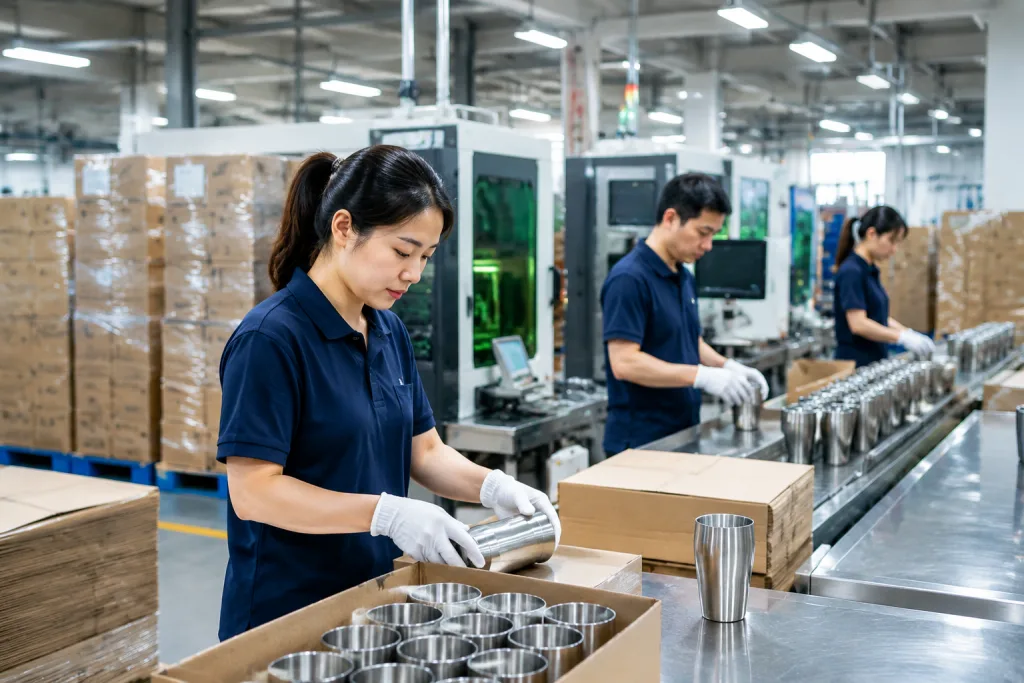
Come to the factory if you can. Zhejiang is about an hour from Shanghai by high-speed train, and a site visit tells you more than ten polished photos. You can check the 304 stainless coil stack, watch the forming machine, and ask QC to pull the sample right off the line. It also tells us you are a real buyer. The pricing usually reflects that. Lead time does too.
If you cannot travel, ask for a video call and make them show the floor, not just a clean office table. A serious tumbler supplier will walk you past the press machines, the packing area, and the carton stack. If they dodge the line or keep cutting away from the warehouse, pause. We've seen that go sideways. Twice.
Build the relationship in stages. Start with a small order, pay on time, and keep your PO clean; one typo on a carton mark can waste a day. By the third order, better pricing and faster turnaround are normal, not a favor. This is the wrong question to ask: "Can you give me partner pricing on day one?" The factory wants proof first. We ship faster when the account is steady.
Get a Quote for Your Promotional Beer Tumbler Order
Contact our team for custom drinkware pricing, samples, and lead times.
Frequently asked questions
What is the typical MOQ for a custom beer tumbler from a Chinese factory?
For a standard 12 oz double-wall stainless steel beer tumbler, the typical MOQ is 1,000 units from a mid-sized factory in Zhejiang. Some factories offer a lower MOQ of 500 units, but the per-unit price will be higher—expect $4.00–$5.50 per unit versus $2.80–$4.50 at 1,000 units. Custom color powder coating may have a separate MOQ of 3,000 units. Always confirm the color MOQ separately from the total MOQ.
How long does it take to produce and ship a promotional beer tumbler order?
Production takes 30–45 days from deposit to shipment for a first order. This includes 5 days for artwork approval and tooling, 20 days for production, and 5 days for QC and packing. Ocean transit from Shanghai to Los Angeles adds 15–20 days, and to Rotterdam adds 25–30 days. For reorders, production drops to 20–25 days. Add 10 days to the factory's quoted lead time for safety.
What customization options are available for beer tumblers?
Common customization options include laser engraving (permanent, dishwasher-safe, one-time setup fee of $50–$80), silk-screen printing (cheaper but fades after 50–100 dishwasher cycles), powder coating in any Pantone color ($50–$80 color-matching fee for first order), custom lid color ($0.05–$0.10 per unit), and embossed or debossed logos on the base ($0.08–$0.12 per unit plus $30–$50 die cost). Matte or textured finishes are recommended over glossy ones.
How do I ensure the quality of a beer tumbler order from China?
Use a simple QC plan: visual inspection of 125 random units (AQL 2.5), dimensional check with a digital caliper (±0.5 mm tolerance), weight check of 10 units (±5 grams), lid fit test (invert for 30 seconds, no leaks), and a dishwasher test on 3 units. For first orders, hire a third-party inspection company like SGS or Bureau Veritas for $300–$500 per day. Always request a material test certificate confirming 304-grade stainless steel.
What should I look for in a canteen manufacturer or drinkware supplier?
Look for a factory that can provide a material test certificate (304 stainless steel), a temperature retention test report, and a lid drop test result. Ask for a technical drawing in English with all dimensions and tolerances. Check if they offer blank inventory programs for faster reorders. Visit the factory if possible, or request a video walkthrough. Avoid factories that cannot provide documentation or hesitate to show their production floor.