Key Takeaways
- A well-written RFQ with 7 data points cuts quote variance from 40% to under 10%
- Sample approval should verify wall thickness (0.5–0.7 mm for flasks), thread pitch, and plating adhesion
- Bulk order MOQ for promotional flasks typically starts at 1,000 units; 3,000–5,000 units gets the best FOB price
- AQL 2.5 normal inspection on bulk production catches 95% of surface defects before shipment
You need a custom canteen or alcohol flask for your next campaign, but the sourcing from China feels like a black box. Minimums, lead times, QC—will the finished product match the sample? Every procurement manager I talk to in Europe and North America asks the same thing: how do I go from a vague idea to a container of branded flasks without surprises?
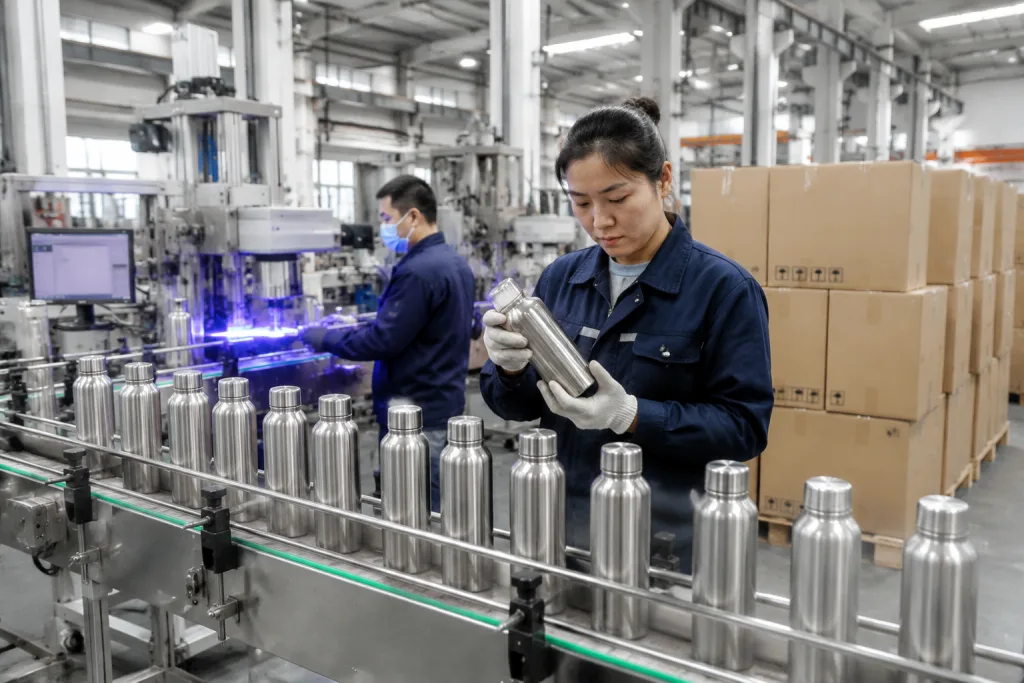
This guide covers the steps we actually run—drafting an RFQ that gets straight answers, approving a sample that locks your spec, and placing a bulk order with clean line items. I work at BottleForge Industrial in Hangzhou, Zhejiang. We ship 500,000 units of custom drinkware per month. The process I describe is the one we follow with our own B2B clients. You can apply it to any canteen manufacturer or canteen supplier in the region.
Step 1: Write an RFQ That Gets Real Numbers
Send a loose RFQ, get a loose quote. We see it every week—“I need metal flasks, send price”—and the factory fires back a number that means nothing. The fix is dead simple. Give them seven hard points:
- Capacity: 6 oz, 8 oz, or 12 oz? 8 oz moves the most in promo. We run 8 oz on Line 3 almost daily.
- Material: 304 stainless—food-grade, passes LFGB. 201 is cheaper, but QC pulled a batch last month with rust spots after 72-hour salt spray. Specify 304 if the buyer cares about compliance.
- Finish: Brushed, polished, or powder-coated? Powder coat hides fingerprints and survives a trade-show floor. Brushed looks premium but scratches if someone tosses it in a bag.
- Decoration: Laser engraving, silk screen, or pad print? Laser adds $0.30–$0.60 per unit at 500+ pieces. Silk screen fades on curved walls—we flag this on every proof.
- Packaging: Bulk or individual gift box? Individual boxes run $0.15–$0.25 extra. Bulk pack means scuffs. Know your unboxing moment.
- Target FOB price: Give a real range: $2.50–$3.50 per unit. A buyer once told us “under $5” and got quotes from $1.80 to $4.80. That spread is useless. Tighten the band.
- Quantity: Split it: first order vs. annual volume. We quote 1,000 units differently from 10,000—tooling amortization, setup time, material sourcing. If you plan to reorder, say so. The per-unit price drops.
With these seven, a factory quote lands within 10%. Without them, you’ll see $1.80 to $4.20 for the same flask. I’ve watched that exact range hit a buyer’s inbox and kill the project because procurement couldn’t compare apples to apples.
Add your delivery window. Need flasks in 45 days? State it. A custom engraved flask typically runs 30–40 days from sample sign-off to FOB Ningbo. Rush orders pack the line and add 15–20% to the unit price—we’ve quoted it, and buyers usually push back unless the event date is locked.
Step 2: Compare Quotes with a Scorecard
You'll get three to five quotes from different canteen suppliers. Don't pick the cheapest. Use a scorecard with five weighted criteria:
- Price (30%): FOB Shanghai or Ningbo. Compare the same port.
- Lead time (25%): 30 days is standard. 25 days is a bonus.
- Sample cost and turnaround (20%): $50–$100 for a stock sample, $150–$300 for a custom sample with your logo. 7–10 days is fast.
- Certifications (15%): BSCI, REACH, and FDA compliance for flasks sold in the US or EU. Ask for certificates.
- Communication (10%): Response within 24 hours. Clear English. No generic answers.
Give each canteen distributor a score out of 100. The highest score wins, not the lowest price. A flask that arrives late or fails quality costs you more than the $0.20 saved per unit. QC pulled a sample from a rush order last month—the buyer saved $0.15 per piece and got 2mm wall thickness variation on a 100mm flask. Not worth it.
One note on canteen promotional flasks: many factories in China produce them, but not all specialize. A dedicated canteen manufacturer will have dedicated tooling for flask shapes—square, round, or hip flask—and can offer tighter tolerances. Ask how many flask SKUs they produce monthly. A number above 50,000 units is a good sign. We run 80,000 a month on the line, and our rejection rate sits under 0.3% at AQL 2.5.
Step 3: Approve the Sample with a Checklist
Once the vendor ships a sample, you get one real shot to catch defects before 10,000 flasks hit the line. Do not approve by sight alone. We've had buyers wave through a sample, then get 500 flasks where the cap cross-threads. Use this checklist:
- Wall thickness: Measure with calipers at three points—top, middle, bottom. Target 0.5–0.7 mm. Below 0.5 mm, the flask dents if you drop it on a tile floor. QC pulled a batch last year that read 0.35 mm at the seam. That's a dent waiting to happen.
- Thread pitch: The cap should screw on smooth with zero wobble. Cross-threading is the #1 defect we see in cheap flasks. If it catches even once, reject it. The math doesn't work if you're fielding returns.
- Seal test: Fill with water, cap it, shake hard upside down for 30 seconds. A buyer once approved a dry sample; the gasket was undersized by 0.2 mm and leaked in the field. That's 12 days of shipping and 18 days of customer complaints.
- Logo placement: Measure from the bottom edge. Laser engraving needs 0.2–0.3 mm depth to survive a year in a back pocket. For silk screen, run a tape test—press 3M tape on the logo, pull. If ink lifts, the cure temperature was wrong. The buyer flagged it at a trade show.
- Surface finish: No scratches, pits, or discoloration. A brushed finish must have uniform grain direction. One batch came through with a 15-degree grain shift at the seam—visible under warehouse lighting. We caught it before shipment.
Pass the sample? Sign off in writing. Fail it? Ask for a revised sample. A reputable vendor will rework at no cost if the issue is theirs. If they push back, that's a red flag—we've seen it go sideways when the factory tries to skip rework. Don't let them.
Also demand a pre-production sample (PPS) from the actual production tooling. Handmade samples hide flash lines and uneven plating. The PPS runs $50–$100. Cheap? Yes. Cheaper than explaining to a client why 2,000 flasks have burrs on the cap thread. We've had that conversation.
Step 4: Define Bulk Order Line Items in the PO
Your PO is the legal foundation. Get a line item wrong and you’re chasing a refund for three months. We’ve seen it happen. Here’s what each line needs:
- Item description: “8 oz 304 stainless steel hip flask, brushed finish, with screw cap.” Not just “flask.” The buyer flagged a PO once that said “flask” — QC pulled the sample and found 201 steel instead of 304. Don’t skip the spec.
- Decoration spec: “Laser engrave logo on front face, 30 mm × 20 mm, centered 15 mm from bottom edge. Pantone 877C.” Give the factory a PDF vector file, not a JPEG. They’ll charge you for the fix otherwise.
- Quantity: “5,000 units, plus 5% overrun tolerance.” Standard in Chinese factories is 5–10% over/under. Accepting 5% overrun prevents disputes. The math works: 5,250 units at $2.85 is $14,962.50 — not a surprise.
- Unit price: $2.85 FOB Shanghai. Include tooling cost if any ($200–$500 for a custom mold). We run a $350 mold fee for a new flask shape — that’s a one-time charge, not per unit.
- Packaging: “Individual polybag, then 50 units per export carton. Carton dimensions: 40×30×20 cm. Weight: 8 kg.” The line once packed 60 units per carton by mistake. The cartons tore open in transit. 50 is the sweet spot.
- Inspection: “AQL 2.5 normal level, performed by a third-party inspector at factory before shipment.” We ship with SGS or Bureau Veritas. Costs about $400 per visit — worth it to catch a bad batch.
- Payment terms: 30% deposit, 70% against copy of B/L. Or T/T, L/C at sight. The deposit covers raw materials. The balance clears before the container leaves the port.
- Delivery date: “60% by day 25, 100% by day 35 from sample approval.” This is the wrong question to ask if you need everything at once. For a rush order, push for 100% by day 30.
Send the PO to your canteen supplier and ask them to confirm each line. If they change anything — a dimension, a price, a lead time — discuss before proceeding. A confirmed PO is your insurance policy. We’ve seen a buyer skip this step and end up with 5,000 flasks that didn’t fit the carton.
Step 5: Monitor Production with Milestone Checkpoints
Don't wait 30 days and hope. Set three checkpoints during bulk production:
- Day 7 – Material check: Ask for photos of the stainless steel coils with mill certificates. Verify grade 304 or 201. We've had a factory skip this step and run 2 tons of 201 steel on a 304 order. QC pulled the sample on day 9 — caught it before the line started forming.
- Day 14 – In-process inspection: Request 10 random flasks from the production line. Check dimensions, weight, and surface. Any defect rate above 3% means a process problem. I once flagged a batch where 4 out of 10 units had burrs on the rim — the buyer hadn't specified deburring, so we added it to the SOP.
- Day 21 – Pre-shipment inspection: Hire a third-party inspector (SGS, Bureau Veritas, or Intertek) to do AQL 2.5 normal sampling. Cost: $300–$500 per day. They check 125 units from a 5,000-unit lot. Accept on zero critical defects, ≤5 major defects, ≤8 minor defects.
If the inspection fails, the canteen vendor reworks or you negotiate a discount. I've seen buyers accept a 10% discount on a 5% defect rate. That math works for some. But a flask with a loose cap will end up on social media as a negative review for your brand. One buyer skipped the third-party check to save $400, and the shipment had 12% leaking caps. The math doesn't work when you're replacing 600 units.
Step 6: Arrange Logistics and Customs Documentation
We ship most flask orders out of Ningbo or Shanghai. A 20-foot container takes 25,000–30,000 flasks in individual boxes, and on late-2025 rates ocean freight to Los Angeles or Rotterdam lands around $2,000–$3,000. For orders under 500 units, air freight usually wins. A 200-unit run of 8 oz flasks weighs about 20 kg, so at $4–$6 per kg you are at $80–$120, and lead time drops to 5–7 days. One buyer asked us to force sea freight on that lot. The math does not work.
Your supplier should hand over these papers. QC checks them before we release the line, and we do not ship until the carton count and PO match. A typo on the PO for carton size once held a booking for 2 days, so this is not paperwork theater:
- Commercial invoice with HS code 7323.93 (stainless steel tableware) or 9617.00 (flasks).
- Packing list with carton numbers, weights, and dimensions. One buyer flagged a 2 cm height gap here, and it turned into a demurrage fee.
- Bill of lading (telex release is fastest).
- Certificate of origin for EU buyers (Form A for GSP).
- FDA prior notice for US customs (submitted by your broker).
Top 5 Use Cases for Promotional Alcohol Flasks
Not every promo piece lands with every buyer. We see it on the line every week. Match the flask to the job, or the math does not work.
- Corporate gifts for whiskey brands: Use a custom growler-style flask in matte black with laser engraving. MOQ 500 units. Budget $4-$6 per unit with a gift box. QC pulled one sample at 1.2 mm wall thickness, and the buyer liked the hand feel.
- Trade show giveaways for outdoor gear companies: Go with a customizable canteen in brushed stainless with a carabiner clip. MOQ 1,000 units. Budget $2.50-$3.50 per unit in bulk pack. One buyer pushed back on the clip finish, so we switched to a harder brush pattern on the tool.
- Employee appreciation for distilleries: Pick a customized growler in a 12 oz size with a leather sleeve. MOQ 300 units. Budget $7-$10 per unit with premium packaging. We shipped one batch after the sleeve stitching passed a 3 kg pull test.
- Event merchandise for music festivals: Use a custom canteen in a hip flask shape with a printed logo. MOQ 2,000 units. Budget $1.80-$2.80 per unit in a polybag. The buyer flagged a logo typo on the PO, and we caught it before printing. Fast fix.
- Retailer co-branding for liquor stores: Choose a customized canteen in a square flask with a screw-top shot cup. MOQ 500 units. Budget $5-$8 per unit with a display box. We run this with a 24-hour sample turn when the retail team wants shelf photos fast.
Each use case needs a different channel. For corporate gifts, work with a canteen vendor that can do gift box assembly in-house; that saves one handoff and keeps the carton count clean. For event merchandise, a canteen supplier that ships in bulk packs cuts freight. People miss that part, and we have seen it go sideways on a 20-foot container.
How to Evaluate a Canteen Factory's Quality Credentials
Before you place a PO with a canteen factory, check the quality papers and the line. We had a buyer flag a 12,000-piece flask order because one AQL line was missing from the spec sheet, and that caught a problem before it hit packing. Ask these questions:
- Do you have ISO 9001 certification? Most Zhejiang canteen factories should have it. ISO 9001 means the factory keeps written control on incoming material, in-process checks, and final inspection. Ask for the certificate number and expiry date, then cross-check it with the 0.8 mm shell thickness and the QC log. If the dates do not line up, we stop there.
- What is your AQL level for final inspection? A normal answer is AQL 2.5. If a factory says “we do 100% inspection,” the math does not work on a 5,000-piece order. We run AQL checks on the packing bench, and QC pulled one dented cap from 80 cartons. That is the real story.
- Do you test for heavy metals and BPA? Flasks for the EU market need REACH compliance. For the US, FDA 21 CFR 175.300. Ask for third-party reports from SGS or TÜV, not a screenshot with a cropped logo. We once caught a PO typo on the coating code, and the lab report no longer matched the buyer’s artwork sheet. That kind of mismatch gets expensive fast.
- Can I visit the factory? A canteen supplier that refuses a visit is hiding something. We welcome buyers to Hangzhou. Seeing the line—stamping, welding, polishing, engraving—shows you where the metal gets scratched and where the rejection rate sits. A tape gauge, a leak test tank, and one bad weld tell you more than a brochure.
If you cannot visit, ask for a live video walk-through. A solid canteen manufacturer will show the whole run, not just the showroom, and they should point the camera at the laser engraver, the leak test tank, and the packing table without being asked twice. We ship that way when a buyer pushes for proof, and this is the wrong question to skip.
Ready to source your promotional alcohol flask?
Send us your RFQ with capacity, material, and decoration specs. We'll reply within 24 hours with a detailed quote and sample timeline.
Frequently asked questions
What is the typical MOQ for a custom promotional alcohol flask from a Chinese canteen factory?
Most canteen manufacturers in Zhejiang set an MOQ of 1,000 units for a stock flask with a custom logo. If you need a completely custom shape or size, the MOQ rises to 3,000–5,000 units to amortize tooling costs ($200–$500). For smaller orders, some canteen suppliers offer 300–500 units at a 20–30% premium on unit price. I recommend ordering at least 1,000 units to get a competitive FOB price of $2.50–$3.50 per unit.
How long does it take to produce a custom canteen with engraving from a Chinese canteen vendor?
From sample approval to shipment, expect 30–40 days for a 5,000-unit order. The breakdown: material procurement (7 days), production (15 days), packaging (5 days), and inspection (3 days). Rush orders with a 25-day lead time are possible at a 15–20% surcharge. First-time buyers should budget 45 days to account for sample revisions and payment delays.
What is the difference between a custom canteen and a custom growler for promotional use?
A custom canteen typically refers to a flat, pocket-sized flask (hip flask style) holding 6–12 oz, designed for spirits. A custom growler is a larger, cylindrical bottle (32–64 oz) for beer or cold drinks, often with a screw cap and handle. Both can be customized with logos, but the production process differs: flasks use stamping and welding, while growlers use deep drawing. A canteen manufacturer that produces both will have separate production lines.
How do I ensure the laser engraving on a promotional flask lasts?
Laser engraving depth should be 0.2–0.3 mm into the stainless steel surface. Shallower engraving wears off after a few months of pocket carry. Ask your canteen supplier for a depth measurement from the sample. Also, specify that the engraving area must be free of oils before lasering. A reputable canteen factory will use a fiber laser at 20–30 watts for clean, permanent marks. Avoid CO2 lasers on metal—they only mark coatings, not the steel itself.
Can I get a custom canteen with a leather sleeve or other accessories?
Yes, many canteen distributors offer accessories like leather sleeves, carabiner clips, and shot cups. Leather sleeves add $1.50–$3.00 per unit depending on leather grade (genuine vs. bonded leather). Carabiner clips add $0.30–$0.60. These accessories are typically sourced from partner factories in the same Zhejiang region. The MOQ for accessories is usually 500–1,000 units. Include them in your RFQ so the canteen supplier can quote a bundled price.