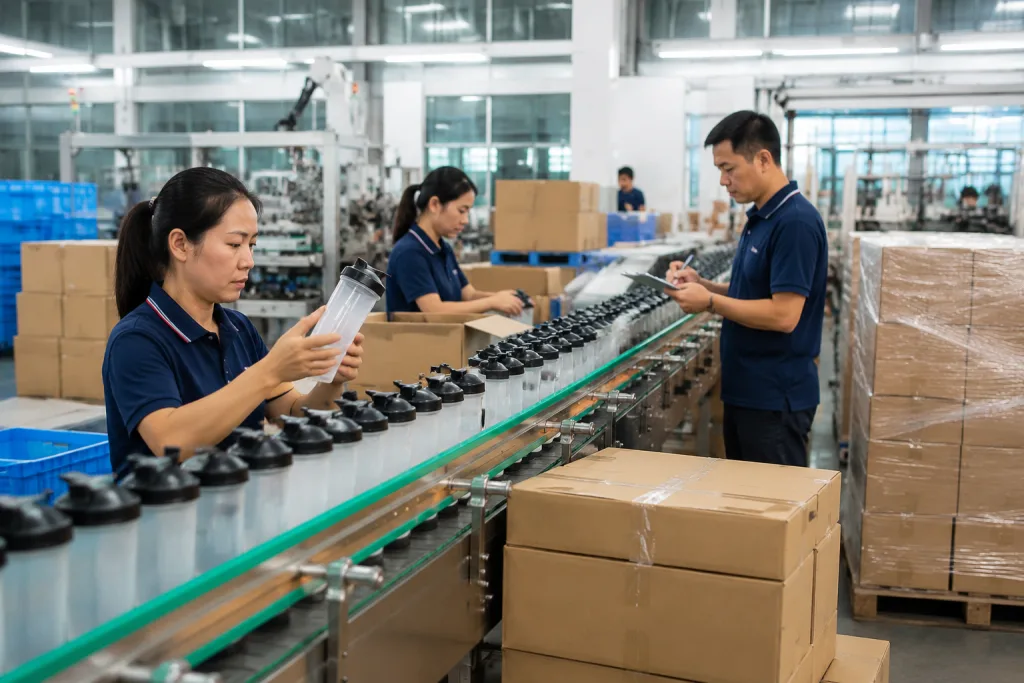
Key Takeaways
- A workable MOQ for a promotional polypropylene bottle UK program is usually 3,000-5,000 pcs per color
- Sample lead time is often 7-10 days, while bulk production commonly runs 25-35 days after sample approval
- A realistic FOB China price for a 500 ml PP canteen starts around USD 0.42-0.88 depending on lid, print, and packing
- For UK imports, ask for REACH compliance, carton drop testing, and AQL 2.5 major / 4.0 minor inspection terms
If you are buying a promotional polypropylene bottle UK teams can hand out, sell, or bundle, the bottle is not the hard part. The hard part is turning a product photo into a spec we can run on the line. A 500 ml PP canteen with a 1.2 mm wall, a push-pull cap, and one-color print needs a different mold check from a sports bottle with a 0.9 mm wall and a flip-top lid.
From our Zhejiang factory, we see the same miss every week: the buyer asks for “custom drinkware” before the use case is pinned down. QC pulled a sample last Tuesday and the print area was 5 mm off the PO sketch, which is how sample rounds get burned. This is the wrong question to ask. If you want a canteen custom job to move fast, give us the line items first. China suppliers price cleanly when the spec is clean.
Start with the use case
Do not start with color. Start with the job. A promotional polypropylene bottle UK buyer usually lands in one of three lanes: event giveaways, retail resale, or distributor packs for trade customers. Each lane changes the quote. We had one buyer flag a 500 ml PP bottle because the cap looked fine on screen but failed the 1.2 m drop test, and that sent the spec back to the line.
For a standard 500 ml PP canteen, we usually sit around 45-65 g in weight, with wall thickness from 0.8 mm to 1.5 mm depending on how stiff the bottle needs to feel in hand. A stadium handout is not the same job as a hiking brand bottle, and this is the wrong question to ask if the channel is still open. Tell us the channel first, then the volume, then the decoration. We cut 6 days off one quote cycle by fixing that order. QC pulled the sample with a caliper and the numbers lined up.
- Event giveaway: low unit cost, one-color print, 1,000-3,000 pcs possible
- Retail: stronger packaging, barcode placement, 3,000-5,000 pcs MOQ
- Distributor drinkware: carton efficiency, stable supply, repeatable decoration
Write the RFQ like a buyer
A clean RFQ saves time. It also keeps the factory from quoting off a glossy photo and guessing the rest. Put capacity, lid type, resin grade, print method, target quantity, destination port, and packing in line one. For UK orders, state FOB Ningbo, FOB Shanghai, or DDP to a warehouse. We run this every week in Zhejiang, and the incoterm changes the math by a lot. One PO typo swapped FOB Shanghai to DDP, and the quote moved 11 percent overnight.
For a promotional polypropylene bottle UK order, write it like this: 500 ml PP body, Tritan-free, BPA-free resin, 1-color silkscreen, individual polybag, 50 pcs per master carton, REACH declaration, sample with blank body and printed body. Put lid pricing on its own line. A flip-top cap can add USD 0.08-0.18 per unit, while a screw cap stays lower. At 10,000 pcs, that spread matters. QC pulled one sample last month and found the cap thread off by 0.6 mm; the buyer flagged it before we shipped. Vague specs cause this mess, and the math does not work.
RFQ details that prevent quote drift
- Capacity and shape drawing, or a reference photo with neck size in mm
- Material: PP, PP+silicone seal, or PP with TPE grip
- Artwork file format: AI, PDF, or vector EPS
- Packing: polybag, color box, or bulk pack
- Testing: REACH, food contact, dishwasher cycle count if needed
Compare samples, not promises
Sampling is where a promotional polypropylene bottle order stops being talk. A supplier can send a polished render in one day; the sample tells you if the cap seals, the print stays on register, and the bottle still looks clean after two washes on the line. For a stock mold, 7-10 days is normal. If we need a small logo plate or a new cavity, add 12-20 days. We run that math every week with a calendar on the packing table. Push the schedule too hard and you pay twice, once in rework and once in freight.
Do not ask for one sample and call it done. Ask for a comparison set: blank bottle, printed bottle, packed bottle. If you are sourcing a customized canteen for a distributor program, check thread feel, cap torque, and the shoulder finish with a torque wrench and a 0.2 mm feeler gauge. QC pulled the sample once and found a 1.5 mm mismatch at the neck, which the render never showed. This is the wrong question to ask if you only want a pretty sample; the math does not work without numbers.
Practical rule: if the sample cannot survive one meter drop testing empty, the bulk pack will not get better.
- Check leak test after 24 hours filled
- Check print rub resistance with alcohol and dry cloth
- Check fit with your own carton dimensions
- Check lid operation at least 30 open-close cycles
Price the PO line by line
This is where a lot of buyers lose margin. A PO for custom drinkware should never stop at “10,000 bottles.” List every cost line that can move the landed price. For a promotional polypropylene bottle UK order, split out the body price, print charge, mold charge, sample fee, packaging, carton mark, and inspection cost. We run it that way on the line because it shuts down the “missing line item” argument after the deposit clears.
A clean PO for 10,000 pcs can read like this: PP bottle body at USD 0.48, one-color silkscreen at USD 0.05, assembled PP lid at USD 0.12, polybag at USD 0.02, inner carton insert at USD 0.03, and export carton at USD 0.04. If the custom canteen needs a new mold, that tool usually sits at USD 1,500-4,500 based on geometry and cavity count. One buyer flagged a PO typo where “mold” was written as “modl,” and QC pulled the sample again before we shipped. Put in the PO whether tooling is built into unit price or billed on its own. The math does not work any other way.
Set the overrun and underrun tolerance in writing. Standard production tolerance is often +/- 5% for color and quantity, but the PO should spell out the quantity band and the inspection level. For most B2B drinkware, AQL 2.5 major and 4.0 minor is the normal ask. If the canteen promotional order is for retail, tighten the carton and label spec too. We have seen this go sideways when a buyer left the carton mark blank and then pushed back on a 12 mm print shift that was already inside the sample approval.
Lock compliance before bulk
For the UK market, compliance is the gate. Not a checkbox. We ask for food-contact declarations, REACH support, and batch traceability before we run the first 1,000 pcs. PP bottles look simple on the line, and that is where buyers get caught out. They still need controlled resin, stable pigments, and inks that pass migration checks. We had a 24 mm cap job held back once because the declaration pack was thin.
We want the resin grade, masterbatch source, and production batch code on the carton. One buyer flagged a PO typo on the item code, and QC pulled the sample before loading. Good call. The math does not work if you ship first and chase papers later. If you are handling canteen accounts or a growler program across several channels, this paper trail matters when a retailer asks for files six months later. “We can send it later” is the wrong answer. We’ve seen that go sideways on a 5,000 pcs order.
- Request REACH and food-contact declarations
- Ask for production batch and resin lot traceability
- Confirm ink and print method for migration risk
- Verify carton labels, item code, and origin mark
Plan bulk production and shipping
Once the sample is approved, we run the bulk line. On our Zhejiang floor, one 8-cavity mold keeps 200,000-400,000 units a month moving, but print stations and changeover time still set the pace, so a 10,000-piece promotional polypropylene bottle UK order usually ships 25-35 days after deposit and final artwork sign-off. We had one buyer push a sleeve copy change on day 4; QC pulled the sample back to the bench, and the schedule slipped 3 days. Freeze the PO. That call saves pain.
For shipping, a 20-foot container only makes sense when you are bundling other custom drinkware. Most first orders go by sea freight in mixed cartons, and we need carton size, gross weight, and pallet plan before the line starts. Ask us how many cartons sit on one pallet and whether the outer carton passes 1.2 m drop testing. We check it with a tape and a scale on the floor, not a sales sheet. The buyer who argues freight before pack-out is set is asking the wrong question.
Use the final production file to lock the color code, print position, carton marks, and spare parts like extra caps or seals. One buyer once sent a PO with carton mark 500 pcs against an order of 5,000; that typo cost a day, and we have seen that go sideways more than once. Get the file right, and the next custom canteen or custom growler run ships cleaner. The math works.
Protect the re-order path
The first order is half the job. The second order is where the margin sits. If the bottle moves, you need a repeatable re-order path, not another 3-round proof cycle or a fresh sample run on the line. We keep one master file with approved sample photos, final artwork, carton spec, and PO lines. QC pulled the sample, checked the cap thread at 28 mm, and that file saved us from a buyer dispute on a typo in the pack count. On repeat programs, that matters more than shaving 2 cents off the first quote. The cheap quote turns into the expensive program later.
If you are building a canteen custom range for a brand, set a simple SKU map: capacity, lid, print, color, pack, destination. The buyer may want to rename it five ways in one email. We see that all the time with customized canteen, canteen customized, and customizable canteen in the same brief, and the buyer flags it every time. The spec has to stay fixed. One approved master spec beats a messy email chain. In our Zhejiang export work, the smoothest accounts are the ones where we ship the same drawing on every repeat order. That is how custom drinkware becomes a supply line, not a one-off job.
Send your RFQ with exact bottle specs
We can quote your PP bottle by body, lid, print, and pack. Give us your target MOQ, artwork, and UK delivery plan.
Frequently asked questions
What MOQ should I expect for a promotional polypropylene bottle UK order?
For most PP promotional bottles, a practical MOQ is 3,000-5,000 pcs per color and per print setup. If the lid is standard and the body mold already exists, some canteen suppliers will go lower, around 1,000-2,000 pcs, but the unit price rises fast. For a custom canteen with a new mold or new cap, expect tooling plus a higher MOQ. A first order of 10,000 pcs is usually where pricing becomes efficient enough for retail or distributor drinkware programs.
How much does a custom PP canteen cost FOB China?
A simple 500 ml PP bottle with standard cap and one-color print often lands around USD 0.42-0.88 FOB China, depending on wall thickness, decoration, and pack-out. A new mold can add USD 1,500-4,500 one time. If you specify a flip-top lid, color-matched parts, or retail packaging, the price climbs. From Zhejiang, the key is to separate body cost, lid cost, print cost, and packaging so you can see exactly where the money goes.
How long do samples and bulk production take?
If the mold exists, samples usually take 7-10 days. A new mold or complex decoration can push sampling to 12-20 days. After sample approval and deposit, bulk production for a normal promotional polypropylene bottle UK order is usually 25-35 days. If you add carton customization, multiple colors, or inspection rework, allow an extra week. That timeline is standard for a canteen factory in China with a normal export schedule.
What compliance documents should I request for the UK?
Ask for food-contact material declarations, REACH support, resin traceability, and carton batch codes. For most PP drinkware, also ask for print ink details and production lot records. If your distributor drinkware program goes into retail, keep the approved sample photos and PO spec on file. The useful standard is not just a certificate; it is a paper trail that matches the actual product, carton, and batch number.
How do I reduce mistakes on the purchase order?
Write the PO as a line-item spec, not a sentence. Include capacity, material, cap type, print method, color code, packing, quantity tolerance, inspection standard, and shipping term. For example: 500 ml PP body, one-color silkscreen, assembled cap, polybag, 50 pcs/carton, AQL 2.5 major and 4.0 minor, FOB Ningbo. That removes ambiguity for the canteen manufacturer and helps you compare quotes from different canteen vendors on the same basis.