Key Takeaways
- Polypropylene (PP) is food-safe, BPA-free, and dishwasher-safe up to 100°C — ideal for German promo use
- Typical MOQ for a custom promotional polypropylene bottle in Deutschland is 3,000 units per design
- FOB price range for a 500ml PP bottle with one-colour silkscreen: €0.80–€1.20 per unit
- Lead time from order to FOB port: 25–35 days including decoration, tooling, and QC
- German buyers should require BSCI, REACH, and LFGB certifications from any canteen manufacturer
You are sourcing a promotional polypropylene bottle for Germany. The brief looks simple: lightweight, BPA-free, dishwasher-safe, full-colour logo. The PO is where orders slip. Suppliers start shaving wall thickness, cap fit, and carton count, and the buyer flags it after samples land. We break down each line item, from resin grade to pack-out, so you can check the PO against German buyer specs and your margin. We have seen that math go sideways fast.
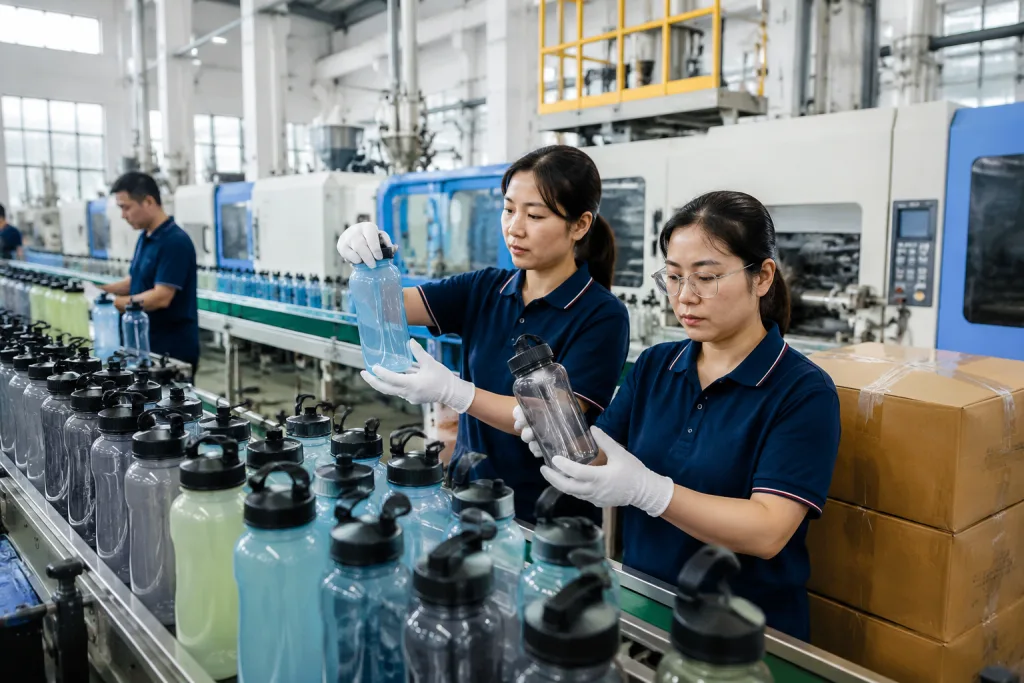
We run custom drinkware production in Zhejiang, China, and ship FOB Shanghai or Ningbo. The line takes in about 1.2 million units a month across polypropylene, stainless steel, and Tritan. Last week QC pulled the sample and checked 2.3 mm with a caliper; that is the sort of number that decides whether a reorder stays clean or gets stuck in email for 12 days instead of 18. This guide comes from export work on promotional polypropylene bottle orders for European distributors, with MOQ, lead time, and decoration cost laid out in plain numbers. No fluff.
Material: Polypropylene Grade and Food Safety
PP is the base resin for promo bottles because the math works: low resin cost, decent impact strength, and food-contact papers German buyers can file without a fight. We run virgin PP only on the line; regrind is a bad bet. I watched one cap go yellow after 3 hot-fill cycles and pick up hopper smell from a dirty dryer. For injection-moulded bottle bodies, the usual melt flow index (MFI) sits at 12–18 g/10 min at 230°C, and that band gives a cleaner fill with less wall swing.
Key certification requirements for Deutschland:
- LFGB — German Food and Feed Code, required for food-contact plastic sold in Germany
- REACH — EU regulation on chemicals, covering phthalates, heavy metals, and bisphenols
- BPA-free — polypropylene is inherently BPA-free, but buyers still ask for a third-party test report
Your supplier should send a material data sheet (MDS) and a certificate of compliance for each batch. We had a buyer flag a PO because the resin code read "PP-virgin" instead of the exact grade; QC pulled the sample, checked the lot label, and the paperwork had to match before we shipped. This is the wrong question to soften. If the factory cannot show both documents, walk away. We keep LFGB and REACH papers on all PP bottle lines, and batch-specific test reports go out within 48 hours of request.
Mould and Tooling: One-Time Cost That Sets Quality Ceiling
A promotional polypropylene bottle is injection-moulded, so the mould sets the quality ceiling for the whole job. Wall thickness, thread fit, and surface finish all come off the tool. For a standard 500ml PP bottle with a 38mm neck finish, a new single-cavity mould usually lands at €3,500 to €6,000 from a canteen factory in China. We run hardened tool steel on that spec, and the cavity polish has to hold up under daily use. On our shop floor, QC checks the first shot with a caliper at 0.1 mm resolution; that is where cheap tooling gets exposed fast.
What you need to know as a distributor or brand owner:
- Existing moulds — a lot of canteen manufacturers keep stock moulds for common volumes like 250ml, 500ml, and 750ml. If the shape matches, you skip tooling cost and cut lead time by 15–20 days. One buyer sent a PO with “5000ml” by mistake; QC pulled the sample, saw the size was off, and we fixed it before the line ran. That is a paperwork problem, not a mould problem.
- Custom mould — if you want a unique body shape or an embossed logo, budget €4,500–€8,000 and expect 40–50 days for first samples. Buyers push back on the tooling quote, then ask for a sharper logo edge at 0.3 mm; the math does not work that way. We’ve seen this go sideways on the first trial, especially when the logo depth is too thin for PP shrink. The steel insert tells the story.
- Mould maintenance — polypropylene wears the cavity over long runs. A decent supplier polishes the mould every 50,000 cycles to keep gloss and thread accuracy in range. We saw a 38mm neck drift after a dirty run; the buyer flagged it, and the gate area needed rework on the next shift. A quick mirror polish and a fresh vent check solved it.
Ask for the stock mould list before you sign off on a custom tool. A lot of German promo orders sit at 3,000–10,000 units, and that volume often fits a 2-cavity stock mould without drama. Anything else is a gamble, and the sample tray usually shows it fast. We run the same check on every new inquiry: if the MOQ is 5,000 and the body already exists, the custom-tool question is the wrong question to ask.
Decoration: Silkscreen, Pad Print, or In-Mould Label
Your promotional polypropylene bottle Deutschland order needs logo work on day one. PP is slick, and the line shows adhesion trouble fast if the ink or label system is off. We run three methods:
Silkscreen (most common)
Single-colour silkscreen on a 500ml cylindrical bottle runs €0.08–€0.15 per unit at 3,000–5,000 pcs. Two colours add about €0.10 each. Setup is €30–€60 per colour. We run it on a jig, and that matters: a straight barrel is easy, while a contoured body needs a custom fixture. QC pulled one sample last month after the buyer flagged a 1.5 mm logo shift. That is a bad day on the line.
Pad print
Pad print fits small logos on caps or narrow panels. Price lands close to silkscreen, but output is slower: 800–1,200 units per hour versus 1,500–2,000 for silkscreen. It works for short runs or artwork with tight corners. This is the wrong question to ask if the logo is large; pad print is for the cap mark, not the whole bottle. We saw a PO typo once where the buyer wrote 80000 pcs on a 500 ml cap-only print, and the math did not work.
In-mould label (IML)
IML is the premium route. The label bonds into the plastic during moulding, so the decoration stays put and resists scratches. We have seen bottles go past 500 dishwasher cycles without peeling or fade. Extra cost is €0.30–€0.50 per unit, and MOQ is usually 10,000+ units because label printing and mould changes take time. The mould shop needs room for it, too; on one line, the label pocket was off by 0.3 mm and the first shot came out short. That scrap pile was not small.
For German promotional use, silkscreen with UV-cured ink is still the standard. It passes LFGB migration tests and holds up through 200+ dishwasher cycles. Ask for a cross-hatch adhesion test report from every batch. We ship this on real production lots, not just a lab sample, because we have seen that go sideways.
Closure and Seal: Cap Types and Leak-Proof Performance
The cap is where promotional polypropylene bottles fail first. One loose cap and the brand looks sloppy. For Deutschland, we usually run a 38mm polypropylene screw cap with a silicone or TPE seal. Ask for these specs:
- Seal material — silicone gasket, food-grade, -40°C to 200°C, is the safe pick. TPE costs less, but it wears faster after repeated opening. We push silicone unless the buyer has a hard price cap.
- Thread type — 38/400 or 38/410. Match the neck finish exactly. A 0.5 mm mismatch on the line starts cross-threading fast, and then the buyer flags leaks in the first carton.
- Linerless vs liner — linerless caps cost less and recycle better. Lined caps hold seal better on carbonated fills or hot fill. For still water at ambient temperature, linerless is the cleaner choice. That is the wrong question to overthink.
- Tamper-evident band — optional, but we recommend it for German retail or giveaway programmes. It adds €0.02–€0.04 per cap, and one PO typo on the band spec can hold a 5,000-piece run.
We check cap-to-bottle torque at 10–15 in-lbs, then QC pulled the sample for a 24-hour water leak test at 0.5 bar on 2% of each lot. If your distributor wants a clean handover, ask for the leak-test report with every shipment. We've seen this go sideways when the seal was approved from a hand sample, not the production mould.
MOQ, Lead Time, and FOB Pricing for German Orders
Let’s put the numbers on the table. For a standard 500ml promotional polypropylene bottle with one-colour silkscreen, a polypropylene cap with silicone seal, and bulk pack at 100 pcs per polybag, 50 bags per export carton, these are the working figures we quote out of Zhejiang.
| Item | Value |
| MOQ | 3,000 units per design per colour |
| FOB unit price | €0.85–€1.10 (USD $0.92–$1.19) |
| Tooling cost (if new mould) | €3,500–€6,000 |
| Sample lead time | 7–10 days (stock mould) or 20–25 days (new mould) |
| Production lead time | 25–35 days after sample approval |
| Shipping to Hamburg (40ft container) | €2,800–€3,500 (sea freight, est.) |
| Inspection (AQL 2.5, Level II) | €250–€400 per day |
For German orders, 3,000 units is the clean starting point. We had a buyer push for 1,500 pieces, but the line still needs the same screen frame, carton setup, and QC pull, so the math does not work. On a stock mould, we ship samples in 7–10 days; with a new mould, plan on 20–25 days because the steel insert and first shot need time to settle. The MOQ stays where it is. That is the real number.
FOB pricing sits at €0.85–€1.10 per unit for this spec, and new mould work usually lands at €3,500–€6,000. We saw one PO where the buyer flagged “silicon seal” instead of “silicone seal”; that typo looked small, but it changed the packing note and slowed approval by a day. Production then runs 25–35 days after sample approval, which is normal for a bottle this size. We run the line on a 12-cavity setup, so one spelling mistake can still cost you a day.
Sea freight to Hamburg for a 40ft container usually comes in at €2,800–€3,500, and inspection at AQL 2.5, Level II costs €250–€400 per day. QC pulled the sample on one batch and found two cap seals out of spec on a 1,000-piece lot, so we held the carton line until the fix was in place. Add 5–10% for transit loss or damage, because this is the wrong question to ask if you expect zero breakage on bulk export. A solid canteen supplier will replace units that sit above the AQL limit. We have seen that go sideways when buyers skip the pre-shipment check.
Packaging Options: Bulk, Retail, or Gift Box
Your promotional polypropylene bottle Deutschland order needs packaging matched to the channel. We run three setups on the line: bulk pack, retail-ready box, and gift set.
Bulk pack
100 pcs per polybag, 50 bags per export carton, so 5,000 pcs per pallet. Cost stays low, with about €0.02 added per unit. Good for giveaway events and corporate gift bags. QC pulled the sample once and the buyer flagged a loose inner bag seal, so we now check the polybag neck with a hand seal tester every run.
Retail-ready box
Individual colour-printed boxes with a window cut-out fit German retail shelves and trade show counters. The add-on is €0.15–€0.30 per unit, with MOQ at 1,000 boxes. Box production takes 7–10 extra days. That time is not optional. We had one PO where the buyer typed the carton height as 210 mm instead of 120 mm, and the print file had to be redone before the line could move.
Gift set
Bottle + premium cap + branded lanyard or carabiner in a rigid gift box. The add-on is €0.50–€1.00 per set, MOQ 500 sets. This is the right pick for higher-value campaigns. We ship these only after drop-test checks on the gift box corners, because a crushed lid kills the whole presentation.
All packaging materials must comply with German packaging law (VerpackG). Your canteen manufacturer should provide a packaging declaration for recycling registration. We include that paper with every shipment to Deutschland, and we do not treat it as a side note.
Quality Control and Compliance for the German Market
German buyers push hard on safety and lot consistency. One bad carton can kill a distributor account in 7 days. The wrong question is whether the factory “has QC.” Ask whether the line can prove it, with records tied to each 3000-unit batch and a signed check sheet at the bench.
- Pre-production meeting (PPM) — go line by line through the spec sheet, resin lot number, and artwork proof before we start. One buyer sent a PO with the cap color typed as “bluee”; we caught it at PPM and saved a reprint on the first pallet.
- During production inspection (DUPRO) — pull 20% of the first day’s output and check wall thickness, thread fit, print register, and cap torque. We run a wall gauge and torque meter on the bench, and if the cap is loose by 0.2 N·m, the buyer flags it on the spot.
- Final random inspection (FRI) — use AQL 2.5, Level II, normal severity, with a 125 pcs sample on a 3000-unit lot. Critical, major, minor is the split; anything else is noise. We have seen this go sideways when a supplier tried to hide sink marks under gloss.
- Third-party inspection — book SGS or TÜV Rheinland for German orders. Budget €350–€600 per inspection day, and do not fight the fee if the order is moving; the math works out faster than a rejected container at port, especially when the buyer already asked for photo evidence from the line.
For shipment, we need three papers in hand: LFGB test report for migration of overall constituents, REACH compliance declaration, and a Certificate of Analysis (CoA) for the PP resin batch. QC pulled the sample, and the resin bag tag had to match the CoA lot code. If a vendor hesitates on those files, walk away. We ship 3000-unit lots, not excuses.
Selecting a Canteen Manufacturer: Criteria Beyond Price
Price matters, but it is not the first filter. For a promotional polypropylene bottle Deutschland order, we score canteen suppliers on five points before we talk cents per piece:
- Certification depth — BSCI, ISO 9001, LFGB, REACH, and FDA if you want one SKU to cover two sales channels. We once had a buyer flag a missing batch reference on the test report; QC pulled the sample again, and the line stopped for half a day.
- Stock mould library — a canteen factory with 40 or 80 stock moulds gives you faster sampling and lower tooling spend. This is not a small detail; on one PO, the buyer wrote 650ml as 650 ml and the draft spec went wrong before we caught it.
- In-house decoration — keep silkscreen and pad print under one roof. We run color checks with a Pantone book at the bench, and the math does not work when a supplier outsources print and blames the ink house later.
- Lead time reliability — ask for the last three promised dates and the actual ship dates. A 95% on-time rate is the floor, not a win; we have seen orders slip from 12 days to 18 days because one supplier missed a cap delivery.
- Communication — you need a sales engineer who can answer spec questions, packaging-law points, and AQL levels without hand-waving. If they need two days to explain a 1.0mm wall thickness, move on.
We are a canteen manufacturer in Zhejiang with in-house mould making, decoration, and QC labs. Weekly we ship to German distributors, and over the last 12 months we held a 97% on-time delivery rate. The buyer pushed back on that number once, so we pulled the dispatch log and the warehouse scan records to show it line by line.
Request a Custom Quote for Your Promotional PP Bottle
Send your spec sheet or target price to our sales engineers. We will reply within 24 hours with MOQ, FOB price, and certification samples.
Frequently asked questions
What is the typical MOQ for a promotional polypropylene bottle in Deutschland?
Most canteen manufacturers set a minimum order quantity of 3,000 units per design per colour for a standard 500ml PP bottle with silkscreen decoration. If you use an existing stock mould, MOQ can drop to 1,000–2,000 units. Custom moulds often require 5,000+ units to amortise tooling cost. Always confirm MOQ with your canteen supplier before requesting a quote.
How long does it take to produce a custom polypropylene bottle from a Chinese canteen factory?
Sample lead time: 7–10 days if using a stock mould, 20–25 days for a new mould. Production lead time: 25–35 days after sample approval and deposit. Total door-to-door time to a German warehouse including sea freight (28–35 days) is typically 60–75 days. Air freight can cut that to 20–25 days but costs 4–5x more.
What certifications does a promotional polypropylene bottle need for the German market?
Minimum requirements: LFGB (German Food and Feed Code) test report, REACH compliance declaration, and a BPA-free statement. For retail distribution, you may also need a packaging registration under VerpackG. A responsible canteen manufacturer will provide these documents with every shipment. Third-party testing by TÜV or SGS adds credibility.
Can I get a polypropylene bottle with a full-colour logo or photo-quality print?
Yes, but not with standard silkscreen. For full-colour decoration, you need either pad printing with CMYK process (limited to small areas) or in-mould labelling (IML) which embeds a pre-printed film into the bottle wall. IML is permanent and high-resolution but requires a minimum order of 10,000 units and adds €0.30–€0.50 per unit. For most promotional runs, 1–2 colour silkscreen is the cost-effective standard.
How do I verify the quality of PP bottles before shipment?
Request pre-production samples first. Then hire a third-party inspection company (SGS, TÜV, or QIMA) to perform a during-production (DUPRO) and final random inspection (FRI) using AQL 2.5 Level II. The inspector will check wall thickness, cap torque, decoration alignment, and leak performance. We include a 2% leak test on every production lot and provide a video report.