Key Takeaways
- A 64 oz stainless promotional growler usually starts around USD 4.80-7.60 FOB China at 1,000-3,000 pcs, before gift packaging and premium coatings.
- Practical MOQ is 1,000 pcs for stock shapes, 3,000 pcs for custom colors, and 5,000-10,000 pcs for new molds or deep customization.
- Normal lead time is 7-12 days for sampling, 30-45 days for mass production, and 25-40 days for sea freight to Europe or North America.
- Decoration method, steel grade, lid design, packaging, inspection level, and freight terms usually change total cost more than the basic bottle body.
A promotional growler looks simple on a campaign brief: 64 oz capacity, stainless steel body, logo on the front, packed in a gift box. Then our quote sheet starts showing mold cost, carton CBM, MOQ breaks, laser or screen-print charges, 7-day sample timing, and a lead time that moves after the AI file is opened on the prepress computer. It happens fast.
If you are buying custom drinkware for a brewery chain, outdoor retailer, corporate gift program, or distributor growler catalog, chasing the lowest unit price is the wrong question to ask. You need a landed cost your finance team will accept and a schedule that still works after QC pulled the sample and found the lid gasket 0.3 mm loose. BottleForge Industrial in Hangzhou, Zhejiang, runs drinkware production for export orders from 1,000 to 80,000 units per month depending on model and finish, and we ship enough growlers to know where the math goes sideways.
What You Are Really Buying
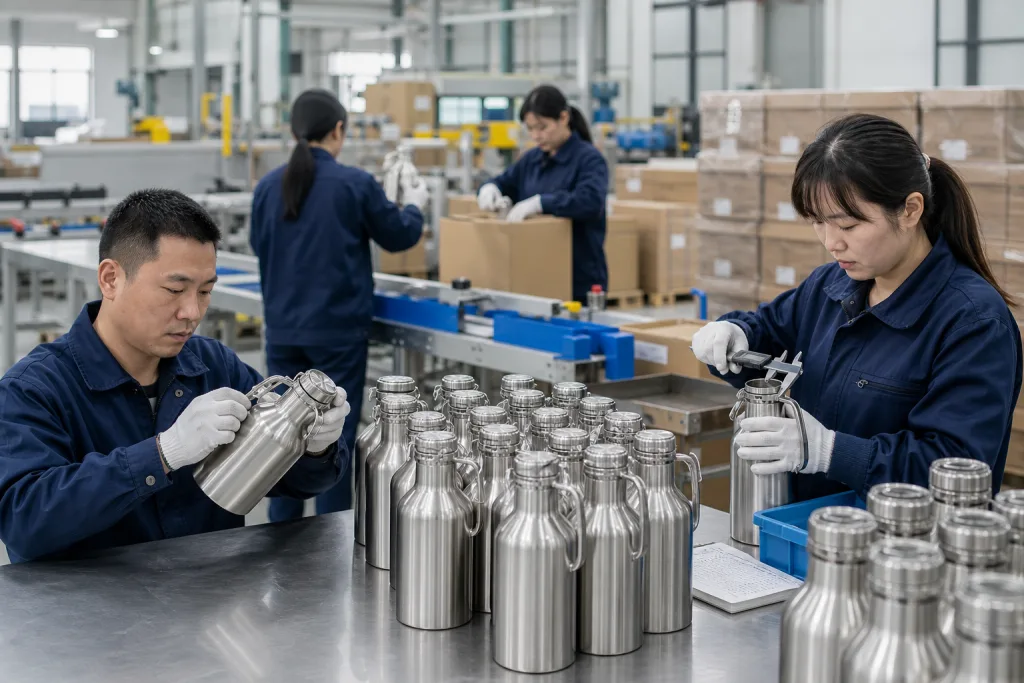
A promotional growler is a product system, not a big bottle with artwork. For B2B sourcing, you are buying the stainless body, insulation result, lid seal, handle pull strength, coating, logo adhesion, retail or bulk pack, compliance file, carton spec, and ship date. Miss one item and the cost lands in your warehouse. We have seen QC pull 12 pieces from a 500-piece pre-shipment lot because the lid gasket sat 0.3 mm proud and the cartons already carried the customer’s campaign code.
Most export buyers ask for 64 oz because it fits craft beer, camping, hydration, and corporate gifting. We also run 32 oz and 40 oz orders when the buyer wants a lighter distributor item for event tables. A common stainless steel promotional growler uses 18/8, also written as SUS304, for the inner wall and either SUS304 or SUS201 for the outer wall. Wall thickness normally sits around 0.4-0.5 mm per layer. Go thinner and the math often fails: you save a few cents, then lose it on dents after a 1.2 m carton drop test or rough LTL handling.
Vacuum insulation adds value, but it adds control points on the line. A non-insulated single-wall customized growler is cheaper and faster, with a typical sample lead time of 7 days instead of 12 days for a vacuum sample, but it sweats with cold drinks and feels less premium in hand. A double-wall vacuum growler must pass vacuum retention checks and leak testing. We test with hot water, a torque check on the lid, and a 24-hour temperature reading; one buyer once flagged a 3°C drop difference between gold and black powder-coated samples. For a canteen supplier or canteen manufacturer serving promotional channels, these tests matter because returns usually appear after the campaign has shipped.
Define the commercial use before you ask for a quote. A brewery giveaway, a paid retail SKU, and a corporate holiday gift should not share one spec sheet. If you only write “custom growler with logo,” most canteen vendors will quote a safe standard model, often with a premium lid, gift box, and 1-color print included. Fine sometimes. Wrong question other times. We have seen a PO typo list “matte back” instead of “matte black,” and that small line item delayed artwork approval by 2 working days.
FOB Price Drivers Buyers Miss
For a stainless promotional growler, FOB China pricing starts with steel grade and wall thickness, then moves into how the body is formed, what finish we run on the coating line, which lid assembly the buyer approves, how the logo is applied, and how strong the export carton needs to be. At 1,000 pcs, a standard 64 oz vacuum model often falls in the USD 4.80-7.60 FOB range. At 5,000 pcs, the same item can drop by 6-12% because setup loss, coating waste, and packing labor spread across more units. At 20,000 pcs, labor is no longer the big story; the quote depends on coil pricing, vacuum line slots, and whether we can keep the same color running for 12 days instead of breaking the line after 3 days. The math does not work if a buyer compares 1,000 pcs pricing against a 20,000 pcs retail tender.
Material grade is the first cost driver buyers can check with a magnet and a spec sheet. SUS304 inside is the standard we recommend for export custom drinkware, especially for coffee, juice, and other acidic drinks. Some quotes look low because the factory changes the outside shell to SUS201, cuts the body gauge by 0.1 mm, or uses a lighter PP lid without saying it clearly on the PI. We saw one PO last April that said “304 stainless” in the title but “201 outer” in a tiny note under packing; the buyer flagged it after QC pulled the pre-production sample. That can pass for a short-term canteen giveaway, but do not approve it by accident.
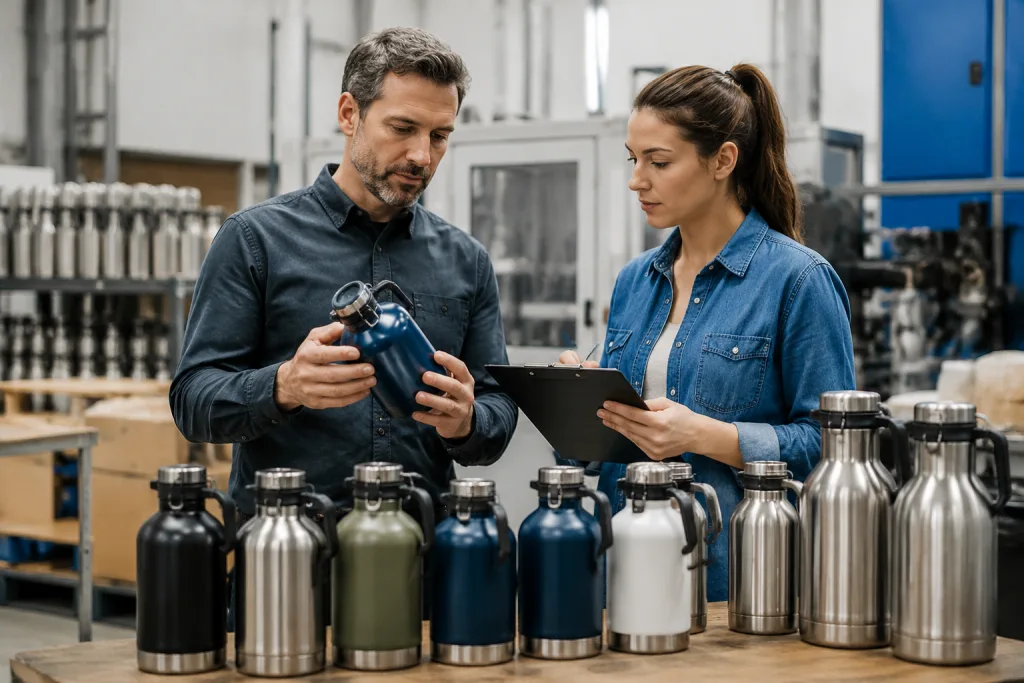
Surface finish is the second driver. Plain brushed stainless is usually the cheapest because it skips color spraying and oven time. Powder coating adds roughly USD 0.35-0.80 per unit depending on the Pantone color, masking area, and how many pcs fail the cross-cut tape test. Rubberized soft-touch coating carries more risk; dust specks and nail scratches show up fast under the inspection lamp. Mirror polish looks strong in a showroom photo, but dents and fingerprints appear after two warehouse transfers, so we do not like it for distributor canteen programs moving through mixed cartons and rough pallets.
Lids get underestimated. A basic screw lid is cheaper than a swing-top or a carry-handle cap because the mold is simpler and the gasket seat is easier to control. A lid with silicone gasket, stainless insert, and molded handle can add USD 0.40-1.20. If you want a customizable canteen look with compass cap or paracord handle, price it as a new assembly, not a logo change. We run a 0.5 mm feeler check on gasket fit during trial assembly; if the lid rocks, the buyer will see leakage complaints before they see repeat orders.
Cheap quotations usually cut cost somewhere. Ask where: steel grade and wall thickness, lid build, coating thickness, inspection level, or 5-layer carton strength.
MOQ Tiers That Change Pricing
MOQ is not a punishment. It is where the loss on the line stops bleeding. For BottleForge in Zhejiang, a stock-shape promotional growler with one-color logo can start at 1,000 pcs. Below that, the math doesn't work: the pad-print fixture still gets set, the AI artwork file still needs checking, cartons still need a mark, and QC still pulls samples under the same inspection sheet. At 1,000 pcs, we can hold unit cost and export packing in a range that buyers will accept. Under 1,000 pcs, the setup charge gets spread over too few bottles, so the piece price looks wrong before freight is even added.
At 1,000-2,999 pcs, expect limited customization. We run standard body, current coating colors, laser engraving or one-position screen print, plus standard export carton. Simple works here. This tier fits canteen distributors testing a new catalog SKU or brand owners running a 30-day promo. You may pay USD 80-150 for logo setup or film charges depending on decoration. One buyer once pushed for four logo colors at 1,200 pcs; after we counted screen plates, ink wash time, and 2% extra reject risk, he cut it back to one color.
At 3,000-4,999 pcs, custom color starts to make sense. Powder coating suppliers like stable batches because one color change can burn 25-40 minutes and waste 3-5 kg of powder during booth cleaning. A canteen customizable project at this tier can usually support Pantone-matched coating and two-position branding, with either a paper belly band or white box packaging. Expect 2-4 days longer for color approval and first-article confirmation, so a normal 12-day decoration plan can become 14-16 days if the buyer rejects the first spray panel.
At 5,000-9,999 pcs, you can negotiate better component cost and packaging options. Gift boxes or kraft boxes become sensible, and molded pulp trays make more sense once the tray mold fee is spread over enough cartons. Printed inserts are also easier to quote cleanly at this volume. This is where distributor growler programs begin to look tidy on landed cost because carton utilization improves; for example, 24 pcs per master carton often loads cleaner than mixed small-batch packing. QC pulled a sample last quarter where the insert was 2 mm too wide, so we now check insert fit before mass box printing.
At 10,000 pcs and above, a customized canteen or growler shape becomes realistic if tooling is justified. New mold or lid tooling may cost USD 1,500-8,000 depending on complexity. A new body shape needs more engineering review than a new cap color. Serious canteen manufacturers will ask for drawings, capacity tolerance, mouth diameter, thread design, and drop-test expectations before confirming tooling. We also ask for a signed drawing version, because one PO typo changing 64 mm to 46 mm on the mouth diameter sent a lid sample down the wrong path for a week.
Decoration Costs and Failure Points
Decoration is where 6 out of 10 promotional growler projects lose days. The buyer sends a logo file, assumes it is print-ready, then our prepress guy opens it in Adobe Illustrator and finds gradients, 0.2 mm hairline text, or a wrap area running across the weld line. Cylindrical drinkware has limits. On a 64 oz growler, a safe front logo area may be around 70 x 90 mm, while a wrap design needs a distortion check and usually a physical proof. We see this go sideways when the buyer approves only the PDF view on a laptop.
Laser engraving is clean and durable. We run it most often on powder-coated stainless because the laser burns off the coating and leaves the metal showing underneath. Typical cost is USD 0.20-0.55 per unit depending on logo size and cycle time; a 45 x 60 mm logo usually takes longer on the rotary jig than buyers expect. It suits premium custom growler orders and corporate gifts. One limit is color. You get the metal mark, not a printed Pantone logo, and no factory can make laser engraving match PMS 186C.
Silkscreen printing costs less for simple one-color artwork, often USD 0.12-0.35 per position at volume. It fits canteen promotional programs where the brand color must read clearly from 1 meter away. Ink adhesion still depends on surface prep and oven curing, not just the ink brand. Ask for a cross-hatch adhesion test if the item will be handled heavily; QC pulled the sample last month because the tape lifted ink near the lower curve after 3 cuts in the grid.
Heat transfer and water transfer can produce full-color graphics, but buyers should budget extra time and a higher reject rate. For promotional drinkware, full-wrap artwork may add USD 0.60-1.50 per unit and 5-10 days to sampling if color proofing is strict. UV print works for colorful designs on limited areas, but curved surfaces are unforgiving. The math doesn't work if the PO says “full wrap, no seam, perfect logo alignment” on a tapered body with a handle bracket in the way.
A professional canteen vendor should review AI, EPS, or PDF vector files before sampling. Do not approve production from a flat mockup alone. Ask for a pre-production sample using the actual coating and decoration method, not a shortcut sample from the showroom shelf. The USD 50-200 sample cost is cheaper than rejecting 5,000 pcs after mass production. We ship better when the buyer signs off on a real PP sample with logo size, position, and Pantone notes written on the approval sheet.
A Realistic Production Calendar
A solid timeline starts before the purchase order lands on our desk. Quotation usually takes 1-3 working days if the spec sheet is clean: 64 oz capacity, 304 stainless, finish, logo method, packaging, target quantity, destination port, and compliance needs. If you send five canteen suppliers a loose “best price custom canteen” note, the math does not work. You get five different assumptions and five prices that are not comparable.
Sampling usually runs 7-12 days for stock shapes with logo. Add 3-5 days for a custom powder color, and 10-20 days if a new lid or mold is in the job. QC pulled the sample last week and found a 2 mm logo shift, which is the sort of thing that slips through if the buyer rushes. Courier to the United States or Europe normally takes 3-6 days. Give yourself 2-5 extra days for internal sign-off. The delay is usually on the buyer side.
For a normal 1,000-5,000 pcs promotional growler order, mass production is usually 30-45 days after deposit and sample approval. For 10,000-30,000 pcs, plan 45-60 days, especially before Chinese New Year or during peak Q3 promo season. We run up to 80,000 drinkware units per month across standard models in Hangzhou, Zhejiang, but the line still needs a slot. If the buyer changes carton marks after PO, we have seen that go sideways fast.
Inspection should happen before final payment and shipment. For B2B export orders, AQL 2.5 for major defects and AQL 4.0 for minor defects is common. We check capacity, leak performance, vacuum retention, coating scratches, logo position, barcode, carton drop condition, and packing count. A third-party inspection adds about USD 250-350 per man-day in China. Cheap insurance. A failed retail delivery costs more.
Sea freight adds 25-40 days to North America and 30-45 days to many European ports, depending on routing. Air freight works for urgent campaign shortages, but a 64 oz stainless growler is bulky. On one rush order, the freight quote came in above the product value. The buyer flagged it, and rightly so. Plan the lane before you promise the launch date.
Landed Cost Beyond Unit Price
FOB price is only the factory gate number. Landed cost also picks up product, packaging, inland trucking in China if it is not included, export handling, ocean freight, insurance, destination port charges, duty, customs brokerage, domestic trucking, warehousing, and sometimes repacking. We ran a case last month: a USD 5.90 FOB customized growler landed at USD 7.20-9.80, and the spread came from carton size, tariff code, order volume, and the delivery ZIP. The buyer flagged the math because the quote looked cheap on paper. It was not.
Carton CBM matters. A 64 oz stainless growler in an individual white box usually packs 12 pcs per export carton. If the carton is around 52 x 40 x 32 cm, that is 0.0666 CBM for 12 pcs, or about 0.00555 CBM per unit before palletization. We measured one sample at 31.8 kg gross with a tape measure on the packing bench, and the freight quote moved on that alone. Gift boxes, foam inserts, and retail sleeves push the volume up fast. For distributor drinkware, this hits warehouse storage and parcel shipping as hard as ocean freight.
Packaging also changes the damage rate. A thin white box may save USD 0.12 per unit, then you eat scuffed coating or crushed corners on arrival. QC pulled the sample and found two dents on the shoulder after a 1.2 m drop test, so we do not chase the cheapest box anymore. For premium customizable drinkware, we usually recommend at least 350 gsm white box or kraft box, plus a polybag or tissue wrap. For e-commerce or FNSKU-labeled shipments, you need carton labels, suffocation warnings for polybags where applicable, and barcode scan verification.
Compliance cost depends on market. For the EU, buyers often ask for LFGB, REACH, and food-contact migration documentation. For the United States, FDA food-contact expectations and sometimes California Proposition 65 review may apply. If the growler is sold as a kids item, ASTM and CPSIA questions can come up, but most 64 oz growlers are adult products. Ask your canteen factory which reports already exist and whether they match the exact 304 stainless, coating, and lid structure you are buying. We have seen this go sideways when the test report was for a different coating lot.
Payment terms affect cash flow. A common structure in China is 30% deposit and 70% before shipment after inspection. For repeat canteen distributors with stable volume, negotiated terms can improve, but first orders usually stay on standard export payment terms. One PO came in with “70% after shipmnet” typed wrong, and that typo caused a two-day delay while the buyer reissued it. On a tight line, two days is not small.
How to Quote Without Guesswork
The fastest way to get a clean quotation is to cut out the assumptions. Send one RFQ sheet with target quantity, required delivery date, destination country, Incoterm, capacity, insulation type, steel grade, coating color, logo file, print size, packaging, compliance documents, and inspection requirements. If you need a distributor canteen program with multiple colors, list the quantity per color. A 3,000 pcs order split into six colors is not the same as 3,000 pcs in one color. We run into this all the time. The buyer flagged it after the first draft.
Be direct about the target market. A canteen distributor selling to breweries needs tougher packaging and logo rub resistance than a brand owner selling outdoor gear online. If the growler will move through retail distribution, ask for master carton markings, inner box barcode, and pallet loading plan. If it is for a one-time event, simpler packaging is fine and the money should go into decoration. One carton drop test at 60 cm told us that story fast.
Ask every canteen manufacturer to quote the same spec. Otherwise, one quote may include SUS304 inner and outer, while another uses SUS304 inner and SUS201 outer. One may include individual boxes, another bulk packing. One may include AQL inspection support, another may not. The lowest number is not automatically wrong, but it has to be explained. We once saw a PO typo swap 304 for 201, and the math stopped working.
For a first order, we normally suggest a stock body, a proven lid, and one controlled decoration method. After you have sell-through data, you can move into a more customized canteen design, a new finish, or special packaging. That keeps the launch date safe and gives you real cost data for the next purchase order. QC pulled the sample on a 1.5 mm lid fit check, and that saved a rework.
China is strong at scalable custom drinkware manufacturing, but it pays buyers who specify clearly. A good canteen supplier will question unclear requirements before deposit, not after production starts. That is the difference between a cheap quote and a deliverable order. We've seen this go sideways when the buyer sent a half-page RFQ and expected us to guess the rest.
Send your growler RFQ for a real factory quote
Share quantity, artwork, destination, and packaging needs. We will return practical pricing, MOQ, sampling time, and production schedule.
Frequently asked questions
What is a normal MOQ for a promotional growler order?
For a stock stainless promotional growler, 1,000 pcs is a practical MOQ for export production. At this level you can usually get one logo position, standard lid, and existing color options. For Pantone-matched powder coating, plan around 3,000 pcs. For a new lid, new body shape, or fully customized growler tooling, 5,000-10,000 pcs is more realistic. Some canteen vendors advertise 300-500 pcs, but the unit price is usually high and choices are limited. If you are a canteen distributor testing demand, start with 1,000-2,000 pcs on a proven model before investing in tooling.
How much should I budget per unit before freight?
For a 64 oz stainless vacuum promotional growler, a realistic FOB China budget is USD 4.80-7.60 at 1,000-3,000 pcs. A single-wall version can be cheaper, while premium coating, heavier lid, retail gift box, or full-color wrap can push the price above USD 8.00. Laser engraving may add USD 0.20-0.55 per unit, and powder coating often adds USD 0.35-0.80 compared with plain stainless. Always confirm whether the quote includes individual box, export carton, logo setup, and pre-shipment inspection support. Those small lines can change your real cost.
Can I mix several colors in one custom growler order?
Yes, but it affects cost and lead time. For 1,000 pcs, one color is the cleanest option. At 3,000 pcs, two or three colors are manageable if each color has enough quantity, usually at least 1,000 pcs per color. Six colors at 500 pcs each will create more coating changeovers, higher reject risk, and longer production time. For canteen customizable programs, we suggest approving one color standard first, then adding colors after repeat sales. If you need multiple colors for a distributor growler catalog, ask for a clear color split quote rather than one blended unit price.
What compliance documents should I ask a canteen factory for?
For Europe, ask for food-contact migration testing, LFGB where required by your customer, and REACH information for coatings and surface materials. For North America, ask for FDA food-contact material confirmation and review whether California Proposition 65 is relevant to your sales channel. If the item could be marketed to children, CPSIA and ASTM questions may apply, though most 64 oz growlers are adult drinkware. Also ask whether reports match the exact steel, gasket, coating, and ink used in your order. A generic old report is better than nothing, but it is not the same as batch-specific compliance support.
How early should I start before a fixed event date?
For a standard promotional growler, start at least 90 days before your event if shipping by sea. A typical schedule is 7-12 days for sample production, 3-6 days for courier delivery, 3-7 days for buyer approval, 30-45 days for mass production, and 25-40 days for ocean freight to North America or Europe. Add another week for customs clearance and domestic trucking. If you need custom tooling, add 20-35 days before mass production. Rush production is possible sometimes, but freight becomes expensive and quality decisions get compressed.