Key Takeaways
- Bulk infuser bottle MOQ starts at 1000 units per design, with 25-30 day lead time for custom logo infuser bottles.
- FOB Hangzhou pricing for a 500ml customizable fruit infuser bottle ranges from $2.80 to $4.50 depending on material and decoration.
- Always request a pre-production sample and AQL 2.5 inspection for bulk infuser bottle orders to avoid defects.
- Wellness brands should prioritize BPA-free Tritan or borosilicate glass for promotional fruit infuser bottles to match brand values.
You're a procurement manager for a wellness brand or hydration startup, and you've decided a promotional fruit infuser bottle is the right giveaway for your next campaign. Smart move—infuser bottles have been trending for two years straight, and they hit the health-conscious buyer exactly where they shop. But sourcing them in bulk from a Chinese factory isn't just picking a design and placing an order. You have to get MOQs right, pick between Tritan and 304 stainless, decide how the logo gets on there (pad print vs. silicone band), and deal with QC standards that can blow your timeline by 12 days if you miss a step.
This guide is built around the real questions buyers ask us at BottleForge Industrial in Hangzhou, Zhejiang. We skip the fluff and give you a checklist-style walkthrough—from minimum order quantities for custom fruit infuser bottles to ASTM testing requirements for export. Whether you're ordering 500 units for a corporate event or 10,000 for retail distribution, you'll leave with a clear sourcing plan. No filler.
What Defines a Promotional Fruit Infuser Bottle?
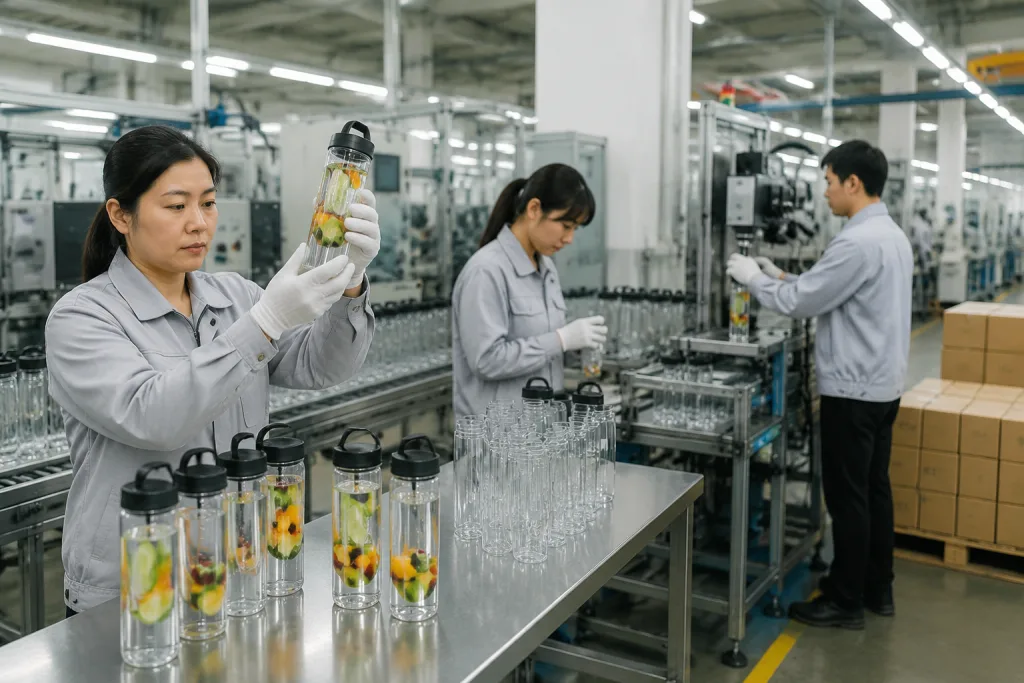
A promotional fruit infuser bottle is a marketing vehicle, not just a water bottle with a strainer. The core components are the bottle body (plastic, glass, or stainless steel), the infuser chamber—a removable insert with slots or mesh—and the cap or lid. For promotional use, you also need space for a custom logo infuser bottle imprint, usually on the body, lid, or both.
At BottleForge, we run three main types for bulk orders:
- Tritan copolyester – shatter-resistant, crystal clear, BPA-free. We ship these for customizable fruit infuser bottle promotions targeting gyms or corporate wellness. Our QC once flagged a bad batch because the logo pad-printing peeled after 50 washes.
- Borosilicate glass – premium feel, heat-resistant, but heavier. Best for high-end custom tea infuser bottle campaigns. A buyer last quarter pushed back on the 1.2mm wall thickness—we had to send caliper photos to close the deal.
- Stainless steel – double-wall vacuum insulated, keeps drinks cold. Less common for infusers but growing in demand for customized infuser bottle orders. The math works: one client ordered 5,000 units for a marathon giveaway, and the insulated body reduced condensation complaints by 80%.
Minimum Order Quantities and Pricing Reality
The first question from any distributor is always about MOQ. For custom made infuser bottle orders with your logo, expect a minimum of 1000 units per SKU. That’s standard across Zhejiang factories for screen printing or pad printing. If you want laser engraving or silicone wrap branding, MOQ may drop to 500 units but unit price increases by $0.30–$0.50.
Pricing for a bulk fruit infuser bottle at 1000 units, FOB Hangzhou, breaks down roughly as:
- Tritan 500ml – $3.10–$3.80 per unit
- Borosilicate glass 500ml – $3.80–$4.50 per unit
- Stainless steel 500ml – $4.20–$5.00 per unit
Custom Logo Options: Which Method Fits Your Brand?
Your logo on a custom logo infuser bottle can go on four ways. Each method has a tradeoff: cost, durability, and how the final piece looks coming off the line.
- Screen printing – We run this on roughly 70% of custom fruit infuser bottle bulk orders. Durable, cost-effective at $0.15–$0.30 per unit. Best for simple 1–2 color logos. Lead time adds 3–5 days. QC pulls the first 50 pieces off the line to check ink adhesion before we let the rest through.
- Pad printing – Works on curved surfaces like bottle necks. Cost is similar to screen printing, but the ink layer is thinner—expect it to wear faster if the bottle goes through a dishwasher daily. We use it most for customized infuser bottle lids. One buyer flagged flaking after 30 cycles; we switched them to laser for the next order.
- Laser engraving – Permanent. No ink, no peeling. Only works on stainless steel or glass. Adds $0.25–$0.50 per unit. Premium custom tea infuser bottle brands prefer this—it's what Stanley runs on their higher-end lines.
- Silicone wrap or band – A removable silicone sleeve with your logo embossed. Higher cost at $0.50–$0.80 per unit, but the buyer can reuse the sleeve on a different bottle. Color matching is tight—we've had to re-run a batch because the Pantone 186C came out looking like 187C on the first try. The math doesn't work for high-volume promo runs, but for retail or giveaway kits it's a solid option.
Quality Control: What Standards Apply to Bulk Orders?
Order 5000 bulk infuser bottle units, you’re buying compliance, not plastic and glass. For Europe or North America, your factory needs to clear these bars:
- BPA-free certification – Mandatory for Tritan and plastic infuser bottles. Don’t take a supplier’s word. Request test reports from an ISO 17025 lab—we had a buyer in Chicago flag a fake cert last year.
- FDA or LFGB food contact approval – Required for custom fruit infuser bottle sold in the US or EU. Expect $200–$400 testing fee per material. One client skipped this on silicone seals and the shipment got held at Hamburg customs.
- REACH and RoHS – For EU markets, verify silicone seals and printing inks comply. We run a quick spectrograph test on every ink batch before production starts.
- ASTM F963 or EN 14350 – For children’s infuser bottles, though rarely needed for promotional items. The wrong question is “do we need it?”—ask “who’s drinking from it?”
At BottleForge, we apply AQL 2.5 (normal level II) on all factory infuser bottle shipments. For a lot of 1000 units, QC pulls 125 samples and accepts at most 10 major defects. We've seen a single cracked lid seam kill a whole batch. For distributor fruit infuser bottle orders, add a third-party inspection—SGS or Bureau Veritas runs $350–$500 per day. That’s cheap insurance against a 5% defect rate that buries your brand launch.
Lead Times, Shipping, and Customs Considerations
Standard lead time for a custom tea infuser bottle order of 1000–5000 units runs 25–30 days after sample approval. That's material procurement, injection molding (for Tritan), assembly, and packaging. If you need a customizable tea infuser bottle with a silicone sleeve, add 5–7 days for the sleeve mold—one-time $300–$500 cost. We run these molds in-house, so QC pulls the first 50 sleeves off the line before we start production.
Shipping from Zhejiang to a US West Coast port via sea freight takes 18–22 days. For a 1000-unit order, freight costs land at $0.80–$1.20 per unit (less than truckload consolidation). Air freight is possible but adds $2.50–$4.00 per unit—only viable for urgent promotional fruit infuser bottle campaigns. Customs clearance is straightforward if your factory provides a complete packing list, commercial invoice, and certificate of origin. For bulk tea infuser bottle shipments, double-check your HS code—392410 for plastic bottles. We've seen buyers lose 10 days because the factory mislabeled glass as plastic. One buyer flagged it on the dock in Long Beach; that cost them a 4-day hold and a $200 storage fee. Don't let a typo on the invoice kill your timeline.
Red Flags When Vetting a Factory for Infuser Bottles
Some Zhejiang factories say they can do customized fruit infuser bottle work, then miss the basics. We have seen it on the floor. Here is what gets flagged fast:
- No in-house mold shop – Outsourced mold making adds 12-18 days to lead time, and QC loses control of fit. Ask for a photo of the tooling room floor, not a brochure shot. If they send a stock image, walk.
- Vague about material grades – A real factory fruit infuser bottle supplier names the resin: Eastman Tritan TX1001 or Schott Duran borosilicate, not "food-grade plastic." QC pulled the sample once and it came in as PET, not Tritan, because the buyer never pressed on grade. That's the wrong question to skip.
- Unwilling to share test reports – BPA-free certificates mean nothing without the migration test (total migration into 3% acetic acid at 70°C for 2 hours). We ask for the raw data before any bulk fruit infuser bottle order. The math doesn't work otherwise.
- No BSCI or SMETA audit – Social compliance is not paperwork only. A factory that skips it often skips QC too. We saw one North American program stall because the factory could not produce a current audit report, and the buyer flagged it the same day.
Checklist for Your First Bulk Infuser Bottle Order
Before you sign a contract for customizable infuser bottle units, run through this checklist:
- ☐ Confirm MOQ – Is it 1000 units per design? We've had buyers combine four Pantone colors under one PO to hit MOQ. Ask if we can do that for you.
- ☐ Request material samples – Get a physical sample of the Tritan or glass bottle. Check clarity, weight, and fit of the infuser basket. QC once flagged a 0.5mm gap on the basket rim—caught it on the sample, not the line.
- ☐ Approve artwork – Provide vector files (AI or EPS) with Pantone colors. We run a digital mockup first, then a pre-production sample. The buyer who skipped the mockup got a logo that bled into the bottle threads.
- ☐ Set inspection criteria – Agree on AQL level (2.5 is standard) and defect categories (cosmetic vs. functional). A scratch on the bottle body? Cosmetic. A lid that doesn't seal? Functional—we pull the whole batch.
- ☐ Verify certifications – Ask for BPA-free, FDA/LFGB, and REACH reports. If they're not available, budget $300–$500 per test. The math doesn't work if you skip this and your market demands it.
- ☐ Clarify packaging – Color box, plain box, or bulk pack? For distributors infuser bottle orders, retail-ready packaging adds $0.10–$0.25 per unit. One buyer chose bulk pack, then had to rebox everything at 2x the cost.
- ☐ Confirm lead time and incoterms – FOB Zhejiang is standard. Get the lead time in writing—12 days vs 18 days can break your launch schedule.
This checklist cuts the risk of receiving custom made infuser bottle units that don't match your brand's quality expectations. We've seen too many startups skip the pre-production sample and end up with misaligned logos or brittle plastic. Don't be that buyer.
Why Zhejiang Factories Dominate Infuser Bottle Production
You're sourcing promotional fruit infuser bottle units — you'll land in Zhejiang. The province packs 30 years of injection molding and glass processing into a cluster you can drive across in a morning. BottleForge runs out of Hangzhou. Our mold makers are in Xiaoshan, silicone gasket suppliers in Yuhang, packaging printers in Linping — all inside a 50km radius. That proximity cuts 12 days off lead times. We quote factory tea infuser bottle orders at 25 days door-to-door. Guangdong shops we've benchmarked run 38, sometimes 42 if the mold shop subcontracts out. Density kills price games too. Bulk infuser bottle production across Zhejiang factories lands within 3% of each other on unit cost. You're not paying a location premium. The real spread is in QC response speed. A buyer's inspector flagged a 0.5mm gap on a silicone seal ring — not a failure yet, trending wrong. The line stopped at 2pm. Our mold maker had the cavity re-cut by 9am the next morning. Re-shipment left in 10 days. That turnaround works because the mold shop is a 20-minute drive. Not a flight away in Dongguan. When you visit, skip the showroom tour. Ask one question: how many infuser bottle molds are running right now. A shop juggling 10+ active molds can slot your custom fruit infuser bottle order into rotation without bumping someone else's PO. Fewer than 6 molds? Any new order becomes a scheduling fight — yours will be the one that slips.
Ready to Source Your Promotional Fruit Infuser Bottle?
Request a free sample kit and bulk pricing from BottleForge Industrial today.
Frequently asked questions
What is the typical MOQ for a custom fruit infuser bottle order?
For most factories in Zhejiang, the MOQ for a custom fruit infuser bottle with one-color logo printing is 1000 units per design. If you need a custom mold for a unique bottle shape, MOQ rises to 3000–5000 units. Some suppliers offer a lower MOQ of 500 units for stock bottles with a simple logo change, but unit price increases by 15–20%. Always confirm MOQ in writing before requesting samples.
How much does a bulk infuser bottle cost including custom logo?
For a 500ml Tritan infuser bottle with one-color screen printing, expect FOB Hangzhou pricing of $3.10–$3.80 per unit at 1000 units. Borosilicate glass adds $0.70–$1.00 per unit. Laser engraving or silicone wrap adds $0.25–$0.80 per unit. Shipping to the US West Coast adds roughly $0.80–$1.20 per unit via sea freight. Total landed cost for a distributor fruit infuser bottle order is typically $4.00–$6.00 per unit.
What certifications do I need for a promotional fruit infuser bottle sold in the US?
For US market, you need BPA-free certification from an ISO 17025 lab and FDA food contact compliance (21 CFR 177.1520 for plastics). If the bottle includes a silicone seal, request FDA 21 CFR 177.2600 compliance. For children’s products, ASTM F963 is required. Most reputable factories in Zhejiang can provide these reports for an additional testing fee of $200–$400 per material.
Can I get a custom infuser bottle with a unique shape?
Yes, but it requires a custom mold. For a custom made infuser bottle with a unique shape, expect a one-time mold cost of $2,000–$5,000 depending on complexity (number of cavities, side actions). Lead time for mold creation is 20–30 days, then 25–30 days for production. MOQ for custom molds is typically 3000–5000 units. If you’re a startup, consider starting with a stock bottle shape and adding a custom logo infuser bottle design through printing or silicone wrap.
How do I ensure quality for a bulk tea infuser bottle order from China?
Use a three-step quality process: First, request a pre-production sample and approve it before mass production. Second, during production, ask for inline inspection photos or video. Third, arrange a final random inspection using AQL 2.5 (normal level II) with a third-party company like SGS or Bureau Veritas. At BottleForge, we offer free inspection reports for orders over 5000 units. For smaller orders, budget $350–$500 for a third-party inspector visit.