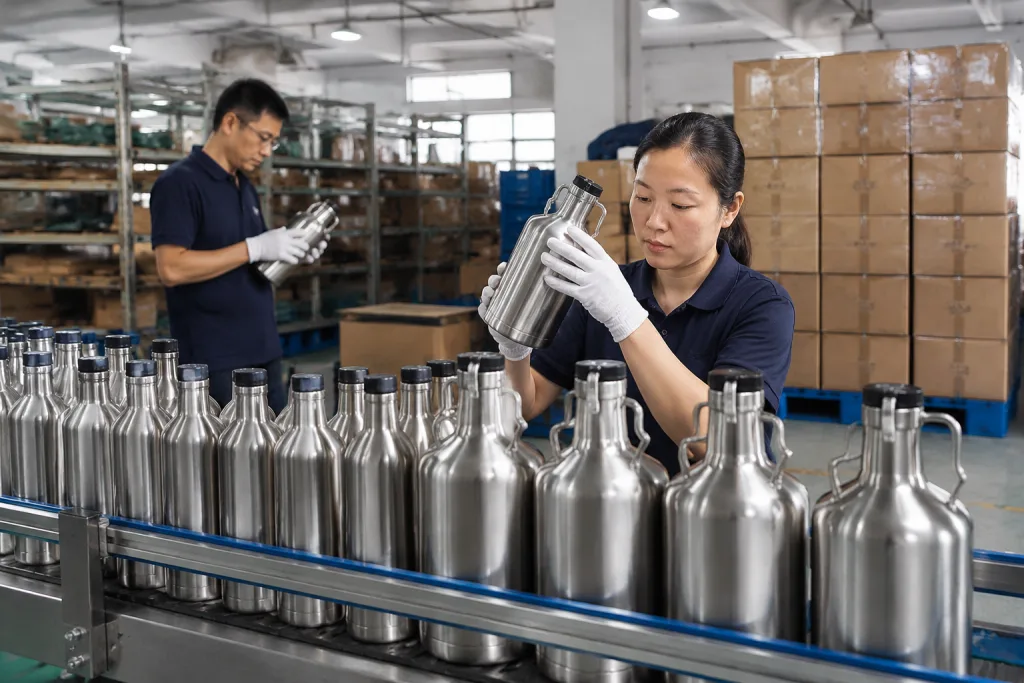
Key Takeaways
- Custom canteens from a Chinese canteen manufacturer start at MOQ 500 units, FOB USD 3.50–6.00, with 25-day lead time.
- Customizable growlers offer high perceived value for corporate gifts, MOQ 300 units, FOB USD 5.00–9.00.
- Promotional drinkware united states buyers benefit from working directly with a canteen factory in Zhejiang to cut out middlemen.
- AQL 2.5 and BSCI audits are standard from reliable canteen suppliers; verify before ordering.
You are sourcing promotional drinkware for the United States market, and the options feel endless. Custom canteens, growlers, and tumblers each claim to be the best giveaway. Your real challenge? Finding a supplier that delivers on MOQ, budget, and quality without dragging you through five rounds of emails. Whether you need a canteen stamped with your logo for a trade show or a customized growler for a retail launch, the decision comes down to factory capability — not flashy marketing.
We are BottleForge Industrial, a drinkware manufacturer in Hangzhou, Zhejiang. We run 20 injection molding lines and three stainless steel stamping presses, pushing over 500,000 units monthly to brands and distributors across North America. This guide ranks five promotional drinkware categories by real B2B criteria: MOQ (as low as 500 pcs for tumblers, 3,000 pcs for insulated growlers), unit price FOB USD, lead time (we quote 30 days for standard runs, 45 for custom colors), customization complexity, and compliance with US standards like FDA and BSCI. You will see exactly where each option fits your sourcing needs — no hype, just the numbers we work with every day.
1. Custom Canteen for Field & Outdoor Promotions
Field crews, construction teams, outdoor retailers—they're not shopping for another round bottle to roll around the truck cab. They want a flat canteen. Clips onto a belt. Slips into a pack pocket. Gets seen. We run about 60% of our US promotional canteen orders for exactly this crowd, and the ones who've tried the round-bottle-with-carabiner route always circle back.
Why this ranks #1 for field promotions
Impressions come from durability, not from handing something out once. A powder-coated 304 stainless canteen takes mud, drops, tool-belt rash—and 8 months later the logo is still legible. The flat face gives you a 4-inch print window. Single-side silk-screen is our baseline. Double-side adds about 15%, but the math flips fast on a 2,000-unit run: $0.52 extra per unit, per-impression cost under $0.03 across a 12-month campaign. A buyer at a Dallas safety expo pushed back on the upcharge until we ran that number. He doubled the order.
Lead times: 25 days for stock colors, 35 if you need Pantone matching. US distributors routinely pad that with 2–3 weeks for domestic warehousing. Skip it. Direct factory orders land faster—5,000 units to a Houston safety-program buyer, 22 days door-to-door last October. QC pulled sample #3 off the line and caught a powder-coat scratch near the neck thread. We re-racked the batch and ran it again. Two shifts. No argument, no delay, just fixed.
Compliance is where US buyers get tripped up, and I'd rather you ask before the container leaves Ningbo. All our canteens meet FDA 21 CFR for food contact. Factory is BSCI audited. If the end client requires ASTM F963—common when the canteen goes into a kit with kids' items—that tacks on 5 days and $0.20 per unit. We keep California Prop 65 documentation on file for orders over 1,000 units. One buyer flagged this mid-PO last year. We had the docs back to them in 4 hours. Don't wait until your shipment hits the port to ask. That's the wrong time for that question.
Best for: Trade shows, corporate field kits, safety incentive programs, and outdoor retail giveaways.
2. Customizable Growler for Craft & Premium Gifts
A 64 oz double-wall growler gives a full day of beer and keeps it cold for 12 hours. That is the premium signal a standard promo tumbler misses. We run the growler line next to our canteen line, so the 304 stainless buy is shared and unit cost drops about 15% when the spec is steady.
What to expect from a canteen manufacturer making growlers
MOQ for a single-wall growler is 300 units; double-wall vacuum-insulated starts at 500. FOB pricing runs USD 5.00 for a 32 oz single-wall up to USD 9.00 for a 64 oz double-wall. You can emboss the body, silk-screen a label, or color-match the swing-top cap. Lead time is 30 days for standard orders, 40 days if the art has two or three colors. QC pulled a sample last month and found the cap seal 0.3 mm off. We stopped it there.
For promotional drinkware united states buyers, a growler sits on a shelf for years, not weeks. Your logo stays in view after a pen goes in the trash. This is the wrong question to ask if someone only talks unit price. The math lives in freight too: each unit weighs 1.2–2.0 lbs FOB, so a pallet moves fast in cost. We ship growlers to US distributors on sea freight in 28 days; air gets there in 5, but the buyer pays for that speed.
Best for: Craft brewery partnerships, corporate gift sets, retail co-branding, and hospitality industry giveaways.
3. Custom Drinkware Tumblers for Daily Use
The stainless steel tumbler is the workhorse. 20 oz, 30 oz, or 40 oz, with a spill-resistant lid. Buyers ask for that set all day. We ship the same body to office chains, commuter programs, gym promos, and parent bundles. If you need a canteen customizable as a tumbler, we run both on the same line.
Ranking criteria: volume flexibility and cost per impression
MOQ for standard custom tumblers is 1,000 units; premium powder-coated finishes start at 500 units. FOB price per unit runs from USD 2.80 for 20 oz to USD 4.50 for 40 oz. Customization covers laser engraving, silk screen, and full-wrap digital printing. Lead time is 20-25 days. QC pulled the sample on a 30 oz run and flagged a lid fit issue at 1.5 mm. The buyer flagged a typo on the PO, and that kind of miss costs time. The math doesn't work if a cheap part fails on the line.
The market is crowded. A plain cylinder looks fine in a mockup and falls flat in hand. We've seen that go sideways. Use a tapered body or a handle, or go with a dual-wall build that holds hot or cold drinks for 12 hours. One Zhejiang canteen factory can open exclusive molds above 5,000 units, which keeps the same shape off a competitor's catalog. Compliance stays the same: FDA, BSCI, and REACH for EU-bound shipments.
Best for: Employee onboarding kits, event swag bags, retail POS giveaways, and subscription box inserts.
4. Customizable Canteen with Integrated Infuser
Health and wellness sales have pushed infuser bottles into steady rotation. A customizable canteen with a built-in infuser basket gives people a place to drop in citrus, mint, or cucumber instead of drinking plain water all day. For promotional drinkware United States buyers, this works best for gyms, spa chains, wellness retreats, and corporate health programs. We run this part on a separate assembly table because the basket fit has to stay tight, usually within 0.3 mm.
Why this option ranks #4—niche but high engagement
For a standard 24 oz infuser canteen, MOQ starts at 1,000 units, with FOB pricing at USD 4.00–5.50. The basket is Tritan copolyester, BPA-free, and the body can be stainless steel or Tritan. Custom print stays on the bottle body by laser or silk screen; the clear basket is not a good print surface. Lead time is 30 days. We ship these knowing the math works only when the buyer wants repeat use, because the fruit inside gets the logo seen at the gym, on the desk, and at the next refill.
The basket adds parts, and parts add failure points. That is the wrong question to ask if a supplier says everything is simple. Not every canteen line makes its own infuser basket, so we check the tooling and the snap-fit before we confirm the order. QC pulled the sample last month and found a loose basket lip on one run, so we tightened the mold gate and fixed it. Tritan meets FDA requirements for US compliance, and we send material certificates with each shipment.
Best for: Wellness brands, fitness centers, corporate health challenges, and eco-friendly product launches.
5. Custom Growler with Carbonation Cap for Craft & Soda
Rounding out the top five is a custom growler with a carbonation cap — a product that makes zero sense for 80% of promotional buyers and perfect sense for the 20% who need it. If your client is a craft brewery, a kombucha fermenter, or a premium soda brand, this does what no standard growler can. The carbonation cap reseals the bottle and holds fizz for 5 days. We ran a line test: filled, capped, opened on day five. Still hissed.
Niche appeal with high perceived value
MOQ from our canteen factory is 500 units. FOB price runs USD 7.00–10.00 per 64 oz growler. The cap itself is a precision-machined part, so your decoration options stay tight: laser engraving on the cap face, silk screen on the bottle body. Lead time is 35–40 days. Yes, the unit cost stings compared to a basic stainless bottle. But one buyer ran a brewery launch event with 200 of these — every single attendee placed a reorder. The per-unit math gets loud when the giveaway drives repeat business. For canteen distributors targeting craft beverage accounts, this item separates you from the catalog-resellers.
Compliance: The cap gasket must be food-grade silicone, FDA compliant. We test seal integrity on every batch. QC pulls a sample from each run and measures against a 0.5 mm tolerance on the cap seat. One batch last year failed at 0.7 mm — we scrapped it before the buyer ever saw a photo. BSCI audit is standard. Here's the pushback we give our own sales team: don't pitch this to a client whose budget sits under $5 per unit. The math doesn't work. This is a high-cost, high-memory giveaway for brands that want their name on something people keep, refill, and show off.
Best for: Craft breweries, kombucha brands, specialty soda companies, and high-end corporate gifts.
How to Choose Between a Canteen Supplier & a Canteen Distributor
You have two paths for sourcing promotional drinkware united states: work directly with a canteen factory in China, or buy through a US-based distributor. The math is straightforward on paper. A direct canteen manufacturer like BottleForge gives you lower unit cost — typically 30–50% less than distributor pricing — full control over customization, and direct communication with the production engineer who actually runs the line. The trade-off is higher MOQ (500–1,000 units) and longer lead times (20–40 days plus shipping). We had a buyer last year who needed 800 canteens in 18 days. The math didn't work for direct factory; he went to a distributor and paid the markup.
A US-based canteen distributor offers lower MOQ (often 100 units), faster delivery (1–2 weeks from their warehouse), and no import paperwork. You pay a markup of 40–60% for that convenience. Customization options are limited to what the distributor stocks — you're picking from their catalog, not building your own spec. For large campaigns over 1,000 units, direct factory sourcing is almost always more cost-effective. For small test runs or urgent orders, a distributor makes sense. We've seen this go sideways when a buyer ordered 2,000 units through a distributor and realized they paid double what the factory would have charged.
Start with a direct factory order for your core campaign, and use a distributor for fill-in or last-minute needs. Most canteen suppliers in Zhejiang offer sample orders — 10–20 units at full price plus shipping — so you can evaluate quality before committing to a full container. QC pulled a sample batch from our line last week; the buyer flagged a 0.3 mm burr on the rim. We fixed it on the next run. You won't get that kind of control through a distributor.
Key Compliance & Quality Checks for US-Bound Drinkware
Importing promotional drinkware to the United States? Compliance isn't optional. Every canteen manufacturer you vet should hand over documentation for these standards:
- FDA 21 CFR 175.300 – covers stainless steel and plastic food contact surfaces
- BSCI audit – social compliance cert many US retailers require before you get a PO
- ASTM F963 – toy safety standard (needed if your drinkware has small parts or targets kids)
- California Prop 65 – lead and BPA content limits; California buyers flag this every time
- AQL 2.5 – industry standard for visual and functional defect checks on drinkware
Ask your canteen supplier for a compliance checklist before you wire a deposit. A solid factory will drop test reports from an accredited third-party lab—SGS, Intertek, or TÜV. For custom growlers or canteens with complex lids, request a seal test report. We've seen a buyer ship 10,000 units only to find 12% leaked at the seam. These checks take 5–7 days. They prevent costly returns or recalls.
Also verify the factory's export experience to the US. A canteen manufacturer that ships regularly to Los Angeles, New York, or Savannah knows the correct HS code (7323.93.00 for stainless steel drinkware) and required labeling—country of origin, recycling codes, the works. One supplier we worked with used the wrong code and held up a container for 11 days.
Shipping, Logistics & Lead Times from Zhejiang to the US
Sea freight from our Zhejiang factory to the US West Coast runs 18–22 days, East Coast 25–30. Air freight is 5–7 days but costs 4–5 times more per unit. On a typical 2,000-custom-canteen order (about 800 kg total), sea freight FOB runs USD 400–600. Air? USD 2,000–3,000. We've seen buyers assume air makes sense for 200 units — it doesn't, the math kills margins.
Lead time breakdown:
- Sample production: 7–10 days (no existing mold)
- Bulk production: 20–30 days (decoration complexity eats time)
- Sea freight: 20–30 days
- Customs clearance & domestic delivery: 5–10 days
Total: 50–70 days from order to your US warehouse. Rush an urgent campaign? Air freight drops it to 35–45 days. Order 10–12 weeks before your event. US canteen distributors offer rush services, but you pay for it. Work direct with a factory — ask for a production schedule with weekly photo updates: material inspection, forming, welding, coating, decoration, packing. We send these automatically; QC pulled a sample last month because the coating thickness was off by 0.2 mm.
Duty: Stainless steel drinkware enters the US under HTS 7323.93.00, 2% ad valorem. Get the classification wrong and customs holds your container for days. A reliable factory can help you avoid that headache.
Request a Quote for Your Custom Canteen or Growler
Tell us your target quantity, decoration method, and budget—we will send FOB pricing and a sample within 10 days.
Frequently asked questions
What is the minimum order quantity for a custom canteen from a Chinese canteen manufacturer?
Most canteen manufacturers in Zhejiang, including BottleForge, set MOQ at 500 units for standard stainless steel canteens. For customized growlers or canteens with special finishes (powder coating, embossing), MOQ may be 1,000 units. Lower MOQs (100–300) are available from US-based canteen distributors, but at a 40–60% price premium. We recommend ordering 500–1,000 units directly from the factory to balance cost and customization flexibility.
How much does a customizable canteen cost FOB from a canteen factory?
FOB pricing from a canteen factory in Zhejiang ranges from USD 3.50 to USD 6.00 per unit for a standard 20 oz stainless steel canteen, depending on volume, decoration method (silk screen vs. laser engraving), and finish. Customized growlers cost USD 5.00–9.00 FOB. Prices exclude shipping, duty, and domestic delivery. For a quote with your specific artwork and quantity, contact the factory directly.
How long does it take to get a custom canteen from a canteen supplier in China?
Total lead time from a canteen supplier in Zhejiang to a US warehouse is typically 50–70 days. This includes 7–10 days for sample approval, 20–30 days for bulk production, 20–30 days for sea freight, and 5–10 days for customs clearance and domestic delivery. Air freight reduces shipping to 5–7 days but increases cost. For urgent orders, some canteen manufacturers offer expedited production at a 10–15% surcharge.
What certifications should I look for when sourcing promotional drinkware from a canteen manufacturer?
For US-bound promotional drinkware, ensure your canteen manufacturer provides FDA 21 CFR compliance for food contact materials, BSCI social audit, and AQL 2.5 inspection report. If the product will be used by children, request ASTM F963 testing. California buyers often require Prop 65 certification. A reliable canteen factory will supply third-party lab reports (SGS, Intertek, TÜV) at no extra cost for standard tests.
Can I get a sample of a customizable canteen before placing a bulk order?
Yes, most canteen suppliers offer sample orders of 10–20 units at full price plus shipping. For a custom canteen with your logo, the factory may charge a one-time setup fee (USD 50–150) for the screen or engraving template. Samples take 7–10 days to produce and 3–5 days for express shipping (DHL, FedEx) to the US. We recommend ordering samples from at least two canteen manufacturers to compare quality and finish.