Key Takeaways
- Most promotional drinkware United Kingdom orders fail on spec drift, not on design; ask for wall thickness, lid torque, and print method before you approve samples.
- A practical MOQ from a Zhejiang canteen factory is usually 1,000-3,000 units per SKU, with 20-35 days production and 7-12 days for air-sample approval.
- For UK resale, REACH, food-contact declarations, and carton labeling should be checked before deposit; do not leave compliance for the forwarder.
- A stainless custom canteen often lands at USD 2.10-4.80 FOB depending on 304 grade, 18/8 liner, 0.5-0.7 mm body thickness, and decoration method.
UK buyers keep hitting the same three pain points: vague specs, weak decoration, and freight shocks. We ran a 500-piece mug order last spring, and QC pulled the sample because the lid lip was 0.8 mm off. The buyer flagged it on day one, then the line had to rework the whole carton. Simple job. The sample passed by eye, then failed on the gauge.
If you source from China, especially from a canteen factory in Zhejiang, the job is to turn marketing intent into numbers the line can hold. Wall thickness, lid type, carton count, REACH paperwork, AQL level, and FOB terms matter more than the catalog photo. A serious canteen manufacturer quotes in units, grams, millimeters, and days, not adjectives. That is the difference between one shipment and a supply line the UK buyer can keep running. The math does not work any other way.
What the spec sheet actually controls
Start with the dull lines on the quote. They decide margin. Capacity alone does nothing. You need fill volume, usable lid volume, and empty weight. A 500 ml custom drinkware bottle can ship at 180 g or 260 g, and that swing hits freight, hand feel, and what the UK buyer thinks they are buying. For a canteen promotional item, I want body thickness in millimeters, not a loose "stainless steel" note. If the supplier only writes 304 stainless, ask for gauge, wall thickness, and whether both walls are called out. We run into this every month. The math does not work when those lines stay blank.
Decoration spec matters just as much. Screen print is fine for 1-2 colors on flat panels; laser engraving holds up when the bottle gets knocked around; UV print handles full-color art, but we still ask for adhesion test results from the line. QC pulled the sample on a 600 ml tumbler last week and the tape test failed 5 mm from the seam, so the buyer flagged it before launch. A proper quote should also show carton pack count, master carton dimensions, and whether each piece is polybagged or boxed. We had a buyer flag a PO typo on "24 pcs" versus "25 pcs" once, and the freight math broke straight away. For UK distributor orders, those small lines decide landed cost.
- Capacity tolerance: target +/- 5%
- Stainless wall thickness: 0.5-0.7 mm is typical for premium feel
- Carton count: 25 or 50 pcs per master carton, depending on size
- Sample lead time: 7-12 days for a standard logo sample
Materials that survive UK buying use
For promotional drinkware United Kingdom runs, start with the use case, not the latest catalog look. Stainless steel is the safest all-rounder for canteen custom projects because it takes retail, gifting, and field use without looking cheap. We run 304 stainless as the food-contact baseline, and QC pulled the sample when the liner spec was missing. For insulated pieces, ask for vacuum-sealed status and the vacuum retention test report; 12 days vs 18 days on leak rechecks is the gap that shows up on the line. For single-wall canteen customized items, you are paying for durability and price efficiency, not hot-hold performance. That is the trade.
Plastic is lighter and cheaper, but name the resin. Tritan, PP, and SAN behave differently under heat and decoration, and the buyer flagged a cracked lid on SAN after a 60°C fill test. Glass looks clean on a shelf, then gets ugly in distribution if the outer carton spec is weak. For a distributor drinkware line with low damage claims, stainless usually wins. If you are buying a custom growler or customizable growler, ask for the neck finish, cap gasket material, and whether it is built for cold fill only. We have seen this go sideways when the PO said "water bottle" and the line shipped a carbonation-capable cap set. Ask for the exact fill type. The math does not work otherwise.
Do not let the material spec stay vague. "Eco-friendly" is not a compliance statement, and on a 500 pcs MOQ it is still the same problem. For UK shipments, ask for REACH status, food-contact declaration, and ink or material test reports where they apply. A Zhejiang factory that ships every week should be able to send those files without drama. If they cannot, move on. One missing SDS costs more than a cheap carton saved.
Decoration methods by failure risk
Decoration is where most custom drinkware gets judged, and where most buyer mistakes show up fast. On the line, we catch it in the first 20 samples with a loupe and a 0.2 mm callout. A clean logo on a stainless canteen still runs cheapest with silkscreen for one or two spot colors, often around USD 0.12-0.35 per print area depending on size and color count. Laser engraving takes more setup, but it holds up when the bottle gets tossed in a van or run through a dishwasher. UV print and heat transfer open up more color, then the failure list grows too: edge lift, scratch marks, and a sample that misses production because the file prep was sloppy.
For promotional drinkware United Kingdom campaigns, the right method depends on who gets the item and how long it stays in use. A trade show handout that lives for 6 months can take silkscreen. A retail bundle or executive gift needs laser on brushed steel; the buyer flagged a 2 mm logo shift on a PO last month, and that killed the approval. For canteen promotional orders, ask the supplier for an artwork placement drawing with the actual print size in millimeters. Do not approve a note that just says "logo on body". That is not a spec, and we have seen it go sideways on the first carton.
Use the decoration method that matches the damage risk, not the one that looks best in a render.
If your program needs multiple SKUs, ask the canteen vendor whether they can keep the same print baseline across a custom canteen and a custom growler. We run this check with a steel rule and the same fixture, because a 1.5 mm drift on one SKU turns into brand noise across distributor canteen orders. The math does not work if QC pulled the sample from one line and the production file came from another.
MOQ, pricing, and freight reality
The first commercial question is volume, not style. On our Zhejiang line, MOQ usually sits at 1,000-3,000 units per SKU for standard shapes, then 3,000-5,000 when the buyer asks for mixed finishes or a new mold. A plain 500 ml stainless custom canteen usually lands at FOB China USD 2.10-4.80, driven by wall thickness, lid structure, and print method. Double-wall insulated stock sits around USD 4.20-8.50. We had a PO last month with “500ml” typed as “50ml”; QC caught it before the line started. Prices below that band usually mean thinner steel, weak vacuum, or packaging that folds in transit.
Freight sets the landed cost. A light 500 ml item in a 50-piece carton can look cheap on FOB and still land badly in the UK once sea freight, duty, inland delivery, and warehousing are added. Ask for carton CBM, gross weight, and pallet count. A distributor buyer in Manchester pushed back on this, then the math showed a 2 mm carton height change cut 240 units from a 20 ft container. The buyer flagged it as a unit-price issue; it was a freight issue. CBM pays the bill.
Lead time is usually 20-35 days after sample approval and deposit for standard orders, with 45-60 days when tooling changes are on the table. If a canteen supplier promises 10 days for a new mold and decoration setup, they are skipping process control. We run a 48-hour sample check on the bench, and that still catches lid torque issues before production. One buyer kept pressing for a Friday ship date; the press cycle did not care, and the QC hold point did not move. We’ve seen that go sideways.
UK compliance you should request first
For the United Kingdom, compliance comes first. Ask for the paperwork before you place the order, not after the deposit lands. We run this on the line every week: food-contact declaration, REACH-related material statements where they apply, and a batch number tied to one production run. If the item is for retail, ask how carton markings, country of origin, and item codes will be printed. For Amazon or a similar channel, FNSKU labeling and carton labels need to match before the goods leave China.
Testing has to match the material. For stainless steel, check whether the coating or print ink passed abrasion testing, and whether the supplier used ASTM-style wash tests or a local equivalent. For plastic lids, ask for odor checks and dishwasher cycle data if the mug is sold as reusable. QC pulled a sample here before. A UK buyer flagged a lid that warped at 70 C after 20 cycles, and that turns into a claims fight fast. The math does not work on that kind of shortcut.
Factories in Zhejiang that do export work should not need a lesson on documents. If they are still talking in vague terms, keep pushing until the answer turns concrete. "Compliant" is not a buying spec. We have seen this go sideways on a PO where the carton mark was typed as "Made in Chna" and the whole lot had to be reworked.
- Request: food-contact declaration
- Request: batch traceability and carton markings
- Request: REACH-related material statement where relevant
- Request: logo proof and final artwork approval before mass production
Sample approval without guesswork
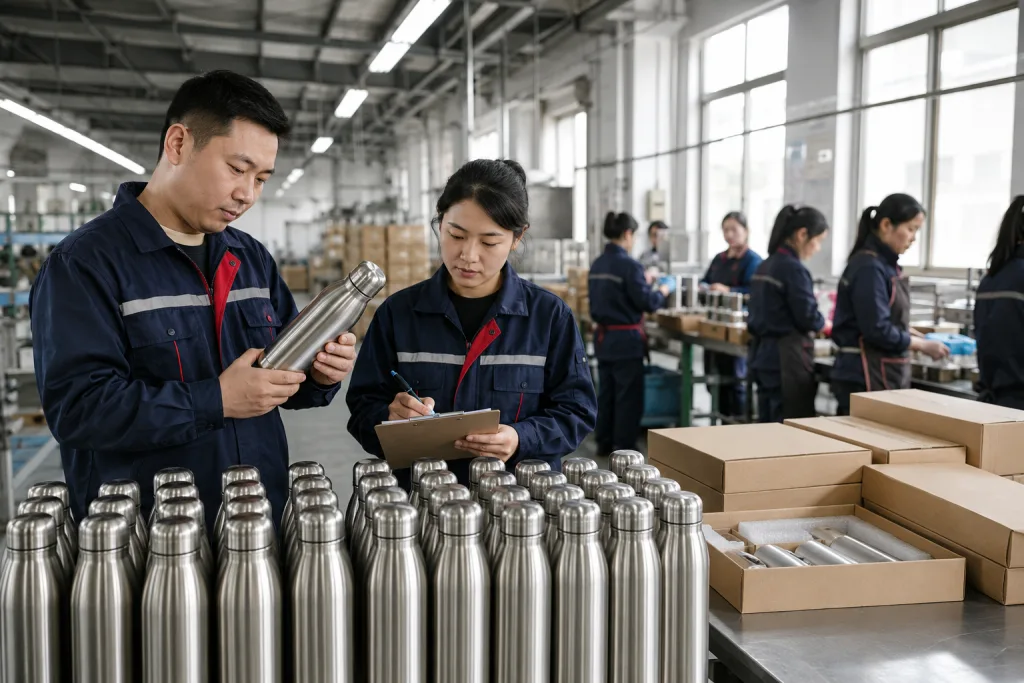
Samples are not souvenirs. They control the line. For a custom drinkware sample, we check three things: body size, decoration repeat, and closure action. Run calipers on height and diameter. A 1.5 mm drift at the mouth finish or lid thread is enough to make caps sit loose in bulk. On one 500 ml canteen job, QC pulled the sample and the bayonet cap clicked cleanly on the bench, then started binding after the first hot fill test. That told us the mold was off at the neck ring.
For repeat orders, ask for one pre-production sample and one golden sample. The golden sample sits on the inspector’s table; we ship against that. Use an agreed AQL, and for most promotional orders that means AQL 2.5 for major defects and 4.0 for minor defects. The math does not work any other way if the buyer wants the same print hit, the same lid color, and the same pack-out from first carton to last. We’ve seen buyers skip this and then chase shade drift on carton 87.
If a buyer signs off without measuring the sample, they are betting on complaints later. That is the wrong question to ask. A proper approval sheet should list dimensions, print position, carton style, and defect limits, then get signed before the line runs. One PO typo can waste a week; we once caught “250 ml” written where the project was 350 ml, and the buyer flagged it before the first 2,000 units shipped.
How to choose a factory partner
You do not need the biggest canteen maker. You need the one that fits your order pattern. If you buy one SKU in repeat runs, pick a canteen factory with steady line changeover and a QC routine the team can follow without guesswork. If you buy mixed promotional sets, pick a canteen vendor that can handle print, packaging, and kitting without turning every small change into a new job. Ask for monthly output in units. We had a buyer flag a 30,000-piece order because the plant said "200,000 a month" but the line we needed was already booked for 18 days. That is the wrong question to ask.
Ask for audit proof. BSCI or an equivalent social audit matters if your buyer requires it. Ask how incoming steel is checked, how vacuum leak testing is done, and what sample rate they run on finished goods. If a supplier cannot explain those checkpoints in plain terms, the math does not work. On one line, QC pulled the sample and found a 1.2 mm cap gap before packing; that saved a lot of noise later. For a canteen distributor or growler program, consistency beats novelty. Your client reorders the unit that lands the same way every time.
One practical test: send a revised artwork file after sample approval. A capable custom canteen supplier will confirm revision control, update the proof, and tell you exactly what changed. We once saw a PO typo swap "silver" for "sliver" on the file name, and the buyer caught it before the plates were made. We run into that kind of slip when the line is moving and the MOQ is tight, so ask how they track changes before you place the order. That is a normal export process in China, and in Zhejiang you see it every week because the line is busy and the deadlines are tight.
Send your spec, get a real quote
We price by millimeters, materials, and cartons, not vague descriptions. Send the target spec and we will quote from our Zhejiang factory line.
Frequently asked questions
What MOQ should I expect for promotional drinkware United Kingdom orders?
For standard promotional drinkware United Kingdom programs, a realistic MOQ is 1,000-3,000 units per SKU. Simple stainless bottles or canteens with one-color print often start at 1,000 pcs. If you want multiple print positions, special caps, or gift boxes, 3,000 pcs is more common. A custom growler with tooling changes may need 3,000-5,000 pcs. The real issue is not just MOQ, but whether the supplier can hold the same spec on repeat orders without redoing tooling or color matching.
How much does a custom canteen cost FOB China?
A basic custom canteen in stainless steel usually lands around USD 2.10-4.80 FOB China, depending on size, wall thickness, print method, and lid. A double-wall insulated version is more often USD 4.20-8.50 FOB. Laser engraving, gift packaging, or a specialty lid can add USD 0.15-0.80 per unit. If you need a canteen promotional item for distribution, ask the canteen factory to quote separately for product, decoration, and carton packing so you can see where the cost sits.
What documents do I need for the UK market?
At minimum, ask for a food-contact declaration, batch traceability, and material statements relevant to REACH. If you are selling through retail or ecommerce, confirm item labeling, carton markings, and origin marking before shipment leaves China. If your order is going to Amazon, you may also need FNSKU labels and carton content labels. For a canteen distributor, the important point is to lock paperwork before mass production, not after inspection, because missing documents can delay customs clearance and warehouse intake.
Should I choose silkscreen or laser engraving?
For short-life promotions, silkscreen is usually the lowest-cost option and works well for 1-2 spot colors. For repeat-use items, laser engraving is harder to damage and usually survives abrasion better. On a stainless customized drinkware line, silkscreen can cost about USD 0.12-0.35 per print area, while laser may carry a higher setup charge but lower failure risk over time. If the item is meant as a premium gift or long-term corporate piece, laser is normally the cleaner choice.
How do I avoid quality problems with canteen suppliers?
Treat the sample as a control document, not a display piece. Measure dimensions, check lid fit, and approve artwork positions in millimeters. Use a written defect standard, often AQL 2.5 for major defects and 4.0 for minor defects on promotional runs. Ask for leak testing, carton drop-test expectations, and the supplier’s monthly output if you plan repeat orders. A Zhejiang canteen supplier that handles exports well will give you these numbers without hand-waving. If they cannot, keep your order small until they prove control.