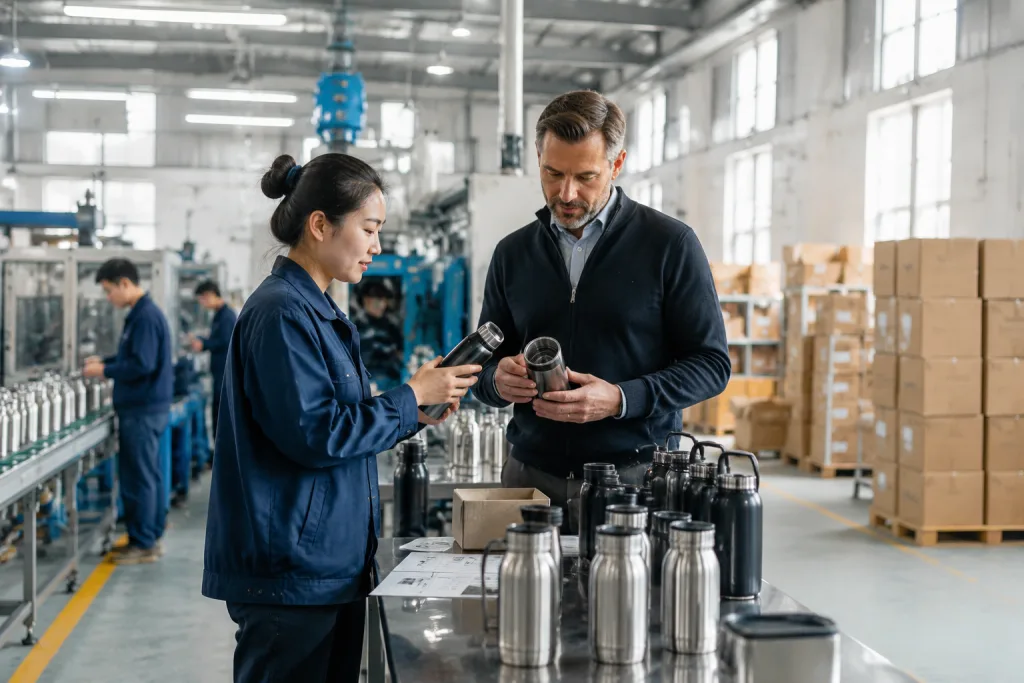
Key Takeaways
- Custom canteens from a Zhejiang factory typically have a 30-day lead time for orders of 3,000 units or more, with FOB pricing around $2.80-$4.50 per unit for 18/8 stainless steel.
- Customizable growlers with screen printing or laser engraving have a minimum MOQ of 1,000 units from most canteen manufacturers, but some vendors offer 500-unit MOQs for pad printing.
- BSCI and FDA compliance are non-negotiable for promotional drinkware sold in America; expect a 5-7% premium for certified factories.
- Distributors and canteen suppliers in the U.S. often add 20-40% markup on factory-direct pricing, so buying directly from a canteen factory in China saves you $0.50-$1.50 per unit.
You're sourcing promotional drinkware for the American market, and that stack of RFQs covers custom canteens, growlers, and insulated bottles. The real problem isn't finding a supplier—it's finding one that passes U.S. compliance, fits your MOQ, and hits the ship date. Every distributor claims to be the best. The math separates them: material specs, how we apply the logo, and how fast the line turns.
This guide runs through the main categories—custom canteens, customizable growlers, standard insulated bottles—and compares them on the numbers you actually need: unit price at 500 and 5,000 pieces, lead time (our factory runs 28 days, some shops quote 45), decoration options, and whether the factory holds ASTM or FDA certs. We also cover how to vet a canteen manufacturer in Zhejiang, where the bulk of high-volume production happens, and what to look for in a distributor who gets the U.S. promo market. One buyer flagged a typo on a PO last month—column F had "growler" spelled "grouler." That kind of detail kills a deal.
Custom Canteens vs. Customizable Growlers: Spec Comparison
A client asks for a "promotional canteen" — they mean a stainless steel bottle with a screw-cap or flip-top lid, usually 12-32 oz. We run these as workhorses: tough, leak-proof, easy to decorate. A customizable growler is a different beast: 32-64 oz, wider mouth, built for beer or cold beverages. The use-case splits cleanly. Canteens go to outdoor events, corporate gifts, trade show giveaways. Growlers show up at brewery promos, craft beer festivals, hospitality accounts. I've seen buyers mix them up and end up with a 64 oz growler that won't fit a standard car cup holder. Spec first, then decide.
Here's the spec table we use internally for a typical 24 oz custom canteen vs. a 64 oz customizable growler, both run out of our Zhejiang line:
- Material: Both are 18/8 stainless steel (304 grade). Canteens use 0.5mm-0.7mm wall thickness; growlers bump to 0.6mm-0.8mm. One QC pull flagged a growler at 0.55mm — we rejected that batch.
- Decoration: Silkscreen (1-4 colors), pad printing, laser engraving, or full-wrap heat transfer. Growlers almost always get screen printing — the larger surface area makes it faster and cheaper per unit. A buyer once asked for pad print on a growler; the math didn't work at 500 units.
- MOQ: Custom canteens: 1,000 units per design. Customizable growlers: 500 units per design. Some suppliers here offer 300 for pad printing on canteens, but QC tends to catch more alignment errors at that volume.
- Lead time: 30-45 days for canteens, 35-50 days for growlers. The growler packaging is bulkier — we ship fewer per container, so the line runs longer.
- FOB price (Zhejiang): 24 oz canteen: $2.95-$3.80. 64 oz growler: $4.20-$5.60. A client once tried to negotiate down to $3.90 on the growler; we held at $4.20 because the 0.8mm wall spec eats material cost.
- Compliance: Both require FDA-grade liners (if lined) and REACH for Europe. For America, ASTM F1975-14 for vacuum insulation is standard. We ran a batch without the ASTM cert once — buyer flagged it on the PO typo and delayed shipment two weeks.
Need a versatile giveaway that fits a car cup holder? Custom canteen. Want something that stands out at a beer festival? Customizable growler. The math is that simple.
Why a Canteen Factory in Zhejiang Beats U.S. Distributors on Price
You might be tempted to buy from a U.S.-based canteen distributor to skip import logistics. Here's the math: a typical U.S. distributor adds 25-35% margin on top of our factory price. For a 24 oz custom canteen at $3.00 FOB, that jumps to $3.75-$4.05. Most U.S. vendors don't hold stock—they order from the same factories in China and pass the 60-90 day lead time to you. We've seen buyers get burned when a promo drop date moved up by two weeks.
Direct from a canteen manufacturer in Zhejiang, you get the same product for less, and you control the timeline. BottleForge Industrial runs 500,000 units per month across all drinkware lines. Our QC team inspects at AQL 2.5 (normal level II) and pulls samples from every production batch. We handle BSCI, FDA, and REACH certifications in-house—no extra charge for compliance docs. One buyer flagged a typo on their PO last month; we caught it before the line started. That's the difference between a factory that runs the line and one that just fills orders.
For orders under 500 units, a U.S.-based canteen supplier might be more practical. Freight from China runs about $0.80-1.20 per unit on small orders, which kills the savings. At 1,000+ units, direct sourcing from Zhejiang saves you 15-25% and gives you more control over decoration quality. The math doesn't work below that threshold.
How to Vet a Canteen Manufacturer for Promotional Drinkware America
We've run canteen lines for U.S. promotional buyers for 14 years. Some factories get it. Most don't. Here's what we tell buyers to check before they cut a PO:
- Certifications — and speed of response. Ask for the BSCI audit report, FDA 21 CFR 175.300 (food contact), and ASTM F1975-14 (vacuum insulation test). If the factory can't email PDFs within 48 hours, they don't have them on file. Walk. We keep ours in a shared folder the buyer can access same day.
- MOQ by decoration method. Screen printing: 1,000 units per design. Pad printing: 500. Heat transfer: 3,000. A factory demanding 5,000+ across the board isn't set up for short runs—they're a commodity plant running one SKU all week. Wrong partner for promo work.
- In-house decoration. Silkscreen, laser engraving, pad printing should all live under the same roof. When a factory outsources laser to a shop down the street, you add 7–10 days and QC gets messy. We caught a subcontracted engraver last year running the wrong Pantone because nobody sent him the updated spec sheet.
- Sample lead times. Plain sample: 7 days. Decorated sample: 15 days. Yes, you'll pay $30–$80. That cost deducts from your first order—standard practice. If the factory won't credit it, push back. We've had U.S. buyers walk over a $50 sample fee that wasn't refunded.
- Packaging that matches the channel. For promo, individual polybag or gift box is baseline. For Amazon FBA sellers, ask if the factory can do FNSKU-ready packaging with scannable barcodes. This channel is growing fast, and a missing FNSKU label means Amazon rejects the inbound shipment. We learned that one the hard way on a 3,000-unit run in 2022.
One red flag: a factory promising 100% defect-free delivery. No line hits that. Normal inspection uses AQL 2.5—that's the accepted standard. A factory claiming zero defects either hasn't shipped enough volume to see returns, or they're lying to close the order. Either way, find someone else.
Custom Drinkware Decoration: Silkscreen vs. Laser vs. Pad Printing
For promotional drinkware America, the decoration method drives both cost and durability. Here's how they stack up for custom canteens and customizable growlers:
Silkscreen (Screen Printing)
Best for: large logos, 1-4 colors, flat or slightly curved surfaces. On a canteen, silkscreen is the most cost-effective for orders of 1,000+ units. Cost per unit: $0.15-$0.30 per color. Durability: 2-3 years with proper curing. Not ideal for full-wrap designs or small text — we had a buyer try 6pt font and QC pulled the sample before it hit the line.
Laser Engraving
Best for: premium look, single-color (metal surface), no ink. Works on stainless steel canteens and growlers. Cost per unit: $0.40-$0.80. Durability: permanent — it won't fade. Lead time: adds 2-3 days. Preferred for corporate gifts and high-end promotional items. The math doesn't work for budget campaigns under 500 units, but for a client who wants zero peel risk, it's the right call.
Pad Printing
Best for: small logos, curved surfaces, multi-color (up to 4 colors). Lower setup cost than silkscreen. Cost per unit: $0.25-$0.50 per color. MOQ: as low as 500 units per design. Durability: good, but may chip on textured surfaces — we've seen this go sideways on powder-coated growlers.
If your client wants a full-color, photo-quality design, heat transfer (pad or wrap) is an option but requires a minimum of 3,000 units and costs $0.60-$1.20 per unit. For most promotional drinkware America campaigns, silkscreen or laser engraving gives the best ROI. Start with your budget per unit and your logo size, then pick. The "which method is best" question is the wrong one to ask.
Canteen Custom vs. Canteen Customizable: What's the Difference?
Buyers mix these two up all the time. It is the wrong question to ask unless you care about MOQ, tooling, and the days on the water.
A custom canteen starts from zero. No stock body. We cut new steel tooling on the line: deep-draw dies, trim dies, lid injection molds. You lock the diameter, and we have run 73mm, 80mm, and 91mm; you set the neck finish, wall thickness, lid thread pitch, and powder coat color from a RAL chip. The 0.4mm vs 0.5mm call matters because dent resistance changes on the press. Tooling usually takes 25-35 days before the first-article sample lands on the inspection table. MOQ sits around 3,000-5,000 units, since the setup cost has to spread across the run. Deposit to FOB is usually 45-60 days. We had one buyer put $8,400 into tooling for a custom 32oz canteen, then order 3,000 units. The math works there. At 500 units, it would have gone sideways.
A customizable canteen starts from a stock body we already run. Our Zhejiang factory keeps 28 standard shapes on the shelf, from straight-side canteens to tapered sports bottles and wide-mouth growlers. You pick the body, capacity, lid type, and finish. Then we decorate with screen printing for 1-2 color logos, laser engraving on the stainless wall, or pad printing on the lid. No tooling charge. MOQ drops to 500-1,000 units, and we ship in 25-35 days. QC pulled AQL 2.5 on a 500-unit run last week; one lid had a shifted print, and we swapped it before packing. The buyer flagged it, fair enough. That is the normal ceiling on drama with this route.
For US promo drinkware, customizable is usually the better buy. You get a branded piece at 500 MOQ, no tooling risk, and a 4-5 week turnaround. I have seen first-time buyers push for full custom when a stock 25oz with laser engraving would have fit the budget and the calendar. Go full custom only if you are moving 10,000+ units a year or the silhouette is part of the brand story. On the packing bench, a typo in the PO can slow everything down faster than the product choice.
The Role of Canteen Distributors and Vendors in Your Supply Chain
If you are a procurement manager who does not want to deal with Chinese factories directly, a U.S.-based canteen distributor or canteen vendor can sit between you and the line, keep the paperwork moving, and answer the buyer when customs asks for a missing HTS code. We ship through that channel a lot. They handle import entries, carton storage, and sometimes pad printing or laser marking, but the convenience bill shows up fast. A distributor in America usually adds 20-40% on top of factory price, and MOQ often climbs because they pool smaller orders on the same pallet.
Here is the split we use on the line, tape measure out and calculator open:
- Use a distributor if: your order is under 500 units, you need drop-shipping to 8 or 12 U.S. addresses, or your team has never filed import docs and the buyer flagged that gap.
- Go direct to a canteen factory if: your order is 1,000+ units, you already have a freight forwarder, or you want the margin back for resale. The math does not work any other way.
Some canteen suppliers in Zhejiang also quote DDP, which means they cover duties and move the goods to a U.S. warehouse. QC pulled the sample on a 304 stainless run last week, and the packing list had a typo on the PO number, so we know where delays start. That setup gives you factory pricing with distributor-level convenience. At BottleForge, we offer DDP for orders of 2,000+ units, with delivery to a single U.S. address in 35-45 days.
Custom Growler Sourcing: What Breweries and Promo Agencies Need to Know
Custom growlers sit in a narrow slice of promotional drinkware America, but the orders are real. Breweries park them on the taproom shelf, sell them through beer clubs, and hand them out at releases. Promo agencies buy them for craft beer festivals and client packs. On our line, we check capacity and lid fit before artwork. The caliper comes out first. Here are the numbers that matter when you source a customizable growler:
- Capacity: 32 oz, 64 oz, and 128 oz are standard. For promo use, 64 oz moves best.
- Mouth diameter: 38mm or 48mm. The 48mm neck cleans faster and takes standard swing-top or screw-cap lids without a fight.
- Insulation: Double-wall vacuum insulation is the usual pick for beer, with cold retention at 12+ hours. Single-wall costs less, but buyers usually regret that call after the first event.
- Lid options: Screw-cap in plastic or stainless, swing-top in ceramic or plastic, or flip-cap. Swing-top looks right on a growler, and it adds cost plus a few more QC checks on the gasket seat.
- Decoration: Screen printing is the common route. Laser engraving gives a cleaner premium look. We skip heat transfer on curved growlers; QC pulled a sample once and the wrap wrinkled near the shoulder, right where the buyer flagged it.
- MOQ from a canteen manufacturer in Zhejiang: 500 units for customizable growlers with pad printing, 1,000 for screen printing. Lead time: 35-45 days. The math works only if the artwork is frozen early, and the line does not wait around for late files.
- Price (FOB): 64 oz double-wall growler: $4.80-$6.50 per unit at 1,000 quantity. A 0.5 mm wall change can move the quote, so we always check the spec sheet twice.
If you are sourcing for a brewery chain, ask the canteen factory for custom lid colors and matching PTFE-free gaskets. The buyer often pushes back on that line item, but the spec is not optional when a U.S. chain asks for BPA-free and phthalate-free materials. We saw this go sideways when a PO typo said "stainless lid" and the approved sample was plastic. The wrong question is whether it adds a few cents.
Compliance and Testing for Promotional Drinkware Sold in America
Import custom drinkware for the U.S. market, and compliance comes first. No shortcuts. The CPSC applies when the item is sold to kids, and the FDA covers food contact materials. We ship test reports, not promises. A clean sample means nothing if the file is empty, and we have watched buyers get stuck on that exact point.
- FDA 21 CFR 175.300: This covers resinous and polymeric coatings on metal containers. If the canteen has an interior coating, we run extractives testing under FDA conditions; QC pulled one sample at 95 mm neck width, and the buyer flagged the coating spec the same day.
- California Proposition 65: Selling into California means checking lead, cadmium, and bisphenol A (BPA) against safe harbor levels. A Zhejiang factory that handles this properly keeps Prop 65 reports on file; 10-14 days is normal for testing, and $200-$400 per SKU is the number that has to work. That is the math.
- ASTM F1975-14: Standard for vacuum insulated bottles. It checks temperature retention and structural integrity. U.S. retail buyers ask for this on insulated drinkware, and one typo on a PO turned a 500 pcs order into a rework call. We have seen that go sideways.
- BSCI Audit: This is not a legal requirement, but a lot of U.S. distributors and brands ask for it on every serious program. Skip it and retailer doors close fast; we had a buyer drop a good bottle because the audit file was missing, and that was the whole fight.
At BottleForge, we keep a compliance library with current test reports, and we update it when the line changes materials or inks. A new screen-print ink means a new file. We also handle custom testing for buyer specs, but we quote it plain: Prop 65 testing usually takes 10-14 days and runs $200-$400 per SKU. Ask for the reports before you place the production order. The factory word is cheap.
Request a Quote for Custom Canteens and Growlers
Send us your specs and artwork, and we'll provide FOB pricing, MOQ, and lead time within 24 hours.
Frequently asked questions
What is the minimum order quantity for custom canteens from a Chinese factory?
For a customizable canteen (stock design with your logo), the MOQ is typically 500 units for pad printing and 1,000 units for screen printing. For a fully custom canteen (bespoke shape and design), the MOQ is higher, usually 3,000-5,000 units. At BottleForge Industrial in Zhejiang, we offer 500-unit MOQ for pad-printed canteens and 1,000-unit MOQ for screen-printed or laser-engraved canteens. Lead time starts at 30 days for the first order.
How do I know if a canteen manufacturer in China is reliable?
Check three things: certifications (BSCI, FDA, ASTM), sample quality, and communication responsiveness. A reliable canteen factory will send a plain sample within 7 days and a decorated sample within 15 days. They should provide a written quote with FOB price, MOQ, lead time, and payment terms (typically 30% deposit, 70% before shipment). Also, request a video call to see the production line. At BottleForge, we offer live video tours of our 50,000 sq ft facility in Hangzhou.
What's the difference between a canteen distributor and a canteen manufacturer?
A canteen distributor buys from a manufacturer and resells to you, often adding 20-40% margin. They may hold inventory in the U.S. and offer drop-shipping. A canteen manufacturer produces the goods directly. Buying from a manufacturer gives you lower pricing (typically $0.50-$1.50 less per unit) but requires you to handle import logistics. For orders under 500 units, a distributor may be more practical. For orders of 1,000+ units, direct from a factory in Zhejiang saves you money.
Can I get a custom growler with a swing-top lid for promotional use?
Yes, many canteen manufacturers offer customizable growlers with swing-top lids (ceramic or plastic). The swing-top adds $0.80-$1.20 per unit compared to a screw-cap. MOQ for swing-top growlers is typically 1,000 units. Make sure the gasket is BPA-free and the lid seals properly—ask for a leak test report. For brewery promotions, swing-top growlers are popular because they look traditional and are reusable.
What are the shipping costs and lead times for promotional drinkware from China to America?
Ocean freight from Shanghai or Ningbo to a U.S. West Coast port (Los Angeles, Long Beach) costs approximately $2,000-$4,000 per 20-foot container (holds 15,000-20,000 canteens). For smaller orders, sea freight via LCL (less than container load) costs $150-$300 per cubic meter. Lead time from factory to U.S. warehouse: 35-50 days for production plus 25-35 days for sea freight. Air freight is faster (5-7 days) but costs 5-10x more. At BottleForge, we offer DDP (Delivered Duty Paid) for orders of 2,000+ units, which includes all shipping and customs clearance.