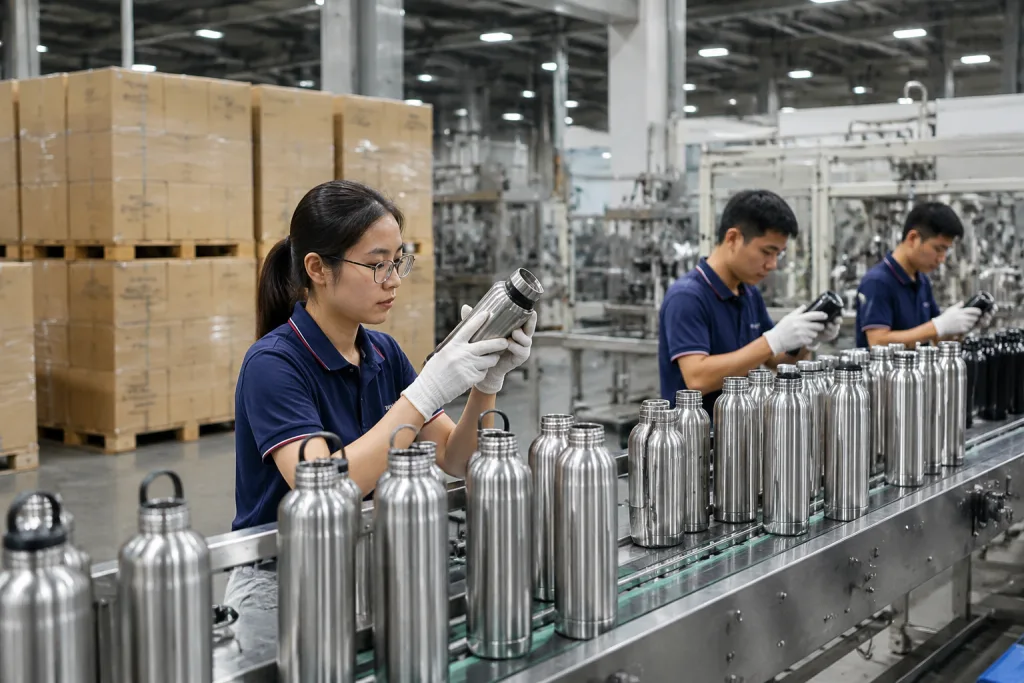
Key Takeaways
- MOQ for custom canteens starts at 500 units; best per-unit price at 5,000+ units drops to $2.80–$3.50 FOB.
- Laser engraving adds $0.30–$0.60 per unit and adds 3–5 days to lead time; silkscreen adds $0.20–$0.40 but requires 7–10 days.
- Factory lead time from order to FOB Shanghai: 25–35 days for stock canteen bodies, 40–55 days for fully custom molds.
- BSCI, REACH, and ASTM F2671 compliance are standard from reputable Zhejiang canteen manufacturers; budget $200–$500 for third-party testing per SKU.
You need 5,000 promotional drink bottles for a Q4 trade show in Chicago, and your boss wants them under $4.50 each with your logo laser-etched. Fine. On our line, that is a 1.8 mm wall stainless job, and the quote moves fast once you add carton drops, engraving setup, and inland trucking. We ship too many orders where the first PO says one carton mark and the buyer later asks why the artwork landed on the wrong SKU. Most US decorators came back at 8 to 10 weeks and $6+ per unit for a stainless steel canteen. The math does not work. You start looking at direct sourcing from a Chinese canteen factory, then the buyer flags hidden costs, a 90-day slip, or a typo that turns one carton mark into the wrong part number.
This guide shows what you will actually pay for a promotional drink bottle USA order by MOQ tier, decoration method, and material, plus the lead times we run from Zhejiang. QC pulled the sample twice before we shipped the first 300 pcs, because one buyer pushed for a 24 oz bottle at a 20 oz price. That is the wrong question to ask. No fluff. Just the numbers you need to place the order without getting burned.
Why Custom Canteen Pricing Varies by MOQ Tier
For a promotional drink bottle USA order, MOQ moves the unit price faster than anything else on the sheet. We run three tiers at our Zhejiang plant: 500 units, 1,000 units, and 3,000 units. QC pulled a 16 oz canteen sample last week, and the buyer flagged the same issue we see every month: small lots get hit hard on setup and labor.
- Tier 1: 500–1,000 units. Expect $4.50–$5.80 per unit FOB for an 18/8 stainless steel canteen with single-color silkscreen. If the job needs a new mold, add $800–$1,500. At this volume, the press line starts and stops too often. The math does not work for the buyer.
- Tier 2: 1,000–3,000 units. Price drops to $3.80–$4.40 FOB. We usually drop decorating setup fees if the art file stays on standard Pantone colors. A buyer once sent a PO with the cap color listed as "sliver" instead of silver; that typo cost us a full day because we had to confirm the spec before we cut film.
- Tier 3: 3,000–10,000 units. $2.80–$3.50 FOB. At this volume, we can dedicate one production line and cut per-unit labor by 15–20%. The shoulder weld jig stays set, the welders stop changing over, and the line moves cleaner from shift to shift.
These figures assume a standard 12 oz or 16 oz canteen with a loop cap. Add $0.15–$0.30 per unit for a carabiner or stainless steel growler-style cap. If you want a custom growler shape, such as a flask profile, mold costs jump to $2,000–$4,000, but at 5,000 units the FOB can still land near $3.20. A contour gauge on the tooling bench shows the difference fast.
The wrong question is asking for 200 units. Most canteen vendors will decline, or quote $7+ per unit because the setup gets spread over too few pieces. Push the order into Tier 2 or Tier 3 and the numbers start to make sense. We’ve seen this go sideways when a buyer tries to save inventory and ends up paying more for the sample run than for the first carton.
The True Lead Time: From PO to Your US Warehouse
A Zhejiang canteen plant ships a stock body in 25-35 days after order confirmation. That is the real clock. We run the line on a 120,000-unit/month schedule for standard 16 oz canteens, so a 3,000-unit order usually takes 5-7 days of machine time, not a vague “soon.” QC checks the neck opening at 28 mm before release, and if the PO says 28.5 mm, the buyer flagged problem starts right there.
- Days 1-5: Artwork approval and deposit, usually 30%. If the buyer flags a unique logo position on a customizable canteen, we add 3 days for proof sign-off. A PO typo on the print size can send us back for another round, and that burns calendar days fast.
- Days 6-20: Canteen body production: stamping, welding, polishing. QC pulled the sample at 1.2 mm wall thickness on one batch and caught a dent near the seam; that batch went back to the line. This is where the schedule lives or dies. No drama.
- Days 21-28: Decoration, either silkscreen or laser engraving. Laser adds 3-5 days. Silkscreen adds 7-10 days because the screen has to dry and cure before we can pack cleanly. The screen room runs hot, and the ink rack does not move fast.
- Days 29-35: Quality inspection to AQL 2.5, packing, and loading. If you ask for SGS or Bureau Veritas, add 3 days. The math does not work any other way, and we've seen buyers miss that on the first quote.
Sea freight from Shanghai to Los Angeles takes 18-22 days. Air freight is 5-7 days, and it adds $1.50-$2.00 per unit. Total door-to-door time lands at 45-60 days by sea, 35-40 days by air. We ship both. The carrier booking is the bottleneck more often than the bottle, especially when the carton count hits 320 and the forwarder wants one more day for space confirmation.
If you are a canteen distributor buying for a Q4 event, place the PO by mid-July. We have seen this go sideways every year when buyers wait until September, then ask for October delivery after the factory rush starts and lead times stretch past 50 days. This is the wrong question to ask in August; by then the line is already booked, and the carton labels are usually in the print room.
Decoration Costs: Silkscreen vs. Laser vs. Embossing
Your promotional drink bottle USA order needs branding. We price decoration by method, and the spread matters on a custom canteen. QC pulled a sample last week and caught a 1.5 mm logo shift; the buyer flagged it, and the whole carton got held.
- Silkscreen (1–2 colors): $0.20–$0.40 per unit, plus a $50–$100 setup fee per color. It runs best on flat or slightly curved canteen bodies. We usually see 2–3 years of wear with proper curing. Textured finishes fight the ink, and the line shows it fast.
- Laser engraving: $0.30–$0.60 per unit, no setup fee. Permanent. No peeling. It works on stainless steel canteens and growlers. Our line runs a 20W fiber laser for fine detail, and it adds 3–5 days to lead time.
- Embossing (raised logo): You need a custom mold, usually $800–$1,200. Per-unit cost rises by $0.10–$20. It fits high-end customized growlers or premium canteens. MOQ is usually 2,000 units, and the mold has to match the neck wall thickness within 0.3 mm.
If you are buying canteens for a university or corporate client, laser engraving is the safer pick. No color-match fight. No peeling after dishwasher cycles. We had a buyer push back on Pantone before; that is the wrong question to ask if the logo has to survive 200 wash cycles.
One hidden cost is artwork. If the design has gradients or halftones, silkscreen will not take it. Then we ship pad printing or digital UV printing at $0.50–$0.80 per unit. A PO typo like “4C” instead of “1C” can waste a day on the line, and we have seen that go sideways more than once.
Material and Compliance Costs You Can’t Skip
Every promotional drink bottle USA order still has to clear US consumer safety rules. We run ASTM F2671 checks for stainless steel bottles and keep FDA 21 CFR paperwork at the line, but unit price is only step one. A sample once came back with a 3 mm lid gap on QC calipers. The buyer cut the order back fast.
- Third-party testing: $200–$500 per SKU for lead, BPA, and phthalate tests. At 5,000 units and up, some canteen vendors roll that into the quote; others leave it on your tab. QC pulled the sample, and one PO typo turned one SKU into two lab reports.
- BSCI audit: If your brand asks for social compliance, a factory with BSCI certification costs nothing extra on our side, but an unscheduled audit from your client can still land at $800–$1,200. This is the wrong question to ask if you only look at bottle price. The audit team still wants payroll sheets and shift records.
- REACH and CA Prop 65: For European or California shipment, your canteen supplier should hand over REACH documents without drama. Budget another $150–$300 for a material declaration letter. We had a buyer flag a missing ink code on a carton mark, and the paperwork held the shipment for 4 days.
Material choice moves the cost too. 18/8 stainless steel (304) is the usual spec for custom canteens, with raw material around $2.50–$3.00 per unit. 201 stainless steel runs cheaper at $1.80–$2.20, but it rusts faster and we do not ship it for acidic drinks. For a customizable growler, 304 is the only sane pick for carbonated beverages; a 1.5 bar gauge is where the shortcut falls apart.
If you’re sourcing a canteen customizable with a Tritan or polypropylene liner, expect about $0.50–$0.80 less per unit. The tradeoff is clear. Those liners take UV and heat badly, and we’ve seen a hot-fill test at 85°C turn cloudy after 12 cycles on the rack.
How to Evaluate a Canteen Factory Without Flying to China
You will not fly to every canteen factory in Zhejiang. Fine. We run the check the same way: ask for a live video walk-through, the sample report, and the last three shipment dates, then line them up against the PO and packing list. One typo on a PO can burn a week, and we have seen that happen on a 40,000-piece run.
- Request a video walkthrough: A real canteen supplier will put the stamping line, welding station, and QC lab on camera without stalling. Ask to see the salt spray tester, the pressure gauge, and the packing room in one clip. If the floor is clean at 3 p.m. and the tape sealer is moving, you are looking at a live plant. If they keep cutting away, we have seen that story go sideways.
- Ask for a sample pack: Good canteen vendors send 3 to 5 samples in different sizes and finishes. Check wall thickness with a caliper; 0.4–0.6 mm is standard, while 0.7 mm is the premium spec for growlers. We had one buyer say the hand feel did not matter. That was the wrong question. The math did not work once the 0.4 mm sample showed up and felt flimsy.
- Check lead time consistency: Ask for the last three shipment dates, not the promised date. If a factory quotes 25 days and ships in 40, that misses a promo drop by a mile. One buyer flagged a PO line that read `ship by 08/06`; the sales team read it as June 8, the buyer read it as August 6. That crossed wires fast, and the carton labels were already printed.
- Verify AQL standards: Most canteen distributors accept AQL 2.5 for visual defects. For a premium customized drinkware run, ask for AQL 1.0; it adds $0.05–$0.10 per unit and cuts the ugly surprise rate. QC pulled the sample on our line last week and caught a logo shift of 1.2 mm before packing. That is the level you want. A 2.5 mm offset will get flagged in retail.
At BottleForge Industrial, we keep a 98.5% on-time delivery rate across the last 12 months for custom canteen orders. Our QC team checks 100% of units for leak testing and logo alignment before packing, using a leak tester and a simple alignment jig. You can request a live video inspection during packing at no charge. We ship the footage the same day, and the buyer gets a clean record before the freight leaves.
Packing and Logistics: What Adds Cost at the Last Mile
Your promotional drink bottle USA order is not done at the factory gate. Packing and logistics can add 8% to 15% to landed cost, and we see margin leak fast when a buyer skips carton specs or asks for retail packs on a 500 MOQ. The line feels it first. One typo on the packing list can turn into a chargeback.
- Retail-ready packaging: A plain polybag adds $0.02 per unit. A custom-printed gift box for a custom growler adds $0.60-$1.20 per unit, and the box line usually wants 1,000 units MOQ. QC pulled one sample last month, and the tape split on a 6 kg drop test. That miss comes back as a chargeback.
- Master carton specs: Standard corrugated cartons at 200 lb test hold 24-36 canteens. If you need double-wall or waterproof cartons for sea freight, add $0.08-$0.15 per unit. We run carton compression checks before packing, and the buyer flagged a 2 mm flap gap that looked minor until pallet stacking started. Bad call to ignore it.
- FOB vs. CIF: FOB Shanghai saves you $0.10-$0.20 per unit versus CIF Los Angeles, but you handle customs clearance and inland freight. For a first-time canteen distributor, CIF is the simpler move. The math does not work any other way if your team has no U.S. broker lined up. We ship this split all the time.
- Duty and tariffs: Stainless steel drinkware from China currently carries a 7.5% tariff under HTS 7323.93. A $3.00 FOB unit becomes $3.23 after duty. We have seen a PO typo turn 3,000 cartons into 300 cartons on the booking sheet, and that mistake cost more than the tariff math on one small order. One missing zero does it.
If you are buying for a promotional campaign, ask the factory to pre-ship 25-50 units by air and check the packing before the ocean booking. That air test usually costs $200-$400. It sounds annoying until a full container lands with dented corners and wet outer cartons. We have seen that go sideways fast.
When a Custom Growler Makes Sense Over a Standard Canteen
A promotional drink bottle USA order does not always need a canteen shape. For craft beer brands, outdoor gear labels, or corporate gifts aimed at beer fans, a custom growler in 64 oz or 128 oz usually fits the brief better. Last month a buyer flagged the 128 oz size, so we checked carton load on the packing table and the cap cost held up. 18 kg cartons told the story.
- Standard 16 oz canteen: $2.80–$3.50 FOB at 3,000 units. Lead time 25–35 days.
- Custom 64 oz growler: $4.20–$5.00 FOB at 1,000 units. Lead time 35–45 days because the mold is larger and the wall stays at 0.8 mm.
- Customizable growler with swing-top cap: $5.50–$6.50 FOB at 500 units. The swing top adds $0.80–$1.20 per unit and needs manual assembly at the line.
We also run a hybrid option: a 32 oz flask-style growler with a carabiner, priced at $3.80–$4.40 FOB. QC pulled the sample on this one for a 2 mm cap gap, then we reworked it for a hiking promo run and shipped clean. This is the better pick for promotional drink bottle USA campaigns aimed at hikers or festival buyers.
If you are a canteen supplier trying to stand out, put both options in front of the client with the same logo and the same print area. The margin on growlers is usually 10%–15% higher, and fewer vendors stock them in this market. We have seen this go sideways when someone chases the cheaper canteen just to hit a quote. One PO typo on the carton count can wipe out the gain fast.
How to Lock in Pricing and Lead Time for Your Next Order
Once you pick a canteen factory, lock the terms on the PO. We check the same points on every order:
- Price validity: Ask for a 30-day quote lock. 304 stainless moved fast in 2023, and we saw 8% swings in one quarter. Put the expiry date on the quote, or the buyer pays the next jump.
- Lead time guarantee: Put the late-delivery clause in writing, say 0.5% of order value per day late. On orders above $20,000, most Zhejiang vendors will sign once the line is booked. This is not optional.
- Sample approval: Require a pre-production sample before mass production. QC pulled a sample with the logo 3 mm too low on one run, and that saved a reprint. Shipping the PPS usually costs $50-$100.
- Payment terms: Standard is 30% deposit and 70% before shipment. If you buy from us every season, push for 30/70 with 15 days credit after shipment. We have seen POs typed as “drinking bottle” instead of “drink bottle,” and the bank caught it.
For your next promotional drink bottle USA order, start 90 days before the event. That gives you 30 days for quoting and sample sign-off, 40 days for production, and 20 days for sea freight. Need a rush? Air freight can cut the total to 50 days, but the math does not work unless you can absorb another $1.50-$2.00 per unit.
We ship more than 120,000 custom drinkware units a month from our Zhejiang plant. One project manager stays on the job, and we send weekly production photos straight from the line. No guessing. A buyer flagged a cap torque issue at 12 days into production last month, and we fixed it before packing.
Get a Firm Quote for Your Promotional Drink Bottle Order
Send us your target volume, decoration method, and deadline. We’ll reply within 24 hours with a price and lead time you can lock in.
Frequently asked questions
What is the minimum order quantity for a custom canteen from a Chinese factory?
Most canteen manufacturers in Zhejiang set an MOQ of 500 units for stock canteen bodies with silkscreen or laser engraving. For a fully custom canteen with a unique shape or embossed logo, the MOQ jumps to 2,000 units. If you need a custom growler, expect an MOQ of 1,000 units. At BottleForge, we accept MOQs as low as 300 units for standard 12 oz canteens, but the per-unit price is $5.50 FOB instead of $3.20 at 3,000 units.
How long does it take to get a promotional drink bottle from China to the USA?
Total door-to-door time is 45–60 days for sea freight and 35–40 days for air freight. Production alone takes 25–35 days for a stock canteen, including decoration. Sea freight from Shanghai to Los Angeles adds 18–22 days, plus 3–5 days for customs clearance. If you’re a canteen distributor ordering for a specific event, place your PO 90 days in advance to avoid rush charges.
What certifications do I need for a custom canteen sold in the USA?
For a promotional drink bottle USA order, you need ASTM F2671 (stainless steel bottle safety), FDA 21 CFR (food contact), and CA Prop 65 compliance if selling in California. Most canteen suppliers in Zhejiang provide these documents for free with orders above 1,000 units. Third-party testing by an accredited lab costs $200–$500 per SKU. BSCI social compliance is also common for retail buyers.
Can I get a custom growler with a swing-top cap for a promotional campaign?
Yes, but expect higher costs and longer lead times. A customizable growler with a swing-top cap runs $5.50–$6.50 FOB at 500 units MOQ, with a lead time of 40–50 days. The swing-top mechanism adds $0.80–$1.20 per unit and requires manual assembly. For a standard 64 oz growler without the swing top, the price drops to $4.20–$5.00 FOB at 1,000 units.
How do I reduce per-unit cost on a custom canteen order?
Increase your MOQ to at least 3,000 units to hit the Tier 3 pricing of $2.80–$3.50 FOB. Choose a standard canteen shape (no custom mold) and use single-color laser engraving instead of full-color silkscreen. Consolidate your order into one SKU—multiple SKUs increase setup fees. Also, opt for FOB Shanghai and handle your own freight to save $0.10–$0.20 per unit.