Key Takeaways
- A promotional double wall bottle quote should list capacity, steel grade, print method, and MOQ; without those 4 items, you are not comparing apples to apples.
- Typical factory MOQ for custom drinkware starts at 1,000 to 3,000 pcs per design, with 25 to 35 days for sample approval and 30 to 45 days for bulk production.
- For Europe and North America, ask for REACH, food-contact compliance, and drop-test or thermal-performance data before you approve the PO.
- A bulk PO should name carton quantity, unit weight, FNSKU or barcode needs, and decoration tolerance so customs and warehouse receiving do not slow you down.
We have watched this exact failure pattern for 12 years on the factory floor in Hangzhou. A buyer in Hamburg or Toronto asks for "a nice insulated bottle." Three factories quote. One uses 201 stainless with a 0.4 mm inner wall. Another says "304" but omits the wall thickness entirely. The third lists a capacity of 500 ml — actual tolerance is ±12 ml, nobody mentioned it. Decoration method? "Logo printing." Silk screen? Pad print? UV? No one asked. The sample arrives, looks fine, the buyer approves. Then the 40-foot container lands and QC pulls an AQL 2.5 inspection: 47 units out of 200 have a crooked print and the vacuum seal is shot on 12. That is not a supplier problem. That is a spec sheet that never existed.
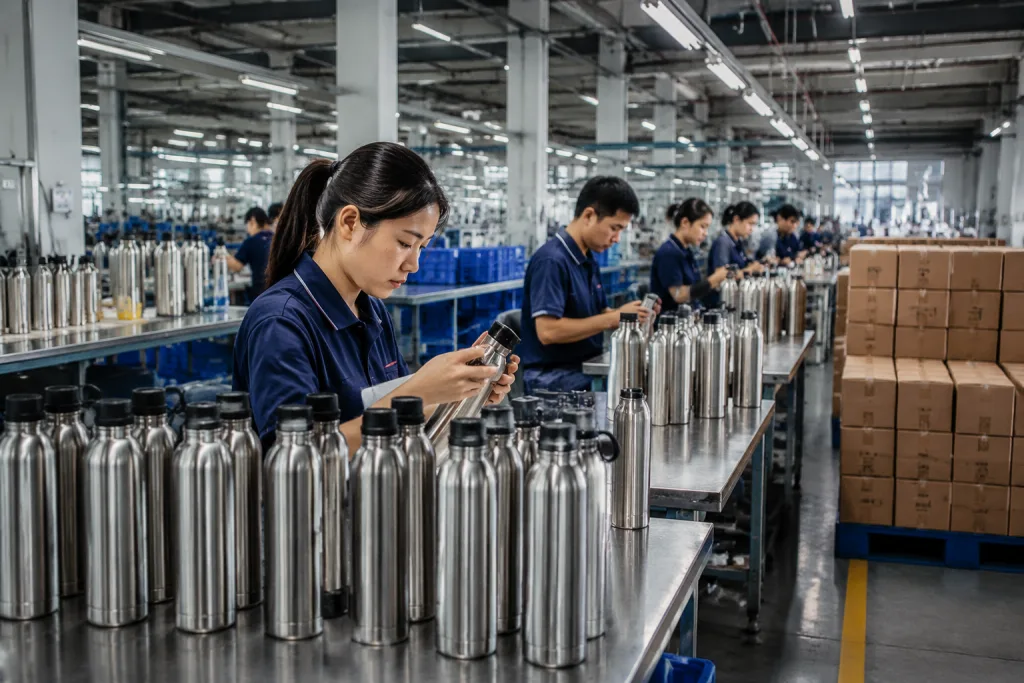
When you work with a canteen manufacturer in China — specifically a canteen factory in Zhejiang that runs its own stainless steel line — the RFQ process should be boringly precise. A real B2B quote breaks out MOQ, FOB Ningbo or Shanghai, print method, ink type (Pantone or RAL), number of decoration positions, lead time in calendar days, and carton dimensions down to the mm. At BottleForge Industrial, we run 180,000 units a month. We see RFQs every week. The bad ones ask for "best price" and attach a JPG of a logo. The good ones specify bottle height to 0.5 mm, wall thickness to 0.1 mm, and request a print color swatch on actual steel before the PO is cut. That last point matters — we have had buyers sign off on a paper proof, then reject the bulk because the ink shifts on the brushed metal substrate. Scope the order before ink hits steel. The math is cheaper up front.
Start With the Real Use Case
Start with the real use case, not the price list. A double wall bottle for a trade show giveaway is different from one headed to Amazon FBA, and it's definitely not the same as a custom growler for brewery resale. The use case decides wall thickness, lid style, finish, and how much decoration area you actually get to work with.
For a promotional run, buyers usually want a 500 ml or 750 ml bottle with vacuum insulation, powder-coated body, and a single-color logo. If you're building custom drinkware for a brand launch, you might need two print positions, matte or gloss powder coat, and a gift box. If you're buying for a distributor program, packaging and carton efficiency matter more than premium presentation. That's where many vendors make the first mistake: they quote a bottle, not a program. We've seen this go sideways when the buyer didn't mention the carton had to fit a standard shelf—QC flagged it after the first 500 units were packed.
Write the use case into the RFQ. Say whether it's for giveaways, employee kits, Amazon FBA, retail distribution, or corporate gifting. Then define the lifecycle: one-time promo, 6-month campaign, or ongoing replenishment. A Zhejiang factory can tune the spec around that—wall thickness, insulation type, even the thread pitch on the lid. The more specific you are here, the fewer surprises at the inspection table.
Build the RFQ Around Five Numbers
Your RFQ needs to be short. It cannot be vague. For a promotional double wall bottle, five numbers do most of the work: capacity, target price, MOQ, sample quantity, and bulk lead time. Everything else hangs off those. Leave them out, and canteen manufacturers will fill the gaps with their own assumptions — and those assumptions rarely match your budget or market reality. We've seen a buyer lose six weeks because they omitted the target price and the factory quoted a ceramic-coated lid they didn't need.
Use a line-item format. A proper RFQ for custom drinkware should include:
- Capacity: 350 ml, 500 ml, 750 ml, or 1,000 ml
- Material: 304 stainless steel, with 201 only if your market allows it
- Wall structure: double wall vacuum insulated, target wall thickness 0.4 to 0.5 mm
- Decoration: silk screen, laser engraving, or 360-degree wrap print
- Packing: bulk pack, color box, or mailer carton
For most canteen custom projects, MOQ sits at 1,000 to 3,000 pcs per color or SKU. Sample cost runs USD 35 to USD 120, depending on whether the mold already has a liner or we have to cut a new one. FOB China pricing for a standard 500 ml promotional double wall bottle starts around USD 3.20 to USD 6.80 at 1,000 pcs. The spread comes down to lid complexity and finish — a push-pull cap is cheaper than a flip-lid with a silicone seal. That is the range you should expect from a serious canteen supplier in China, not a number pulled from a catalog. QC pulled a sample last month that came in at USD 2.90 and the wall thickness measured 0.35 mm — too thin to hold vacuum reliably.
Check the Bottle, Not the Render
Catalog photos hide a lot. We see it every week. Before you sign off on a canteen customizable sample, ask for the build sheet: inner and outer steel gauge, seam finish, vacuum test method, lid gasket material, and coating thickness. On one job, QC pulled the sample apart with a seam gauge and found a weak vacuum draw; the render looked clean, but the cap started weeping after 30 open-close cycles.
For stainless vacuum bottles, the usual build is 304 inside and outside, with powder coating at 60 to 80 microns and a food-grade silicone gasket. If a supplier says “double wall” and cannot give you the gauge or the vacuum hold test, the quote is not ready. That is the wrong question to skip. We check the rim, base weld, and lid thread alignment under a caliper, because cheap work shows up there first, usually at 0.3 mm before anyone spots it by eye.
Ask for a cut sample or sectioned sample if the project is over 5,000 pcs. A wall section tells you more than a marketing sheet ever will.
For a customizable canteen or customized drinkware order, ask for compliance papers as well: REACH for Europe, food-contact declarations, and FDA-related material statements if the buyer needs North America coverage. A canteen vendor that ships to EU and US accounts should have those in the file cabinet, not on a promise. On one PO, the buyer flagged a typo on the destination code, and the paperwork delay cost 12 days versus 3 days for sample approval. In Zhejiang, plenty of factories have the docs, but the folder is often a mess. Audit that part hard.
Choose Decoration for the Market
Decoration is not just branding. It shifts cost, yield, and how the bottle reads on shelf. For a promotional double wall bottle, we usually steer buyers to one-color silk screen or laser engraving. Clean. Simple. It ships. On the line, a 1-color screen at 120 mesh gives a tight print, while full-wrap art on a curved steel body looks busy and lands uneven. For a more premium canteen customized look, powder coat with a laser mark or a single spot color print gives a sharper finish.
Pick the method based on how the customer handles the bottle. A laser-marked custom growler works for breweries and outdoor channels because the mark does not chip, and we have seen pad print fail after 30 wash cycles in our wash test rack. A silk-screened canteen promotional item is fine for short-cycle giveaways where the bottle gets handed out at events. For custom drinkware sold on Amazon or through retail, the buyer flagged label durability and carton crush strength first. Fair point, but that is the wrong question to ask if the decoration falls off in week two.
Setup cost for print plates or laser programming is modest, but it still belongs in the quote. We usually see USD 25 to USD 80 for basic decoration setup, more for multi-color artwork, and MOQ moves the price fast. Ask your canteen supplier to confirm decoration tolerance, usually 1 to 2 mm for print placement. If they cannot state that number, QC pulled the sample and the math does not work for a distributor program. Reorders are where this goes sideways. Three months later, the same SKU has to match color and placement, and a 2 mm drift is enough to trigger a complaint.
Sample Like a Buyer, Not a Tourist
The sample is where you prove the concept. Don’t just tear open the carton and admire the paint. Put calipers on it. Fill it to the neck, weigh it, shake it, and leave it in a cold room overnight. QC pulled a sample last week that looked clean but leaked at the lid after 3 minutes in a backpack. Scrap it.
When you receive a custom canteen sample, check capacity against the claimed volume within a reasonable tolerance, usually +/- 5%. Check lid torque, leak resistance, and insulation performance with a thermometer probe on the line. For a standard vacuum bottle, ask for hot and cold hold results over 6 to 12 hours, depending on the design. If the supplier sends a temperature curve, good. If you only ask for photos, that is the wrong question to ask.
Sample approval should also cover the commercial details buyers miss: carton dimensions, unit weight, barcode location, and whether the bottle fits your retail shelf or mailer system. For distributor canteen programs, I would not release bulk until the final sample matches the exact box structure and inner protection. We once saw a PO typo shift the carton size by 10 mm, and the buyer flagged it before shipment. In Zhejiang, the better factories treat packaging like part of the spec, not an afterthought.
Write the PO Line by Line
Your bulk PO should be boring. That is a good sign. Boring means everything important is written down. For a promotional double wall bottle, don't stop at item name, quantity, and price. Put the exact SKU, artwork file name, lid color, coating code, carton spec, and delivery term on the PO. A canteen distributor that buys the same model six times a year will save money here because reorders run from the same spec, not from memory.
A usable PO line for custom drinkware should include:
- Product name and internal SKU
- Capacity and dimensions
- Material and finish
- Decoration method and artwork reference
- MOQ, unit price, and total quantity
- Packing spec, including carton pcs and master carton mark
- Incoterm, usually FOB Ningbo or FOB Shanghai for Zhejiang shipments
- Inspection standard, such as AQL 2.5 major / 4.0 minor
If you need FBA, add FNSKU labeling and carton barcodes at PO stage — not after the line is running. If you are buying a custom canteen, custom growler, or customizable growler for retail, add drop-test and leak-test requirements. We had a buyer skip the leak-test line once. QC pulled the sample and found a 0.3 mm gap in the lid gasket. The whole order sat in the warehouse for two weeks while we fixed it. A clean PO also helps your canteen supplier and your freight forwarder work from the same facts, which saves you days when the schedule is tight.
Inspect at the Factory, Not the Port
Production starts. You need eyes on the line before cartons are sealed. Port inspection catches problems after the truck leaves the factory — at that point rework costs you freight and time. At the factory you walk the line, pull samples, and stop bad runs before they hit the packing table. For a canteen factory in Hangzhou we check print position with a 0.5 mm tolerance, cap color against the PMS chip on the PO, vacuum retention on a test rig, and carton count by pallet layer.
Use AQL sampling, not a walkthrough and a thumbs up. For promotional double wall bottles we run AQL 2.5 on major defects — seam gaps over 0.3 mm, off-color prints, weak vacuum. Minor defects get AQL 4.0. Zero tolerance for leakage, wrong artwork, or mixed SKUs. One buyer flagged a "30 oz" engraving that read "03 oz" on the pre-pro sample — the laser file had a typo. That was caught in-process. A canteen vendor in Zhejiang that hesitates on in-process photos at coating, printing, and final packing is a vendor you skip. Plain as that.
For distributor orders over 5,000 units we recommend pre-shipment inspection on 100% outer cartons and sampled inner units. Retail and e-commerce buyers should verify master carton labels, shipping marks, and barcodes match the booking. Sounds basic. A missing carton mark held a 20-foot container at Long Beach for two hours of re-scanning. Good canteen suppliers already pack to export specs. The better ones check the label tape before the line even starts.
Plan Reorders Around Capacity
Good buyers don't treat the first order as a one-off. They set the project up so reorders are fast. If your promotional double wall bottle sells, you want the second PO to move in days, not weeks. That means the factory keeps your artwork, coating code, and carton layout on file — and your team keeps the PO structure stable. We had a buyer last year change the box size by 3 mm between runs. QC pulled the sample and flagged it. The line stopped for two days.
Ask your canteen manufacturer for monthly output, reorder lead time, and whether they reserve raw material for repeat orders. A factory in Zhejiang with 180,000 units per month can usually handle a repeat custom drinkware program faster than a small trading setup — but only if your spec does not change every round. If you are buying as a canteen distributor or distributor growler channel, standardize the SKU across markets where possible. One lid. One box. One artwork system. Three near-identical versions triples the chance of a typo on the PO. We've seen it happen.
The practical goal is simple: lower error rate, predictable margin, and less back-and-forth. A canteen promotional bottle that is easy to reorder is worth more than a prettier sample nobody can reproduce at scale. That is the part buyers learn after the first import cycle — usually when their second shipment arrives with the wrong logo.
Send your RFQ and we’ll quote it cleanly
Share your capacity, artwork, and target quantity. We’ll return a line-item FOB quote, sample lead time, and packing spec from Hangzhou, Zhejiang.
Frequently asked questions
What is a normal MOQ for a promotional double wall bottle?
For a standard promotional double wall bottle, MOQ is usually 1,000 to 3,000 pcs per design or color. If you need multiple colors, each color may carry its own MOQ. For laser engraving, some canteen manufacturers in Zhejiang can handle smaller runs, but pricing is higher, often by 10% to 25%. If you want custom packaging, add another 500 to 1,000 pcs equivalent in planning because carton and insert changes affect setup time. A serious canteen factory should tell you MOQ before quoting sample cost.
How long does sample and bulk production usually take?
A normal sample cycle is 7 to 15 days if no new mold is needed. Bulk production for custom drinkware usually runs 25 to 35 days after sample approval and deposit, with an extra 5 to 10 days if you need special packaging or multiple decoration passes. If the order includes a new lid or molded handle, expect longer. For China shipments from Zhejiang, you also need to leave time for export booking and inland trucking. In practice, total project time from RFQ to ready-to-ship is often 35 to 50 days.
What documents should I ask for before placing the PO?
Ask for food-contact declarations, REACH support for Europe, and material specifications for 304 stainless steel, silicone gasket, and coating. If you are selling in North America, keep the supplier’s compliance files organized with the PO so you can answer retailer or marketplace questions fast. For a canteen customized order, request product dimensions, unit weight, carton size, and artwork proof with color reference. If the bottle is for Amazon, also request barcode and FNSKU labeling confirmation before production starts.
What price range should I expect for a bulk order?
For a standard 500 ml promotional double wall bottle from a canteen supplier in China, FOB pricing often lands around USD 3.20 to USD 6.80 at 1,000 pcs, depending on finish, lid type, and decoration. Powder coating, complex lids, or premium packaging can push the price higher. A custom growler or larger capacity bottle usually costs more because of stainless usage and shipping weight. If you are comparing quotes from canteen vendors, make sure the steel grade, print method, and carton spec are identical before comparing the numbers.
How do I reduce risk when buying from a canteen factory in China?
Start with a written RFQ, then approve a physical sample, then release bulk only after the final sample matches the PO. Use AQL 2.5 major and 4.0 minor, and require leakage as a zero-defect item. Ask for in-process photos, carton marks, and one labeled master carton before shipment. If you are working with canteen manufacturers in Zhejiang, keep the same artwork file and SKU code for reorders. That lowers error rates more than negotiating a few cents off unit price.