Key Takeaways
- The best promotional coffee travel mug for most buyers is a 12oz double-wall stainless steel tumbler with a press-fit lid, MOQ 500 units, FOB price $3.20–$4.50.
- For maximum logo visibility, choose a 14oz ceramic-coated tumbler with full-wrap silkscreen; MOQ 1000 units, FOB $5.80.
- Vacuum insulation (ASTM tested) is non-negotiable for coffee brands—expect 4–6 hours heat retention at 95°C fill.
- BSCI audit and REACH compliance are standard for our factory; always request AQL 2.5 inspection before shipment.
You need a promotional coffee travel mug that holds heat for 6+ hours and survives a 1.5-meter drop onto concrete without denting. Cheap tumblers lose vacuum within 90 days — we've cut open failed samples to confirm it. The lid seal leaks. The print flakes after wash cycle 3. Last year a buyer rejected a full 40-foot container because the logo alignment was off by 2mm on 8,000 units. You cannot absorb that kind of brand damage on a corporate gift order.
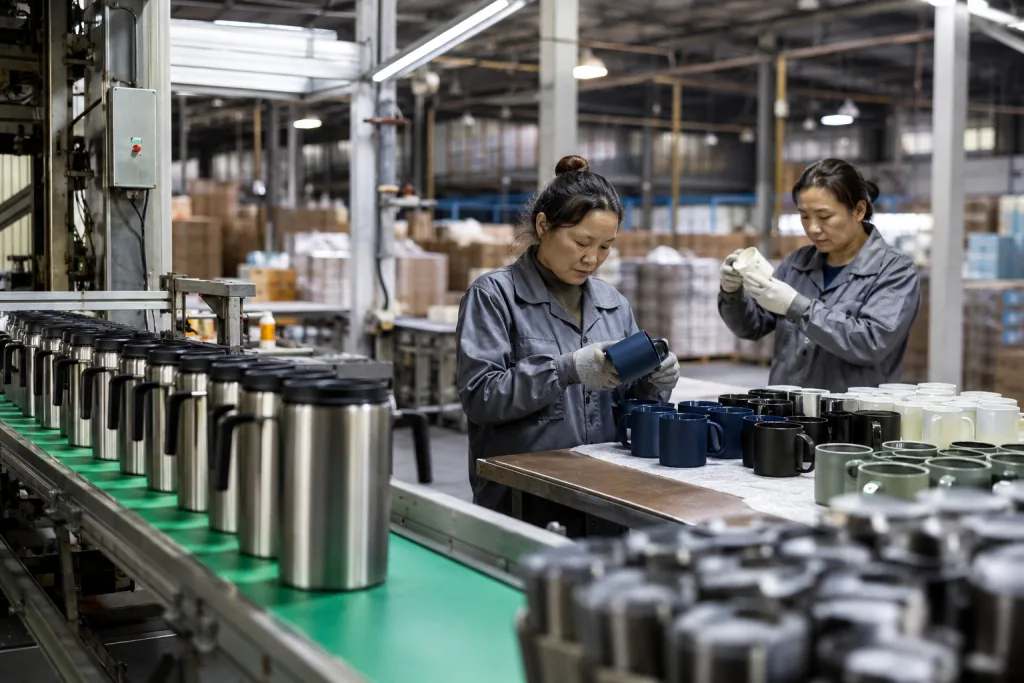
Our Zhejiang factory runs 500,000 travel tumblers per month across 12 lines. We ship to 35 countries. This guide ranks five bulk tumbler configurations — not by marketing claims, but by thermal retention (tested with a Type-K thermocouple at 95°C fill), print adhesion (cross-hatch tape test at AQL 2.5), and the real unit price at 10,000+ MOQ. No fluff. Just the engineering specs and the numbers we quote.
1. 12oz Double-Wall Stainless Steel Tumbler
Best for: trade show handouts, office welcome kits, and mid-tier corporate gifts where unit cost matters more than premium feel.
This model moves more volume through our Hangzhou line than anything else. 12oz is the sweet spot—fits a standard coffee shop pour and slides into a Honda Civic cup holder without jamming. We run these in 304 (18/8) stainless, 0.5mm wall, with a copper-plated vacuum gap. Lab numbers: 95°C fill holds 65°C at 4 hours, 48°C at 6 hours. That's enough for a commute. A German buyer flagged that the 6-hour number drops to 42°C if the lid isn't seated fully, so we now include a quick-fit check card in every carton. QC caught a batch with a 0.1mm burr on the rim last quarter; we reworked the line and rechecked every unit before shipping.
The lid is a push-fit silicone seal with a sliding drink opening. Splash-resistant, not leak-proof. If someone throws it in a bag sideways, it will weep. We're upfront about that because returns hurt both sides. For branding, the 360° cylindrical body gives you a clean canvas. Silkscreen holds up to 4 colors and survives about 200 dishwasher cycles before fading. Laser engraving is the permanent option—no ink to lift, but you lose color flexibility. MOQ is 500 units. Single-color silkscreen lands at $3.20 FOB Shanghai. Lead time runs 25–30 days after deposit, though we've pushed it to 22 days on a quiet line in March. One distributor tried to spec 5 colors on a 300-piece order; the math doesn't work—setup cost alone eats the margin.
If you're stocking a catalog as a coffee mug distributor, this is your baseline SKU. It passes ASTM E2654 for vacuum integrity. EU food contact is covered. We had a German buyer test it against LFGB migration limits last year—no issues, even on the silicone seal. A U.S. buyer once asked for a leak-proof lid on this body; we told him straight up it's not the right build. Pick the 16oz screw-cap model if that's the requirement.
2. 14oz Ceramic-Coated Travel Tumbler
Best for: coffee brands that want a premium feel and maximum logo real estate.
Ceramic-coated stainless steel gives you the taste of glass or ceramic without the breakage risk. The interior is a food-grade ceramic layer—non-stick, no metallic aftertaste. We coat the exterior in any Pantone you send. The full-wrap surface takes large logos or multi-color designs: silkscreen, pad print, or full-wrap heat-transfer decals. Last year a buyer tried a four-color gradient on this model. QC pulled the first sample because the magenta shifted. We fixed the screen tension. It ran clean.
Capacity is 14oz, which fits a large coffee order. Vacuum insulation holds: 95°C to 60°C after 5 hours, same as the 12oz stainless model. The lid is a threaded screw-on cap with a silicone gasket—leak-proof when closed. We use a 0.6mm outer wall. Dropped one off a loading dock in Yiwu. No dent. The math works for field use.
MOQ is 1000 units. FOB price: $5.80 per unit for a two-color silkscreen. Lead time: 30–35 days. If you are sourcing coffee mug promotional products for a premium brand, this justifies the higher unit cost with a better unboxing experience and longer logo lifespan. The ceramic coating resists scratches better than painted stainless. We ship these to a Swiss coffee roaster every quarter. They never flag the coating.
3. 16oz Vacuum-Insulated Stainless Tumbler with Handle
Best for: bulk travel mug orders for outdoor, construction, or industrial corporate gifts.
Your end users want more volume and a handle they can actually grip. This 16oz tumbler adds a fold-flat stainless steel handle and an 80mm wide mouth—wide enough to fit a standard ice cube or a brush for cleaning. The double-wall vacuum construction uses 304 stainless, but we bump the inner wall to 0.6mm. We've seen these survive a drop off a scaffolding without denting. The 0.4mm wall won't.
Thermal retention: 95°C to 55°C after 6 hours. The lid is a twist-off with a silicone seal and a flip-top drinking spout—spill-resistant enough for a truck cab, not fully leak-proof. Customization is silkscreen or laser engraving on the cylindrical body. The handle can also take a small logo, up to 20mm x 20mm. A buyer once tried to fit a 30mm logo there; QC pulled the sample and told them it would blur. They went back to 20mm.
MOQ: 500 units. FOB price: $4.20 per unit for single-color silkscreen. Lead time: 25 days. This is a strong option for coffee mug in bulk orders where the recipient uses the mug daily on a workshop bench or job site. The handle adds perceived value without a huge cost jump—the math works better than adding a leather sleeve.
4. 10oz Double-Wall Glass Travel Mug with Silicone Sleeve
Best for: coffee mug private labeling for boutique roasters or eco-conscious brands.
Glass tumblers are moving fast in specialty coffee. This 10oz build uses borosilicate glass, rated to 150°C, with a double wall that keeps the outside easy to hold. The silicone sleeve comes off for washing, and we can mold your logo in raised lettering. We ran Pantone 294C for a Portland roaster, and the sleeve matched their bag color on the first sign-off.
The heat hold is decent, just not stainless steel territory. We measured 95°C down to 50°C in about 2.5 hours on the line. For slow drinkers who want a clean taste and no metal note, that is the right trade. The lid is a silicone press-fit with a drinking slit, so this is not a toss-it-in-the-tote mug. Custom work covers any Pantone on the sleeve, embossed logo, and laser etching on the glass base. Keep the artwork vector-based; QC pulled a sample once because the halftones broke up on small text at 1.2 mm.
MOQ: 1000 units. FOB price: $6.50 per unit, with the $800 one-time silicone sleeve mold charge included. Lead time: 35–40 days. If you are a coffee mug OEM manufacturer trying to land a shelf piece, this one does the job. Fully recyclable at end of life. A Berlin buyer asked for that on the last PO, and the math does not work if the spec sheet is vague.
5. 20oz Stainless Steel Tumbler with Slide Lid and Straw
Best for: coffee mug customizable orders for cold brew, iced coffee, or all-day hydration.
This 20oz tumbler fits promo runs that need one SKU for hot coffee and cold brew. The clear Tritan lid has a slide opening, and the reusable straw keeps it useful for iced coffee. QC pulled the sample after a 12-hour chill test on the bench; the ice still held shape. Buyers ask for that number first.
The body uses 304 stainless with a powder-coated finish. We run silkscreen or full-wrap heat transfer, and the 60mm flat lid leaves room for a small logo. MOQ is 500 units. FOB is $4.80 per unit for single-color silkscreen. Lead time is 25 days. One buyer flagged a PO typo on the lid size, and the math stopped working until we corrected it. That happens on the line.
This fits summer campaigns and year-round use in warm markets. The 20oz size cuts refill breaks, which is why it moves in staff kits and retail promos. If your bulk coffee tumbler order has both hot and cold drinkers, this is the wrong question to ask about which lid wins; this one handles both without drama.
How to Choose the Right Bulk Travel Mug for Your Program
We price these jobs from three inputs: budget per unit, decoration method, and where the mug gets used. If the artwork is still a rough sketch, this is the wrong question to ask first. Lock the use case, then the line stops eating time on rework. A tape measure on the packing bench tells us more than a polished mockup.
Budget: At 500-1000 units, FOB usually lands between $3.20 and $6.50. Silkscreen adds $0.20-$0.50 per color, and laser engraving adds $0.10-$0.30 per unit. We had one buyer send a PO marked "1 color" while the artwork file carried a 3-color logo. QC pulled the sample, the math did not work, and we fixed it before the run. Ask for a pre-production sample before we start; we charge $30-$50 with your logo, and that fee comes back against the order.
Customization: Silkscreen is the clean pick for solid logos. For gradients or photo-style artwork, we run heat-transfer decals, which add $0.40-$0.80 per unit. Laser engraving stays permanent, but it only works on bare stainless or glass, not painted bodies. A buyer flagged a painted black tumbler and asked for engraving on top; we had to turn it down because the laser burns through the coating. That is a shop-floor limit, not a sales excuse. The math doesn't work any other way.
End-user environment: Office buyers usually pick 12-14oz cups with leak-proof lids. Outdoor crews and plant teams go to 16-20oz, and they ask for handles or straws because they carry the mug all day. Coffee shops lean toward glass or ceramic-coated bodies for taste purity. We ship these by use case every week, and a 14oz spec on a 20oz program is where projects go sideways. One wrong lid height, 2 mm off, and the carton count starts drifting.
All our production is BSCI audited, and materials comply with REACH, FDA, and LFGB standards. We recommend AQL 2.5 inspection for critical defects. On a recent 5,000-piece order, QC caught a 1.5 mm lid gap on the sample pack, and that saved a full rework. For more on MOQ and pricing structures, see our bulk order guide.
Why Source from a Zhejiang Factory Direct
Zhejiang still makes a large share of China’s stainless steel drinkware, and our Hangzhou plant runs 500,000 units a month. We keep the vacuum insulation line, powder coating line, and silk screen line separate. A PO typo on lid color cost us 2 days once. Factory direct is not a slogan here; it is how we keep the order moving.
For coffee mug manufacturers and private label buyers, going direct gives you control over custom colors, thread sizes, and lid styles without distributor markup. MOQ starts at 500-1000 units, and buyers push back on that number fast. Fair enough. We hear it every week. The math works at the line, not in a middleman quote. We also ship to Amazon FBA warehouses—see our FBA guide for details.
QC is part of the run: incoming thickness checks, 0.35 mm gauges for wall stock, in-process vacuum pressure and lid-fit checks, then final random sampling per AQL 2.5. QC pulled the sample on a 316 batch last month and caught a loose lid insert before packing. That saved a return claim. We issue test reports, material certificates, and the BSCI audit summary. If you are new to sourcing from China, read our sourcing guide for supplier communication and payment terms.
Customization and Branding Options Compared
Your logo is what gets the PO signed. We run these orders every week, and the line keeps running into the same tradeoffs: unit cost, rub resistance, and how fast the artwork clears QC.
- Silkscreen printing: Good for 1-4 solid colors. It sticks on stainless, ceramic coating, and powder coat, with a 15mm minimum logo height. Cost usually lands at $0.15-$0.30 per color per unit. One buyer pushed a 12mm mark last quarter. The print shop said no. Correct call.
- Laser engraving: Permanent, no ink to peel. It works on stainless and glass, and the mark stays monochrome in silver or black. Cost runs $0.10-$0.30 per unit. We use it for corporate gifts when the buyer wants a clean look and low rework risk. QC pulled a sample last month, and the buyer had flagged a typo on the PO, not the engraving.
- Heat-transfer decal: Full-color with photo-level detail. Cost is $0.40-$0.80 per unit. It is less forgiving than silkscreen, and dishwasher cycles can crack the image. We keep it for short-run promos. The math does not work for 12-month campaigns.
- Embossed silicone sleeve: Made for glass tumblers. You pay a one-time mold cost of $600-$1000, then $0.20-$0.40 per unit. Durable. Tactile. The sleeve mold usually takes 7 days, and we check the raised logo depth at 0.8mm before release.
We also run pad printing for curved surfaces and UV printing for flat lids. One buyer once asked for both on the same SKU, and that job went sideways fast. If you want the clean split, our printing methods guide lays it out without the sales talk.
Get a Quote for Your Custom Travel Tumbler Order
Send us your design or logo, and we will reply within 24 hours with FOB pricing, MOQ, and lead time.
Frequently asked questions
What is the minimum order quantity (MOQ) for a custom promotional coffee travel mug?
For most stainless steel travel tumblers, our MOQ is 500 units per design. For ceramic-coated or glass models, MOQ is 1000 units. If you need a custom color or lid style, the MOQ may increase to 2000 units. We can sometimes accommodate 300-unit trial orders for repeat clients, but standard MOQ is firm for first orders. FOB Shanghai pricing starts at $3.20/unit for 500 units of the basic 12oz stainless model.
Can I get a sample with my logo before placing a bulk order?
Yes. We offer pre-production samples with your logo applied using your chosen customization method. Sample cost is $30–$50 per unit (refundable with a production order of 500+ units). Lead time for samples is 10–15 days after artwork approval. We recommend ordering 2–3 samples to test for fit, finish, and thermal performance.
What certifications do your travel tumblers have?
Our factory is BSCI audited (Social Compliance). All stainless steel is 304 (18/8) food grade, compliant with REACH, FDA, and LFGB standards. Vacuum insulation is tested per ASTM E2654. We provide material certificates and test reports upon request. For EU buyers, we can also provide Declaration of Conformity for the Food Contact Materials regulation (EC) 1935/2004.
How long does it take to produce a bulk order of custom travel mugs?
Standard lead time is 25–30 days after deposit and artwork approval. For larger orders (5000+ units) or complex customization (full-wrap decals, custom lid molds), lead time extends to 35–45 days. We can expedite to 20 days for an additional 10% rush fee. Shipping from Shanghai to US West Coast takes 15–20 days by sea, 5–7 days by air.
Do you offer drop-shipping or Amazon FBA prep services?
Yes. We can ship directly to Amazon FBA warehouses in the US, UK, EU, and Canada. We also offer FNSKU labeling, polybagging, and case packing per Amazon requirements. The service fee is $0.15–$0.30 per unit depending on packaging complexity. For more details, see our Amazon FBA drinkware guide.