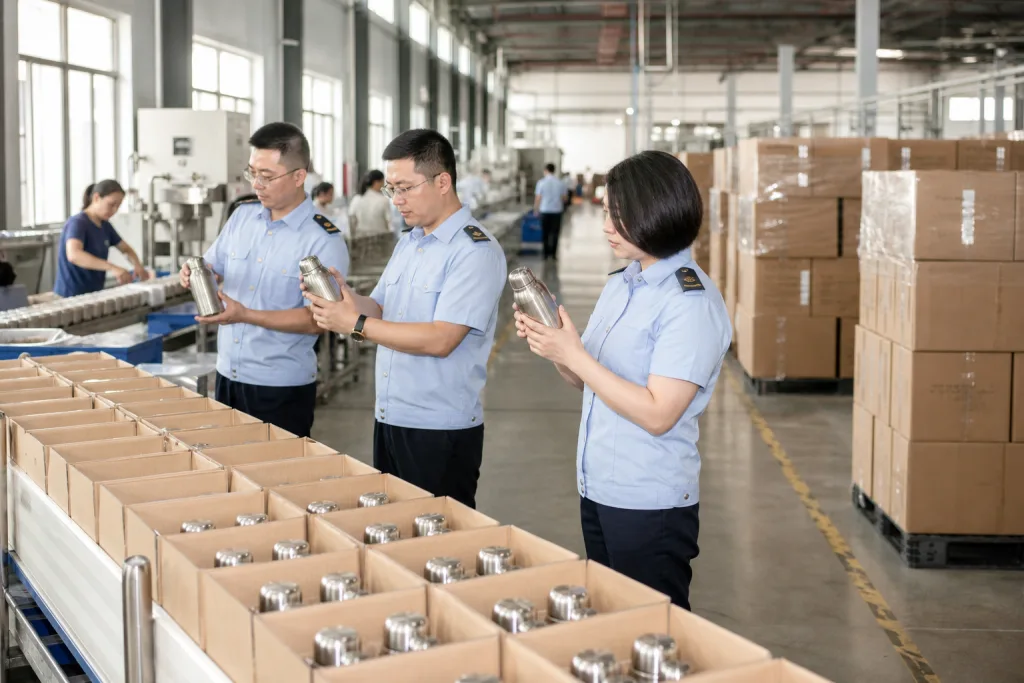
Key Takeaways
- A practical promotional canteen MOQ usually starts at 1,000 pieces per color and 3,000 pieces for molded or private-label parts
- 304 stainless steel costs more than aluminum, but it is the safer default for repeat-use custom drinkware in Europe and North America
- Laser engraving suits durable logos; silkscreen and powder-coat printing fit larger graphics but need adhesion testing
- Plan 30-45 days production after artwork approval, plus 7-10 days for pre-production sampling if color matching is required
A promotional canteen looks simple until you have to approve 5,000 pieces for a campaign, retail bundle, school program, or outdoor event. Then every choice hits the quote: 304 stainless steel or aluminum, single-wall or vacuum, laser logo or screen print, bulk carton or retail box. Small choices add up. Last month the buyer flagged a 0.35 mm wall thickness because the sample dented after one drop on our packing table.
You do not need a pretty catalog first. You need a costed spec sheet and a sample that passes use-case checks. As a canteen manufacturer in Zhejiang, China, we see the same 3 buying mistakes: paying for vacuum insulation on a one-day giveaway, choosing a logo process that fails our 3M tape abrasion check, or ignoring 13.8 kg carton weight until the freight quote lands. The math does not work when the canteen is cheap but the carton kills the budget.
Start With The Use Case
The first decision is not material. It is what the promotional canteen must survive after the recipient opens the box. We run samples for a one-day hiking event differently from a university welcome pack that sits in a dorm bag for a year. Same shape, different build. Last month QC pulled a 750 ml sample with a 0.35 mm single-wall body; fine for a weekend handout, wrong for retail resale.
For short-term event giveaways, a lighter single-wall body with a standard cap and one-color logo is usually enough. The target FOB China price may sit around USD 2.20-3.80 depending on capacity, finish, and packing. For a retail-grade custom canteen, the buyer usually expects thicker walls, better coating, leak testing, barcode labels, and individual kraft or color boxes. That pushes cost up, but it cuts complaints. We have seen this go sideways when a buyer saved USD 0.18 per piece and then found 23 caps leaking during a carton drop check.
Ask four questions before you request quotes from canteen suppliers. Put the answers in the RFQ, not in a late-night WhatsApp message after the PI is issued. One buyer once sent “mat black” on the PO; the line printed matte black, but their artwork file called for satin black.
- Who receives it? Staff, students, campers, retail customers, or loyalty-program members. A staff gift can accept simpler packing; retail customers will check the box, barcode, and cap feel.
- How long should it last? One event, one season, or daily use for more than 12 months. The math changes if the canteen needs to survive 180 school days.
- Where will it be sold or distributed? EU, UK, US, Canada, or mixed markets with different labeling rules. We ship different warning labels for US and EU cartons.
- What does failure mean? A scratched logo is annoying; a leaking cap in a backpack is a refund problem. QC should test the cap before mass packing, not after 48 cartons are sealed.
A good canteen vendor should push back if your brief is inconsistent. If you request a low unit price, full-color wrap print, retail packaging, and 500 pieces per design, the issue is not negotiation. The math does not work. That brief is trying to buy an event giveaway and a shelf-ready retail item in the same SKU, and the factory will find the gap at sampling or during AQL inspection.
Choose Material Before Decoration
Material choice sets the real cost structure for any canteen custom order. Aluminum is light and cheaper on the first quote, but it usually needs an internal liner or coating for beverage contact. That coating is where the risk sits. On the line, QC checks adhesion with a cross-cut tester and 3M tape; if the liner lifts at the bend near the shoulder, the math does not work no matter how low the unit price looks. Stainless steel, especially food-contact 304, costs more but is cleaner for safety files and repeat use.
For most North American and European promotional canteen programs, we quote 304 stainless steel when the product is meant to be used more than 30 times, not tossed after one event. A typical single-wall stainless canteen may use 0.45-0.55 mm body thickness. We measure it with a digital micrometer before polishing because 0.40 mm and 0.50 mm can look the same in a photo. Vacuum insulated designs are heavier and cost more, but they move the item from cheap giveaway to premium gift. If you are sourcing a custom growler or customized growler style, 18/8 stainless steel is usually the right starting point.
Plastic parts matter too. Caps may use PP, Tritan, silicone seals, or stainless outer covers. For EU buyers, REACH and LFGB expectations should be discussed before mold confirmation. For US buyers, FDA food-contact compliance and, where relevant, California Proposition 65 review may be needed. Do not leave this until final inspection. We had one PO where “silicon ring” was typed instead of “silicone ring,” and the buyer flagged it during document review, not during production.
A cheap body with a weak cap is still a weak product. Most user complaints on canteens come from leakage, odor, coating chips, or cap thread damage, not from the metal body alone.
As a canteen factory in Zhejiang, we confirm material, cap structure, and test requirements before quoting decoration. Good sample, wrong base. We have seen this go sideways: the buyer approves a clean laser logo, then asks for LFGB testing on a cap gasket that was never specified. We run the quote only after the BOM is locked, including steel grade, wall thickness, cap resin, seal material, and MOQ.
Match Capacity To Channel
Capacity is a commercial decision, not just a product decision. A 500 ml promotional canteen fits school packs, conference bags, and tighter freight budgets; last month we packed one model at 48 pcs per export carton, 13.6 kg gross, and the buyer’s forwarder accepted it without repacking. A 750 ml or 1,000 ml canteen feels more outdoor and premium, but carton size and freight cost jump fast. The math doesn’t work if you choose the biggest size for a cheap handout. A 64 oz customizable growler is a good fit for brewery, camping, or outdoor retail channels, but it is the wrong item for a trade show giveaway where people carry 3 brochures and a laptop bag.
For distributor drinkware programs, we usually see three working ranges, but we don’t treat them the same on the line. The 350-500 ml range works for kids, education, and indoor events where the buyer often asks for lighter cartons under 15 kg. The 600-800 ml range is the safest adult size; we run this most often because it balances grip, logo space, and shelf price. The 1,000-1,900 ml range suits outdoor, fitness, brewery, and camping promotions, but QC pulled samples before where the strap screw loosened after a drop test at 1.2 m. If you are a canteen distributor managing several customers, choose two standard molds and change finish, logo, or packaging by project. That keeps MOQ and stock risk sane.
Shape changes the branding result. A flat-sided military-style customized canteen gives a large logo panel, but dents show more clearly if the wall is too thin; we’ve seen this go sideways on 0.45 mm bodies after bulk cartons were stacked 6 layers high. A round bottle-style canteen has better production stability and easier vacuum forming, but the logo area curves. Small artwork suffers. If your artwork has text under 6 pt, curved printing can turn fuzzy, and the buyer will flag it even when the stainless body passed inspection.
Check freight before you approve the sample. A 1,000 ml stainless canteen in individual box may pack 24 pieces per export carton, while a 500 ml model may pack 48 pieces. That difference changes pallet count and landed cost; on one PO, a buyer typed “500 ml” in the item line but attached a 1,000 ml carton plan, and we caught it during pre-production review with the packing ruler on the sample table. If your promotion has a fixed delivered budget, ask your canteen supplier for carton dimensions with the first quote, not after production.
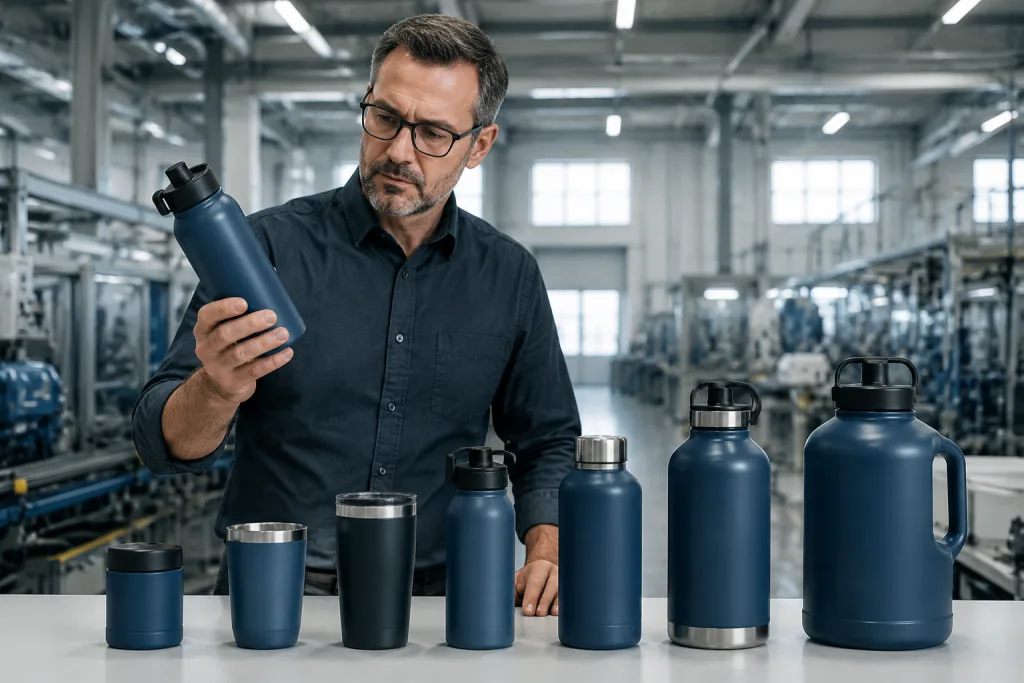
Pick The Logo Method Carefully
Decoration is where 6 out of 10 promotional canteen projects lose quality, at least from what we see on our Hangzhou sampling desk. The right logo method depends on surface finish, order size, artwork style, and abrasion target. A canteen customizable program with one 45 mm white logo is a different job from a retail customized drinkware line with full-color artwork across 4 SKUs. Ask for the logo method after you confirm the coating. Not before.
Laser engraving is the toughest choice on stainless steel and powder-coated bodies. We run it for corporate logos, outdoor brands, and distributor growler programs where the buyer expects repeated washing. The catch is color: laser does not print full color, and a buyer once flagged a black powder-coated sample because the engraved mark looked too bronze under office lighting. Silkscreen printing works for one to three spot colors on smooth cylindrical areas, and it keeps the unit cost down. Heat transfer or UV printing can handle complex graphics, but QC should pull the sample for a cross-hatch test and a 3M tape pull on the actual coating.
Powder coating feels better in hand than basic spray paint, and it can pass 3M tape adhesion tests when the pretreatment and curing oven are controlled. On our line, we check coating thickness with a film gauge, usually around 60-80 μm depending on the finish. Matte colors are tricky. White and pale finishes show carton dust and glove marks faster during warehouse handling, while dark colors hide small scratches but make laser marks stand out harder.
For Pantone matching, allow a tolerance. Metal substrate, coating thickness, and curing temperature can shift the final shade, even when the PO lists the correct Pantone code and the artwork file is clean. On orders above 3,000 pieces, we normally suggest a pre-production sample with the final logo and finish; the math doesn't work if you discover a shade problem after mass coating. For urgent canteen promotional projects, use a standard stock color to save 5-7 days. Less exciting, yes. Safer when the delivery date is fixed.
Set MOQ, Price, And Lead Time
MOQ is not a trick number. It comes from material purchasing, coating line setup, silk-screen or laser print setup, carton MOQ, and AQL 2.5 inspection cost. For BottleForge Industrial in Hangzhou, Zhejiang, our common MOQ is 1,000 pieces per color for standard promotional canteen models and 3,000 pieces for deeper customization such as exclusive cap color, custom molded accessories, or special retail packaging. Our current canteen factory output across drinkware categories is about 420,000 units per month, depending on season and product mix. On the line, one color change on powder coating takes about 45 minutes, and the spray booth needs cleaning before the next Pantone color runs. Small orders eat that time fast.
Price depends on specification more than negotiation style. This is where buyers push too hard on the wrong line item. A standard single-wall stainless custom canteen may quote from about USD 2.50-5.50 FOB Ningbo or Shanghai. Vacuum insulated canteens and custom growler products can move into USD 6.00-12.50 or higher when capacity, coating, and packaging increase. Aluminum can be cheaper, but compliance and liner quality must be watched closely. QC pulled one aluminum sample last quarter with uneven inner coating near the shoulder, about 8 mm exposed, so the math did not work after rework and retesting.
A realistic timeline is 7-10 days for sample preparation after artwork confirmation, 30-45 days for mass production after deposit and sample approval, and 3-5 days for final inspection and shipment booking coordination. Peak season in China, usually before major retail holiday shipments, can add 7-15 days if components are not booked early. We run sample logos on a flatbed UV printer or laser jig first, then check logo size with a caliper before the buyer signs off. Artwork delays hurt. A missing 1 mm bleed on a wrap design can turn 7 days into 12 days.
Payment terms for new buyers are often 30% deposit and 70% before shipment, with FOB terms being the most common. If you need DDP, Amazon FBA labeling, or distributor canteen split shipments, say it at RFQ stage. Late logistics requirements cause more delay than most buyers expect. We have seen this go sideways when a PO says “FOB Shanghai” but the routing email asks for 6 carton marks, FBA labels, and 3 warehouse splits after packing is finished. The buyer flagged it late; we had to reopen 186 cartons and lost 2 working days.

Check Compliance And Inspection
A serious canteen manufacturer should be comfortable talking test reports before unit price. For Europe, buyers usually ask for LFGB, REACH, and food-contact papers. For the US, FDA food-contact rules and ASTM-related checks may apply, depending on the product and end user. Kids’ items need tighter control: 3 mm small-part limits, coating safety, and label review before the line runs.
Factory audits matter when you sell to retailers, public institutions, or larger brands. BSCI, ISO 9001, and Sedex do not promise a perfect shipment, but they tell you whether the factory has a real management system. If a canteen vendor won’t show basic paperwork, we know the math does not work. Last month QC pulled one sample where the audit file was missing the 2024 renewal page, and the buyer flagged it on the spot.
For inspection, use AQL instead of a vague “please check quality.” A common setting is AQL 2.5 for major defects and 4.0 for minor defects, with critical defects not accepted. We run leakage tests, cap torque, coating adhesion, logo position, barcode scanning, carton drop checks, odor, and internal cleanliness. For vacuum canteens or custom growler items, insulation testing belongs in the plan; a 12-hour hold against an 18-hour spec tells you more than a long email thread.
You should also approve a golden sample. Keep one at the factory and one with your team. The golden sample locks coating color, logo size, print position, cap fit, packaging, and accessories. Without it, final inspection turns into a debate over opinions. One PO typo on “matte black” versus “metal black” has sent a whole batch back to rework, so we prefer a signed sample and move on.
Design Packaging For The Route
Packaging has to match the route to market. A bulk-packed promotional canteen for an internal campaign can go in a polybag or paper wrap, with egg-crate dividers and a 5-ply export carton. A retail canteen for store shelves needs a printed box, barcode, warning text, country-of-origin marking, and often a hang tag or insert. A distributor drinkware order is different again; we often split cartons by customer code or use neutral boxes so one shipment can feed three downstream accounts.
Carton quality is not a small detail. For sea freight, we run 5-ply export cartons as the base line. If the goods move through parcel networks or FBA warehouses, compression strength and inner protection start to matter fast. One buyer pushed back on a 12 kg carton limit last season, and the math did not work until we changed the inner pack. Amazon-style shipments may call for FNSKU labels, suffocation warnings on polybags, carton weight limits, and appointment rules. Put those into the quotation, or you will eat the extra label work later.
Sustainability claims need discipline. Recycled stainless steel, recycled cartons, plastic-free packaging, and reusable packaging can all be solid options, but do not print a claim you cannot back up. We had QC pull a sample once because the recycled-content statement on the box did not match the supplier file. European buyers are watching greenwashing closely. If you want FSC-certified paper or a recycled content declaration, lock that before box sampling.
The right canteen supplier will ask how the goods move after leaving China. If the answer is wholesale pallets, the packaging can be lean. If the answer is individual e-commerce parcels, the bottle has to survive a rough handoff from line to warehouse to courier van. One PO came in with a typo on the pack spec, and the buyer flagged it before we printed 20,000 cartons. Packaging is part of product engineering, not a decoration step.
Send Your Canteen Brief For A Practical Quote
Share capacity, quantity, market, logo files, and delivery date. We will return a realistic specification, MOQ, FOB price, and timeline.
Frequently asked questions
What is a realistic MOQ for a promotional canteen order?
For a standard promotional canteen using existing tooling, 1,000 pieces per color is a realistic MOQ. If you need custom coating, retail packaging, or multiple logo positions, 1,000-2,000 pieces is still workable but the unit price rises. For custom molded caps, exclusive shapes, or a private-label canteen customized from tooling, expect 3,000-5,000 pieces minimum. Very small runs under 500 pieces are usually not efficient in China because coating, print setup, carton printing, and inspection costs are spread over too few units.
Which material is best for a custom canteen: aluminum or stainless steel?
For most B2B buyers in Europe and North America, 304 stainless steel is the safer choice for repeat-use custom drinkware. It is more durable, easier to position as premium, and simpler for food-contact confidence. Aluminum can work for low-cost canteen promotional programs, especially where weight matters, but the inner liner or coating must be controlled carefully. If the product will be sold at retail, used outdoors, or washed frequently, stainless steel with 0.45-0.55 mm wall thickness is usually worth the extra cost.
How long does production take after we approve the artwork?
For existing canteen factory models, sampling usually takes 7-10 days after artwork and Pantone references are confirmed. Mass production normally takes 30-45 days after deposit and sample approval. Add time if you need custom packaging, new accessories, special coating, or third-party lab testing. Sea freight to Europe or North America may add 25-40 days depending on port and season. If your event date is fixed, start the project at least 75-90 days before the required delivery date.
Can one canteen manufacturer handle both canteen and growler programs?
Yes, if the manufacturer has the right welding, polishing, coating, vacuum testing, and inspection capacity. A custom growler or customizable growler has higher risk than a small single-wall canteen because capacity is larger and sealing performance is more visible to users. Ask for previous production photos, leak test methods, insulation test data if vacuum insulated, and carton specifications. If you are a canteen distributor building a broader outdoor line, keeping canteen and growler production in one factory can simplify color matching and packaging control.
What logo method should we choose for long-lasting branding?
For durability, laser engraving is the strongest option on stainless steel and powder-coated canteens. It will not peel like ink, and it handles daily use well. For larger or colorful graphics, silkscreen printing is economical for one to three colors, while UV printing or heat transfer can support more detail. Always test adhesion on the final coating, not only on a random sample bottle. For orders above 3,000 pieces, approve a pre-production sample and define acceptable logo tolerance, usually within 1-2 mm for placement.