Key Takeaways
- Tritan wholesale MOQ usually starts at 3,000 pcs, with FOB prices around USD 1.05 to 2.80 depending on lid, capacity, and decoration.
- For retail programs, 650 ml to 1,000 ml Tritan bottles are the easiest best wholesale drink bottle sizes to move.
- If you need REACH, LFGB, and BPA-free claims, ask for resin traceability and third-party test reports before deposit.
- A 0.8 mm to 1.2 mm wall works for most bulk drinkware programs; go thicker only if drop resistance matters more than cost.
Producing tritan bottles wholesale isn't hard because the bottles are complicated. It's hard because three decisions you make in week one — lid assembly, wall thickness, decoration — will swing your landed cost by 20% to 35% before you ever negotiate a unit price. We watched a buyer's quote jump 28% on a single spec change: screw cap to push-pull lid with a silicone gasket. The mold was fine. The seal wasn't. That's the game.
European and North American buyers aren't shopping for a bottle. They're shopping for a spec that clears customs, survives a 28-day ocean leg, and still leaves 40 points of margin at retail. Tritan sits in a weird middle ground. It's lighter than glass, won't shatter, and doesn't carry the metallic aftertaste some customers complain about with stainless. But it's not as cheap as PET. The math works for some channels and breaks for others — you need to run the landed cost against your shelf price before you commit to the material.
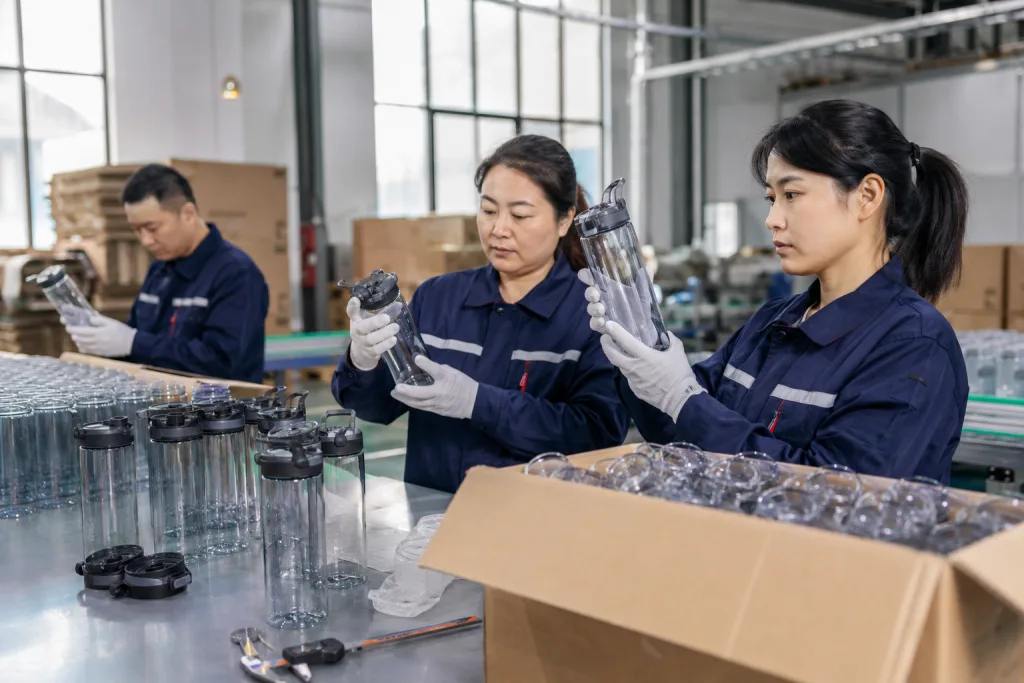
We run about 500,000 units a month across our drinkware lines in Zhejiang. Tritan MOQ typically sits at 3,000 pcs, lead time 25 to 35 days after sample sign-off. Sounds smooth. It is, until a vague PO hits the floor. Last month QC pulled an entire batch at the gate — cap gate mark was 0.3 mm off the drawing. The buyer flagged it in photos before we caught it on the line. That 0.3 mm cost us six days. China can move fast, but only when the spec sheet is tight. A fuzzy purchase order doesn't get a discount. It gets a delay.
What Tritan actually buys you
Tritan is a copolyester. You get glass-like clarity without the breakage, and you skip the weight of stainless steel. For a wholesale buyer, that means fewer insurance claims from transit damage — we saw one US buyer drop cracked-bottle claims from 3% down to 0.2% after switching. Better shelf display, and a hand-feel that beats standard PET. That is why fitness, outdoor, kids, and office retail programs run on it.
Don't buy the marketing. Ask for the resin grade. Eastman Tritan MXF is common; some knockoffs claim "Tritan-like" but yellow after 200 UV hours. Ask for wall thickness. Ask for the exact test standard they used — not "we tested it," but "ASTM D256 for impact" or "EN 1186 for migration." A proper export spec shows a BPA-free declaration, REACH compliance for Europe, and food-contact test support under LFGB or FDA, depending on your market. For a typical 750 ml bottle, 0.9 mm wall is standard. Spec 1.2 mm and it feels sturdier, but resin cost jumps and FOB goes up by USD 0.10 to 0.25 per piece. In Zhejiang, most factories can make a pretty sample. The real question is whether they can repeat it across 20,000 pcs with the same clarity and a cap that seals every time — QC pulled a batch once where 8% of caps leaked because the injection pressure drifted overnight. That is where you find a usable supplier, not just a showroom.
Spec table first, opinions second
We run spec tables before opinions—same order we use when a buyer sends an RFQ. Below is the comparison logic that drives our export quotes, stripped of marketing fluff.
| Use case | Best capacity | Typical MOQ | FOB range | Why it fits |
|---|---|---|---|---|
| Fitness retail | 650-750 ml | 3,000 pcs | USD 1.15-1.85 | Light, clear, easy to carry |
| School and family | 500-800 ml | 3,000 pcs | USD 1.10-2.10 | Safety story and spill control |
| Promo and private label | 700-1,000 ml | 5,000 pcs | USD 1.20-2.80 | More print area, better margin |
| Outdoor and travel | 900-1,200 ml | 3,000 pcs | USD 1.35-2.40 | Better for longer use windows |
You can source bulk drinkware in a dozen materials. Tritan wins where two things collide: display clarity and break resistance. It won't replace every bottle on your line sheet, and it shouldn't. Get the use-case fit wrong and you're sitting on 3,000 pcs that don't move. Get it right and post-arrival complaints drop to near zero. We watched a buyer flag a cracked lid on a competitor's PP bottle at 5,000 pcs—QC pulled the sample, wall thickness was 0.45 mm. We shipped 0.75 mm wall Tritan and the whole run landed clean.
Compare Tritan against other materials
Buyers comparing Tritan with stainless, aluminum, glass, or low-cost plastic usually ask which one wins. Wrong question. Channel, fill method, and landed cost decide it. Tritan does not hold heat, so hot-fill is off the table, and thermal retention is weak. On our line, a 750 ml body needs no vacuum shell or powder coat. If the buyer wants a clear bottle with a clean shelf look at controlled cost, Tritan is the one we ship.
Against stainless, Tritan runs about 40 grams lighter on a 750 ml body, and decoration costs less. Silkscreen or matte spray usually saves about $0.15 per bottle, and we see that on the quote sheet before sampling starts. Against glass, freight loss changes fast: one broken case per pallet dropped to one case in ten pallets after we changed the pack spec. Against cheap plastic, clarity and hand feel help it sell at retail. We ship a typical 750 ml Tritan bottle with a flip lid 15% to 30% cheaper landed than a comparable stainless bottle, depending on cap complexity and carton packing, 24 units versus 18. For European buyers, REACH paperwork is straightforward, and there is no coating claim or metal-component claim to chase. The math does not work any other way.
Use-case fit by channel
- Retail starter packs: Tritan bottle with straw lid or flip lid
- Corporate gifts: Tritan with one-color logo and retail carton
- Outdoor programs: Tritan with locking cap and carry loop
- Kids programs: Tritan with smaller capacity and soft-touch spout
For beer growler wholesale or beer growler wholesale bulk requests, Tritan only fits when the buyer wants a lightweight, clear vessel for cold drinks. It is not a pressure-rated fermentation container. QC pulled a growler sample last month because the lid seal failed at 2.5 bar on the test rig. A growler bulk order is not a standard drink bottle order, and that is where people get burned. The lid seal spec is the part that usually causes trouble, and the buyer flagged it after the PO typo showed 2.5 bar instead of 2.5 bar test hold time.
Use the lid to control the quote
The lid is where a quote slips fast. A plain screw cap is cheap. A flip-top, straw lid, or locking cap adds tooling steps and more hand work on the line. If the brief says beer tumbler bulk, beer tumbler wholesale, or beer tumbler wholesale bulk, treat the lid as a cost line, not decoration. Same story for alcohol flask bulk, alcohol flask in bulk, alcohol flask wholesale, and alcohol flask wholesale bulk. Buyers want a small format, then push for a premium closure. We see that push every week.
For Tritan bottles, the base setup is a PP lid with a silicone gasket. A carry handle can add USD 0.08 to 0.20 per unit. A custom logo insert adds another USD 0.05 to 0.15. On a 5,000 pc run, the math does not hide. One buyer flagged a PO because the lid line said 1 color insert while the artwork called for 2; that typo moved the sample date by 4 days. We tell buyers to match the lid to the sales channel. Retail gets the better closure. Trade promo gets the simple lid, then we spend on print and carton finish. The MOQ on the closure matters more than the brochure does.
Seal testing has to sit in the acceptance criteria. We run upside-down leak checks, 24-hour static storage, and 1.0 m drop tests on packed samples for export retail. QC pulled the sample, and the cap failed only after the third drop because the gasket sat 0.3 mm off center. If a supplier cannot name the test method, they are guessing. This is the wrong question to ask after the cargo is on the water. Ask for the test sheet before we cut the mold.
Decoration changes the economics
Decoration is where wholesale drink bottle buyers keep margin or give it away. A plain clear Tritan bottle is the cheapest path. Add a one-color silk screen or a laser mark on a stainless cap, and the same item jumps into a higher retail tier fast. On a 6,000-piece run, the buyer flagged a USD 0.12 gap on print method alone. For North American orders, laser works on stainless parts; on Tritan, screen printing and pad printing are the practical calls. If your order also touches custom-logo.html work, finish beats logo size every time.
Use a simple rule. Promo giveaway, keep it to one-color print and a kraft or white box. Retail SKU, ask for matte spray, a translucent tint, or a PMS match that is measured, not guessed. A tint can add USD 0.06 to 0.18, and a special surface finish can climb faster when the rejection rate goes up. This is the wrong question to ask if you only stare at print unit cost. On the line, the real cost shows up in rework from misaligned graphics, dust in the cure area, or ink that fails the tape test. QC pulled the sample on one batch because the logo shifted 1.5 mm. We also caught a PO typo that swapped 1,000 pcs for 10,000 pcs, and that sort of mistake wrecks the quote before it reaches the floor. Zhejiang plants that know bulk drinkware will show sample acceptance photos, not just a polished final sample.
For buyers asking about wholesale growler or growler wholesale orders, decoration also splits channels. A matte charcoal body with a simple print reads like a different product from a clear fitness bottle, even if the base mold is the same. That matters when you want 3 SKUs from one platform mold. We ship those builds with the same neck finish and a different wrap label. The buyer usually sees the line of separation before we do. The math works. We ran a 2-color version next to a one-color version on the same 48 mm cap, and the higher-decor unit took an extra 12 days versus 18 days through cure and inspection.
Compliance is not optional
For Europe and North America, compliance sits in the buying decision. It is not a cleanup task after the PO is signed. Ask for REACH test reports on every relevant part, a food-contact declaration, and LFGB support if you sell into Germany or the nearby markets. On one Tritan run, QC pulled the sample at 18g because the lid insert was undocumented, and that sort of miss slows the whole line. If the bottle has stainless parts or plated trim, ask for ASTM or ISO references where they fit the build.
Do not take a generic BPA-free line and call it done. We want resin source records, lid material confirmation, and packing materials that do not carry odor or leave a stain ring. A good Zhejiang supplier will send carton drop test results, an AQL sampling plan, and pre-shipment photos without a fight. For export retail, AQL 2.5 on major defects and 4.0 on minor defects is a common start, though some brands push critical seal and print issues to 1.5. The math is plain. If the supplier says yes to everything but cannot show the data, the buyer flagged it for a reason.
Ask for the test report before you approve the order, not after the shipment is on the water.
Factory capacity and lead time matter
Procurement teams often chase unit price and miss production slotting. That is the wrong question to ask. A Tritan project with a custom lid, custom color, and retail packing can sit behind other molds if the factory does not have open line capacity. At our Hangzhou plant, we run three drinkware lines, and a normal Tritan order ships in 25 to 35 days after sample sign-off. If new tooling is part of the order, add 20 to 30 days for mold work and first article approval. QC pulled the sample on a caliper, and the lid fit was 0.3 mm off on the first shot.
Capacity is not a brag number. It decides whether you can restock a seller SKU before peak season. If you are planning bulk canteen or drinkware wholesale programs for Q4, get sample approval done before the freight window tightens. A 20,000 pcs order of a plain 750 ml Tritan bottle is manageable. The same order with a custom cap, matching color, insert card, and color box can push the schedule out by 7 days. We saw a buyer flag a PO typo on carton count once, and that added two days while the line waited. China factories can move fast, but clean approvals move faster.
How to place a cleaner order
Buyers who get cleaner results on produce tritan bottle wholesale orders run the same order every time. Lock the capacity and use case first. Pick the closure and leak standard next. Set the decoration method after that. Finish with compliance papers. We have seen quotes go sideways when someone asks for pricing before the spec is pinned down; the line starts guessing, and that is where trouble starts.
For a solid RFQ, put these points in black and white. Last week QC pulled a 750 ml sample with a caliper, and the buyer flagged a missing gasket note. That typo cost a day.
- Capacity: 500 ml, 750 ml, or 1,000 ml
- Material: Tritan body, PP lid, silicone gasket
- Decoration: one-color print, laser, or none
- Packing: bulk pack, white box, or retail box
- Target: canteen wholesale, wholesale drinkware, or retail launch
If you are comparing best wholesale drink bottle options across channels, keep the RFQ honest. A bottle for beer growler bulk or alcohol flask wholesale bulk is not the same job as a school bottle or a fitness bottle. The math does not work if you mix them. A cheaper quote usually comes from a loose spec, not a better factory. We have watched that turn into extra sampling, new artwork plates, and 12 days lost before the PO is even clean. That is the wrong question to ask.
Get a Tritan quote matched to your spec
Send your target capacity, lid style, and packing needs. We will quote a clean FOB price, MOQ, and lead time for your market.
Frequently asked questions
What MOQ should I expect for Tritan bottle wholesale orders?
For a standard Tritan bottle with an existing mold, MOQ is usually 3,000 pcs. If you want a custom lid, custom color, or special packing, many factories will ask for 5,000 pcs or more. For smaller test runs, expect the unit price to rise by 15% to 30% because setup and QC costs are spread over fewer pieces. For Europe and North America, I would not start below 1,000 pcs unless the supplier already has stock or semi-finished inventory. A serious Zhejiang factory should tell you MOQ, lead time, and packing ratio up front, not after sample approval.
What is a realistic FOB price for produce tritan bottle wholesale?
For a plain 500 ml to 750 ml Tritan bottle, FOB China is often USD 1.05 to 1.85 per piece. Add a better lid, color finish, or logo work, and the range can move to USD 1.90 to 2.80. If you need retail carton packing, insert cards, or multi-step decoration, expect extra cost. The biggest price drivers are lid complexity, wall thickness, and defect rate. A 0.8 mm wall with a basic cap is very different from a 1.2 mm wall with a locking lid. Always compare quotes on the same spec sheet.
Can Tritan bottles meet EU and US compliance needs?
Yes, if the supplier gives you proper documents. For Europe, ask for REACH and food-contact support, and for Germany-focused retail, LFGB testing is worth requesting. For the US, ask for FDA food-contact declarations and resin traceability. If the bottle includes mixed materials, confirm each component separately: body, lid, gasket, and print ink. Do not accept a generic BPA-free claim alone. A proper export file should include batch records, material declarations, and test reports tied to the shipment. That is normal practice for a China supplier serving Europe and North America.
What capacities sell best for wholesale drink bottle programs?
For most retail and promo channels, 650 ml to 1,000 ml sells best. A 750 ml bottle is usually the easiest to merchandise because it looks balanced, fits cupholders better than oversized bottles, and keeps freight density reasonable. For school and family buyers, 500 ml to 650 ml works better. For outdoor programs, 900 ml to 1,200 ml gives more drinking time between refills. If you are building a wholesale drinkware line, I would avoid too many sizes at launch. Two capacities and two lid styles are enough for a first order.
How do I reduce risk on a first China order?
Start with one existing mold, one color, one print method, and one packing spec. Ask for pre-production samples, then approve using a written checklist that includes seal test, drop test, carton count, and print alignment. Use AQL 2.5 for major defects as a baseline, and tighten it if the order is retail-critical. Ask for production photos at the start, mid-run, and before packing. If the supplier in Zhejiang or elsewhere in China cannot give you those updates, your risk goes up fast. On a 3,000 pc order, one bad seal batch can erase all your unit-price savings.