Key Takeaways
- A private labeling vacuum flask usually starts at 500 units MOQ and 35-45 days lead time for standard colors.
- For outdoor use, 316 inner steel and 0.35-0.45 mm wall thickness are safer than chasing the lowest FOB.
- A laser logo on stainless usually adds USD 0.08-0.20 per piece; a 1-4 color silk screen is often cheaper for large runs.
- A factory in Zhejiang with 120,000 units/month can handle mixed SKUs, but artwork and packaging approval still control the schedule.
Source a private labeling vacuum flask, and the first trap is not color. It is the spec sheet that looks clean and then falls apart on the line. We have seen a 500 ml bottle lose vacuum after a drop test, a cap start leaking at 2,000 cycles, and a logo peel after two dishwasher runs. That gets expensive fast. For outdoor retail or promo work, the custom thermos has to match the channel, not the catalog shot.
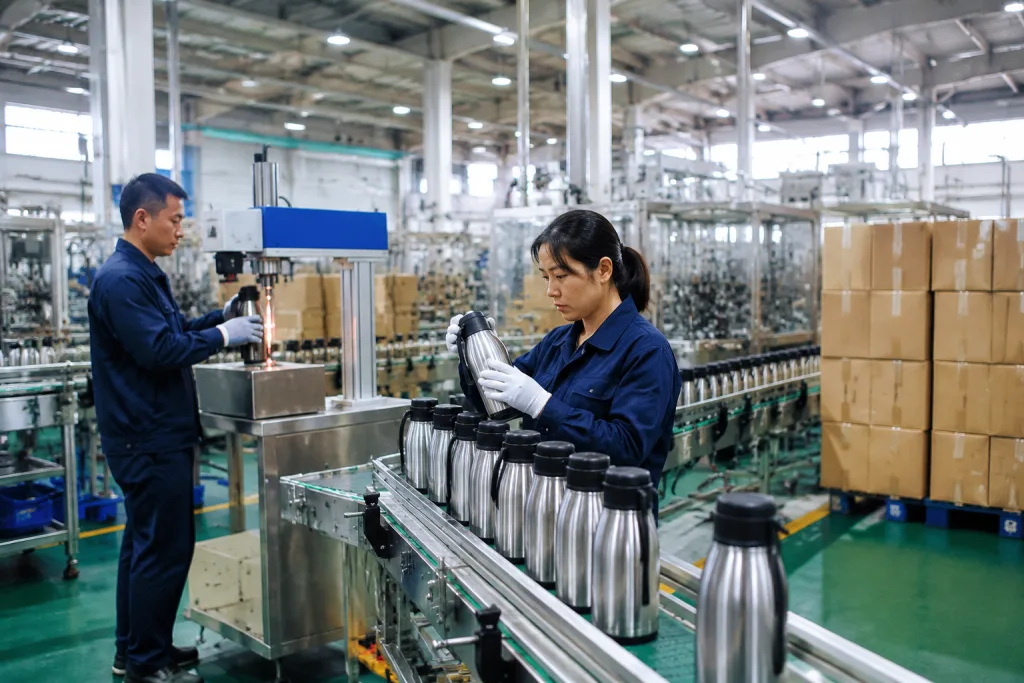
We run stainless thermos programs in Zhejiang, and the pattern is familiar. Buyers who ask for wall thickness, leak testing, coating, and carton packing get cleaner numbers. The ones chasing the lowest FOB often reorder 12 days later than planned, then ask why the margin is gone. QC pulled the sample last week on a 304 stainless run, and the buyer flagged a 0.3 mm gap at the lid. The math does not work if you only want the cheapest unit. This guide breaks down the main thermos formats, where each one fits, and how to read a factory offer with numbers that hold up in China and export markets.
What Buyers Really Compare
Do not start with decoration. Start with the spec sheet: steel grade, capacity, lid structure, vacuum retention, and the test standard on the PO. We run a 500 ml straight-body flask, a 750 ml wide-mouth thermos, and a 1,000 ml commuter bottle on the same line; the buyer usually spots the gap in lid torque, not print quality. For promo brands, the math is tight. Once the unit price goes past USD 4.20 FOB, the logo does not save the deal.
What buyers compare is use case fit. A thermos bulk order for hiking needs grip, drop resistance, and a powder coat that survives a 1.2 m abrasion test; a thermos promotional order for a trade show needs MOQ control, fast branding, and carton sizes that do not waste freight. A distributor program needs repeatable output across 3 to 6 SKUs, or replenishment turns messy fast. QC pulled the sample, checked the 24-hour cup test, and the buyer flagged a lid color mismatch on one run. This is the wrong question to ask if you only look at price; the quote has to show thermal retention, packaging spec, and carton count.
| Spec | Outdoor Retail | Promotional | Distributor |
|---|---|---|---|
| Steel grade | 304/316 | 304 | 304 |
| MOQ | 1,000 pcs | 300-500 pcs | 1,000-3,000 pcs |
| Lead time | 40-45 days | 25-35 days | 35-45 days |
| FOB target | USD 3.80-6.20 | USD 2.90-4.80 | USD 3.40-5.90 |
Best Use Cases By Flask Type
Plain answer: not every custom thermos deserves private label money. Match the bottle to the job. A narrow-mouth 500 ml bottle fits commuting and gift sets. A 750 ml wide-mouth bottle handles soup, trail use, and outdoor retail because it fills, cleans, and pours cleanly. A 1,000 ml model is the safer thermos manufacturer choice when the buyer wants better shelf value. QC pulled a sample with a 5 mm lid gap once, and that batch got flagged on the spot.
Outdoor retail fit
Outdoor retailers should lean toward matte powder-coated bodies, silicone bases, and lids with a carry loop that does not snap at 2 kg pull. If the bottle goes into backpacks and campsite use, ask for a 4-6 hour hot test above 75°C at 24 hours, not brochure talk. We run that on the line with a probe thermometer, and the numbers matter. In our shop, sell-through gets better when wall thickness stays around 0.35-0.40 mm and the cap stays under 85 g. We’ve seen this go sideways when a buyer pushed for a thinner shell to save 6 g. The math doesn't work.
Promotion fit
For promotional brands, a customizable thermos is mostly a branding tool. Keep the structure simple: single-wall outer shape, standard cap, laser logo, and one PMS color. That keeps your custom thermos cost under control and cuts the risk of uneven coating or slow assembly. If you are buying thermos custom for event programs, a supplier that can hold 300-500 pcs MOQ without inflating unit price is worth more than a flashy catalog. We once had a PO typo that read 3,000 instead of 300, and the math did not work for anyone. This is the wrong question to ask.
Steel Grade And Vacuum Performance
Most buyers start with 304 stainless because the grade is familiar and the price stays in a safe zone. For a private labeling vacuum flask, that works for retail and promo runs, but it is not always the right call on a 12-month repeat order. If the line is going to outdoor users, food-contact checks, or a premium shelf, a 316 inner liner earns its place. We had one buyer push back on a USD 0.22 upgrade, then QC pulled the sample after a 48-hour salt-spray check and the answer changed fast.
Vacuum performance matters more than logo size. A solid stainless thermos should stay above 68°C after 12 hours in standard hot-water testing, and a tight lid seal can lift that by a few degrees. Wall thickness, neck weld quality, and vacuum chamber consistency do the real work. Ask for ISO or internal QC data, and ask for 100% leak testing before carton packing; we run that check on the line with a pressure rig, not a sales line.
Do not buy a bottle just because the outside looks heavy. A thick shell with poor vacuum is still a bad flask.
For factory thermos orders, we normally hold the inner wall at 0.35-0.45 mm depending on capacity and target price. That range gives us workable weight, stable forming, and decent thermal retention. If a supplier says they can go thinner and cheaper without data, the math does not work. We have seen that go sideways on 500 ml samples when the weld bead at the neck started to oval after forming.
Branding Methods That Hold Up
Logo placement is where a lot of custom thermos jobs go sideways. Laser engraving is the safest pick for premium, long-life branding because it does not peel, and on our line the charge usually sits at USD 0.08-0.20 per unit once the logo size and fixture setup are locked. Silk screen is cheaper on flat panels and bigger runs; for thermos bulk orders, it works when you need 1-4 colors and the buyer wants the unit price held tight. Heat transfer and UV print also work, but abrasion and hand contact show up fast. We saw one UV sample fail after a 1.2 kg drop test on the corner weld.
If you are buying distributors thermos stock for resale, look past the first print. Ask about 50 wash cycles, not the first sample photo. The math does not work any other way. A proper manufacturer thermos program needs artwork proofing, Pantone matching tolerance, and a placement diagram with millimeter marks; QC pulled one sample last month where the logo sat 3 mm too low, and the buyer flagged it on the spot. For promotional thermos orders, we usually push one strong logo plus one capacity mark, because crowded graphics age badly and make the bottle look cheaper than it is.
- Laser engraving: best for stainless finish and long cycle life
- Silk screen: best for larger runs and controlled color count
- UV print: good for short campaigns, but check wear resistance
- Wrap label: acceptable for very low MOQ, but not premium
In Zhejiang, one production day can run several branding methods, but art approval still drives the schedule. We ship faster when the buyer sends final vector files before sampling, not after. A PO typo like “capactiy” instead of “capacity” can stall the line, and every revision costs time. This is the wrong question to ask when someone says the artwork is “almost ready.”
MOQ, Pricing, And Lead Time
Price only makes sense once we tie it to quantity and packing. A private labeling vacuum flask with a standard 304 inner liner, single-color logo, and kraft box usually lands around USD 2.90-4.50 FOB at 1,000 pcs. The cap style moves the quote fast. Switch to 316 steel, a color powder coat, and a premium gift box, and the number usually sits in the USD 4.80-7.20 range. That is normal Zhejiang factory pricing. We showed this sheet to a buyer who said the line was padded, then QC pulled the sample and the math held.
The MOQ moves with the amount of change. Keep the body shape and cap standard, and 500 pcs is workable for a lot of custom thermos jobs. Ask for a new mold, a special lid, or a full-color carton, and 3,000 pcs is the honest answer. Lead time is usually 7-10 days for sample approval, then 25-35 days for production on standard runs, or 40-50 days when the coating or packing is custom. A proper thermos factory should give you a monthly output number. 120,000 units per month is normal on a well-run line in Zhejiang. We run into PO typos on lid color and carton size all the time, and one wrong code can throw the schedule off if nobody catches it early.
Do not let anyone bury packing cost. Inner boxes, master cartons, drop tests, and palletization can move landed cost by 6-12%. This is the wrong question to ask after the order is locked. If your channel is retail or Amazon-style fulfillment, carton dimensions and barcode placement matter as much as bottle price. We have seen shipments held because the buyer flagged a 2 mm carton mismatch, so we check the tape measure before we quote.
Quality Checks You Should Demand
Quality control is where private labeling vacuum flask sourcing stays cheap or gets expensive fast. We want cheap, not sloppy. Ask for a written QC plan with AQL 2.5 for major defects and AQL 4.0 for minor defects at final inspection. That is not paperwork fluff; it tells you whether the supplier thermos can run export work without guessing. For food-contact compliance, ask for REACH on EU-bound orders and FDA-related documentation for North America. If the bottle has coating, demand abrasion and adhesion tests. A pretty sample means nothing if the line starts flaking at 500 rubs.
The right factory thermos also logs leak testing, thermal performance, and packing checks. We run 100% lid-fit and pressure-leak testing on the line, then sample-check thermal retention by batch. For shipping integrity, drop testing from 1.0 m on at least six faces is a solid baseline for export. QC pulled the sample last month and the cap torque was 18 Ncm on one lot, then 11 Ncm on the next. That spread kills cartons. If your thermos manufacturers cannot explain gasket consistency and torque control, the math does not work.
What to verify before PO
- Material report for inner and outer stainless steel
- Vacuum retention test result by capacity
- Logo method and abrasion expectation
- Carton drop and compression spec
- Certificate set for target market
For thermos custom programs, the sample is not enough. You need a pre-production sample, a signed spec sheet, and a packing reference sample. We had one buyer flag a PO typo on carton count, 12 pcs instead of 24 pcs, and the rework cost more than the printing. A 0.5 mm logo shift on the line can trigger a claim. We've seen this go sideways before. This is the wrong question to ask if you only look at the first sample. Repeatability across reorders is what keeps distributor thermos programs clean.
How To Order Without Drama
If you want the order to stay clean, send one clear email to the thermos supplier. List capacity, target market, logo method, color, packaging, and annual forecast. One page is enough. We run this every week in Hangzhou, and it cuts ten back-and-forths to two because the factory can quote the right flask family, stock line, semi-custom, or full custom build without guessing.
For outdoor retailers, I start with three SKUs: a 500 ml commuter flask, a 750 ml wide-mouth hiking bottle, and a 1,000 ml value model. That is the clean setup. For promo brands, keep it tighter and move fast. QC pulled a 58 mm mouth sample once, and the buyer flagged the lid style on the second order because the product code had changed. This is the wrong question to ask; stability is the point.
Work with a manufacturer that can answer real numbers: 500 pcs MOQ, 35-45 days after sample approval, BSCI or factory audit files on request, FOB Ningbo or Shanghai without customs noise. The math does not work if the answers stay fuzzy. We have seen it go sideways when the PO had a typo on the carton count and the line started on the wrong pack spec. A good custom thermos partner keeps the buying process controlled.
Send your spec sheet, get a real quote
We can match you to the right private labeling vacuum flask, confirm MOQ, and give you a FOB quote with packaging and lead time.
Frequently asked questions
What is a realistic MOQ for private labeling vacuum flask orders?
For standard stainless thermos models, 500 pcs is realistic if you keep the body shape and lid from the existing mold. If you want a new mold, special coating, or full custom packaging, 3,000 pcs is more typical. For a thermos bulk order with standard colors, some factories in Zhejiang can go lower on repeat runs, but the first order usually sets the baseline. Always confirm whether the MOQ applies per color or per SKU, because that changes the economics fast.
How much does a custom thermos cost FOB China?
A normal custom thermos with 304 stainless, one-color logo, and standard box often lands around USD 2.90-4.50 FOB at 1,000 pcs. Move to 316 steel, powder coating, or gift packaging, and you are more likely at USD 4.80-7.20. Very small orders can be 15-30% higher per unit because setup and labor are spread over fewer pieces. Ask for separate pricing for bottle, lid, print, and carton so you can see where the money goes.
Is 316 steel worth it for outdoor retail?
Usually yes if your positioning is premium or your customers will use the bottle hard. 316 inner steel improves corrosion resistance and gives you a stronger story for a custom thermos line. The cost increase is often USD 0.18-0.40 per piece, depending on volume and finish. For entry-level promotional thermos programs, 304 is often enough. For trail, camping, and marine-adjacent use, 316 is the safer call.
How do I know the vacuum flask will hold heat properly?
Ask for a thermal retention test with a specific starting fill temperature and room temperature reference. A decent 500-750 ml flask should still hold above 68°C after 12 hours in standard testing, with better units doing more. Do not accept vague claims like 'long heat preservation.' Request the test method, batch number, and whether the result was from one sample or a production lot. A real thermos manufacturer will have this data.
What branding method lasts longest on stainless thermos?
Laser engraving is the most durable on a private labeling vacuum flask because it does not peel or fade like a surface print. It usually costs USD 0.08-0.20 per piece depending on logo size and setup. Silk screen is still useful for larger runs and lower cost, especially on promotional thermos orders. If the bottle will be washed often or used outdoors, laser is usually the safer choice.