Key Takeaways
- A private labeling thermos order usually starts at 3,000 units MOQ and 35-45 days bulk lead time from a Zhejiang factory
- Double-wall 304 stainless with 0.4-0.5 mm inner wall is the sensible baseline for most retail and promotional thermos bulk programs
- A realistic factory price for a 500 ml custom thermos is often USD 3.20-6.80 FOB depending on lid, finish, and decoration
- Approve logo placement, leak testing, vacuum retention, and carton drop tests before you green-light the full run
You do not buy a private labeling thermos the same way you buy a catalog item. Once the logo is on, the gift box is fixed, and the retailer sets a ship date, the bottle is only one piece. The real job sits in the 0.8 mm wall, coating adhesion, lid seal, and whether the line can repeat the same build across 3,000 or 30,000 units without drift.
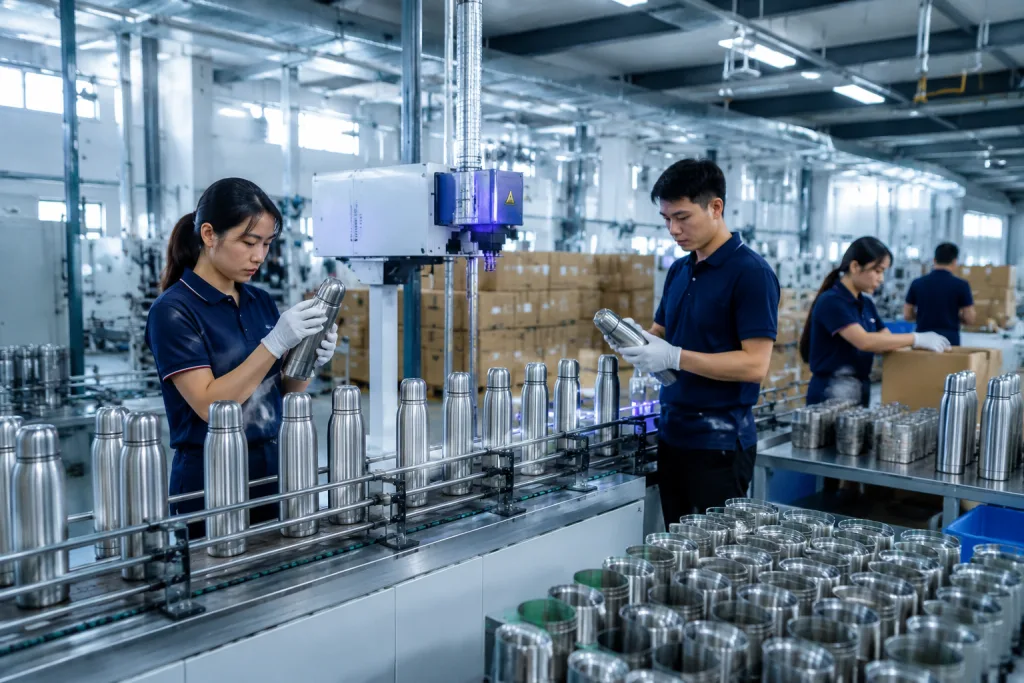
At our Hangzhou, Zhejiang factory, we run a thermos order as a controlled process, not a sales pitch. For a standard stainless thermos run, MOQ starts at 3,000 units, first samples land in 7 to 10 days, and bulk lead time is usually 35 to 45 days after approval. QC pulled the sample with a torque wrench last week and caught a loose lid ring at 18 N·m. That kind of miss kills a shipment. If you buy for outdoor retail or promotion, this is the wrong question to ask: not "can it look good?" but "can the supplier hold spec, pass REACH and food-contact checks, and ship product you can sell?"
Start With the End User
Start with the person holding the bottle, not the logo on the side. A private labeling thermos for an outdoor store has to survive a backpack drop, fit a cup holder, and pour cleanly with gloves on. A promo item has a different job. We run the line to those two specs differently, and the buyer who treats them as the same usually gets burned on the first sample.
For retail shelf programs, we usually push a 500 ml or 750 ml stainless thermos with 304 inner and outer walls, 0.4 to 0.5 mm wall thickness, and a leak-tested PP or stainless lid. On one chain order, QC pulled the sample after a 1.2 mm lid gasket missed the drop test on the third round, so we tightened the spec before mass production. For premium outdoor use, a powder-coated body and 6 to 8 hours heat retention at 70°C fill is fine only if the test method is written down. “Keeps hot all day” is the wrong question to ask. Ask for the start temperature, room temperature, and test duration, or the quote is just noise.
If you are buying for a chain, write the use case in one line before you request samples: trail, commute, corporate gift, or event giveaway. That line decides whether you need a basic thermos bulk item at USD 3.20 FOB or a more finished customized thermos at USD 5.80 to 6.80 FOB. We saw a PO come through with “750ml” typed as “75ml” once, and the buyer flagged it before we packed the cartons. In Zhejiang, the factories that save you money are the ones that ask the hard questions first.
Build the Spec Sheet Properly
A clean spec sheet protects margin better than a week of haggling. For a custom thermos, the first page needs capacity, steel grade, wall thickness, lid type, finish, print method, carton count, and test standards. Leave one line loose and the quote drifts. On a 5,000 pcs run last month, the buyer flagged a missing lid spec, and the line stopped while QC pulled the sample again.
Write specs that a caliper and a scale can check. Example: 500 ml capacity, 304 stainless inner and outer, 0.45 mm body wall, 50 mm mouth opening, matte powder coat, laser logo 40 x 18 mm, one-color printed gift box, and individual polybag plus export carton. That is enough for a thermos factory to quote without guessing. A vague sheet does not save time; the math does not work when a PO typo turns 500 ml into 550 ml and the buyer wants a free redo. For a promotional thermos, keep the shell the same and cut back the decoration. For a distributor program across regions, lock carton dimensions early so warehouse handling stays simple. We have seen 12 days slip into 18 because carton size was left open.
- Material: 304 stainless for mainstream retail, 316 only when the buyer truly needs it
- Body: 0.4-0.5 mm wall thickness is common for balanced cost and durability
- Lid: screw lid, push-button, or cup lid depending on use case
- Finish: powder coat, spray paint, or bare steel with polish
That is how a supplier thermos quote stays comparable across China and Zhejiang factories instead of turning into a guessing game. We run into this all the time: two quotes look close, then one hides a thinner shell or a cheaper lid spring. Ask for the same measurement set every time. QC pulled a 0.43 mm shell once and the buyer pushed back hard; the cheap quote disappeared fast.
Sample Before You Talk Volume
Do not sign off a bulk thermos order from photos alone. We have seen good-looking shots hide bad thread engagement and a lid sitting 1 mm off-center. QC pulled the sample, and the hinge marks showed up on the second open-close cycle. For private labeling thermos work, we run two samples: a pre-production sample for structure, then a decorated sample for branding. Skip the second one and the logo shift will bite you.
Sampling is where the money math shows up. A plain laser logo may carry no setup charge, while full-color silkscreen on a curved body can add USD 0.15 to 0.35 per piece depending on coverage. A buyer flagged a special lid on one PO, and that change pushed tooling and sampling by 6 days on one job and 11 days on another. The math doesn't work if the sealing ring stops seating cleanly after the change, and we have seen that go sideways.
Ask the factory to send one sample for drop check, one for leakage, and one for print approval. One sample is not enough when you are controlling both function and branding.
At our Zhejiang facility, sample turnaround for a standard stainless thermos is usually 7 to 10 days. If the buyer wants a new mold lid, count on 20 to 30 days before sign-off. We run a bench leak test at 0.3 bar before release, and that catches a lot of bad lids early. Faster than a field failure. Always.
Read the Factory Quote Line by Line
A quote for private labeling thermos work should read like a bill of materials, not a marketing brochure. Body finish, lid type, logo method, packaging, carton spec. That is the line. If the factory sends one price for “thermos factory product,” you do not have a procurement-grade offer yet. You have a placeholder, and we have seen that go sideways after PO stage. On our line, QC pulled the sample against a 0.2 mm coating gauge before we even talk margin.
For a 500 ml standard build, FOB China pricing often lands around USD 3.20 to 4.20 for a basic matte powder-coated thermos bulk run, and USD 4.80 to 6.80 for a more finished retail-grade custom thermos with better lid hardware or detailed packaging. Freight, duties, and domestic labeling can add more depending on destination. A buyer once pushed back on a quote with a typo in the carton count, and the math stopped making sense fast. If your order is for a promotional thermos campaign, ask whether the factory can cut cost by using a common lid and one-color decoration without changing the steel spec. That is the cleanest savings move.
Watch these quote traps:
- MOQ stated as “negotiable” without a real floor. In practice, most thermos manufacturers in China want 3,000 to 5,000 units per design, and we run into this every week.
- Packaging that is not tied to carton count. Your warehouse cost depends on it, and a 24 pcs/carton line can change the landed math.
- Missing test items. You need leak, vacuum, and coating adhesion checks, not just a visual inspection. QC pulled a lid at 24 hours and the seal failed.
- Unclear logo method. Silk screen, laser, and heat transfer do not behave the same on curved steel, and the buyer flagged it after seeing the first proof.
Good thermos suppliers are specific because they know every vague line becomes a dispute later. We ship from Hangzhou with that in mind.
QC the Order Like a Buyer
QC on a private label thermos starts before mass production. We run the first check on the raw tube, approve the decorated sample, then inspect the first 200 pieces before the line goes full speed. On stainless bottles, I watch leak seal, vacuum hold, logo rub-off, and carton crush on 5-layer export cartons. One 0.5 mm cap gap turned into a leak claim after launch. That is why we stay picky.
Use AQL sampling. We usually run AQL 2.5 for critical and major defects on consumer drinkware unless the retailer asks for tighter limits. Critical defects are leakage, sharp edges, and dirty interiors. Major defects are print shift, dented bodies, and lid failure. Minor defects are cosmetic marks that do not stop function, but shelf stock still needs them under control. The math does not work if you wave those through. We have seen buyers push back after 3,000 units were already packed, and then everyone loses a week.
Ask the thermos manufacturer to test:
- Leakage: inverted for 24 hours at room temperature
- Vacuum retention: thermal performance checked on a defined time curve
- Drop test: 1 meter onto plywood or carton corner, depending on your retail risk
- Dishwasher or hand-wash resistance: only if the product claim requires it
If you are buying distributor thermos stock for several markets, ask for photo records from inline inspection and a final report with accepted, reworked, and rejected counts. QC pulled the sample with a caliper and a 500 g weight, then found lid torque drift on one shift. A factory that shows numbers is easier to manage than one that sends vague reassurance. We ship better when the data is on the table, not after the buyer flags it.
Branding Choices That Hold Up
Not every decoration method sticks on stainless thermos bodies. For a mark that has to last, laser engraving is the hard-wearing choice. It costs more once the artwork gets large or the line work is tight, but it will not peel. Silk screen is the lower-cost play for a promo thermos, especially a one-color logo, though QC will catch wear fast if the bottle takes rough handling. Heat transfer gives full-color decoration, and then the curvature and wash test matter. We ran a batch at 40 x 18 mm last month; the buyer pushed for a bigger mark, but the math does not work on that tube. The laser head on the line does clean work, but only inside the right zone.
For outdoor retail, a matte powder coat with a laser logo is the setup we trust. For corporate gifting, a glossy finish with a printed box can look sharper on shelf, but scratches show up sooner. Keep the logo simple. Give the print room. A 40 x 18 mm mark is usually clear without crowding the body, and a narrow cylinder will throw off alignment if you try to stretch artwork across it. The line already taught us that lesson, with a 12-day rework versus an 18-day clean run. A 0.3 mm shift at the seam is enough to make the badge look off.
This is where a thermos vendor earns the fee: by telling you when an artwork idea will fail on the line. A good supplier will move the logo away from the seam, cut the line count, or switch from full wrap print to a single-side mark. Those changes save money and cut rejects. We had one PO with a typo on the logo position code, and the buyer flagged it only after proofing; fixing it before print saved a scrapped sleeve. In Zhejiang, the factories that keep export orders moving protect the print line as hard as the steel line. This is the wrong question to ask if the art looks nice but misses the process limits.
Packing, Labels, and Freight
Once the bottle clears approval, packing still needs work. A private labeling thermos can pass QC and still arrive cracked if the carton spec is thin. For export, we run one inner box per unit and a 5-ply master carton unless the order is a promo run and the buyer is chasing the lowest landed cost. One time QC pulled a 3 mm tray that bowed under stack load, and we killed the run before it hit the line. Retail-ready stock has to survive pallet compression and the rough handoff at the forwarder.
For Amazon or marketplace programs, barcode control is where we see trouble. If you need FNSKU labels, tell the factory before production starts, not after the line has printed 8,000 cartons. For wholesale cartons, check the item code, color code, quantity, and gross/net weight. A carton marked 48 x 36 x 26 cm that takes 2 handlers instead of 1 will slow the warehouse. The math does not work.
FOB terms from China are common, but they do not move packaging accuracy off your plate. Ask for the drop-test result, confirm the inner tray locks the lid, and check whether the bottle finish will rub against the paperboard. We have seen a matte spray get scuffed by one loose insert, and the buyer flagged it on arrival. At 20,000 units, a weak carton turns into claims fast. That is the wrong place to save 0.08 USD per set.
Choose the Right Buying Partner
There is a real gap between a thermos supplier and a thermos manufacturer, and buyers feel it fast. A factory runs the steel coil, the vacuum line, the coating booth, and final assembly. A trader can source, sure, but if the order goes sideways, the handoff gets longer and the blame gets messy. For private labeling thermos sourcing, we want buyers talking straight to the factory team unless the program is tiny or split across too many SKUs to justify it. We run a 12,000-unit MOQ on one line for this job. That is the real test.
What you need from the partner is not charm. You need stable capacity, clean QC records, and the ability to repeat the same customized thermos next season without changing the core build. Ask for monthly output, not a showroom pitch. A serious stainless thermos plant in Zhejiang should handle 200,000 units a month across separate control for body forming, vacuuming, coating, and packing. If the supplier cannot say units per month, the program is not ready for a long-term order. QC pulled the sample at 2.1 mm on one shell, and the buyer flagged it on the spot, so this is the wrong question to ask if you still want vague answers.
For outdoor retailers and promo brands, the best thermos manufacturers are the ones that can handle a one-off customized thermos project and a repeat distributor thermos replenishment order without changing the build. That keeps China sourcing steady. It also separates a real factory from a loose network of middlemen. We ship repeat lots with the same lid tool, and we fix PO typos before the line starts because the math does not work when a supplier has to relearn the spec every season.
Request a thermos quote with real specs
Send capacity, logo method, lid type, and target market. We will quote a private labeling thermos order that matches your retail or promo brief.
Frequently asked questions
What is the usual MOQ for private labeling thermos orders?
For most stainless thermos programs, the practical MOQ is 3,000 units per design and color. Some thermos suppliers can quote 1,000 to 2,000 units, but the unit price usually rises 15% to 30% because setup, carton, and print costs are spread over fewer pieces. If you need multiple colors or multiple lid styles, count each variation separately unless the thermos manufacturer agrees to combine them under one tooling and one packing plan.
How much does a custom thermos cost FOB China?
A standard 500 ml private labeling thermos from China often lands around USD 3.20 to 4.20 FOB for a basic retail build, and USD 4.80 to 6.80 for a more premium customized thermos with better lid hardware, powder coat, or stronger packaging. Laser engraving, complex print, and special lids add cost. Freight, duties, and labeling are separate. The biggest price swing is usually packaging, not the steel body itself.
What tests should I require before shipment?
At minimum, ask for leak testing, vacuum retention testing, coating adhesion, and carton drop checks. For consumer drinkware, AQL 2.5 is a common inspection level for major defects unless your program is tighter. I also recommend visual inspection for dents, seam lines, and logo placement. If you are buying for outdoor retail, one 1-meter drop test on a filled sample is worth more than a page of product claims.
Can a thermos be branded with a full-color logo?
Yes, but full-color branding changes the production risk. Silk screen is fine for simple one-color artwork, and laser engraving is the most durable on stainless. Full-color heat transfer or pad print can work on a promotional thermos, but you need to check curvature, abrasion, and wash resistance. For a long-life retail item, I usually recommend laser on powder coat, or a restrained print area that does not wrap too far around the body.
How long does a bulk thermos order take in China?
A normal timeline is 7 to 10 days for samples and 35 to 45 days for bulk after sample approval and deposit. If you need a new lid mold or a special box structure, add 20 to 30 days. In our Hangzhou, Zhejiang factory, that schedule is realistic for standard private labeling thermos orders. If someone promises a large custom thermos run in two weeks, they are skipping steps or guessing.