Key Takeaways
- A practical private labeling thermal bottle MOQ is usually 500-1,000 units per style, with 18-35 days after sample approval.
- FOB China pricing for a 500 ml 304 stainless bottle often lands around USD 3.20-6.80 depending on vacuum structure, coating, and logo method.
- For Europe and North America, ask for REACH, food-contact declarations, and drop-test records before you approve production.
- The cheapest quote often excludes packaging, barcode labeling, and carton drops; those details can add 8-15% to landed cost.
Private labeling thermal bottle orders look tidy on paper. Then the real quote lands. The bottle is one line item. Logo setup, Pantone match, packaging, compliance tests, carton marks, and rework all show up on the sheet. We had a buyer send a PO with the lid color typed as “sliver”; QC pulled the sample on the bench, and that typo would have burned a week if we had missed it. Comparing only unit price is the wrong question.
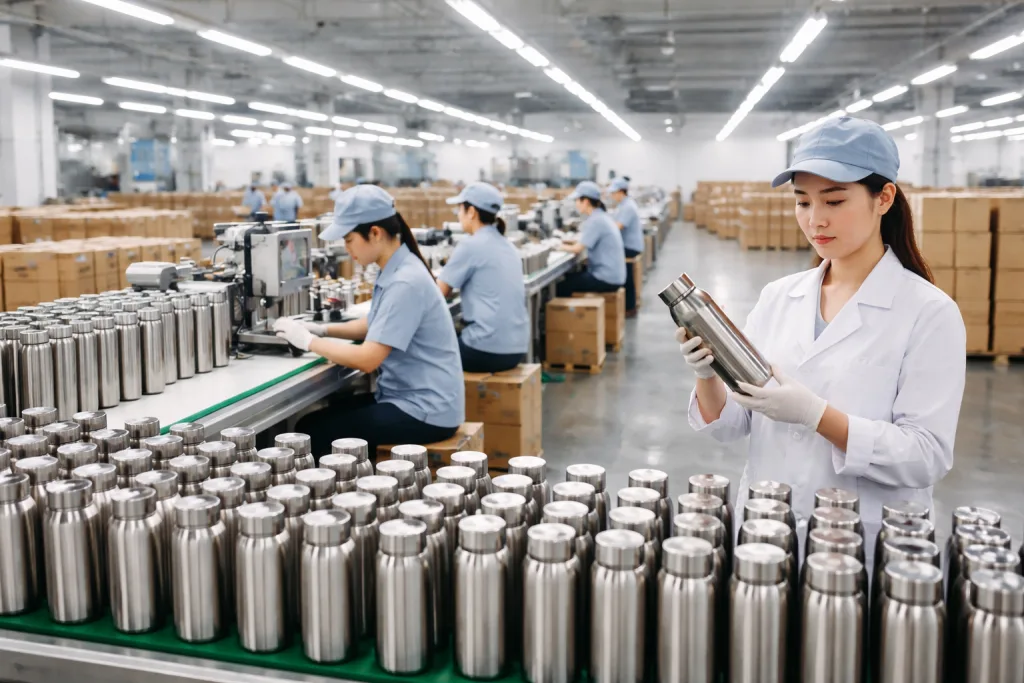
From Zhejiang, we see the same pattern every week: buyers want a custom bottle program that ships clean, not a sample that looks fine on a desk and then cracks in transit. On the line, we check the vacuum gap at 12 mm and run a lid torque test before packing. The right canteen factory puts MOQ, 18-35 day lead times, and decoration limits on the table early. The math does not work any other way.
What are you really buying?
What you buy is not just a bottle that holds heat for 12 hours and cold for 24. You are buying a production spec we can run again and again without the carton crushing in transit, the cap wobbling, or the buyer flagging the finish on arrival. A 500 ml single-wall bottle and a 500 ml vacuum insulated bottle sit in different cost bands, weigh different on the packing table, and sell to different channels. Same on a canteen customizable line versus a stainless travel tumbler. The math does not work if you lump them together.
A decent canteen supplier should split the quote into body material, lid build, insulation, finish, decoration, packaging, and test standard. We had one PO last season with “silk screem” on the artwork line; QC pulled the sample, fixed the typo, and the buyer still pushed back on the 38 mm cap because the torque felt loose. A 304 stainless steel bottle with a powder-coated finish, silicone sealing ring, and laser logo is a different job from the same bottle with a silk-screen logo and plain white box. Ask for the wall spec. A common thermal bottle body uses 0.4 mm inner and outer 304 stainless steel with vacuum sealing; thinner stock dents faster on a drop test and shows it on the line.
The mistake is treating every private label quote like the bottle alone decides the grade. It does not. Logo area, lid torque, weld consistency, and leak performance carry the sale, and we have seen this go sideways when a distributor signed off on an AQL 2.5 sample but never checked the print after 200 cycles. If you are building a custom drinkware line for retail or distributor work, check fit, finish, and print durability on the sample, then make the factory prove the same result at production scale.
How do you compare quotes?
Put private labeling thermal bottle quotes on one sheet, or you will pick the wrong supplier. We see that go sideways on the floor all the time. A quote that looks 12% lower often leaves out the cap type, lead time, carton spec, or compliance test charges. The clean way is simple: make every canteen manufacturer price the same build with the same assumptions. We run 500 ml, 304 stainless steel, vacuum insulated, one-color logo, individual box, and a fixed master carton count on the same sheet.
Use this checklist:
- Base price at FOB Ningbo or FOB Shanghai, not loose domestic pricing.
- MOQ by color and by logo method. A printed logo may start at 500 units; a custom molded lid may need 3,000+.
- Sample charge and sample lead time. A decorated sample usually takes 7-12 days.
- Packaging format. Retail box, egg crate, or bulk pack changes freight and breakage. QC pulled one carton and found a 4 mm corner crush after a 1.2 m drop test.
- Test standard. Ask for leak test, thermal retention, and coating adhesion results, not sales talk.
If you are a canteen distributor, ask whether the factory can hold the same carton spec for replenishment. Ask it early. This is the wrong question to ask too late. We saw a buyer flag a PO typo on the carton count, and the rerun cost more than the margin on the first order. On a stable line, Zhejiang factories can ship 80,000-150,000 units per month, but only when the spec stays frozen and the master carton does not keep changing.
Which decoration method fits?
For private labeling thermal bottle programs, decoration choice is where margin gets made or lost. We see it on the line every week. If the art is one solid color with a clean logo, silk screen is the low-cost route and usually beats laser marking on unit price for runs above 3,000 pcs. If the buyer wants a hard-wearing finish, laser engraving or a fired-on style print holds up better, especially for distributor drinkware sold through corporate channels. Powder coating changes the feel too. On a 500 ml bottle, a 0.35 mm logo edge looks crisp after coating, and QC pulled the sample twice when the buyer flagged the first proof as too dull.
Do not overbuy decoration. We've seen that go sideways. A canteen customized with six PMS colors, a full wrap print, and an embossed cap pushes the price up fast without lifting sell-through, and the math does not work on a basic SKU. For a typical 500 ml private label bottle, a one-color silk screen logo may add USD 0.12-0.35 per unit at scale, while laser marking may add USD 0.20-0.50 depending on complexity and batch size. If your brand expects heavy use and repeated washing, ask for scratch testing and dishwasher-cycle guidance. We run that check with a steel wool pad on the sample before we release the lot.
Practical rule: choose the simplest decoration that still looks intentional. That is how a canteen vendor protects budget and reorder consistency. For gift, event, or seasonal promotion, a promotional finish can justify stronger color focus. For retail or subscription, keep the decoration restrained and let the bottle shape do the work. The buyer once sent a PO with the logo size typed as 25 mm on one page and 2.5 mm on another; we stopped it before production. Simple wins.
What specs matter most?
Specs are where a purchase order stops being a sketch. The line has to run to numbers. For a custom thermal bottle, we look at insulation time, steel grade, seal performance, lid thread fit, and carton drop survival. A proper spec sheet says whether the bottle keeps liquid above 60°C for 6, 12, or 24 hours under one defined test method. Leave out the method, and the number is just sales copy.
Ask for these details before you approve a customized drinkware order:
- Material: 304 stainless steel is standard for food-contact parts; 316 is used when the margin supports it.
- Capacity tolerance: plus or minus 5% is common.
- Leak test: 100% vacuum and lid leak check before packing.
- Drop test: 1.0 m to 1.2 m onto hard surface for export cartons, depending on pack style.
- Finish thickness: powder coating around 60-90 microns is common for better wear.
A Zhejiang factory should quote these numbers without thinking. We run calipers on the neck finish, and QC pulled the sample if the thread jumps even 0.2 mm. If the answer is vague, the math does not work. North American buyers usually ask for ASTM-aligned test references or an internal QC report tied to a real standard, and that is the right pressure to put on us. Buyers in Europe should ask for REACH and food-contact declarations. Basic due diligence. We have seen this go sideways on a PO typo that changed the carton spec after approval.
How should packaging work?
Packaging is where a drinkware job looks cheap on paper and gets expensive after the first freight claim. We have seen QC pass a sample box, then 300 cartons land with scuffed paint and a shifted insert because the board was only 3 mm. For private labeling thermal bottle orders, the box is part of the product. If you sell through retail, Amazon FBA, or corporate gifting, lock the pack spec before the line starts running.
Start with the unit pack. Box size, insert type, and barcode position decide how the goods move through packing and inbound checks. If the program needs FNSKU or retail shelf rules, ask the canteen supplier to print the label at the right size and exact spot; one buyer flagged a 2 mm barcode drift on the PO and the scan failed at receiving. For a master carton, set carton count, gross weight, and stacking strength up front. A 50-piece master carton often ships cleaner than a 24-piece format, but only when the bottle shape and lid height leave the space.
For a canteen distributors program, packaging also drives return rates. Cheap inserts save a few cents and cost real money later. A custom drinkware pack should survive one normal drop test without crushing the cap or denting the shoulder. If the factory cannot show a carton-drop result from QC, the math does not work and you are carrying the risk on your own books.
What should your QA checklist include?
A procurement manager does not need a 30-page quality system to buy a private labeling thermal bottle well. We run a short checklist the factory can actually use on the line. Pre-production sample is the control. Bulk has to match it. Clean and simple. On one order, QC pulled the sample and found a 2 mm logo shift after the first carton drop test. That miss gets expensive fast.
Use this checklist before release:
- Confirm artwork placement, Pantone code, and logo size on the signed sample.
- Verify lid torque and open/close feel on at least 10 random samples with the torque wrench.
- Check vacuum performance after 24 hours of rest.
- Inspect coating for pinholes, bubbles, or orange peel under the light box.
- Define AQL. For export orders, AQL 2.5 major and 4.0 minor is a practical starting point.
- Ask for pre-shipment photos and carton marks before balance payment.
For a customized growler or larger thermal vessel, this checklist matters more because cap seals and shoulder dents show up fast. The math does not work if you skip them. We’ve seen a 3 mm dent pass hand feel, then fail at packing because the cap ring sat off-center by 1.5 mm. A buyer once pushed back on a gloss finish, and that was the right call. We’d rather kill an over-ambitious spec than ship a weak bottle that comes back on the first replenishment cycle. A disciplined canteen custom program is boring in the best way: same spec, same result, every shipment.
When does a custom canteen make sense?
A custom canteen makes sense when the bottle has to carry more than a logo. We run into this on a 750 ml body spec, a 38 mm mouth, a side finger groove, or a cap built for gym bags instead of gift sets. That is where a brand stops looking like a catalog item. One buyer sent over a sketch with a 1.2 mm shoulder radius; QC pulled the sample and the cap sat loose in the thread gauge. For a distributor, same deal. You want something the next factory cannot lift from its sample shelf.
Custom is not always the smart play. A full mold can land at USD 8,000-20,000 once the body, lid, and packing inserts are counted, and lead time often sits at 35-60 days before pilot output. The math does not work for every order. We’ve seen buyers ask for a new silhouette, then flinch when QC pulled the first sample and the wall thickness was off by 0.4 mm at the shoulder. A semi-custom route usually wins here: use an existing bottle body, change the lid, print or laser the branding, and set the carton art to match the channel. Fast is fine. Expensive and late is not.
The same logic applies to custom growler projects. If the channel needs a beer or beverage growler profile, we usually keep the tooling standard and spend the money on branding, a tighter packout, and a carton that ships clean. MOQ stays workable, margin stays visible, and the product can land this quarter instead of next year. We had one buyer flag a PO typo on the carton count, 2,400 pcs vs 2,040 pcs, and that is the kind of thing that blows up a launch. This is the wrong question to ask: the bottle shape is not the whole job, the supply chain is. We ship what the line can hold, not what looks good in a mockup.
What should a vendor prove before launch?
Before launch, a canteen vendor has to prove three things: the bottle matches the signed sample, the papers suit the destination market, and the line can run the same order twice without drift. Simple. That is the real gate. On our line, a 1.5 mm lid gap on a pilot run is enough to stop shipment, and we have seen that exact miss turn into a chargeback.
The proof pack should include the signed artwork proof, pre-production sample photos, the material declaration, a thermal test report, and a packing list mockup. For private label thermal bottle orders going into Europe, we ask for REACH-related declarations plus any migration or food-contact statements the buyer’s compliance team wants on file. For North America, the import packet needs to be clean before the first carton hits the warehouse. QC pulled the sample last week, checked it against the PO on a steel ruler, and found the typo was in the color code, not the bottle; that still costs a day.
“A good private label bottle is not the one with the flashiest finish. It is the one you can reorder six months later without changing the spec.”
That is the standard for canteen suppliers and canteen vendors alike. If the factory cannot repeat the build, the math does not work. We have seen this go sideways when a buyer treats the first sample like the finish line. A stable spec matters more than a one-off win. The line wants a fixed target, not a moving one.
Send your bottle spec for a real quote
Get pricing, MOQ, and lead time from a Zhejiang factory that builds private label drinkware for export channels every day.
Frequently asked questions
What is a realistic MOQ for a private labeling thermal bottle?
For a standard 500 ml private labeling thermal bottle, 500-1,000 units per style is a realistic starting point. A simple silk-screen logo usually stays near the lower end, while custom lids, special coatings, or new molds can push MOQ to 3,000 units or more. If you need mixed colors, expect MOQ to apply per color unless the canteen factory agrees to a shared production run. For first orders, many buyers keep one color and one logo method to protect cash and reduce approval risk.
How much does a custom thermal bottle cost FOB China?
For a 304 stainless, 500 ml insulated bottle with a simple logo, FOB China pricing often falls around USD 3.20-6.80 per unit, depending on finish, lid quality, and packaging. A powder-coated surface, laser engraving, or premium gift box can add USD 0.20-1.20 each. Tooling for a new lid or body shape is separate and can range from USD 8,000 upward. Zhejiang factories with stable lines can usually quote faster and more consistently than a loose trading arrangement, but you still need the full spec.
What tests should I ask for before paying the balance?
Ask for leak testing, insulation retention testing, coating adhesion, and carton-drop records. For export, a practical QC file often includes AQL inspection results, material declarations, and photo evidence of packing. If the bottle is for Europe, ask for REACH-related support and food-contact declarations. If the bottle is for North America, keep your import and marketplace paperwork aligned. A real canteen manufacturer should be able to show these documents before shipment, not after a claim.
Can I do canteen promotional orders and still keep quality acceptable?
Yes, but keep the structure simple. A canteen promotional order works best with one logo, one body color, and standard packaging. That keeps decoration cost down and improves consistency across large runs. For 5,000-10,000 units, a simple print or laser mark is usually enough for corporate gifting or event programs. If you add complex wraps, multiple colors, or custom inserts, you will raise both cost and defect risk. Promotional does not need to mean disposable.
How long does production usually take in China?
For a mature private label bottle with approved artwork, typical lead time is 18-35 days after sample confirmation and deposit. If you need custom tooling, new packaging, or a very busy season slot, allow 35-60 days. A capable canteen factory in Zhejiang may produce 80,000-150,000 units per month across several lines, but your own order still depends on spec stability, material availability, and how fast you approve proof files. Slow approval from the buyer side is the most common delay.