Key Takeaways
- MOQ for private labeling tea bottles typically starts at 3,000 units per SKU from Zhejiang factories.
- FOB prices range from $2.80 for single-wall glass to $5.50 for double-wall stainless steel with infuser.
- Sample turnaround is 10–15 days; bulk production takes 35–45 days after sample approval.
- AQL 2.5 with critical defect zero is standard for canteen suppliers serving North American and European distributors.
I watched a buyer lose $14,000 on a tea bottle order. They rushed the pre-production sample, skipped the AQL 2.5 inspection, and 2,000 units landed with lid threads that wouldn't seat. The distributor dropped them. That's not a sourcing problem—it's a process problem. If you're launching a private label tea bottle line or adding canteen customizable SKUs to your catalog, the gap between a decent sample and a clean bulk shipment is where margins get eaten.
We run this every day at BottleForge Industrial in Hangzhou, Zhejiang. Here's the working math: MOQ 3,000 units, FOB $2.80–$5.50 per unit depending on the cap assembly and wall gauge, 35–45 days production. Last quarter a buyer flagged a Pantone mismatch on the PP cap during the pre-production sample review—QC pulled it at our end, corrected the masterbatch, no reprint needed. That's the difference. This guide covers the full flow: RFQ through final inspection, with the details that actually matter when you're putting your brand on a bottle.
Step 1: Define Your Tea Bottle Specifications
Before you send an RFQ, lock the spec sheet. A private label tea bottle has to hold 95°C water without leaking, infuse loose leaf cleanly, and survive a desk-to-concrete drop. We ran a 12-day sample round once because a buyer left out the lid gasket size. Start with these points:
- Volume: 350ml, 500ml, and 750ml are the usual picks. On shelf, 500ml moves best for most retail sets we ship.
- Material: Borosilicate glass takes heat up to 150°C. 304 stainless steel is food-grade and BPA-free. Double-wall build is the standard for insulation; single wall is the wrong call for hot tea.
- Lid type: Use a flip-top with a built-in infuser basket, or a screw-top with a separate infuser chamber. The infuser mesh should be 304 stainless steel with 0.3mm holes; coarser mesh lets tea dust through, and QC pulled the sample for that on the line.
- Finishing: Print the logo by silkscreen, with 2-color max for low MOQ, or laser engrave it if you want no color limit and no peeling after 100 dishwasher cycles.
For canteen customizable products, you can also set a custom Pantone lid color or a gradient powder coat on the body. At BottleForge, we saw buyers skip these specs, then complain the sample missed the mockup by a mile. The math doesn't work. State wall thickness at 1.5mm for glass and 0.5mm for stainless steel, and call out the leak test: 5,000 open/close cycles with 90°C water. The line runs cleaner when you write it down. One typo on a PO can waste a week.
Step 2: Send RFQs to Zhejiang Canteen Manufacturers
Once the spec sheet is locked, send RFQs to the right canteen supplier. Zhejiang has a lot of drinkware factories, especially in Hangzhou and Yiwu, and the spread is wide. We had one buyer lose 6 days because the PO said “tea bottle” in one line and “canteen” in another, so the factory quoted the wrong item. Send the sheet and ask for these points:
- FOB price per unit at your target MOQ, usually 3,000 units for private labeling tea bottles. For glass, we usually see $2.80–$3.50. For stainless steel with infuser, $4.00–$5.50 is the normal band.
- Sample cost and lead time—stock samples usually run $50–$100, while a custom sample with your logo sits at $200–$400. Lead time is 10–15 days, and QC pulled the sample only after the logo file was fixed at 300 dpi. The buyer flagged the old PDF twice.
- Certifications: BSCI for social compliance, REACH for chemical safety, FDA or LFGB for food contact. Ask for the file, not a promise. A factory that cannot send the test report the same day is not ready. We keep the scanner by the office door for this.
- MOQ breakdown: Some factories will do 1,000 units for stock designs, but custom colors or logo placement usually push it to 3,000. Ask for the exact number and the extra charge. The math does not work if you guess. We saw a 1,500-unit quote jump after the Pantone code changed.
At BottleForge, we run 500,000 units a month across our drinkware lines, so we can take small runs and full containers. Still, if your MOQ is under 2,000, you pay for setup time and the line change. For a 500-unit promotional order with a logo, FOB usually jumps 30–40% above the standard MOQ price. We’ve seen that go sideways fast when the buyer pushes for a first quote that ignores pad print setup and the 12 mm lid tolerance.
Step 3: Evaluate Samples Like a Procurement Pro
You have three canteen samples on the table. Good. Test them like we run the line, not like a product page sells them. A buyer once liked a cap at first glance, then QC pulled the sample and found a 1.2 mm gap at the seal. Use this checklist:
- Leak test: Fill with 90°C water, shake hard for 30 seconds, then invert it for 5 minutes. Zero drops. We do this at the bench with a timer, and one drop is already a fail.
- Infuser performance: Steep loose-leaf tea for 3 minutes, then pull the infuser. The water should stay clear, with no sediment at the bottom. Check the mesh first: 0.3mm holes, and the basket should stay clean after three washes. If the buyer wants a finer screen, that is a new spec, not a small tweak.
- Heat retention: For double-wall bottles, measure the outer surface after 10 minutes with hot water inside. Keep it below 45°C so hands do not get burned. We run this with an IR thermometer on the line, and the math does not work if wall thickness drifts by even 0.2 mm.
- Logo durability: Scratch the silkscreen logo with a coin. If it flakes, reject it. Laser engraving should stay clean and show no wear after 100 dishwasher cycles. A PO typo on logo size has burned more than one order.
We see the same miss all the time: a buyer approves the sample on looks, then bulk lands in a different blue because the factory switched Pantone batches. That is the wrong question to ask. Ask for a color chip or a physical powder-coat sample before production, and lock it down in writing. At BottleForge, we ship a signed sample approval form that fixes material, color, logo position, and packaging before the line starts. Serious canteen work needs that paper trail, not hope.
Step 4: Negotiate the Bulk Order Contract
Sample approved. The bulk PO is where the deal gets real. We run the line off the spec sheet, and the contract has to match it line by line, from artwork to carton marks. If the PO says 304 stainless on page 2 and glass on page 4, we stop and fix it before any tooling gets touched.
- Unit price and MOQ: At 3,000 units FOB Shanghai, a private label tea bottle with double-wall glass, infuser, and silkscreen logo usually lands around $3.20 per unit. Laser engraving adds $0.30 per unit. The buyer flagged a typo on one PO last month, and we had to reissue the pricing page before the line could start. MOQ is the first number we check.
- Payment terms: Standard terms are 30% deposit with PO and 70% before shipment. For first-time buyers, we ask for 50% deposit and 50% against BL copy. One buyer pushed for 30/70 on the first deal; the math does not work when we need to buy caps, sleeves, and cartons before we even pull the first bottle. We had a cap mould run waiting on a 2,000-unit deposit before.
- Lead time: Bulk production takes 35–45 days from deposit receipt. Sea freight adds 10–15 days to the US West Coast or 20–25 days to Europe. QC pulled the sample at 42 days once because the lid gasket was 0.4 mm off, and that pushed vessel booking back a full week. That 0.4 mm matters.
- Packaging: State the inner box and the outer carton in the PO. Gift box or simple sleeve, both need to be named. For retail-ready packaging with your brand, budget another $0.50–$0.80 per unit. We shipped a canteen order in a plain sleeve once, and the buyer came back asking why the shelf looked dead. This is the wrong question to leave open.
- Quality inspection: Lock in AQL 2.5, normal level II, with critical defects = 0, major defects ≤ 2.5%, minor defects ≤ 4.0%. Third-party inspection from SGS or Bureau Veritas works, or we issue a factory report. We checked a 2,000-piece lot with calipers on the cap thread, and that caught the bad batch before loading. One gauge saved the shipment.
Put the defect clause in writing. We offer 2% free replacement for manufacturing defects, but do not assume every supplier does. For custom growler or canteen customized orders, this clause matters because the unit value is higher and one missing gasket callout turns into a headache fast. We once had a PO typo on gasket thickness, and the replacement fight lasted longer than the production run.
Step 5: Monitor Production and Pre-Shipment Inspection
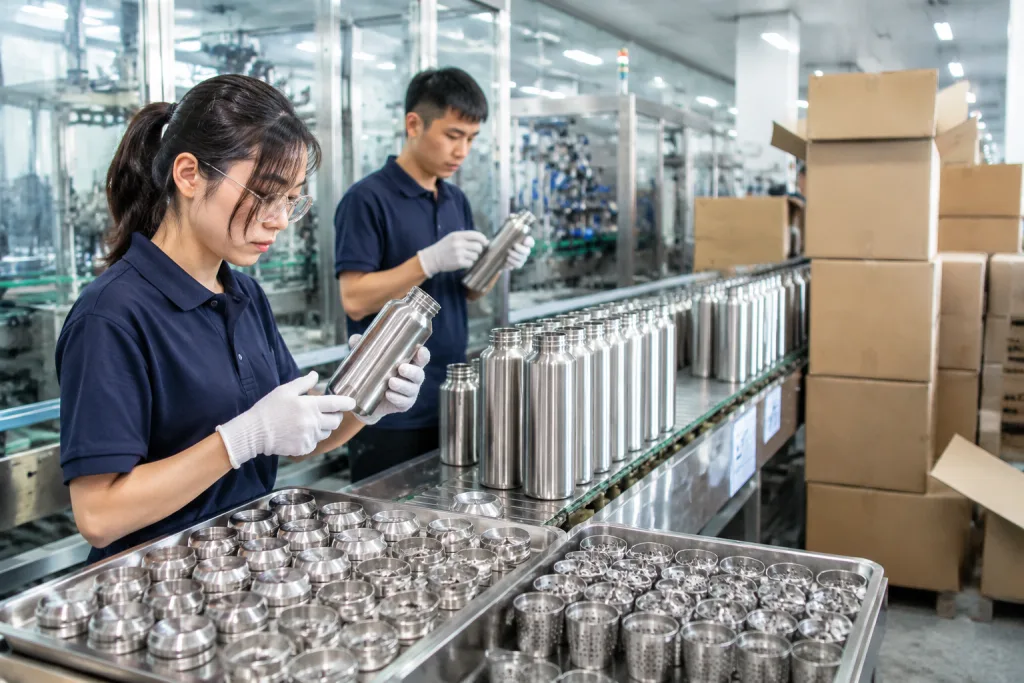
Once the deposit clears, stay on the line. We run four checkpoints: raw material in, molding done, first article signed off, final assembly packed. On one private label tea bottle order, QC pulled the sample at 9:20 a.m. and the buyer flagged a 2 mm logo shift before we shipped the rest. We send photos and short videos at each stage, from glass blowing to logo application, so nobody is guessing.
Book the pre-shipment inspection when 80% of the order is finished. That timing catches problems before the cartons are sealed. This is the right moment to check the lot, not after the truck is booked. The inspector will check:
- Appearance: No scratches, bubbles, or color variation. We use a 4-point lighting system with a D65 light source for color matching.
- Function: Random sample 125 units from a 3,000-unit order and test for leaks, lid function, and infuser mesh integrity.
- Packaging: Carton strength at edge crush test ≥ 32 lbs/inch, correct label placement, and barcode scan if applicable.
If the inspection fails, do not take a discount and move on. Ask for rework or a fresh run. We have seen this go sideways on a 6,000-piece order when the buyer accepted soft cartons. The math does not work. A pass report means your custom drinkware is packed to spec and ready to go.
Step 6: Logistics, Customs, and Market Launch
Your bulk order is packed. Now it has to move from Zhejiang to your warehouse. We usually quote FOB Shanghai or Ningbo. On a recent run, a 20-foot container to the US West Coast came in at $2,000–$3,500 and held 15,000–20,000 units of 500ml tea bottles. Rotterdam adds $1,000–$2,000 on top. Air freight is for samples or a rush reorder, not the main load. We ran one 18kg export case through QC twice because the buyer flagged a typo on the packing list. That is where the money leaks.
Customs clearance needs a commercial invoice, packing list, and bill of lading. For private labeling tea bottles, you may also need a certificate of compliance for food contact materials, with FDA for the US and LFGB for Germany. We keep those in the file cabinet with the test report, and if a supplier cannot produce them, we stop there. A PO typo once turned "500ml" into "50ml", and the broker held the shipment until the invoice was fixed. The wrong number on one line can freeze the whole carton stack.
Once the goods arrive, the launch starts. You can sell through your own e-commerce site, Amazon FBA, or a canteen distributor, but the bottle needs a clean story and a clean box. A factory in Zhejiang, inspected, branded, and shipped on schedule. That is what buyers remember. On the line, we keep the MOQ visible because launch timing breaks when inventory and ads do not match. We have seen that go sideways at 12 days versus 18 days on a reorder window, and the math does not work.
Get Your Private Labeling Tea Bottle Quote Today
Send us your spec sheet and we'll reply with FOB pricing, sample cost, and lead time within 24 hours.
Frequently asked questions
What is the MOQ for a private labeling tea bottle with a custom logo?
For most canteen manufacturers in Zhejiang, the MOQ for a private labeling tea bottle with a custom logo is 3,000 units per SKU. Some factories offer a lower MOQ of 1,000 units for stock designs (existing molds) but charge a premium of 20–30% per unit. If you need a fully custom mold (unique shape), MOQ jumps to 5,000–10,000 units. At BottleForge, our standard MOQ for a private labeling tea bottle with silkscreen logo is 3,000 units at $3.20 FOB Shanghai. For laser engraving, MOQ is the same but adds $0.30 per unit.
How long does it take to get a sample of a custom tea bottle?
Sample turnaround for a private labeling tea bottle is typically 10–15 days from spec approval. If you're using an existing mold with a custom logo, the factory will produce a stock sample with your logo applied—this takes 7–10 days. For a fully custom mold, expect 20–25 days for the first sample. At BottleForge, we charge $100 for a stock sample (refundable with bulk order) and $350 for a custom sample with your logo and Pantone color. We ship samples via DHL or FedEx, which takes 3–5 days to the US or Europe.
What certifications should my canteen supplier have for tea bottles?
For private labeling tea bottles sold in North America and Europe, your canteen supplier should have BSCI (social compliance audit), REACH (chemical safety for EU), and FDA or LFGB (food contact material certification). Additionally, ask for ISO 9001 for quality management and ASTM testing for drop and thermal shock resistance. At BottleForge, we maintain all these certifications and provide them with every quotation. If a canteen vendor can't provide these, do not proceed—you risk customs rejection or liability issues.
Can I get a custom color for the lid or body of my tea bottle?
Yes, most canteen manufacturers offer custom Pantone colors for lids and powder-coated bodies. For private labeling tea bottles, the typical MOQ for a custom color is 3,000 units per color. The cost premium is $0.20–$0.50 per unit depending on the finish (matte vs. glossy). At BottleForge, we require a physical color chip or Pantone number to avoid color mismatch. For canteen customizable products, you can also combine multiple colors (e.g., black lid with white body) but this may increase the MOQ to 5,000 units per combination.
What is the typical lead time for bulk production of a private labeling tea bottle?
Bulk production for a private labeling tea bottle takes 35–45 days from deposit receipt, assuming sample approval is complete. This includes raw material procurement (7 days), production (20 days), quality inspection (3 days), and packaging (5 days). Add 10–15 days for sea freight to the US West Coast or 20–25 days to Europe. For urgent orders, air freight can reduce transit to 3–5 days but costs $4–$6 per kg. At BottleForge, we stick to a 40-day lead time for standard orders and communicate any delays immediately.