Key Takeaways
- A basic PP private labeling shaker bottle usually starts around USD 0.85-1.45 FOB at 3,000-5,000 pcs
- Logo printing adds 3-7 days; new mold work can add 25-40 days before mass production
- For gym chains, 5,000-10,000 pcs per color is the practical MOQ for stable color matching
- Use AQL 2.5/4.0 inspection and leakage testing on every production batch
A private labeling shaker bottle looks simple until you price it. The bottle body, cap mold, mixing ball, logo method, carton mark, insert card, and inspection standard all change the landed cost. If you are buying for a gym chain or fitness brand, a vague quote like “USD 1.20 to 3.50” is not enough to plan a launch.
From our factory network in Zhejiang, China, we see buyer mistakes in two places: underestimating customization lead time, and choosing the cheapest cap design without testing leakage. BottleForge Industrial runs 80,000–120,000 sports bottles per month depending on material and decoration mix, but the right plan starts with realistic MOQ, cost drivers, and approval checkpoints.
What You Are Actually Buying
A private labeling shaker bottle quote covers more than a printed cup. You're buying a system: body resin grade, lid geometry, thread tolerance stack, mixing mechanism, measurement scale accuracy, logo application method, retail polybag, outer carton spec, and the compliance file behind it. Miss one parameter and the cost or failure risk shifts somewhere you didn't expect.
Most fitness brands start at 500 ml, 600 ml, 700 ml, or 28 oz. Body material splits three ways. PP holds the lowest unit cost—we run it for promotional giveaways where $0.12–$0.18 FOB matters more than clarity. Tritan looks sharper on a shelf but scratches if the line doesn't control ejector pin marks and conveyor handling. We've seen a buyer reject 3,000 pcs over scuffs that a PP run would have shipped without comment. A 40x loupe on the cavity surface tells you the story before molding even starts. Stainless steel (304, sometimes 201 for budget lines) lands heavier and higher retail, but the internal fillet radius at the base becomes the real issue with protein powder. Residue collects there. A dishwasher won't reach it. If the end user is shaking whey every morning, Tritan or PP is usually the cleaner answer. We've had a Dutch brand switch mid-project from 304 to Tritan after the third round of photos showing gunk in that radius—they ate the tooling cost and moved on.
Lids kill projects. A flip cap with a 0.8 mm hinge might survive the showroom and crack at 1,200 cycles. Thread mismatch—say a lid OD tolerance running +0.15 mm against a cup neck at -0.10 mm—leaks during carton vibration testing, not on the QC bench. We learned this the expensive way on a 50,000-pc order where the first container landed with a 4% leak rate. Before we quote bulk, we lock down lid wall thickness at the gate, silicone gasket Shore A hardness (usually 50±5), and a torque-leak threshold: 2.5 N·m applied, then inverted for 4 hours at 40°C. A gym chain doesn't treat a leaking bottle as a minor defect. One leaker becomes a front-desk complaint multiplied across 120 locations, and suddenly your buyer is asking for a full sort-and-rework at origin. Nobody budgets for that.
First-time China sourcing: split "visual customization" from "structural customization." Logo print, silk-screen or heat-transfer, is straightforward—2–3 days to make screens, no tooling. Changing the cap profile, adding a pill compartment, or designing a custom made shaker bottle means mold steel gets cut. That's 25–35 days for tooling, two sample rounds minimum, and a real risk of timeline creep if the first T1 sample doesn't seal. We tell buyers to budget 60 days from deposit to approval on any new cavity, and that's if nothing goes sideways. One T1 that leaks pushes everything by three weeks. I've watched a Q4 holiday launch die because someone thought 45 days would cover it.
FOB Cost Ranges That Matter
FOB pricing for a customizable shaker bottle comes down to four cost drivers: material, capacity, cap complexity, and decoration. Start with ranges, not a single target number. A 600-700 ml PP shaker with a standard mixing ball and one-color silk screen logo lands around USD 0.85-1.45 FOB China at 3,000-5,000 pcs. Tritan version? USD 1.65-2.80. Double-wall stainless jumps from USD 3.80 to USD 7.50 depending on steel grade, powder coating, and lid design. A buyer last month asked for a USD 2.50 stainless bottle — the math doesn't work at that price with 304 grade steel.
Decoration is not free, even when a supplier buries it inside the unit price. One-color silk screen adds USD 0.05-0.12 per unit. Multi-color screen printing bumps to USD 0.12-0.30. Laser engraving on stainless steel runs USD 0.10-0.25. Full-wrap heat transfer or UV printing can add USD 0.35-0.80. Need individual barcode labels, FNSKU labels, polybags, insert cards, or retail boxes? Budget another USD 0.05-0.45 per unit. QC flagged a batch last quarter because the insert card had a typo on the care instructions — check every proof.
For a bulk fitness water bottle or bulk gym water bottle campaign, the cheapest quote usually removes something important: thicker carton, leak test labor, master carton label, or spare gaskets. Ask for a costed BOM. You do not need a 12-page engineering file, but you should know whether the body is PP or Tritan, whether the lid has a silicone ring, and whether the quote includes packing suitable for e-commerce handling. We run a standard AQL 2.5 inspection on every line.
At BottleForge in Zhejiang, we quote FOB Ningbo or Shanghai most often. EXW can look lower, but you will pay the export handling somewhere else. We ship 40HQ containers weekly.
MOQ Tiers And Practical Choices
MOQ isn't a penalty. It's the factory's math for covering setup time, color change loss, print registration, and the minimum run on custom-printed shrink sleeves. For a standard custom logo shaker bottle, we quote 3,000 pcs per design as the working number. Some of our stock-color programs ship at 1,000 pcs, but you'll eat a 15-18% unit cost bump and you're stuck with whatever colors are already on the line. Want a custom Pantone body tint? 5,000 pcs per color is where the math actually works.
Here's how we scope it for fitness brands and gym chains walking into their first order:
- 1,000-2,000 pcs: Trial runs, influencer kits, a single gym location launch. Unit cost is higher. Color choices are whatever we're running that week — not yours.
- 3,000-5,000 pcs: This is the floor for one logo, standard flip-cap lid, and basic polybag packing. We shipped 3,200 pcs to a Seoul box gym last quarter at this tier.
- 10,000-30,000 pcs: Distributor-level volume. You get color stability across batches, and we can hold a dedicated injection machine for your body color through the full run.
- 50,000 pcs and up: Tooling amortization flips in your favor. Dedicated production slots. Carton optimization by pallet layer — not just by container.
A note for distributor buyers serving multiple fitness studios: six colors at 1,000 pcs each looks great in a pitch deck. We've seen it go sideways when three of those colors sit dead in a warehouse while the other three sell out in two weeks. Three colors at 3,000 pcs per SKU keeps the line moving and your inventory cleaner. Fewer SKUs, faster replenishment, fewer half-empty cartons taking up pallet space.
Custom tooling is a different animal. New cap, new body mold, a pill compartment in the base — that's not a decoration job. Tooling MOQ starts at 10,000-20,000 pcs. Mold charges run USD 3,000 to USD 15,000 depending on cavity count and side-action complexity. We quoted USD 8,200 last month for a three-cavity shaker body with a threaded storage base. The buyer's initial ask was 5,000 pcs. The mold cost alone made the per-unit math look terrible. We told them to either bump the volume or start with a stock body and focus the custom work on the lid.
Timeline From Quote To Shipment
A normal private label run takes 35-60 days after artwork approval and the deposit clears. Ocean freight is separate. If a supplier promises 15 days for a customized sports water bottle with new packaging and Pantone color, ask what they are skipping. Usually it is sample approval, lab testing, or proper QC. We've seen this go sideways — a buyer accepted a 15-day rush once, and QC pulled the sample for failing a drop test at 1.2 meters. That order got delayed anyway.
For a standard custom shaker bottle, the timeline breaks down like this: 1-3 days for initial quotation, 3-7 days for artwork layout, 5-10 days for pre-production sample, 20-30 days for mass production, 2-4 days for final inspection, and 3-7 days for export booking and loading. Add 25-40 days if you need new mold tooling. Add another 7-14 days if you require third-party lab testing for FDA, LFGB, REACH, or BPA-free claims. The math doesn't work if you skip the pre-production sample — that step catches 80% of the artwork typos and color mismatches. Last year we had a buyer skip it, and the label said "Hydration" spelled wrong on 5,000 units.
China holidays matter. Before Chinese New Year, capacity tightens from mid-December. After the holiday, factories may take 10-20 days to return to stable output. Zhejiang production is efficient, but it is not magic. If your gym chain wants bottles for a January fitness challenge, place the purchase order in October, not December. We run into this every year — buyers who wait until November end up paying air freight or missing the launch window entirely. One client paid $3,200 in air freight to get 8,000 units to Chicago in time.
Air freight can rescue a late launch, but it is expensive for bottles because the volume is high. A 700 ml bulk sports water bottle order fills cartons quickly — a 40-foot container holds about 20,000 units. For North America or Europe, plan ocean freight at roughly 25-45 days port to port depending on route, sailing, and congestion. A buyer flagged a typo on a PO last month that pushed everything back two weeks. Double-check your paperwork. One wrong digit on the port code and the container sits in Shanghai for an extra week.
Decoration Costs And Brand Finish
A logo method that doesn't match the substrate kills a bottle faster than a bad lid design. We've pulled samples off the QC table where the print looked great on flat PP panels but ghosted the moment it wrapped around a curved shaker body. Different use cases demand different approaches. A bottle sitting on a retail shelf at $24.99 needs a finish that holds up under store lighting and handling. A free giveaway at a gym counter has a different cost envelope entirely—the buyer usually cares about "good enough" at the lowest per-unit hit.
Silk screen printing handles 90% of the PP and PE shaker orders we run. One- or two-color logos, solid blocks of ink, no halftones. It survives normal hand washing and costs roughly $0.08–$0.15 per print at 3,000 units. The real constraint is registration on curved surfaces. We've had buyers submit artwork with fine 0.5pt lines that simply won't hold on a tapered bottle wall. If your logo depends on gradients or photographic detail, screen printing isn't the answer—you'll get banding and a fuzzy edge that reads "cheap" from two feet away. Heat transfer handles full-color work and wraps contours better, but it's $0.25–$0.45 per unit and needs a dedicated abrasion test. We run a simple coin-scratch check on every heat-transfer pre-production sample because we've seen prints lift after three dishwasher cycles. UV printing on plastic bottles looks crisp when the surface treatment is dialed in, but skip the flame or corona treatment and the ink flakes off inside a week.
Laser engraving on stainless steel gives a permanent, premium mark—no peeling, no fading—but it's subtle. You won't get contrast on an unpainted 304 body. For a gym bottle that's being sold, not tossed into a swag bag, powder coat the steel first, then laser-engrave through the coating. The exposed stainless underneath creates a sharp, tactile logo. We run this combination at roughly $1.20–$1.80 all-in at 2,000 units. On the plastic side, embossing or debossing a logo into a shaker body means cutting the mold. Setup runs $400–$800 for a single cavity, so the math only works at 10,000-plus units. Below that, the per-unit amortization makes your finance team wince.
Artwork approval is where orders go sideways. Every spec sheet needs four things: logo dimensions in millimeters, print position measured from the base or the parting line, a Pantone code, and a stated placement tolerance. On curved PP bottles we hold ±2 mm, and that number isn't negotiable—tighter than that and you're paying for rejects the factory won't absorb. For multi-logo gym chain programs, lock one master layout first. Approve it. Then swap in the individual club artwork files. We've cut approval cycles from 18 days to 6 days doing it this way, because the placement, size, and color spec don't move once the master is signed off.
Compliance And QC Are Not Optional
We've seen this movie: buyer hammers us for three weeks over $0.03 on printing, then Thursday afternoon fires off an email demanding FDA docs for a Monday shipment. Backwards. If that bottle holds water, whey, or pre-workout, lock down food-contact requirements before you wire the deposit. For the U.S., FDA food-contact compliance and BPA-free material statements are the baseline — but "BPA-free" is a claim, not a certificate. Get the actual test report. Not a sentence on a spec sheet. For the EU, LFGB is the floor. REACH and specific migration testing depend on material and the member state you're importing into. We've had German buyers pass LFGB and still get flagged at customs because the migration test on the silicone gasket wasn't on file. One missing document, one held container.
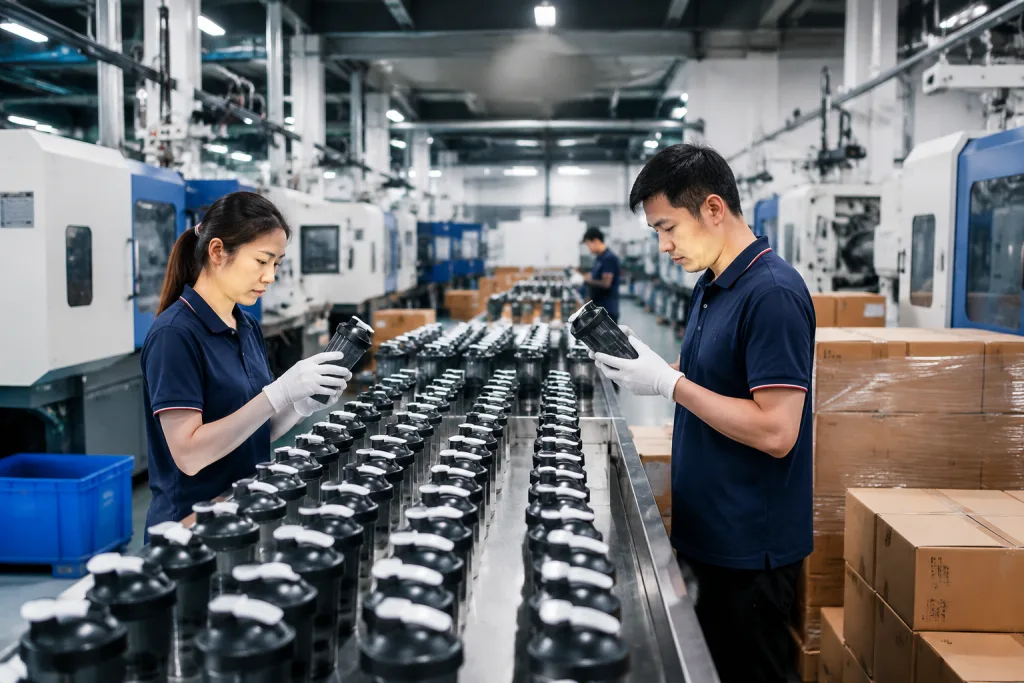
A proper inspection plan for a distributor sports bottle order hits four checkpoints: incoming raw materials, first-article approval, in-line sampling, and final random inspection. Skip the in-line and you're gambling. We caught mold misalignment at batch 200 that wasn't there at batch 20 — same mold, same operator, different shift. AQL 2.5 for major defects and AQL 4.0 for minor defects works for most orders. Some buyers push for AQL 1.5 across the board. Fine, just know it adds roughly 12% to the inspection cost and doesn't change the zero-tolerance items. Critical defects — contamination inside the bottle, sharp burrs on the rim, a cap thread that strips on first close, or a leak that pools water in the carton — those are zero tolerance regardless of AQL level. QC pulled a carton last month where the cap thread failed on sample 3 of 125. We rejected the lot. No debate.
Leakage testing is where we see the most sloppy work. Here's what we run: fill to rated capacity, close the lid at the torque spec from the cap mold datasheet — not "hand tight," because hand tight varies by three people and a lunch break — shake 30 seconds, invert 10 minutes, then pull carton vibration samples. If your factory can't tell you the design torque for the cap, that's a red flag. Walk away or send your own QC. Drop testing from 1.0 meter on filled and half-filled samples is standard. No plastic bottle survives a 2-meter drop onto concrete, and anyone who claims theirs does is selling marketing, not engineering. What you're looking for is whether the cap pops open or the base cracks — those are design failures, not abuse.
Social compliance catches buyers off guard more than anything else. The larger gym chains and supplement brands now require BSCI, Sedex, or ISO 9001 documentation as part of the vendor onboarding packet, not as a post-order checkbox. Ask your supplier for the audit certificate and the validity date before you send the PO. We've had a buyer request a Sedex SMETA audit three weeks into production — the factory's audit had expired, and the re-audit added 14 days and $2,400 to the timeline. Retrofitting compliance after production starts is slow, expensive, and entirely avoidable. The wrong question is "can you get this?" The right question is "send me the certificate with the expiry date, now."
Packing, Cartons, And Freight Math
Packing eats margin faster than most buyers pencil in. A straight polybag-and-master-carton setup costs maybe $0.03 per unit. Put it in a retail color box and you've paid for paper, blown out the carton cube by 8–12%, and opened a damage path if the box stock dips below 350 gsm. We've watched a 700 ml shaker drop from 50 pcs per carton to 42—just because the color box walls added 3 mm all around. That math runs away from you across a 40HQ.
E-commerce needs a different animal. Skip the flimsy outer. You want an individual mailer-grade box that passes a 1.2 m drop test, plus a master carton with the edge crush rating printed right on the flap. Standard 700 ml plastic shaker: 50 pcs per carton, carton dims roughly 58 × 45 × 42 cm. Those numbers move with lid height and bottle taper—don't lock them in until we've pulled the final sample. Stainless steel packs tighter at 24 to 30 pcs per carton, because weight hits 15 kg in a hurry and you need divider inserts to stop body-to-body scratching. We cap carton gross weight at 16 kg. Push past that and DHL or UPS ground handlers get rough—we've seen crushed corners spike when cartons top 17 kg on a pallet.
Marketplace sellers: send label specs before the line starts. FNSKU barcodes, suffocation warnings (mandatory for polybag openings over 125 mm), country-of-origin marks. Slapping these on after cartons are taped is a rework charge and a warehouse rejection waiting to happen. For distributor programs splitting to three DCs, we'll break carton marks and packing lists by destination. But it has to sit on the PO as a line item. If it's in a WeChat message, it didn't happen. I've had that fight more than once.
Freight on plastic bottles runs on volume. A $1.20 unit cost means nothing if oversized retail boxes push CBM 22% higher than a nested polybag pack. Before you confirm bulk, nail down four numbers: CBM per carton, gross weight, pcs per carton, cartons per 40HQ. Your logistics team can build a real landed cost from that. Without it, they're guessing—and the guess always comes in low.
How To Brief The Factory
A clear RFQ beats hard negotiation. Send "need price for customizable fitness water bottle with logo" and quotes come back anywhere from $0.55 to $2.10. The factory either quotes cheapest PP or pads the number for unknowns. Neither helps you.
For a quote we can actually build from, send: capacity in ml, material preference (Tritan vs PP vs 304 stainless), target market (US gym chain or EU supplement brand?), logo method — pad print, screen print, or in-mold label, Pantone number, packing type, annual forecast, first order quantity, compliance docs needed, delivery deadline. Comparing a customized fitness water bottle, customized gym water bottle, and customized sports water bottle in one campaign? Ask the factory to quote all three as a range with identical assumptions. The real cost difference becomes visible. The sports bottle typically runs $0.12 more per piece due to the loop lid and wider mouth.
Give us a target FOB range. Some buyers hide the budget, afraid the supplier prices up to it. We've seen this go sideways. A target like "USD 1.30-1.60 FOB for 5,000 pcs" tells the engineer which material, wall thickness, and lid structure work from day one. Target $0.80 for a Tritan bottle with silicone seal? A good supplier tells you the math doesn't work — then shows the trade-off in wall thickness or lid type.
For gym chains, decide early: giveaway, member retail item, or premium loyalty product. One buyer tried using a single SKU for promo and retail. We ran the numbers. The retail-ready bottle with shrink-wrap sleeve and individual packing cost 40% over the bulk polybag version. Giveaways run simple PP with one-color pad print. Retail custom gym water bottles need better finish, tighter inspection, a box that survives transit. One SKU doing every job ends up too expensive for promotion, too basic for retail.
Send Your Shaker Bottle RFQ For Real Costing
Share capacity, quantity, logo, packing, and target market. We will return a practical FOB quote and lead-time plan.
Frequently asked questions
What is the normal MOQ for a private labeling shaker bottle?
For a standard PP or PE shaker with your logo, the normal MOQ is 3,000 pcs per design. If you accept stock colors and simple one-color printing, some projects can start at 1,000-2,000 pcs, but the unit price may be 10-25% higher. For custom Pantone body colors, 5,000 pcs per color is more realistic because resin mixing and color changeover create waste. If you need a new cap, new body shape, or molded logo, plan for 10,000-20,000 pcs and tooling charges. For distributors shaker bottle programs, we usually recommend fewer colors at higher volume instead of many small SKUs.
How much does a custom logo shaker bottle cost from China?
A basic 600-700 ml PP custom logo shaker bottle is often USD 0.85-1.45 FOB China at 3,000-5,000 pcs with one-color silk screen printing. Tritan usually runs USD 1.65-2.80 depending on clarity, thickness, and lid structure. Stainless steel shaker or sports bottle designs can range from USD 3.80 to USD 7.50. Packing changes the number: a retail box, insert card, barcode label, or FNSKU label can add USD 0.05-0.45 per unit. The safest way to compare quotes is to ask each supplier for material, capacity, decoration, packing, carton quantity, and inspection standard in writing.
How long does production take after we approve the sample?
For a standard customized shaker bottle, mass production usually takes 20-30 days after sample approval and deposit. Add 5-10 days before that for pre-production samples, and 2-4 days after production for final inspection. If you need new mold tooling, add 25-40 days before the first approved sample. Lab testing for FDA, LFGB, REACH, or BPA-free claims can add 7-14 days depending on the test lab. Ocean freight to Europe or North America often adds 25-45 days port to port. For a fixed gym launch date, work backward and allow at least 70-100 days total.
Which material is best for a gym chain shaker bottle?
For a gym chain giveaway or member onboarding kit, PP is usually the best cost-performance choice. It is light, economical, and suitable for large bulk gym water bottle orders. For a retail product, Tritan gives better clarity and a more premium feel, but it costs more and needs better scratch control during packing. Stainless steel is strong for a custom sports water bottle line, especially with powder coating and laser engraving, but it is heavier and not always ideal for mixing protein powder. If your bottle will be sold at reception for USD 8-15, Tritan or a higher-grade PP structure is usually worth considering.
What quality tests should we require before shipment?
At minimum, require a final random inspection using AQL 2.5 for major defects and AQL 4.0 for minor defects. Critical defects should be zero tolerance. For shaker bottles, leakage testing is essential: fill to rated capacity, close the cap, shake for 30 seconds, invert for 10 minutes, and inspect for seepage. We also suggest cap hinge cycling, thread fit checks, logo adhesion testing, dishwasher simulation if claimed, and 1.0 meter drop testing on selected samples. For EU or U.S. sales, confirm food-contact documents before production starts, not after cartons are packed.