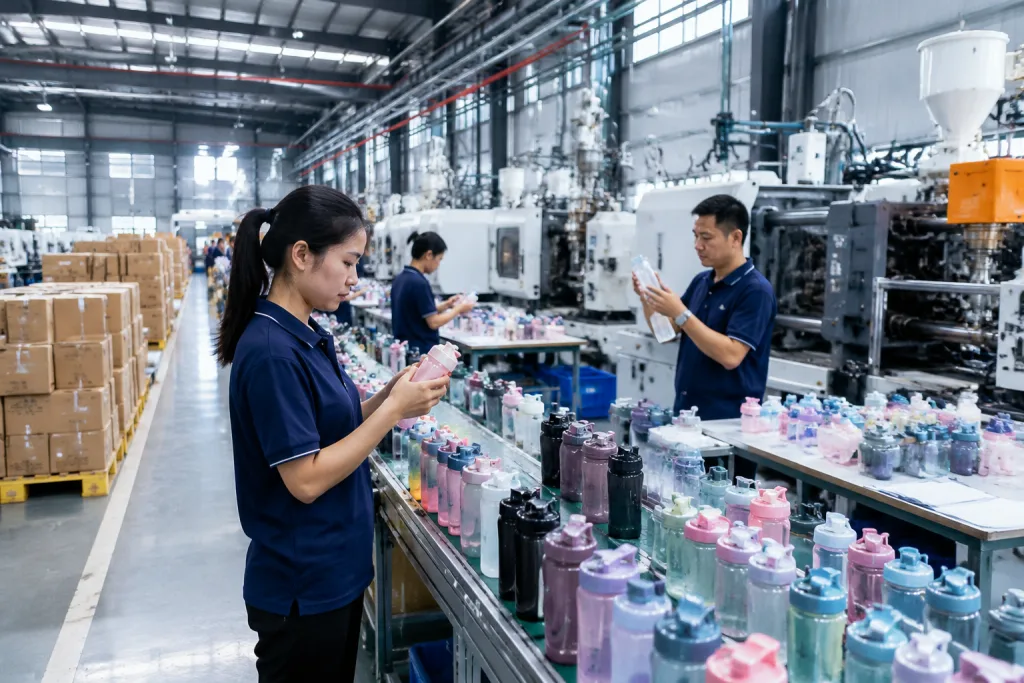
Key Takeaways
- Start with the use case: PP bottles usually fit 500 ml to 1,200 ml, with 0.8-1.5 mm wall thickness depending on durability needs
- Expect practical MOQ from 3,000 pieces per color for standard molds and 10,000-30,000 pieces for new color or custom mold work
- Decoration choice affects durability: silk screen is cheaper, heat transfer gives more coverage, and IML needs higher volume
- A serious canteen factory should quote AQL inspection, food-contact compliance, carton drop testing, and a 25-45 day production window
A private labeling polypropylene bottle looks simple until the PP grade is wrong, the logo rubs off after 30 alcohol wipes, or the master carton splits during a retailer drop test. We see it on the line. Last April, QC pulled 12 samples from a 3,000-piece pilot run because the silk-screen logo lost ink after the third MEK tape check. For B2B buyers, finding a canteen supplier in China is not the hard part. The hard part is locking the spec before we release the mold, printing screen, and carton dieline, because that is where margin, shipment date, and brand reputation get protected.
At our Hangzhou, Zhejiang factory, we see this purchasing mistake 3 or 4 times a month: the buyer asks for the lowest FOB price before confirming where the bottle will be used. Wrong first question. A school canteen customized for children may need a lighter 450 ml body, a rounded cap edge, and barcode placement checked by QC with a 0.5 mm tolerance gauge. A distributor canteen for outdoor retail needs thicker walls and a cap that survives drop testing. A canteen promotional bottle for events needs cheaper packing, faster line speed, and an MOQ the buyer can actually move. We run these jobs differently. The math does not work if one spec is forced across all three just to save USD 0.03 per piece, and we have seen that go sideways when QC pulled the sample after the carton barcode sat 6 mm too low.
Start with the buying decision
The buying decision for a private-label PP bottle is four questions, not one. Who holds the bottle. Whether it ships for a single summer promotion or sits on a retail shelf for 18 months of reorders. What the logo measures in mm across the widest point. And which compliance file—FDA, EU 10/2011, LFGB, CPSIA—your customer requests before they release payment. These four answers determine the PP resin grade, the mold approach, the cap design, the decoration tooling, the packaging drawing, and whether we inspect to AQL 2.5 or 1.5. We've seen it break: a buyer asks for a price first, then sends a 45 mm logo after the silk-screen fixture is cut. Now the fixture is scrap, and the timeline slips 7 days.
PP—recycling code 5—makes sense for lightweight sport bottles and canteen programs where budget and drop survival matter more than temperature retention. It costs less than stainless, survives drops that crack Tritan, and handles warm-fill up to about 70°C without deforming. Wrong application? Vacuum insulation, boiling water, or a premium growler where 12-hour cold retention closes the sale. Last week QC pulled a PP sample after a 1.2 m drop onto concrete. The bottle body was fine. The flip-cap hinge showed a white stress mark at the gate. That's a mold-flow issue, not a material failure, but the buyer flagged it and we re-ran the gate design before PPS sign-off.
Frame the project before you request pricing from canteen manufacturers. Four buckets:
- Retail or promotion: Retail means color-box artwork, barcode control, surface finish tighter than a promo bottle, and defect sorting that catches scuffs a promotional buyer ignores. Promotional orders typically ship in bulk cartons with a one-color logo, but dark matte colors still show scratches under warehouse lighting, and we've had buyers reject on that.
- Child, sport, or outdoor: Kids’ bottles trigger bite-safe spout geometry and ASTM F963 / CPSIA review for the US. Outdoor buyers care about leak resistance and clip strength. We run a 24-hour inverted leak test on cap assemblies before approving the pre-production sample, not after.
- One-season or repeat SKU: A reorder SKU needs mold ownership terms, Pantone tolerance locked to a physical standard, and packaging drawings with carton dimensions in mm. A repeat SKU with loose color approval drifts by the second shipment. We've measured 2.3 ΔE on a third reorder where the buyer never signed a limit sample.
- Importer or distributor: A distributor drinkware program runs on stable master carton dimensions and predictable replenishment lead times, not a cheap first order. One PO arrived listing 48 pcs per carton while the approved packing spec said 60 pcs. That typo held container booking for two days while both sides re-confirmed.
A standard PP bottle line in Zhejiang runs 80,000 to 150,000 units per month, depending on shape complexity and cap assembly. That capacity only helps if the specification is frozen early. Changing color, logo size, or cap material after PPS approval adds 5–10 days. If the cap insert mold is already on the press, the math doesn't work—you're paying for tool change downtime and wasted pre-forms. We ship fastest when the buyer locks Pantone, logo position, and carton mark before we cut the screen film.
Choose the PP grade and structure
The first technical choice is resin grade. Food-contact PP must be specified clearly — don't assume it. For Europe, ask your canteen manufacturer for material declarations aligned with EU food contact requirements and REACH/SVHC status. For North America, request FDA food-contact confirmation and, where relevant, California Proposition 65 review. If the bottle is for children, add CPSIA and ASTM-related checks based on age grading and components. One buyer we worked with skipped the Prop 65 check on a lid liner. QC pulled the sample six weeks later — the liner had trace styrene. That cost us a reorder.
Most private label PP canteen bottles use injection molding, extrusion blow molding, or a combo of molded body and separate cap. Injection-molded parts give cleaner threads — cap crossthreading drops to near zero. Blow-molded bodies run faster for larger lightweight shapes, but you lose thread precision. The right choice depends on volume, cap complexity, and whether you need a translucent or solid-color body. If your cap has a flip hinge and a lock tab, injection is safer. We've seen blow-molded caps snap on drop test at 1.2 m.
For general canteen customizable programs, we normally discuss these specification ranges:
- Capacity: 500 ml, 650 ml, 750 ml, 1,000 ml, and 1,200 ml are common retail sizes. 750 ml moves fastest in EU school tenders.
- Wall thickness: 0.8-1.0 mm for low-cost promotional use — these go 12 days from mold to pallet. 1.1-1.5 mm for outdoor or school use. The 1.2 mm midpoint is the sweet spot for drop height vs. material cost.
- Cap seal: silicone gasket is preferred for leak resistance. TPE is possible but must be checked for odor and compliance — we rejected a batch last quarter because the TPE smelled like burnt rubber after hot fill.
- Temperature claim: avoid exaggerated claims. PP is fine for normal warm drinks, but we do not recommend boiling water claims unless the exact structure is tested. One client put "100°C safe" on the label before the mold was cut. The cap warped at 85°C. The buyer flagged it.
A good canteen supplier should also tell you what cannot be done. Very sharp square shoulders may look clean in a rendering but create uneven wall thickness in production — you'll see thin spots at the corners in the first 50 pieces off the line. A translucent body with heavy pigment can show flow marks, especially around the base. A wide-mouth canteen customized with a flip cap needs extra drop testing because the hinge becomes the weak point. We run 10 drops at 1.5 m before we sign off on that geometry. If the hinge cracks on drop 8, the math doesn't work for a school contract.
Decide how private label should look
Branding is where most private-label PP bottle programs bleed margin. A buyer asks for a large wraparound logo, the factory quotes a low unit price, and nobody brings up rub resistance, registration tolerance, or how the ink sits on a curved PP surface. PP has low surface energy — roughly 30 dynes/cm untreated. That means a corona treater and a solvent-based ink. Not a standard water-based screen print. Skip this step and the decoration flakes off in transit. We've pulled samples from a new line where half the logo was gone before the carton was opened.
Here's what actually works on the production floor for custom drinkware:
- Silk screen printing: good for one to three colors, simple logos. MOQ runs around 3,000 pieces per color. The math works if the artwork avoids tiny serif text and large coverage gradients. One buyer sent artwork with 8-pt font on a 500ml bottle — QC couldn't read it, and we had to stop the line to re-approve a modified stencil.
- Heat transfer: handles multi-color artwork and wraps around the body better than screen print. Adds $0.12–$0.18 per bottle depending on coverage. For a custom canteen or customizable canteen program, this gets you a retail shelf look without tooling commitment. We run this on our semi-auto transfer machine with a silicone roller at 180°C — the adhesion is night-and-day different from a cold peel.
- In-mold labeling: the label fuses into the wall during injection. Scratch resistance is excellent. No peeling edge. But you need 20,000 pieces or more per design for the economics to work. We don't recommend it for a first order — the mold insert alone locks you in before you've validated the market.
- Embossed or molded logo: clean, durable, zero ink to fail. Mold modification runs $800–$1,500 depending on cavity count. Not for a 500-piece test. A buyer once asked for this on a 1,000-piece PO and the per-unit amortization pushed the bottle cost past what made sense for their channel.
For a canteen promotional order, a single-color silk screen logo gets the job done. For a retail distributor line, heat transfer or IML looks better on shelf — side-by-side, the difference is obvious. Amazon? Keep the logo readable in the front thumbnail at 150×150 pixels. Physical store? The side panel and hang tag do the selling; the front logo just needs brand recognition.
Demand decoration testing on the approved sample — not on a flat test panel. We run 3M tape adhesion, alcohol rub with a weighted cloth (50 back-and-forth cycles), and visual check under D65 lighting. The AQL inspection covers logo position tolerance within 1.5mm, color deviation against a signed sample, ink pinholes over 0.3mm, and scratches. These sound like small details. They're what separates custom drinkware from giveaway stock. We've seen a 30,000-piece shipment get rejected at the port over a 2mm logo shift — the buyer flagged it against the signed sample and the entire lot went to dispute.
Set MOQ, price, and tooling logic
A factory's MOQ isn't arbitrary. It's driven by resin minimum purchase lots, color-change purge cycles, screen setup waste, cap sub-assembly runs, and whether the packing line hits 2,200 pieces per hour or stalls at 1,400. Any quote worth reading separates standard-mold capacity from custom-mold capacity. If three suppliers all parrot "low MOQ no problem," you still have no purchasing basis. Push harder.
For standard PP bottle molds, 3,000 pieces per color is a real starting point for private-label printing. We've run 1,200-2,000 pieces when the body color stays stock and the logo is a single-color silk screen, but the unit price climbs because setup loss gets spread thin. Once a buyer specifies a new Pantone match, 5,000-10,000 pieces is the floor. Masterbatch blending and purge scrap eat margin below that. For a new mold, first production run typically lands at 10,000-30,000 pieces. A 650 ml single-wall bottle with a simple cap hits the low end; a 750 ml double-wall with a flip-top and locking ring pushes toward the high end. We've quoted 18,000 MOQ on a custom mold after the buyer added a second silicone gasket and a finger loop—tooling complexity drives volume.
FOB pricing moves with resin cost, cap design, decoration layers, and packaging spec. A 650 ml PP bottle with a one-color logo, bulk-packed in a master carton, runs roughly USD 0.75-1.25 FOB Ningbo. A 1,000 ml bottle with a silicone seal, separate retail box, hang tag, and multi-color heat transfer often lands at USD 1.60-2.80. Tooling splits cleanly: USD 2,000 for a simple cap insert, USD 12,000-35,000 for a full new body-and-cap mold set. We once quoted USD 8,500 for a cap mold alone because the buyer wanted a child-resistant push-and-turn mechanism with three internal detents. Small detail, big steel cost.
Stop comparing bottle unit price. Compare landed cost per sellable unit. We shipped a 40HQ to Long Beach where better retail packaging cut carton crush damage from 3% to 0.8%. That saved more than a USD 0.05 price shave ever could. Distributors also need replenishment predictability. A factory that holds color within Delta E 1.5 and keeps carton dimensions stable across three production runs is worth a higher FOB. QC pulled a sample last month where the second run drifted to Delta E 2.3 on a navy blue. The buyer flagged it immediately. We re-ran the batch. Consistency costs something.
Match compliance to your market
Compliance is market-specific. Destination country, user age, and sales channel each pull a different document stack. A polypropylene bottle sold to a Canadian gym chain doesn't need the same paperwork as a kids canteen going to a US big-box retailer. We had a buyer spend $4,000 on EU migration tests for a product that ships exclusively to Texas — pure waste. The opposite mistake stings harder: one buyer skipped CPSIA third-party testing on a bottle clearly marketed to children 12 and under. US Customs held the container. Demurrage hit $18,000 before it cleared.
For Europe, start with an EU food-contact declaration backed by test reports. If Germany drives the bulk of your volume, add LFGB sensory and migration testing — the EU framework regulation alone won't satisfy a German retailer's compliance team. REACH SVHC screening (224 substances as of early 2025) and packaging material declarations fill out the file. For the US, FDA 21 CFR food-contact support is the floor. Add California Proposition 65 screening if the bottle uses colored PP, a painted decoration, or a TPE gasket — phthalates and heavy metals concentrate in those materials. Products marketed to kids require CPSIA third-party testing at a CPSC-accepted lab. We run this on children's canteens with bite valves and straws, plus ASTM F963 mechanical checks on small parts. For Canada, we point buyers to a local lab partner for CCPSA and food-contact review. The regs overlap with FDA but aren't identical, and a Canadian importer of record should own that verification.
Factory audits don't prove a bottle is compliant. They prove whether the management system can produce consistent compliance evidence. BSCI, Sedex SMETA 4-pillar, ISO 9001:2015 — standard asks on distributor drinkware programs. At our Hangzhou plant, we run inspection gates at six points: incoming resin lot verification (we check melt flow index against the supplier COA), injection parameter logs, assembly torque on lid threading, pneumatic leak testing at 0.3 bar, decoration adhesion, and final packing. QC pulled a batch last month because the torque reading drifted 0.4 N·m after a mold change. That discipline matters before your compliance docs ever reach a buyer's desk.
Request a compliance matrix before the first sample ships. One sheet. Columns: test item, standard, sample quantity, lab name, cost owner, lead time. We fill these out with buyers during quoting because the math gets ugly if you delay. Testing after mass production is the wrong move. If a silicone gasket fails LFGB odor testing or a masterbatch pigment triggers a restricted substance flag, you're facing rework or scrap on 5,000 finished bottles. Catch it on a pre-production sample and the fix costs a $300 retest and two weeks.
Build packaging for real logistics
Packaging is functional freight. On a private-label PP bottle order, the box determines barcode scan rates, warehouse putaway speed, whether a retailer accepts the shipment, and whether Amazon flags it for FBA damage. A bottle that comes off the line clean but lands with a crushed retail box still lands on your P&L.
What we spec depends entirely on channel. Bulk promo orders ship in individual polybags inside export master cartons—done. Retail shelf placement calls for a color box, belly band, hang tag, or kraft sleeve. E-commerce needs a sturdier single-unit box with a flat barcode zone and an ISTA-6 drop expectation. If FNSKU labels are in play, send us the artwork before production starts. Confirm label position on both the unit pack and the master carton. We had a buyer skip this last year and eat 8,000 re-labels at their 3PL. The math was ugly.
Master carton spec is a cost-vs-claims decision. PP bottles in export handling—rough port transloading, container sweat, stack pressure—get 5-ply corrugated, especially when carton weight crosses 12 kg. 3-ply works for sub-500 ml bottles, but the 15-cent saving per carton evaporates the first time a pallet gets rejected. We drop-test from 60–80 cm based on carton weight and buyer spec. Bottles with flip lids or belt clips need orientation locked in. Last month QC pulled a sample where the lid punched through the kraft sleeve on the first drop. We rotated the bottle 90 degrees and it passed clean.
For canteen distributors, pallet cube drives landed cost harder than unit price. A 1,000 ml bottle pencils out on margin until you realize the carton dimensions eat 12% more container space than the 750 ml SKU. Ask for carton dims, gross weight, net weight, and units per 20GP, 40GP, and 40HQ. FOB Ningbo or FOB Shanghai is standard out of Zhejiang. If your DC runs automated receiving, carton label consistency is not a nice-to-have. We load roughly 1,200 cartons per container. One digit wrong on the PO number and the scanner dumps the pallet into exception handling. SKU, PO number, item number, quantity, gross weight, country of origin—every field has to match the packing list line for line.
Use samples to remove doubt
Sampling kills doubt before it hits your deposit. For a private-label PP bottle, run three stages: existing sample, artwork sample, pre-production sample. Skip the pre-pro and you save about a week. We've watched that week turn into re-runs on color matching, logo registration, or cap torque—the math doesn't work.
An existing sample gives you hand feel, wall thickness, cap operation, and a rough sense of capacity—but it won't use your final resin or your logo. The artwork sample nails down print size, placement, and color on whatever stock bottle we pull from the shelf. The pre-production sample is the one that matters: final resin grade, final colorant batch, final cap, final silicone gasket, final decoration, final polybag and carton. That's your approval standard. We had a buyer approve artwork on a plain white 500 ml bottle back in 2023. QC pulled the pre-pro off the line and caught a 2mm logo shift—nobody spotted it on the artwork sample because the bottle body curve wasn't identical.
Check samples like a buyer, not a designer. Fill it to the fill line. Cap it. Shake it upside down for 30 seconds and look for drips. Set it on white copy paper for two hours—any seepage shows immediately. Open and close the cap 50 times. Sniff the interior for off-gassing from the resin or colorant. Scratch the logo with a fingernail. Measure actual capacity to the fill line with a graduated cylinder, not brimful. If you're selling it as 750 ml, the practical fill better back that up. One importer flagged a bottle marked "750 ml" that only held 705 ml to the fill line. That's a retail claim problem, and in some EU markets, it's a non-conformance.
Our timeline out of Zhejiang: 3–7 days for available stock samples, 7–12 days for logo samples once artwork is approved, then 25–45 days for production after deposit and pre-pro sign-off. Summer promo season compresses everything. If your retail shelf date is May, approving samples in late March is already tight. Resin procurement takes what it takes. Printing cure time doesn't bend. Inspection needs a window. Vessel booking doesn't wait. A canteen factory can't shrink that chain without pushing risk into your shipment.
Control production without micromanaging
I've never seen a private label PP bottle project fail because a buyer watched the injection machines too closely. I've seen 30-plus fail because nobody agreed what "done" meant. The controls that matter are simple: golden sample sign-off with a signed label on the sample bag, incoming PP resin check against the material COA, first-article inspection with calipers on neck ID and thread height, in-process leak testing (at least one pull per cavity every 2 hours on a 24-cavity tool), decoration inspection, packing audit, and final AQL inspection. Put it in the PO or quality agreement before we cut tooling. After steel is on the CNC, late control language gets expensive.
AQL levels need to match where you sell. We default to AQL 2.5 on major defects and 4.0 on minor defects, zero critical defects accepted. Major means the bottle leaks, the logo is wrong, the color is off by more than a Pantone shade, the cap is cracked, there's a sharp burr on the parting line, or the packaging doesn't match the spec. Minor covers light surface scuffs, print registration drifting 0.5 mm inside tolerance, and carton rub marks from the strapping machine. For a premium retail run, say a branded canteen going onto a shelf at REI, you can tighten to AQL 1.5/2.5, but the factory will charge for the extra sorting time. That's fair. The math falls apart when you're rejecting 8% of a 10,000-piece order over hairline scratches nobody's customer will notice, and we've seen this go sideways during rework at 9 p.m. on the packing line.
Ask for production photos. Then verify them. We send line shots mid-run, usually with the cavity-number tray and leak tester visible, but a photo won't tell you if the barcode scans or if three cartons in the middle of the pallet got crushed. A third-party inspection before shipment runs USD 180-350 per man-day in China. For a first order of 3,000 custom PP bottles, that's about 1.5% of the invoice. The inspector pulls cartons at random, checks quantity, appearance, function, packaging, barcode readability, carton marks, and drop test if your spec calls for it. I've had inspectors catch a wrong neck finish on 20% of the units after QC pulled the sample and missed the thread gauge mismatch entirely. That one day paid for itself.
A good supplier relationship is practical. You send clear artwork, compliance targets (FDA, LFGB, whatever your market needs), packaging files, and dates that account for a 4-week mold trial plus 2 weeks of decoration sampling. We send back honest manufacturability feedback, such as "this wall thickness will sink" or "that print location puts registration marks inside the mold parting line, move it 3 mm," plus stable production and transparent problem reporting. This is the wrong question to ask: "Can you just make it like the sample?" Better ask what tolerance we run on the neck, what MOQ fits the color batch, and whether the cap torque passes after 24 hours. That's how one PP bottle order turns into a repeat distributor program across 1 L growlers, shelf-ready canteens, and shaker cups with separate lid tooling. The alternative is a PO that goes quiet for six weeks and then blows up three days before the vessel sails. We've seen both.
Send your PP bottle specification for a factory quote
Share capacity, logo method, market, packaging, and target quantity. We will reply with MOQ, FOB pricing, lead time, and sample plan.
Frequently asked questions
What MOQ should I expect for a private labeling polypropylene bottle?
For standard molds, 3,000 pieces per color is a realistic MOQ for a simple logo order. If you use a stock body color and one-color silk screen printing, some factories may discuss 1,000-2,000 pieces, but the FOB price usually rises because setup cost is spread over fewer units. For a new Pantone body color, plan around 5,000-10,000 pieces. For a new bottle or cap mold, the first run is usually 10,000-30,000 pieces, plus tooling cost. A canteen supplier quoting 500 pieces for full custom color, custom packaging, and low price is probably hiding cost or risk somewhere.
Is polypropylene safe for food-contact drinkware?
Food-grade PP is widely used for drinkware, lunch boxes, lids, and sports bottles, but safety depends on the exact resin, pigment, gasket, ink, and production control. Ask for food-contact declarations and test reports that match your market. For Europe, buyers often request EU food-contact, LFGB where needed, and REACH/SVHC screening. For the US, request FDA food-contact support and Proposition 65 review when applicable. If the product is intended for children, CPSIA and age-related mechanical safety checks may be needed. Do not accept a generic “BPA free” statement as a complete compliance file.
Which logo method is best for a PP canteen promotional order?
For most canteen promotional orders, one-color silk screen printing is the best cost-to-result choice. It works well at 3,000 pieces and above, especially for simple logos under about 80 x 120 mm. If you need full-color artwork, gradients, or larger wraparound graphics, heat transfer is usually better but adds cost and sampling time. In-mold labeling gives a strong retail look, but it normally needs higher volume, often 20,000 pieces or more per artwork. Whatever method you choose, approve a decorated curved sample and ask for adhesion and rub checks, not only a digital mockup.
How long does production take after I approve samples?
For a standard private label PP bottle, mass production usually takes 25-45 days after deposit, artwork confirmation, and pre-production sample approval. Available samples can ship in 3-7 days. Logo samples commonly take 7-12 days. Add time for lab testing if your retailer requires new reports; this can add 7-15 working days depending on the test scope. Peak season before spring and summer promotions can extend lead time. If you also need ocean freight to Europe or North America, build the project backward from your warehouse date, not your purchase order date.
Can the same supplier make PP bottles and other custom drinkware?
Some canteen manufacturers focus only on plastic molding, while broader custom drinkware factories or groups can also support stainless steel tumblers, sports bottles, glass bottles, and custom growler projects. The advantage of using one coordinated supplier is artwork consistency, shared packaging standards, and easier replenishment planning. The risk is assuming every category uses the same process. PP bottles, stainless vacuum items, and glass bottles need different testing and tooling logic. Ask the supplier for category-specific capacity, QC flow, and compliance experience before combining programs under one purchase order.