Key Takeaways
- For private labeling military canteen projects, 1,000-3,000 pcs is a realistic MOQ for most custom colors and logos
- 304 stainless steel canteens usually cost more than HDPE models but support higher perceived retail value
- Laser engraving is safer for long-term branding, while silkscreen is cheaper for 1-color canteen promotional orders
- A serious Zhejiang canteen supplier should confirm AQL level, material certificates, leak testing, and packing specs before deposit
A military canteen looks simple. Try putting a private label on one, though, and the PO gets messy fast. 304 stainless or Tritan? Single-wall or vacuum insulated? Screw cap only or cap-with-cup set? Laser logo or molded mark? Retail box or 24-piece bulk carton? One missed spec hits the bottom line. Last month, a buyer flagged a 0.3 mm gap on a cap liner drawing. Sample sat upside down for 30 minutes on the QC bench—failed the leak test cold.
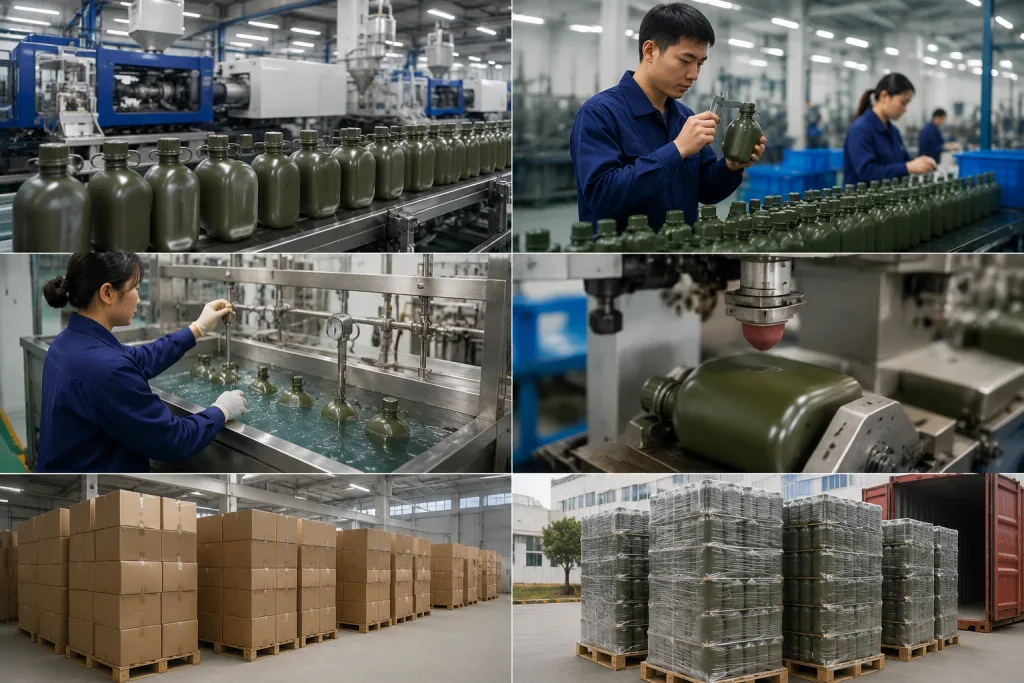
We run canteen production in Hangzhou, Zhejiang. On the line, we see the same pattern: buyers chase unit price, then pay later. Leakage. Coating chips. Missing compliance files. Cartons crushed at the corners. QC pulled the sample. A canteen that's 2% cheaper isn't cheaper when it means 38 reworked cartons before shipment. We once caught a PO typo—“matte black” became “matt back.” The coating team stopped the run before 3,000 bodies got sprayed wrong. China can supply most custom canteen formats. But only a handful of factories are set up for private labeling military canteen orders with controlled AQL, stable lead time, and export-ready paperwork.
How We Rank Canteen Options
A “best” canteen for private label is rarely the one that looks toughest on the sample table. It’s the one that matches your buyer profile, your channel, your compliance exposure, and your landed cost math. A distributor canteen headed to outdoor retail has different specs than 5,000 giveaway pieces for a security expo. Government-style tenders care more about uniform pantone matching and carton marks than retail hang tags—we’ve seen a $14,000 order held at port over a wrong shade on the lid, so this isn’t theoretical.
We rank the five options below the same way we evaluate canteen inquiries every week at BottleForge Industrial in Zhejiang: material reliability, tooling risk, logo flexibility, MOQ, FOB price range, packing efficiency, and after-sales exposure. Our floor runs about 480,000 drinkware units a month across stainless bottles, travel tumblers, custom growler lines, and canteen projects. Standard private label lead time lands at 25–35 days after artwork approval for repeat molds, and 45–60 days when new tooling or a specialty coating like cerakote enters the workflow.
Here’s the scoring logic we actually use on the line:
- Fit for purpose: field use, retail shelf, promotion, camping, or distributor replenishment.
- Branding control: laser engraving, silkscreen, pad print, heat transfer, embossing, or molded logo.
- Compliance: LFGB, FDA, REACH, CA Prop 65, BPA-free claims, and food-contact documentation.
- Production risk: leakage, cap tolerance, coating scratches, denting, color drift, and carton damage.
- Commercial sense: MOQ, FOB price, freight cube, and reorder stability.
If a canteen vendor can’t walk through these points before quoting, you’re not comparing suppliers. You’re collecting numbers, and the numbers alone won’t tell you whose cap gasket fails at AQL 2.5 or whose powder coat chips inside the master carton after a 28-day sea freight journey.
Best Overall: 304 Stainless Canteen
A 304 stainless single-wall canteen with a screw cap and optional canvas pouch—this is the SKU we push 9 times out of 10 when a buyer asks about private labeling military canteens. It looks right. It's faster to certify than plastic alternatives. And you can price it as premium drinkware without the compliance team flagging it. For most brand owners, this is your starting point.
Capacities run 1.0 L or 1.2 L. Body wall thickness we spec at 0.5-0.6 mm. Go thinner and QC will flag dents straight out of the polybag. Go thicker and the FOB jumps past what most distributors will stomach. A basic 304 canteen with laser logo lands around USD 3.20-5.80 FOB Ningbo or Shanghai—cap design, pouch inclusion, finish, and carton packing shift that number. MOQ is 1,000 pcs for laser engraving on existing models, 3,000 pcs for custom powder coating, 5,000 pcs and up when new mold tooling is involved.
This works for outdoor, survival, bushcraft, and tactical distributors running repeat SKUs. If you're doing a one-off promotional run, the math doesn't hold. Laser engraving is our go-to—it outlasts silkscreen by a wide margin on matte powder coat and brushed steel. That matters when the canteen gets tossed into a pack with metal clips and fire starters. For retail shelf presence, pair a 1-color logo on the bottle with a printed kraft box. We've seen that combo move units at outdoor expos.
For stainless canteen customized projects, ask your canteen supplier to confirm steel grade by test report, not by sales promise.
The real weak spot is denting. A flat canteen body shows transport damage more obviously than a round bottle—we had a buyer flag this on an unboxing video last quarter. The fix isn't the steel. It's the pack-out. Use 5-layer export cartons, individual polybags or paper sleeves between units, and run drop-test packing before mass shipment leaves the line.
Best Budget: BPA-Free Plastic Canteen
If your priority is low unit cost, a BPA-free plastic canteen wins on price. This is the standard pick for youth camps, event merch, high-volume promo runs, and basic outdoor kits. It does not match the feel of stainless steel, but it works if the buyer knows the trade-offs.
Most plastic military-style canteens use HDPE, LDPE, PP, or Tritan—depends on clarity, flex, and target cost. HDPE is typical for classic opaque green, black, tan, or blue canteens. It is light, impact-resistant, and cheap. FOB pricing runs USD 0.85-2.20 on existing molds, with MOQ around 3,000 pcs for standard colors and 5,000-10,000 pcs for a matched Pantone. A molded logo adds tooling cost of USD 600-2,000 depending on insert complexity. We had a buyer last summer who skipped the Pantone match to save 10 cents per unit—then QC pulled the first sample and the color was wrong. You get what you pay for.
For private labeling, plastic offers several branding routes: silkscreen, pad print, in-mold labeling on certain designs, molded embossing, printed pouch, or hang tag. The most economical is a 1-color silkscreen logo on one side at around USD 0.08 per canteen. For rough handling, molded branding is better—meaning the logo is part of the tool, so it does not rub off. That route only works if the order volume justifies the tooling.
The risk here is compliance language. Do not casually print “BPA-free,” “food grade,” or “military grade” unless your canteen manufacturer has the paperwork to back it up. For Europe, ask about LFGB and REACH. For North America, request FDA food-contact documentation and CA Prop 65 review where applicable. A serious canteen supplier in China should also test cap fit and leakage after hot-water aging. We have seen caps deform after a single dishwasher cycle when the buyer pushed too hard on material cost. That is the wrong question to ask—ask about the heat deflection temperature of the cap resin, not just the bottle body.
Best Premium: Insulated Steel Canteen
An insulated stainless steel canteen keeps the classic military profile but actually holds temperature. It's not the cheapest path — a basic single-wall runs about $2.50 less at FOB, and it's not the most authentic field design. For outdoor retail, corporate gifting, and brand-led bottle programs, the margin works better. We ship about 40% of our private-label canteens in this insulated version now.
Construction is double-wall vacuum insulated, 304 stainless inner wall. We sometimes spec 201 stainless on the outer wall to hold the price down when buyers push for a sub-$7 landed cost. Our practical build: 304 inner, 201 or 304 outer, copper coating inside the vacuum layer if thermal performance is the selling point, and a powder-coated exterior. Capacities run 750 ml to 1.2 L. FOB price sits around USD 6.50–11.50 depending on lid type, whether you add a nesting cup, handle style, coating, and retail packaging. MOQ is 1,000 pcs for laser logo on stock finish, 3,000 pcs for custom color. QC pulled a sample last week that lost 15°C at 6 hours — copper coating was missing from the vacuum layer. The line supervisor caught it on the vacuum test rig before it hit packing.
This is the right choice if your canteen has to sit beside premium bottles or custom growlers. Branding options: laser engraving, 1–2 color print, full-wrap heat transfer, or retail sleeve. Laser engraving stays cleanest over long use — no edge peeling, no fade. Full-wrap artwork looks strong online, but we've seen it peel on curved shoulders when the buyer skipped adhesion testing. The math doesn't work if you have to scrap 200 units because the film lifted at the radius.
The biggest buyer mistake is assuming every insulated canteen performs the same. A buyer flagged a competitor's unit last month that dropped from 95°C to 48°C in 6 hours — uninsulated performance in an insulated shell. Ask for thermal test data at 6 hours and 12 hours. Ask for vacuum retention testing. Ask for AQL 2.5 inspection criteria. At BottleForge Industrial in Hangzhou, we recommend 100% leak testing on the line and vacuum random testing before packing. Insulated bodies need stronger carton protection than single-wall — a dented vacuum bottle loses both appearance and insulation. Returns cost more than the unit.
Best Authentic Set: Canteen With Cup
For buyers who want a more authentic field-kit presentation, the canteen with nesting cup and pouch is the strongest option. It is bulkier and more expensive to pack — our container team calculates roughly 15% more cube per unit compared to a standard bottle — but it feels like a complete product rather than a bottle with a different silhouette. This format is common for survival kits, camping bundles, heritage outdoor labels, and distributor canteen assortments.
The set normally includes a 1.0 L stainless or plastic canteen, a stainless steel cup, a belt pouch or nylon cover, and sometimes a shoulder strap. A stainless canteen plus 304 cup set may range from USD 6.80-13.00 FOB depending on steel thickness, cup gauge, pouch material, and logo placement. MOQ is typically 1,000 sets for existing components and 3,000 sets if you need custom pouch color or woven labels. We had to push back on a buyer last month who wanted a 500-set run with a custom-digital pouch print — the math doesn't work on that scale.
Private labeling can be handled in three places: laser logo on the canteen, stamped or laser logo on the cup, and woven or rubber patch on the pouch. If your budget allows only one branded touchpoint, brand the pouch first for shelf visibility and the canteen second for long-term identity. For a canteen customizable set sold online, specify the exact packed size and gross weight. Freight cost can move the landed price more than the logo method.
The production risk is component matching. You need to confirm the canteen nests properly with the cup, the pouch fits after logo patch sewing, and the cap does not rub against the pouch seam. QC pulled a sample last month where the canteen lid was 2 mm too tall and it dented the pouch seam in transit. AQL should cover all components, not only the bottle. Inspect cap leakage at AQL 1.5, visual defects at AQL 2.5, and pouch stitching at AQL 4.0, unless your retailer requires stricter standards.
Best Promotion: Aluminum Style Canteen
Aluminum-style canteens work for large promo runs where military looks matter more than field abuse. Lighter than stainless, looks better than plastic. You can color-coat the body. We have run these for event programs, outdoor club merch, and price-sensitive drinkware campaigns — think $2.50 FOB, 3,000 pcs, single-color logo.
Most aluminum canteen bodies use food-contact internal coating because raw aluminum reacts with acidic drinks. This is where buyers slip. We have seen QC pull samples where the inner coating peeled after three dishwasher cycles. Ask your canteen vendor for coating test reports, adhesion testing, and food-contact compliance. If the vendor cannot explain the inner coating, walk. FOB price runs USD 2.20-4.50 depending on capacity, cap, finish, and logo. MOQ is 2,000 pcs for existing shape and 3,000-5,000 pcs for custom color.
Logo options: silkscreen, heat transfer, water transfer, and laser on certain coatings. Silkscreen handles a single color cleanly. Heat transfer works for colorful artwork, but scratch resistance depends on varnish and curing — one buyer flagged a heat-transfer canteen where the graphic rubbed off against a backpack strap. If you are selling rugged outdoor gear, aluminum will disappoint. It dents. It cannot match stainless steel’s perceived durability. One drop on gravel and the buyer is calling you.
Use this option when your drinkware program has a fixed campaign date, controlled usage expectations, and a unit price ceiling. Do not use it for a serious outdoor gear brand that expects repeat field use. Most canteen distributors slot aluminum at entry price points, with stainless steel or insulated models as the core range. The math works for volume, not for brand equity.
Logo, Packaging, and Compliance Details
Private labeling lives or dies on the boring details. A perfect sample turned into a rejected shipment last year because the artwork file had a typo and nobody caught it until QC pulled the sample at the port. Before you pay a deposit, freeze a written spec sheet. Lock down capacity tolerance (±2% or we reject on arrival), material grade, wall thickness in mm or resin type, cap material, gasket durometer, logo size and position, color standard as a Pantone number — not "close to this" — carton quantity, barcode placement on the box, and the AQL inspection level you expect.
Pick the branding method for the use case. Laser engraving runs first for stainless steel — it survives dishwashers and sand. Silkscreen drops cost on simple promo runs but the buyer should know it wears; we've seen a 1,000-piece order come back with faded graphics after six months. Heat transfer handles large graphics but needs scratch and tape testing; we saw graphics peel in transit on a 40-foot container last quarter. Molded logos hold up on plastic canteens but want 5,000+ units to justify the tooling cost. For online retail, the box sells the bottle: kraft box, color box, belly band, hang tag, or pouch label match the shelf. If you sell through Amazon, add FNSKU labels, carton labels, a suffocation warning on polybags where required, and drop-test the master cartons — we run 10 drops at 18 inches before we ship. One buyer skipped the drop test and got crushed boxes on arrival.
Compliance should match your market, not the factory's standard file folder. For Europe, ask for LFGB food-contact testing, REACH for coatings and accessories, and packaging waste data if your importer manages EPR. For the United States and Canada, confirm FDA food-contact suitability, CPSIA if children will handle it, and CA Prop 65 if you sell in California — one buyer flagged it after QC missed the warning label on a 20,000-piece run. For institutional procurement, BSCI, ISO 9001, or Sedex audit status may come up, even on a simple stainless bottle. The math is simple: a failed compliance check costs more than the audit.
Plenty of canteen suppliers in China can make the item. Fewer can hold color consistency, leak rate, and documentation across repeat orders. That is where your supplier qualification matters.
Choosing Your China Canteen Partner
Warranty terms interest me more than "best price." What happens when the shipment fails a leak test? Who eats the cost when the powder coat flakes after one wash cycle? Who pays when a retailer rejects 3,000 carton labels because the barcode printed 0.3mm off-register? The right factory answers these questions before you sign the PO. The wrong ones stay vague until the balance payment clears—then suddenly everything's "your responsibility."
An RFQ that gets a useful quote needs specifics. Send the target market, annual forecast, first order quantity, preferred Incoterm, logo in vector format, packaging requirement, compliance market (FDA, LFGB, or both), and an acceptable FOB range. For a retail custom canteen, include the target retail price and the margin you need. A canteen distributor should tell us whether you need exclusive color rights, neutral cartons, mixed models in one container, or reorder support over 12 months. Running a distributor growler or customizable growler program alongside canteens? Consolidate materials and coatings where possible. We've seen QC variation spike when a buyer uses three different coating suppliers for one order. Supplier A's coating cured fine. Supplier B's batch showed adhesion failure at the neck thread after 48 hours of salt-spray testing. Nobody caught it until the container was already on the water. That's a $14,000 claim nobody budgeted for.
At BottleForge Industrial in Hangzhou, Zhejiang, we recommend starting with existing molds unless your first order clears 5,000 pcs and your annual forecast is solid. Existing molds kill tooling risk. Lead time drops to 25–35 days after sample approval. New tooling makes sense only when the design difference is visible enough that your buyer will pay for it—not because the CAD rendering looks sharp. I watched a buyer sink $4,200 into a new mold for a contour change you couldn't spot at arm's length. That margin never comes back.
Pre-shipment inspection is non-negotiable. We run ANSI/ASQ Z1.4 with AQL 1.5 for critical functional defects, AQL 2.5 for major visual defects, and AQL 4.0 for minor packaging defects. Require 100% leak testing at the production line for any customized canteen project. This isn't overkill. QC pulled a sample last year that passed the random test but failed the full line check—12% of the run had hairline welds invisible in the sample draw. 12%. On a 10,000-piece order, that's 1,200 leaking canteens. Cheaper to catch it in Hangzhou than to explain wet cartons to a retailer in Rotterdam, Hamburg, Toronto, or Chicago. The shipping alone on a rejected container eats your margin for the quarter.
Send Your Canteen Spec Before You Source Blind
Share capacity, material, logo, market, and order volume. We will return practical options, MOQ, FOB range, and production risks.
Frequently asked questions
What MOQ should I expect for private labeling military canteen orders?
For existing stainless steel canteen molds, a realistic MOQ is 1,000 pcs for laser engraving or simple 1-color logo. Custom powder coating usually starts at 3,000 pcs because the coating line needs batch efficiency. Plastic canteens often start at 3,000 pcs for standard colors and 5,000-10,000 pcs for matched Pantone resin. New mold or molded-logo projects can require 5,000 pcs or more, plus tooling charges from about USD 600 to USD 4,000 depending on complexity. If a canteen supplier quotes 100 pcs with full customization at a very low price, check whether it is trading stock, manual decoration, or a non-repeatable arrangement.
Which material is best for a private label military-style canteen?
For most B2B buyers, 304 stainless steel is the safest material because it balances durability, perceived value, and food-contact acceptance. Use 0.5-0.6 mm wall thickness for a practical single-wall canteen. Plastic HDPE or PP is better for budget canteen promotional projects, youth camps, or very large giveaways, with FOB prices often below USD 2.20. Double-wall insulated stainless is best for premium retail, usually USD 6.50-11.50 FOB. Aluminum-style canteens work for lightweight campaigns, but you must verify the internal coating and avoid overclaiming rugged performance. Match the material to the channel, not just the target price.
Can I put my logo on the canteen, cup, pouch, and packaging?
Yes, but each branding position has a different cost and risk. Laser engraving on stainless steel is durable and usually efficient at 1,000 pcs. Silkscreen is cheaper for 1-color logos, especially on plastic or coated aluminum. Pouch branding can use woven labels, rubber patches, embroidery, or printed patches, with MOQ commonly around 1,000-3,000 pcs. Retail boxes can be custom printed, but full-color packaging often needs 1,000 pcs minimum and adds setup cost. For a canteen with cup set, approve a full pre-production sample showing every logo position before mass production. Do not approve bottle artwork alone.
What compliance documents should a canteen manufacturer provide?
For Europe, ask for LFGB food-contact testing and REACH documentation for coatings, plastics, pouches, and printed components. For the United States, ask for FDA food-contact suitability and review CA Prop 65 exposure if selling into California. If the product is marketed to children, CPSIA may apply. For institutional buyers, factory audit documents such as BSCI, Sedex, or ISO 9001 may be requested. The exact file depends on material and market. A reliable canteen manufacturer in China should be willing to review your destination country before confirming labels or claims such as “BPA-free,” “food grade,” or “dishwasher safe.”
How long does production take after I approve the sample?
For an existing model with laser logo or simple silkscreen, production usually takes 25-35 days after artwork, sample, and deposit are approved. Custom powder coating, pouch development, or retail packaging may push this to 35-45 days. New mold projects commonly need 45-60 days before mass production, including tooling, T1 sample correction, and pre-production approval. Add ocean freight time separately: roughly 28-40 days to many European ports and 18-35 days to North America depending on route. If you have a fixed launch date, lock artwork and compliance requirements before sampling, not after.