Key Takeaways
- For private labeling hydration flask orders, realistic MOQ is usually 1,000-3,000 units per SKU/color
- 304 stainless steel inner wall and 201 or 304 outer wall affect cost, weight, and corrosion risk
- Laser engraving lasts longer than screen printing, but print can handle multi-color retail branding
- Plan 30-45 days production after artwork, sample, deposit, and packaging files are approved
A private labeling hydration flask looks simple until you approve the wrong sample. Then the problems show up: weak vacuum retention (tested at 62°C after 12 hours—our QC flagged it), logo rub-off after 200 wipes, dented cartons that delayed a Dubai order by three weeks, unclear food-contact paperwork the buyer's compliance team rejected, or a supplier who quoted cheap but could not repeat the finish on 5,000 units.
If you buy custom drinkware for retail, promotion, or distributor programs, your decision is not just "which bottle looks good." You need to lock four things early: product construction, branding method, compliance package, and commercial terms. BottleForge Industrial manufactures in Zhejiang, China, so we see the same mistakes from new importers and experienced canteen distributors every season.
Start With The Buying Decision
Fastest way to source a private-label hydration flask? Don't send the same RFQ to 15 factories. You'll get 15 quotes with 15 different assumptions—some quoting 304 stainless, some quoting 201, some including lid cost, some not. No clean comparison. Decide what the flask has to do for your channel first. Wrong question to ask at this stage: "What's your best price?" Right question: "What matters to my buyer?"
Retail buyers care about shelf appearance above everything. Carton drop-test results, barcode scannability under store lighting, color consistency across three production batches, repeatable supply without mid-season stockouts—lock these before the first container leaves Ningbo. Corporate gift programs flip the priorities. Logo placement area and on-time delivery usually beat secondary packaging. We had a Swiss corporate client who rejected a shipment because the laser engraving was 1.2 mm off-center—on a 30,000-piece order. Outdoor and sports channels shift focus again: wall thickness (0.4 mm vs 0.5 mm matters), cap strength under repeated drops, carry handle attachment design, leak testing at altitude. A one-time 5,000-piece promotional flask order is not the same animal as a distributor drinkware program reordering 20,000 pieces every quarter.
Four filters to run before you ask a flask supplier for pricing:
- Product tier: single-wall bottle, double-wall vacuum flask, straw lid, chug lid, or insulated growler. Vacuum flasks need a copper-coated inner wall—if the factory skips this, heat retention drops by 4-6 hours.
- Branding depth: logo only, full private-label packaging with UPC codes, custom Pantone color matching, custom mold parts, or the full stack. Each layer adds setup time. Custom molds alone add 25-35 days before the first sample ships.
- Compliance market: EU REACH/LFGB, US FDA food-contact expectations, California Prop 65 review, or retailer-specific testing protocols. LFGB testing alone runs about €600-900 per SKU. Budget for it.
- Commercial model: FOB Ningbo/Shanghai, DDP to your warehouse, Amazon FBA prep with labeled cartons, or distributor mixed-container supply. FBA prep means the factory must apply FNSKU labels and meet Amazon's carton weight limits—one overweight carton and the whole pallet gets rejected at the fulfillment center.
Our Zhejiang shop runs roughly 300,000 vacuum bottles per month across standard models. Capacity isn't the real constraint. The bottleneck, almost every time, is surface finishing, logo process, and packaging approval. We've seen factories with plenty of steel welding capacity still need 7-10 extra days for powder coating or UV printing during peak season—October through December, when every line in Zhejiang is oversold. That delay kills a delivery promise. QC pulled a batch last November where the powder coat on 200 pieces showed orange peel texture under inspection lighting. AQL 2.5, Major, and we had to re-coat the whole lot. Buyer wasn't happy about the five-day slip. Neither were we.
Choose The Flask Construction
Construction sits at the intersection of landed cost, return rate, and hand feel—three numbers that make or break a private label program. We run nearly every flask as double-wall vacuum stainless. Cold retention lands where your sell sheet needs it, and the weight gives that heavy-in-the-hand signal buyers mistake for quality. Inner wall is 304 (18/8). Outer wall: some buyers spec 201 to pull $0.12–0.18 per unit out of the BOM. It works for a promo run. But if you're building a brand, full 304 inside and out dodges the "my flask is rusting" emails that start hitting your inbox around month six.
Wall thickness before forming: 0.4 mm is standard on 500–750 ml flasks. You can drop to 0.3 mm and save about $0.08 per piece. We pulled a sample where the thinner stock dented from a waist-high drop onto the QC lab floor—not a shipping simulation, just an inspector who fumbled it. On bigger vessels like a 1.5 L custom growler, thin walls don't pencil out. Ask your factory about base reinforcement (a welded foot ring or thickened bottom), handle pull strength on the test jig, and cap thread engagement. A growler handle that snaps at 8 kg load won't survive one camping trip. Returns eat margin faster than any per-unit saving you found on the BOM. We've seen it.
Lids are where buyers bloat the BOM without meaning to. A screw cap: one part, one mold, nearly nothing to fail. A straw lid for the fitness channel adds a silicone tube, flip hinge, vent hole, sometimes a dust cover—five extra components, five extra inspection points. Each one is a point of failure. We had a batch where the flip hinge spring fatigued after 2,000 open/close cycles. Buyer flagged it at AQL 2.5. We reworked all 20,000 pieces. If you're stocking this SKU long-term, lock down spare parts availability. A lid you can't source 18 months later turns a $9 flask into landfill.
Vacuum performance gets measured, not guessed. We run a hot water test post-vacuuming and again after aging: fill with water at 96°C, cap it, check surface temp at hour 6 and hour 12. A 500 ml flask should hold above 55°C at the 12-hour mark if the vacuum is tight. Get the test method from the vendor in writing—ambient temp, fill volume, where they take the measurement. "Keeps hot all day" is copywriting. Buyers need a spec sheet with numbers. Without it, you're buying marketing, not a flask.
Set Branding Before Quotation
Private labeling is not one project. A one-color logo on a stock bottle? That's simple. A full custom canteen — Pantone powder coat, retail box, hang tag, insert card, barcode label, master carton marks — that's a different animal. Price difference runs 15-40% depending on materials and MOQ. We see buyers lump them together, then the PO gets flagged because the costing doesn't match.
Five logo application methods. Laser engraving cuts clean on powder coated 304 stainless. Single-color only — it exposes the raw steel underneath. Screen printing works for one- or two-color logos at decent unit cost. UV printing handles gradients and more colors, but watch out: we had artwork that looked perfect on screen and failed adhesion on the production line. QC pulled the sample at 80% opacity and we had to re-run. Heat transfer and embossing on silicone or plastic round out the list. For a canteen promotional giveaway, screen print is enough. For a retail private label line, laser plus custom packaging reads premium. That's the difference between USD 1.20 and USD 4.50 per unit.
Custom color has its own rules. A canteen customizable by color typically needs 1,000 units per color minimum to keep powder coating runs stable. Five colors at 500 units each? The math doesn't work — unit price jumps and you pay three setup fees. We run into this every month. For color matching, send Pantone C references. Website images shift on different monitors. On matte powder coating, the paper chip never matches exactly because the texture changes how light hits the surface. Our QC flags this every time a new buyer pushes back on the color sample. One buyer insisted the chip was wrong; we shipped the production sample, and it was within Delta E 1.5. He approved it.
Packaging is where buyers under-budget most often. A printed white box runs USD 0.25-0.60 depending on size and paper grade. A rigid gift box hits USD 1.20-2.50 or more. We've had a buyer budget USD 0.30 per unit and want a magnetic-lid gift box. Not happening. If you sell through canteen distributors, ask them upfront: blank master cartons, distributor labels, FNSKU labels, retail barcode placement? A good supplier asks these questions before production, not after the goods are packed and palletized. One missed sticker location costs USD 0.08 to fix at the factory and USD 0.80 to fix at a 3PL. Ask early.
Compare Prices The Right Way
A low unit price means nothing if the quotation assumes different things. When comparing canteen suppliers in China, get a line-by-line quote: capacity, steel grade, lid type, coating, logo process, packaging, MOQ, sample cost, lead time, payment term, carton size, gross weight, and Incoterm. FOB Ningbo and EXW Zhejiang aren't the same landed cost — we've seen buyers miss that by 12%. One buyer flagged a USD 0.30 difference per unit, but didn't notice the quote switched from vacuum insulation to single-wall.
Rough B2B range: a standard 500-750 ml double-wall stainless flask with one-color logo and simple box runs about USD 3.20-6.80 FOB China at 3,000 units, finish and lid depending. A custom growler? More like USD 7.50-14.00. Retail gift packaging, special coatings, molded caps, and low quantities push that higher. These aren't promises—they're screening ranges. If someone quotes you USD 2.10, start asking questions. We had a buyer compare a USD 4.20 quote from us against a USD 2.80 quote — QC pulled the sample and found the inner wall was 0.30 mm instead of 0.40 mm. The math doesn't add up.
MOQ is driven by finishing and components, not just the bottle body. Stock color plus laser logo? Some vendors take 500-1,000 units. Custom powder color: 1,000-3,000 per color. New lid mold or fully customized shape? Tooling runs USD 2,000-8,000, and MOQ jumps to 5,000-10,000 units. We've had a buyer push for 2,000 on a custom lid — the math doesn't work at that volume. The line can't justify a mold changeover for less than 5,000 pieces; tooling cost per unit would be over USD 1.50.
Payment terms shape supplier behavior. Standard is 30% deposit, 70% before shipment after inspection. Repeat distributor programs? Some factories talk staged production or credit after history. New buyers should not expect open account from a Zhejiang canteen factory — that's just not how we run. If a quote sits far below market, check whether it dropped inspection, swapped to thinner steel, downgraded packaging, or switched Incoterm without telling you. We've seen "EXW" quotes suddenly become "FOB" after the buyer paid the deposit — the buyer ate a 15% margin hit.
Check Compliance And Testing
Compliance is not decoration. Ship into the EU, UK, US, or Canada, and you need test documents tied to the actual parts in your order — not a PDF from a different SKU that happened to pass six months ago. For a stainless flask, buyers typically request food-contact reports covering five items: the inner steel body, silicone seals, lid plastics, interior coating, and print inks. EU buyers default to LFGB or EU 1935/2004, plus REACH screening for restricted substances. US buyers want FDA food-contact declarations and, depending on the state where inventory lands, a Prop 65 assessment. We once saw a full container held at Rotterdam because the REACH doc referenced a gasket compound we'd switched out three production runs earlier.
Don't accept a stray lab report from a different model. A document worth keeping lists the material description, test standard, lab name, issue date, and a clear match to your order's parts. Swap the coating, ink, silicone color, or plastic grade, and the old report is dead. For kids' drinkware, ASTM and CPSIA requirements kick in — especially on coatings and any surface a child can reach. We had a buyer catch a mismatch last quarter: the plastic lid grade on the report didn't match what we molded. QC pulled the sample at 11 a.m., and by 3 p.m. we had the re-test booked. The buyer's comment on the PO was two words: "check again."
Audit depth depends on your retail channel. Big-box buyers often require BSCI, Sedex/SMETA, or ISO 9001. A smaller canteen distributor may skip the full social audit, but you should still ask for traceability logs, incoming material checks, and production inspection records. Our shop handles export paperwork daily — but plenty of workshops fold when a Western retailer drops a 14-document compliance pack. We ship stainless flasks to a UK outdoor brand that sends their own auditor twice a year. The math doesn't work if your factory can't produce a clean incoming-material log on the first request. Last audit, the auditor asked for the 304 stainless mill cert from batch 3 — we handed it over in four minutes. That's the standard.
Set AQL levels before shipment. A standard general inspection runs AQL 2.5 for major defects, 4.0 for minor defects, and zero for criticals. Define critical issues explicitly: leaking, rust, sharp edges, wrong logo, wrong barcode, odor, failed vacuum, carton damage. If you leave them vague, the inspector and the factory will disagree — and the buyer always sides with the inspector. We learned this the hard way when an inspector flagged "odor" as critical on a 2,000-piece order. The factory called it minor. The buyer paid for air freight and we reworked the lot over a weekend. Now we write odor thresholds into the inspection spec: any smell detectable at arm's length from an open flask is critical, period.
Decide Your Supply Model
Your supply model decides what you actually buy, not just how you buy it. A brand owner shipping to their own warehouse needs a repeatable game—same Pantone code, same cap SKU, same carton outer dimensions, same GS1 barcode, and a reorder lead time that doesn't slide. We've seen a buyer lose six weeks because they swapped lids mid-run and had to re-approve packaging at the factory gate. A distributor running a growler program works different. They want one base model, three stock colors, and the ability to print 15 different logos for regional accounts without touching the tooling once.
Selling to 40 small accounts? Pick a base flask that supports fast logo work. Stock body, stock lid, custom print. That's the lowest-risk structure—it lets the canteen vendor combine production across POs and ship partials without holding inventory hostage. If you need a custom shape, a custom lid, or a welded handle, the timeline shifts hard. New mold sampling runs 25-45 days before line production even starts. We quoted 38 days once and delivered 52 because the buyer kept tweaking the handle draft angle by half a degree. The math doesn't lie.
Amazon supply is a packaging discipline, not a product discipline. FNSKU labels, suffocation warnings on polybags, drop-test-ready cartons, exact carton weights on the PO. A carton over 16 kg gets flagged by some warehouse programs—extra handling fees stack up fast. For retail distributors, inner cartons matter more than master cartons because sales reps split cases in the field. We once shipped a 24-unit master with no inners to a distributor in Texas; their warehouse team had to hand-split every carton for three days straight.
Plan lead time backwards from your shelf date. A standard private-label hydration flask order: 7-12 days for sample and artwork sign-off, then 30-45 days on the line, plus ocean transit. Around Chinese New Year, add 3-4 weeks of buffer. Zhejiang factories run at full load before the holiday, and a three-day delay on carton artwork approval can miss the vessel cutoff by two weeks. The buyer who signs off on Monday morning gets a December delivery. The buyer who debates the barcode placement for ten days gets a February surprise.
Rank The Five Best Use Cases
No single flask fits every buyer. The right match depends on your channel, margin, and how much risk you can carry. Here is how we rank the common private label options — pulled from actual buyer conversations, not a catalog.
Best all-round retail SKU: 600-750 ml vacuum flask
This size hits the sweet spot. Broad appeal, manageable weight, enough surface area for a logo that doesn't look squished. It moves through office, gym, school, and travel. With 304 inner steel, powder coating, and laser logo, customers perceive value without complex parts. We saw one buyer reorder 3x on this size alone — repeat orders tell the real story.
Best promotional choice: 500 ml stock-color bottle
For canteen promotional orders tied to a fixed event date, stock color with one-color print keeps lead time under 30 days. It is not the flashiest option, but it eliminates approval risk when the event calendar won't budge. QC pulled a sample once because the Pantone was off by 2 shades — stock color avoids that headache entirely.
Best outdoor line extension: 1.2 L custom growler
A custom growler or customizable growler fits camping, beer festivals, and outdoor retail. The math changes though: shipping cost runs 40% higher per unit, and the box takes up more pallet space. Works only if your retail price leaves room — we've seen buyers try to hit a $14.99 price point and lose margin on freight.
Best distributor program: shared body, multiple logos
For canteen distributors servicing multiple clients, one bottle body with different customer logos keeps inventory lean. You hold base stock in neutral color, then decorate by batch. One distributor we work with runs 6 logos on the same body — their canteen supplier holds 4,000 units, and they pull 500 at a time for each client.
Best premium private label: custom color plus retail box
A customized canteen with Pantone finish, laser logo, and branded retail box looks controlled on a shelf. The trade-off is real: MOQ jumps to 3,000 units, approval time stretches to 45 days, and color management gets strict — one buyer flagged a typo on their PO and the color batch had to be remade. Not for first-time importers.
Ranking criteria should be simple: repeat order probability, defect risk, landed cost, retail presentation, and how easily your canteen manufacturer can reproduce the item six months later. Everything else is noise.
Keep Approval Control Tight
The best way to avoid disputes is to make the approved sample and production file boringly specific. Include bottle capacity, dimensions, weight tolerance, steel grade, lid material, silicone color, coating code, logo size, logo position, packaging dieline, barcode number, carton marks, test requirements, and inspection standard. One missing spec—say, logo position in mm from the lid edge—and you get 5,000 bottles with the mark sitting crooked.
Ask for a pre-production sample when the order is important or the design is new. A digital mockup won't tell you about color, logo depth, or hand feel. We had a buyer in Melbourne approve a rendering, then reject the actual sample because the logo was 0.3 mm too shallow. For repeat orders, you may allow production against a signed golden sample and updated artwork file. Keep one golden sample with you and one at the factory. Label both with date, version, and SKU—we've had a QC grab the wrong sample off the shelf because someone skipped the label.
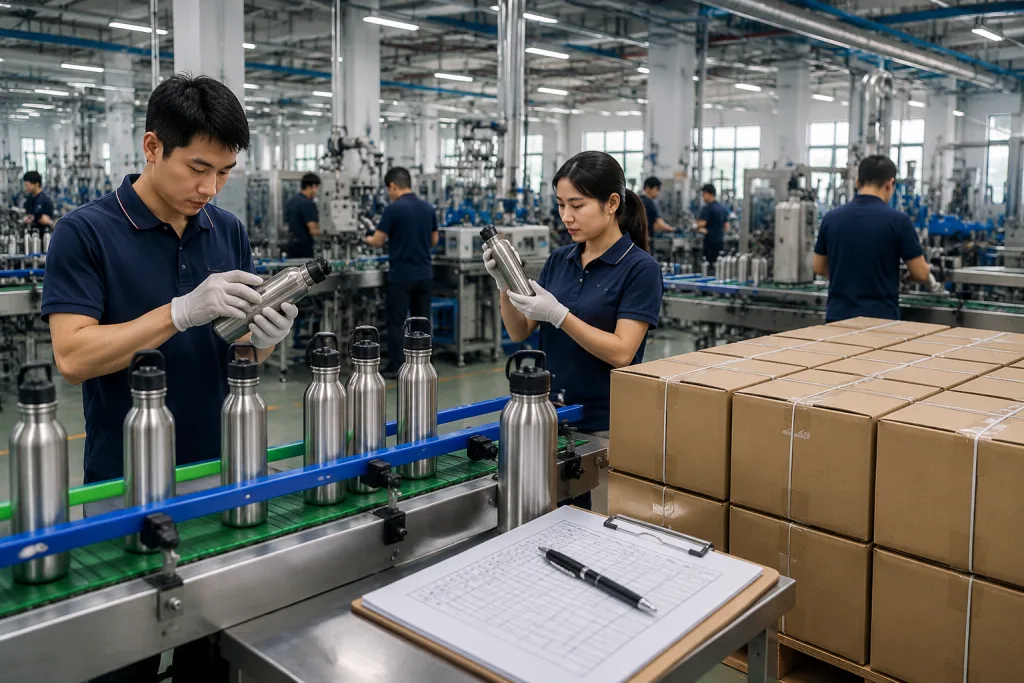
During production, request photos or short videos from key steps: raw bottle body, coating, logo application, assembly, leak testing, and packing. The video should show the leak tester running at 0.5 bar for 8 seconds—if it's shorter, push back. For orders above 5,000 units, a mid-production inspection catches problems before everything is finished. Final random inspection should happen when 80% of goods are packed. QC once pulled a sample from a 4,000-unit run where 12% of bottles had uneven coating. We caught it at mid-inspection and saved the entire order.
A serious factory won't be offended by clear controls. Good factories prefer buyers who specify requirements early. Vague buyers create rework, and rework costs money. Whether you call it canteen customizable, canteen customized, or private label drinkware, the math is the same: freeze the spec before mass production, then inspect against it. A 30-minute approval delay on the PP sample can push your delivery by 12 days. We've seen it happen.
Send your flask brief for a factory quote
Share capacity, logo method, target market, quantity, and packaging needs. We will reply with practical MOQ, FOB pricing, and lead time.
Frequently asked questions
What MOQ should I expect for a private labeling hydration flask?
For a standard flask with stock body color and one logo, expect 500-1,000 units if the factory has inventory or open production. For custom powder coating, a realistic MOQ is 1,000-3,000 units per color because coating lines need setup time and stable batch efficiency. For a fully customized canteen shape, new cap, or molded handle, MOQ often moves to 5,000-10,000 units, plus tooling cost. If a canteen supplier offers 100 units with custom color at a very low price, check whether it is actually spray paint, leftover stock, or trading inventory rather than controlled factory production.
How long does production take after I approve the sample?
For normal customized drinkware, plan 30-45 days after deposit, artwork, packaging files, and sample are approved. Simple laser logo on existing stock can be faster, sometimes 12-20 days, but that depends on inventory and season. New color coating, UV print, gift box packaging, or special lids add time. Around Chinese New Year, add 2-4 weeks because Zhejiang and other China manufacturing areas close or slow down. If your launch date is fixed, confirm the inspection date, vessel cutoff, and final delivery date before you issue the purchase order.
Is laser engraving better than screen printing for flask branding?
Laser engraving is usually better for durability because it removes or marks the surface rather than adding ink on top. It is a good choice for premium private label bottles, distributor canteen programs, and outdoor products that get heavy handling. Screen printing is better when you need solid brand colors, larger graphics, or lower cost on a canteen promotional order. For multi-color artwork, UV printing or heat transfer may be more suitable. The best method depends on coating type, logo size, target price, and whether the product will be dishwashed, scratched, or used outdoors.
What tests should I request before importing to Europe or North America?
At minimum, ask for food-contact test reports covering stainless steel, silicone seals, plastic lid parts, coating, and printing ink. EU buyers often request LFGB, EU 1935/2004 related documents, and REACH screening. US buyers may ask for FDA food-contact support and California Prop 65 review. For kids’ bottles, ASTM and CPSIA-related checks may apply. Also request leak testing, vacuum performance testing, and an AQL final inspection. Use AQL 2.5 for major defects and 4.0 for minor defects unless your customer has stricter rules.
Should I buy from a canteen factory or a trading company?
A direct canteen factory is usually better when you need stable repeat production, technical changes, or controlled inspection. A trading company can be useful for mixed small quantities across many product types, but they may have less control over steel grade, coating schedule, and corrective action. Ask any canteen vendor whether they own the welding, vacuuming, coating, and packing process or outsource it. Also ask for production photos, audit documents, and past export experience. The right choice is not about the label; it is about control, transparency, and whether they can repeat your approved sample at scale.