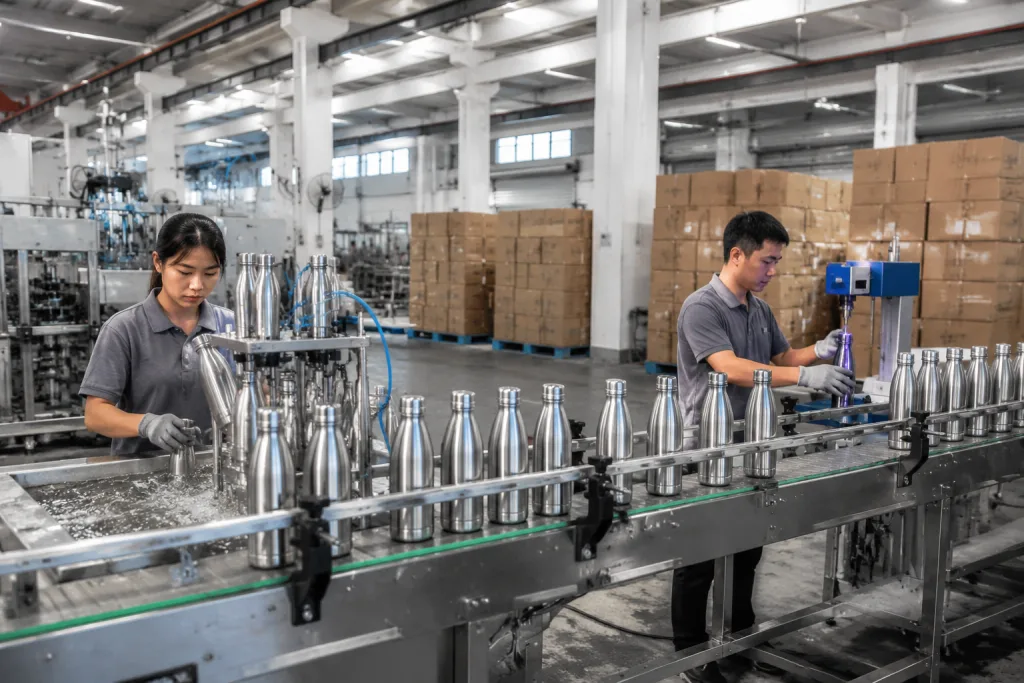
Key Takeaways
- Start with use case: 500 ml single-wall PET and 950 ml double-wall stainless solve very different buyer problems
- Typical stainless MOQ is 1,000-3,000 units per color; custom mold projects usually start at 5,000-10,000 units
- Plan 25-35 days production after artwork approval for standard private label hydration bottles in Zhejiang, China
- AQL 2.5/4.0 inspection, LFGB or FDA food-contact tests, and carton drop testing should be agreed before deposit
A private labeling hydration bottle program looks simple until you have to sign the PI. Then the cheap-looking choices start eating margin: 201 or 304 stainless steel, powder coating or spray paint, laser engraving or silkscreen, neutral carton or retail box, FOB Ningbo or delivered duty paid. We once had QC pull a 500 ml sample because the buyer’s PO said “matte black,” but the approved sample card was Pantone Black 6C with 8% gloss. Small gap. Big argument. If you buy for a distributor drinkware line or a retail private label, the bottle spec is only half the job.
At our Hangzhou, Zhejiang sales desk, stronger buyers do not start with a catalog page. They start with use. Gym bottle with a one-hand lid. School bottle with a 45 mm name label area. Outdoor flask with handle strength checked at 18 kg on the line. Then we confirm the sales market for FDA or LFGB, the logo method with logo size in mm, and the reorder model with MOQ and carton plan. China can make almost any customized drinkware spec, but that is the wrong question to ask. The real question is whether the spec still works after tooling, color loss, AQL 2.5 inspection, and 12 days of packing pressure before we ship.
Start With The Buying Decision
Before you ask a canteen factory for a quotation, decide what job the bottle must do. A gym brand is usually fighting for one-hand opening and sweat-proof grip; a university bookstore cares more about school color, barcode position, and carton count; a corporate gift distributor will push back on logo area and gift-box cost first. These are not the same hydration bottle. We see 12 to 15 RFQs like this every week from Europe and the US, and the caps, carton specs, and price ceilings usually split after the first 2 questions. If the brief is loose, the supplier will quote the mold already sitting on the line. That may be convenient for production, but it may not fit your order.
Use four filters, and put numbers beside each one. For drinking occasion, desk use and school bottles can accept a simpler flip lid, while sports, hiking, travel, and insulated hot/cold models need tighter checks on lid leakage, straw length, and grip diameter; one model change can move the cup-holder diameter from 68 mm to 78 mm. We run that check with a caliper before artwork approval, not after mass production. For sales channel, retail shelf and Amazon FBA need cleaner cartons, barcodes, and 1.2 m drop-test control; a one-day event giveaway often only needs a plain white box and a readable logo. For landed cost, a USD 2.20 plastic bottle and a USD 7.80 vacuum flask can both be correct, just not on the same PO. For reorder certainty, monthly repeat orders can carry a custom color, private mold insert, or 5,000 pcs MOQ, while a one-off campaign should stay close to stock tooling. The math does not work otherwise.
At BottleForge Industrial in Zhejiang, we usually ask for target FOB price, annual volume, required certification, and branding area before sending options. This is not paperwork. Last month QC pulled a 3,000-unit sample plan where the bottle looked good, but the gift box added USD 0.42, the Amazon carton missed the 18 kg limit, and the logo file had a one-letter typo copied from the PO. Small miss. Big delay. We have seen this go sideways when the buyer approves the bottle but forgets the outer carton, then asks us to fix it 3 days before booking the vessel. Better to catch that before the line starts.
The better question is not “what is your best bottle?” It is “which bottle protects my margin and still feels right to my customer?”
Choose Material By Channel
Material sets three things in stone: FOB, gram weight, and the test file the buyer's lab will run. It also shapes that first 10-second judgment when someone picks up the bottle. For private-label hydration bottles, we run five materials on our Hangzhou lines—304 stainless, Tritan-style copolyester, PP, glass, and aluminum. Each maps to a channel. Pick wrong, and the landed cost blows out before the first PO ships.
304 stainless steel is the default for premium custom drinkware. For 500–1,000 ml bottles, our standard double-wall vacuum spec uses 0.4 mm inner wall and 0.5 mm outer wall. That gauge takes powder coating, laser engraving, and color-box packing without the finish looking thin. Unit cost is higher—no way around it. But the math holds when the cap seal passes the 100% air-pressure check and QC pulls zero leakers from the carton. We've had buyers try to shave 0.05 mm off the inner wall to save $0.12 per unit; the leaker rate on that batch hit 4% at final inspection.
Plastic hydration bottles fit sports clubs, school canteens, and promo orders where the buyer is chasing a sharp price. PP gives the lower FOB. Tritan-style material looks clearer on shelf and reads closer to retail drinkware—buyers notice the difference in the sample room. Get the BPA-free declaration and the destination food-contact test report before you confirm artwork, not after the PO is typed. We've seen this go sideways: buyer approved "Tritan" over email, then sent a PO that said "PC bottle" by mistake. The factory ran PC. The shipment got flagged at the port.
Glass bottles suit wellness brands that want a clean look. Breakage is the part buyers underestimate. A silicone sleeve helps, but it adds a station on the line. On one 20,000-piece order, the sleeve station became the bottleneck—two operators couldn't keep pace with the filling line, and we had to split the run across an extra day. Aluminum canteens are light and cheap. The inner lining decides whether you get taste complaints. If the buyer already worries about metallic smell, skip aluminum. Stainless is the safer canteen option, and the per-unit difference shrinks fast when you factor in a rejected shipment.
For Europe, ask for LFGB or EU 1935/2004 food-contact documentation. For North America, FDA food-contact compliance applies; for kids' items, CPSIA or ASTM requirements kick in. This is not paperwork to clean up later. A serious canteen supplier in China should have test reports, material declarations, and batch traceability records on file before the first carton gets taped. If they can't produce those within 48 hours of your request, find another factory.
Decide How Private The Label Is
Private label isn't one bucket. It's four levels, and each one hits your landed cost differently. Level one: grab a stock bottle from the warehouse, laser your logo, done. No mold fee. Level two: custom body color, cap color, branded retail box. Level three: modify an existing lid or accessory the factory already runs—same base tool, different surface finish or a silicone insert swap. Level four: full custom mold. This is the most private, the slowest, and the most expensive option. A buyer we worked with last year spent six months on a cap redesign. The stock cap sitting on our shelf would have shipped in 30 days.
For most canteen distributors, level one or two does the job. You own the customer experience through color, logo placement, carton label, insert card, hang tag, barcode, and retail box—not through a proprietary thread pitch nobody asks about. A 750 ml matte black stainless bottle with a laser logo and a branded box reads as proprietary. Mold cost: zero. Last month QC pulled a sample off the line and caught a 1.2 mm gap in the lid liner. On stock tooling that's a 5-minute fix—adjust the silicone gasket seat on the assembly jig. On a custom mold that same gap means a steel revision and two weeks gone.
Custom mold earns its place when the math works: a unique grip shape, a patented lid function, a retail identity you can't fake with color and packaging, or annual volume north of 30,000 units. Tooling for a new stainless bottle body and lid set runs USD 3,000 to USD 12,000 depending on complexity. Plastic injection molds climb fast when multiple cap parts stack up—we quoted USD 18,000 for a flip-cap with a locking ring last quarter. The buyer pushed back. We walked through the four cavity inserts and the locking mechanism tolerances, and the number held.
If you're building a new wholesale range, don't over-customize on the first order. A canteen customizable program lives and dies on reorder flexibility. One late cap component on a fully custom bottle can delay the entire shipment—we've watched a 40-foot container sit for eight days over a silicone gasket from a third-party sub-supplier. Standard private label projects in Zhejiang factories run 25 to 35 days after deposit and artwork approval. Custom mold projects add 35 to 60 days before production even starts. Buyer asks "why 70 days for a standard bottle?" Wrong question. Custom mold is where lead times actually bite.
Match Branding To The Surface
Your logo method is a production decision, not a graphics choice. It dictates minimums, lead time, and how the bottle holds up after 200 dishwasher cycles. Pick wrong, and we're reworking 3,000 units because the ink lifted off a textured coating.
- Laser engraving: We run this on powder-coated stainless daily—304 and 316L both take it clean. The beam burns off coating to expose raw steel underneath. What you get is a silver-gray mark, not a Pantone match. Permanent. No consumables. We've engraved down to 4pt text on a 500ml bottle without fill issues. MOQ typically 500 pcs.
- Silkscreen printing: Works on flat or single-axis curved surfaces. One or two spot colors. Our line starts making sense around 1,000 units—below that, screen setup cost eats your budget. Artwork width over 120mm on a small-diameter bottle? We'll flag it. Registration drifts on tight curves.
- Heat transfer: Full-color, large coverage. We use it for wraparound growler graphics. The catch: adhesion on textured powder coat. QC pulls 5 samples per 1,000 and tests with 3M tape. If the coating is a rough matte finish, expect to pay for extra adhesion promoter and a longer cure time.
- UV printing: Short-run friendly. No plates, no screens. Scratch resistance is the weak point—we've seen it fail a thumbnail test on a glossy coated bottle that passed on matte. Test it yourself before signing off a retail program.
- Embossed or molded logo: Caps, silicone sleeves, Tritan lids. Needs a steel mold. Tooling runs $800–$2,000 depending on cavity count. The per-unit cost drops fast above 10,000 pcs.
For a promo canteen order at 2,000 units, silkscreen lands right: cheap per impression, fast setup. For a $45 retail bottle sold through outdoor channels, laser engraving reads premium and won't wear off. A 64oz growler with a full-wrap illustration? Heat transfer. Asking for laser on a curved glass growler is the wrong question—the beam geometry doesn't work.
Approve a pre-production sample. Not the digital proof. We had a buyer last year reject a white silkscreen on a matte black bottle because it printed light gray. One sample caught it. 5,000 finished units would've been a chargeback.
Set MOQ And Reorder Logic
MOQ comes from real constraints on the line. Our powder booth runs a minimum 300 pieces per color—anything less and the labor to clean guns between shades wipes out your margin. Screen makers charge ¥200–400 per screen and won't touch a file below 500 impressions. Stainless coil ships in 2-ton lots from the mill. Know these breakpoints and you negotiate with numbers, not guesses.
Standard stainless bottles: budget 1,000 units per model, 1,000–3,000 for a custom color. We've shipped 500-piece laser engraving runs on stock colors. The line supervisor hates it, QC pulled samples twice because the operator rushed, but it went out the door. Unit price bumps 15–20% at that volume. Plastic bottles need roughly 3,000 units. A 4-cavity injection mold running 3,000 shots is a half-day block. Below that the resin dryer hasn't settled and you're chasing moisture specks in the cavity. Custom growlers and large vacuum items land at 1,000 units if the body mold already exists—new tooling is a separate conversation, and a long one.
Our Zhejiang partner lines push about 300,000 stainless units a month across bottles, tumblers, and food jars. Slide deck number. On the floor it's discrete slots: powder coating runs Tuesday and Friday, cap assembly splits Wednesday with another buyer's order, and the carton supplier needs 12 working days for printed boxes. Capacity is there. Slot availability is what delays your shipment by three weeks.
Think in reorder blocks. A 1,500-unit first PO tests the market—fine. Your second order needs to land before warehouse stock drops under 30%. Shanghai to Rotterdam runs 28–38 days port-to-port. LA/Long Beach is 14–22 days. Add customs clearance and inland trucking: call it 18 days port to dock. Miss that window and you're air-freighting 200 units at ¥45/kg to plug a shelf gap. We've watched a buyer burn ¥9,000 in air freight on a ¥12,000 order. The math goes sideways fast.
Start with two colors and one capacity. Not six and three. Last quarter a buyer insisted on four colors across two sizes for a first order. Inspection flagged color variation on one SKU—within AQL 2.5 tolerance, but visible to the eye. The whole shipment sat in a Rotterdam warehouse for three weeks while we argued acceptance criteria. Two-and-one gets you cleaner QC, one carton spec, and sell-through data you can actually read without a spreadsheet migraine.
Control Cost Without Cheapening
I see buyers fixate on the unit price and miss the real cost drivers. For a private-label hydration bottle, the spread between USD 1.80 and USD 9.50 FOB comes down to five levers: material grade, wall thickness, lid assembly, surface finish, and packaging spec. Shift one lever and the quote moves. The factory isn’t padding the BOM—the BOM is the BOM.
A 600 ml single-wall tritan sports bottle with a basic push-pull lid runs about USD 1.30–2.60 FOB. Step up to a 750 ml double-wall 304 stainless bottle with vacuum insulation, powder coat, and a screw-on bamboo lid, and you’re at USD 5.20–8.50 FOB. A 1,900 ml stainless growler with a handle cap, full-color wrap, and gift box can push past USD 14.00 FOB. These numbers move with the LME nickel price, the RMB/USD rate, and whether your order fills a 20GP or a shared 40HQ. Last quarter we quoted a 5,000-piece growler order at USD 11.30 FOB Ningbo; same spec at 1,200 pieces came in at USD 14.80. MOQ math is real.
Four places you never save. Silicone seals: a USD 0.06 gasket fails after 40 dishwasher cycles and the lid leaks. We’ve had a buyer flag it at AQL 2.5 inspection—3,200 units reworked on our floor. Retail cartons: if the bottle ships through Amazon FBA or a parcel network, a 1.2 mm B-flute box collapses. We run a drop test at 76 cm; thin cartons split open. Powder-coated bottles need PE bag sleeves inside the carton, or the coating scuffs in transit. Straw lids for kids’ programs: untested bite valves are a recall waiting to happen. Pay the USD 400 for third-party lab testing.
Where the math works. Use an existing mold—new tooling amortization hits small orders hard. Limit the decoration to one Pantone laser engraving instead of a four-color wrap. White box with a brand sticker cuts USD 0.90 per unit versus a full-print rigid gift box. Consolidate your growler and bottle SKUs into one shipment; LCL surcharges eat margin. Always ask for FOB Ningbo or Shanghai pricing first, then get a forwarder quote. DDP looks simple, but I want you to see the sea freight line item, the 25% Section 301 tariff if it applies, and the destination handling charge. Know the real landed cost before you negotiate the ex-factory price.
Inspect Before The Goods Leave
We write the QC criteria straight into the PO. A friendly canteen vendor might say “we check everything,” but we’ve seen that sentence fall apart when the container lands. For export drinkware from China, we run ANSI/ASQ Z1.4 with AQL 2.5 for major defects, 4.0 for minor. Critical defects at zero. No exceptions.
Define the defects before the line starts. Major: leaking caps, failed vacuum, wrong logo, wrong color, sharp edges, serious dents, barcode that won't scan, dirty inner surfaces. Minor: a 0.3mm coating speck, light carton scuff, print shift within our tolerance. For vacuum bottles, we pull sampled units and run a hot water insulation test and a leak test. QC flagged a batch last month where the lid gasket was 0.5mm undersized — the leak test caught it, rework cost us 3 days, buyer never saw it.
Packaging tests catch problems the bottle itself won't. A bottle passes factory inspection and still arrives dented because the carton buckled. For retail and e-commerce, we specify 5-ply export cartons with divider inserts, a 1.2m drop test, master carton gross weight under 18 kg, and exact FNSKU label placement for Amazon inbound. One buyer skipped the drop test spec. 30% of their cartons arrived crushed. The math didn't work for anyone.
Compliance documents need to match the actual materials, not just the product name. For stainless steel, we provide food-contact reports for the inner steel and the lid components separately. For plastic lids, seals, straws, and powder coatings, ask whether the test covers those parts — many reports cover only the bottle body. For the EU, REACH extends to coatings and accessories, not just the steel. In North America, Prop 65 review depends on the sales channel. BSCI and ISO 9001 factory certificates are useful for the audit file, but they don't replace product testing on the actual shipment.
Pick A Supplier You Can Manage
The cheapest quote almost never comes from a factory you'll still want on order three. You need a supplier you can actually manage across runs. I look for four things. English that doesn't need three back-and-forth emails to clarify one question. An engineering team that can turn around an exploded lid drawing inside 48 hours. Lead times that hold—we quote 35 days and land between 33 and 36. And honest handling when something breaks. A factory that ships 53-foot containers of bottles but goes silent when lid seals leak at AQL 2.5 isn't a supplier. That's a liability.
Ask questions that expose how the factory runs. Who owns the mold—and will they hand over the mold-ownership certificate without stalling? Can they send you the exploded lid-assembly drawing, or is that farmed out to a sub-supplier who's never answered an English email? What's the real MOQ for spare lids? Not "we'll include some." I mean the number where they'll actually run a separate line. If the logo prints 3 mm off-center, how many days for a replacement run—and who eats the air freight? Can the packing line split 60% blue / 40% green by customer PO, or are they dumping everything into one master carton and calling it done? Which port? Ningbo is our default. If a factory pushes Shanghai for a 20GP, I want the reason—the drayage spread can chew 4% of margin on a $2.80 FOB bottle. Also ask: can they produce the audit documents your retailer's compliance team will request? If the answer starts with "we'll try," walk.
Trading companies earn their place when you're pulling three categories—stainless bottles, Tritan sports bottles, bamboo-lid jars—and you don't want to manage four factories yourself. Direct manufacturers win when engineering control matters, raw-material traceability matters, and shaving 8–12% off unit cost on repeat orders matters. The hybrid setup works: one accountable export partner in Zhejiang running the relationship, with specialized workshops for 304 stainless double-wall, Eastman Tritan injection, and custom gift-box packing. The model isn't the risk. Split responsibility is. We saw a 40HQ container sit at Long Beach for 19 days because the lid supplier, the bottle factory, and the trading agent all pointed at each other over a silicone seal spec nobody owned. One accountable party catches that during PP-sample review.
For a first project, send a spec sheet, not an essay. Capacity: 750 ml. Material: 304 stainless, inside and out. Target FOB: $2.30–$2.60. Order quantity: 3,000 units. Destination: US, so FDA. Logo method: laser engraving, 40 mm × 15 mm. Packaging: individual white box with UPC, 24 per master. Required certificates: FDA, Prop 65, LFGB if EU-bound. Expected ship date. A serious factory comes back with options: "We can hit $2.55 with 304/304 and 0.5 mm wall; if you accept 304/201 for the outer wall, we're at $2.38—but that won't pass LFGB." That's the conversation. Private-label drinkware is a repeat business when the first shipment is boring. Correct carton marks. Correct barcode placement. Zero leakers in the QC sample. No customs hold because the lab test skipped a phthalate screen. Boring means the inspection report matches the PO line by line. That's the job.
Send Your Bottle Spec Before You Request Quotes
Share capacity, quantity, logo method, packaging, market, and target FOB price. We will return practical options, not a random catalog dump.
Frequently asked questions
What MOQ should I expect for a private labeling hydration bottle?
For stainless steel bottles, expect 1,000 units per model as a workable starting point, with 1,000-3,000 units per custom Pantone color. If you use existing stock colors and laser engraving, some suppliers may accept 500 units, but the FOB price is higher. Plastic hydration bottles often start at 3,000 units because resin color matching and injection molding setup need volume. Full custom mold projects usually start at 5,000-10,000 units, and some lid designs need more. If you are a new distributor, begin with one capacity and two colors to keep MOQ, inspection, and inventory risk under control.
How long does production take after I approve the sample?
For a standard private label stainless hydration bottle in Zhejiang, China, plan 25-35 days after deposit, artwork approval, and sample confirmation. Plastic bottles may be similar if the mold exists and color masterbatch is ready. Custom colors, heat transfer artwork, retail boxes, or special caps can add 7-15 days. New mold development may add 35-60 days before mass production starts. You also need shipping time: ocean freight to Europe or North America is commonly 25-45 days port to port, plus customs and inland trucking. For seasonal launches, work backward at least 90 days from the required delivery date.
Which logo method is best for private label bottles?
For powder-coated stainless bottles, laser engraving is the most durable and clean option. It is excellent for premium custom drinkware, but it does not reproduce Pantone colors because it exposes the metal under the coating. Silkscreen is better when you need a one- or two-color logo at a lower cost, especially for canteen promotional orders. Heat transfer or UV printing works for full-color graphics, but scratch and adhesion tests are important. For plastic bottles, screen printing and UV printing are common. Always approve a physical pre-production sample, because logo size, surface curve, and coating texture can change the final look.
What certifications should I ask a canteen supplier for?
Ask based on your sales market and material. For Europe, request LFGB or EU food-contact related testing for stainless steel, plastic lids, silicone seals, and coatings where relevant. For North America, ask for FDA food-contact compliance documents, and consider CPSIA or ASTM requirements for children’s bottles. REACH may apply to coatings, inks, and accessories in the EU. Factory documents such as BSCI, Sedex, or ISO 9001 help with retailer onboarding, but they do not prove the actual bottle is compliant. Make sure the report model, material, and components match your ordered product, not a similar item from three years ago.
Should I buy from a canteen factory or a trading company?
If you are buying one simple bottle at high volume, a direct canteen factory can give better engineering control and stable repeat pricing. If you need stainless bottles, plastic sports bottles, glass bottles, packaging, and accessories together, an export trading partner may manage the project more efficiently. The real issue is accountability. You need one party responsible for samples, artwork, inspection, carton labels, and shipment documents. For distributor canteen programs, we usually recommend one experienced China export partner with access to specialized factories, especially when the order includes several bottle types and different branding methods.